Trump Gets Serious: Powell Faces Criminal Investigation, Rate Battle Intensifies

Original Title: "Power Struggle Behind Criminal Charges: Powell vs. Trump's Rate Battle"
Original Author: 1912212.eth, Foresight News
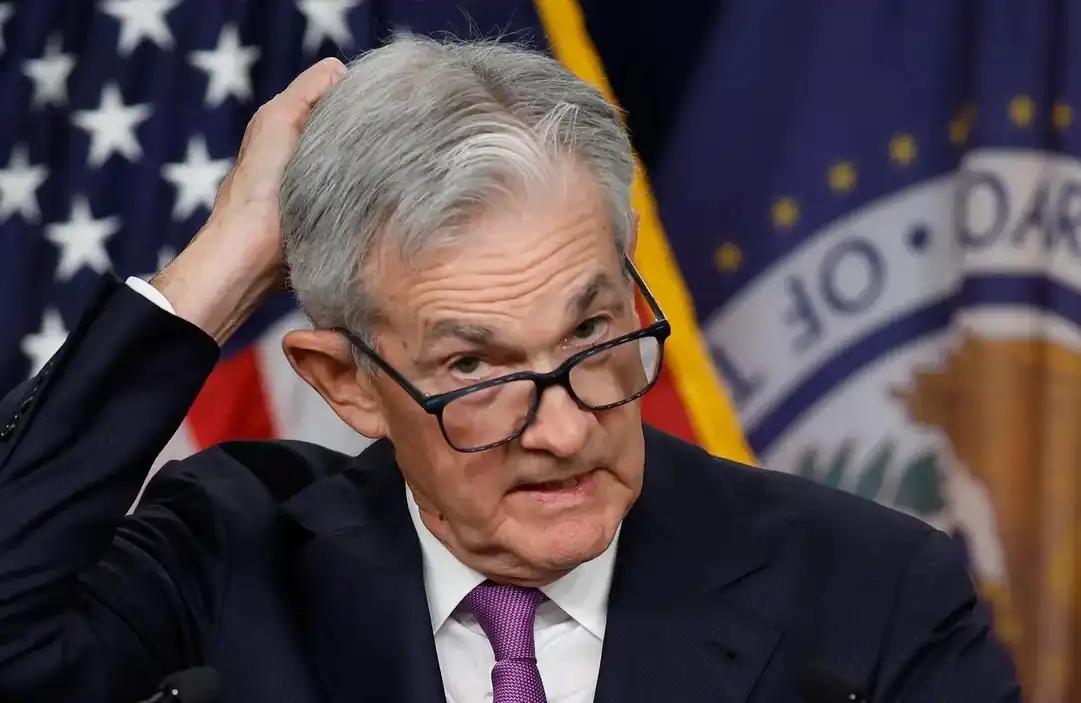
On January 11, Federal Reserve Chair Jerome Powell released a rare video statement publicly accusing the U.S. Department of Justice (DOJ) of threatening criminal charges in an attempt to force the Fed to yield to Trump's interest rate policy demands. This event quickly became the focus of the global financial markets, sparking widespread concerns about the Fed's independence.
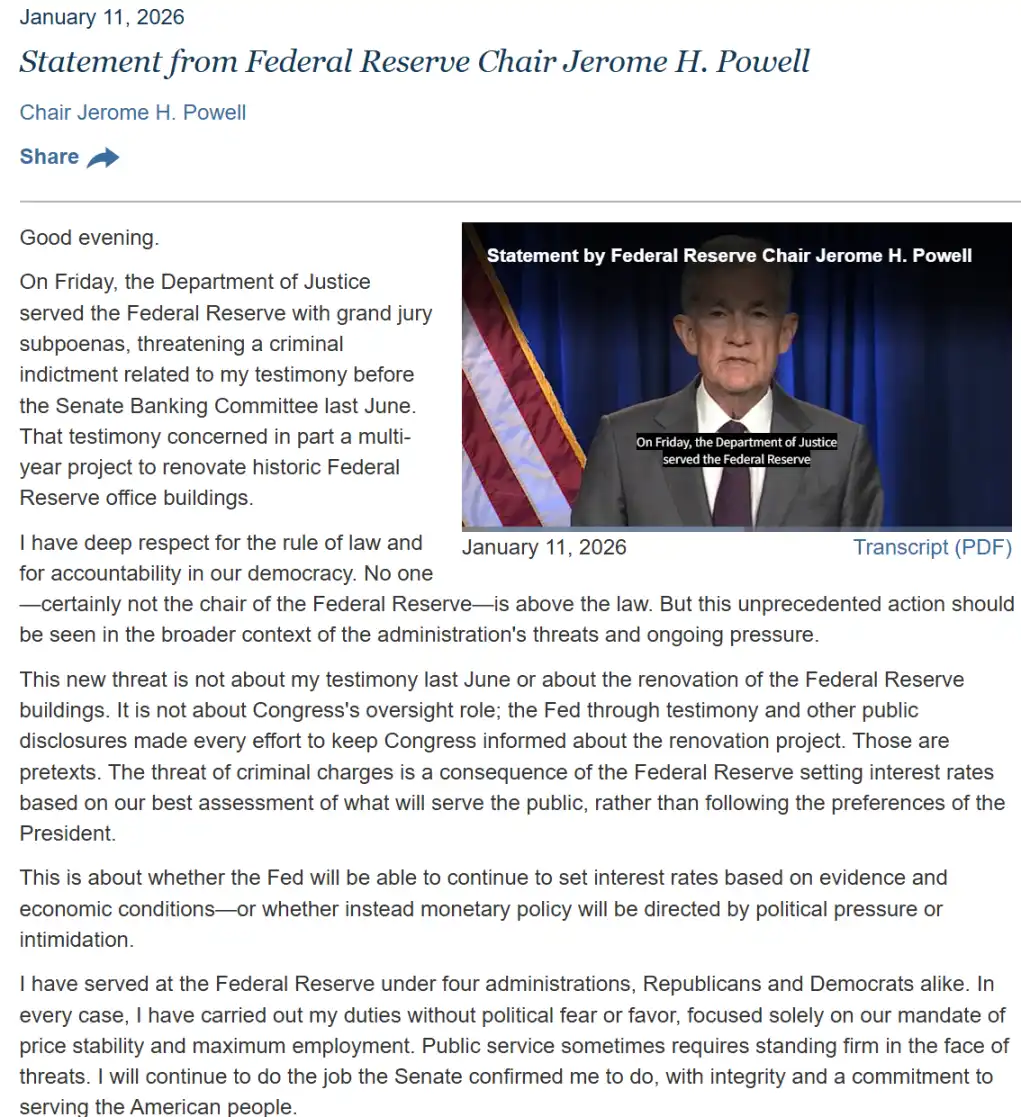
In his statement, Powell emphasized that this threat was a "consequence" of the Fed setting rates based on the public interest rather than presidential preferences and called it a naked attack on central bank autonomy. This event was not isolated but the latest manifestation of the political and economic entanglement during Trump's second term.
Following the event, U.S. stock index futures quickly fell, with S&P 500 futures dropping over 0.5%, Dow futures falling 150 points during the Asian session. Spot gold rose 1.88%, spot silver surged around 4%, and in the crypto market, BTC was still hovering around $91,000.
Trump's Repeated Dissatisfaction with Powell's "Slow Rate Cuts"
Powell was appointed as the Federal Reserve Chair by then-President Trump in 2018 and was reappointed in 2022, with his term originally set to end in May 2026. As the helm of the Fed, Powell led the central bank through the tests of the COVID-19 pandemic, economic recovery, and high inflation, with his policy known for being data-driven and incrementally adjusted.
However, after Trump's victory in the 2024 election, returning to the White House, he quickly turned his ire toward the Fed. Trump had long criticized Powell for being "too slow to act," especially on interest rate policies. He publicly demanded the Fed to significantly cut rates multiple times to stimulate economic growth and stock market performance, even pledging during his campaign to "take control" of the Fed to advance his "America First" economic agenda.
The catalyst for the event was a $250 million renovation project at the Fed's Washington headquarters. The project, initiated several years ago to modernize the aging facilities, faced controversy due to cost overruns and transparency issues.
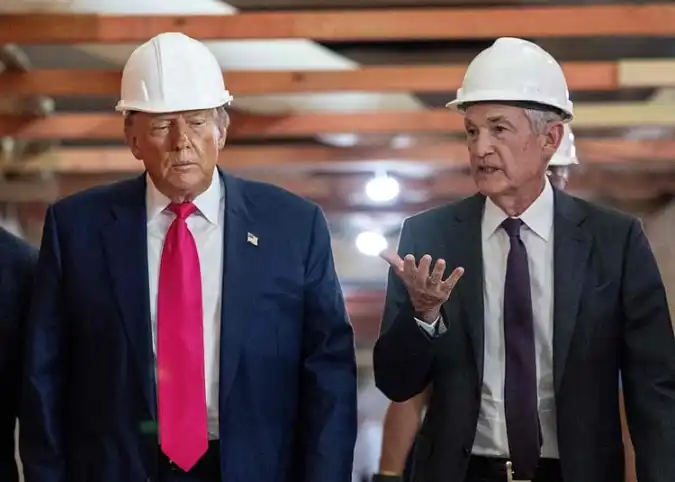
In July 2025, Republican lawmaker Anna Paulina Luna accused Powell of providing false testimony to Congress about the project during a hearing and called for a criminal investigation. This accusation did not immediately escalate at the time, but after Trump took office, the DOJ swiftly intervened. On January 11, 2026, multiple media outlets reported that the U.S. Attorney's Office for the District of Columbia had officially launched a criminal investigation into Powell, focusing on whether Powell misled Congress and whether project funds were improperly used. A grand jury has issued subpoenas requesting the Fed to provide relevant records.
On January 12, according to NBC, Trump stated in a phone interview that he was unaware of the Department of Justice's investigation and once again criticized Powell. "I know nothing about this, but he obviously has not done a good job at the Fed, nor has he done a good job on building." When asked how he would respond to Powell's suggestion that the subpoena was government pressure on the Fed to cut rates, Trump said, "No, I wouldn't even think of doing it that way. The real pressure that should be put is the reality of high rates. That's the only pressure he should be feeling."
In a video statement, Powell candidly linked this to interest rate policy. He noted that the DOJ's actions were "unprecedented," aimed at using criminal threats to force the Fed to lower rates to meet Trump's demands. In the statement, Powell reiterated that the Fed's statutory mandate is to maintain price stability and maximize employment, not to succumb to political pressure. He described this event as a "flagrant attack on the Fed's independence" and hinted that it was a continuation of the Trump administration's pressure on the central bank.
As early as Trump's first term, Powell clashed with the White House for refusing to drastically cut rates, leading Trump to publicly call him an "enemy." The timing of this investigation is particularly sensitive: the Fed's most recent meeting kept the benchmark interest rate in the 4.25%-4.5% range, far higher than Trump's desired level.
The latest data on Polymarket shows that the market's probability of the Fed staying put in January has risen to 96%.
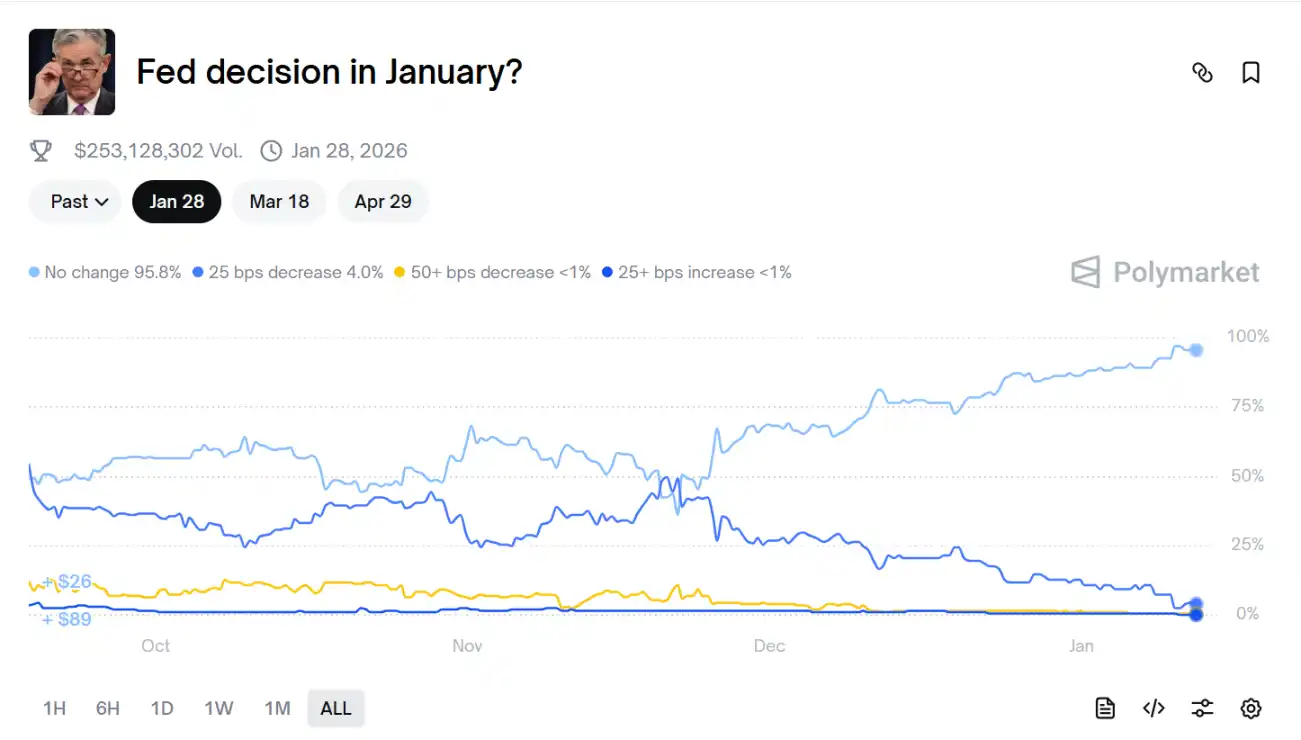
Supporters on X see him as a hero defending independence, while opponents accuse the Fed of "destroying the economy." Some netizens argue that "abolishing the Fed is the right path," while others believe that a warning like this could trigger a constitutional crisis.
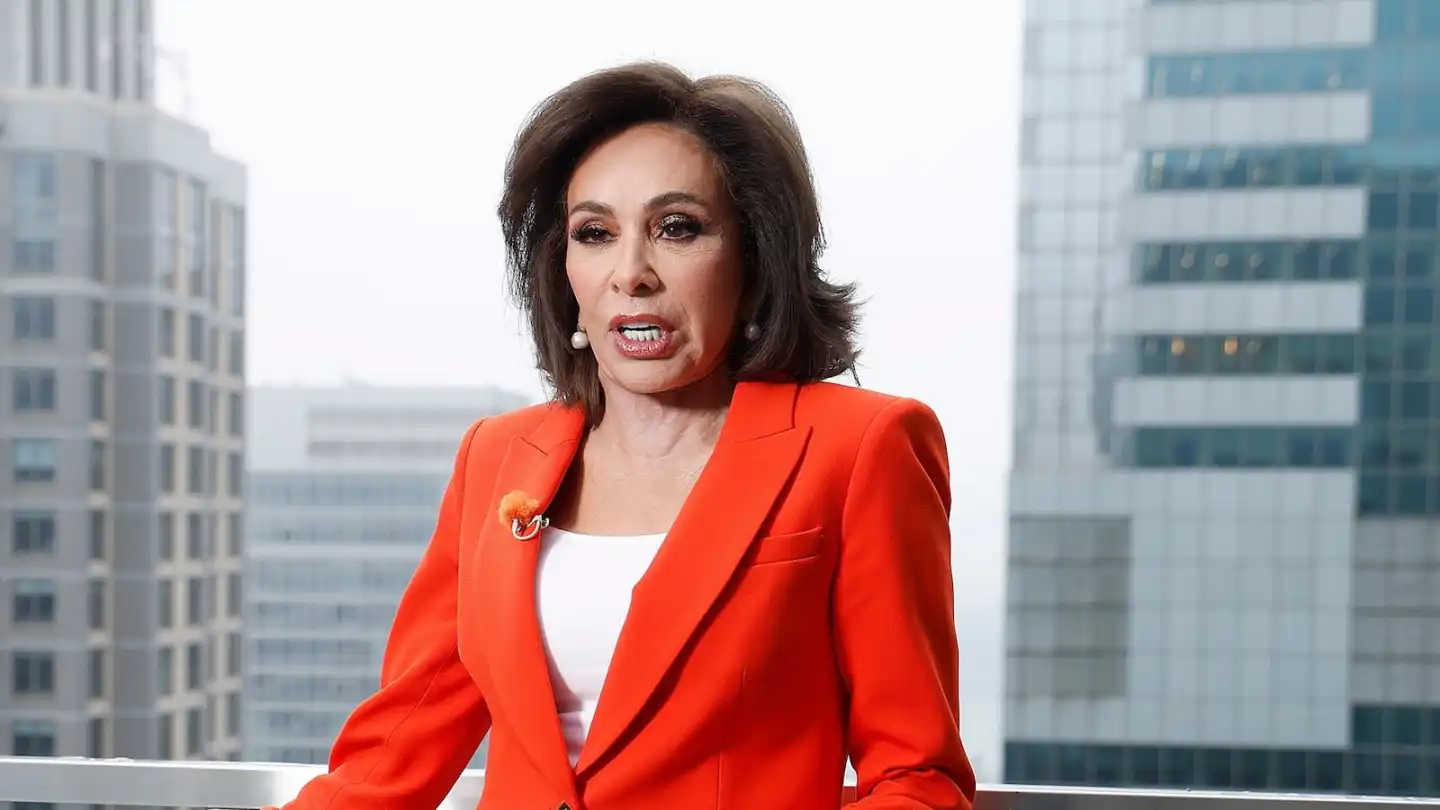
The investigation was authorized by newly appointed U.S. Attorney Jeanine Pirro, a staunch ally of Trump, further deepening concerns about political interference.
Powell responded by stating that he would fully cooperate with the investigation but would not let it affect monetary policy decisions. The root of this event can be traced back to the institutional design of the Fed. Established in 1913, the Fed was intended to be independent of politics, but there have been precedents of presidential intervention in history, such as the shadow of the Nixon-era Watergate scandal. This event marks an extension of Trump's "deregulation" agenda, as he has pledged to restructure federal institutions, including weakening the Fed's power, since taking office.
As of January 12, the investigation is still in its preliminary stages, with prosecutors requesting documents multiple times and the White House declining to comment. Analysts predict that if the investigation escalates, the Fed may be forced to accelerate rate cuts to alleviate pressure, but this could trigger an inflation rebound, affecting U.S. economic growth.
Powell himself may face personal risk: if charged, he may have to resign or even face imprisonment, although legal experts believe the evidence is weak.
Powell has responded actively through a public statement, and in addition to hiring a lawyer to challenge the subpoena's legality, he could appeal to the court or seek assistance from bipartisan lawmakers, especially those concerned about the Fed's independence.
Hassett and Warsh Emerge as Top Fed Successor Candidates
Powell's criminal charge incident has exacerbated market uncertainty. Following the incident's exposure, investors are worried that damage to the Fed's independence could lead to policy disarray. Powell's statement emphasized that the threat of criminal charges would "undermine" the central bank's reputation and potentially increase risk premium.
Furthermore, this incident is seen as a signal of Trump's consolidation of power, triggering strong backlash from Democrats and social groups. Democratic lawmakers have called it a "constitutional crisis" and are concerned that the Justice Department is being weaponized for political retaliation.
The latest speculation on Fed nominees, although Powell's term lasts until May 2026, has accelerated discussions of his successor. Trump has stated that he will announce the nominee by the end of this month.
In the latest data from Polymarket, the market is betting highest on Kevin Warsh at 43% and Kevin Hassett at 39%. Warsh was nominated as a Fed Governor by President Bush in 2006, becoming the youngest Fed Governor at the time. He is known for his hawkish stance but is market-friendly. In 2017, Trump had considered appointing Warsh as Fed Chair but ultimately chose Powell.
Hassett is a well-known conservative American economist, currently serving as the White House National Economic Council Director, and previously as the Chair of the White House Council of Economic Advisers, supporting low interest rates and the Trump economic agenda. In November 2025, he was seen as the top candidate for the next Chair of the Federal Reserve by Trump and his advisor allies.
Welcome to join the official BlockBeats community:
Telegram Subscription Group: https://t.me/theblockbeats
Telegram Discussion Group: https://t.me/BlockBeats_App
Official Twitter Account: https://twitter.com/BlockBeatsAsia