Data Voting: A Look Into 2025's Hottest Trading Products | OKX Year in Review
Quote: What truly determines returns is the account-level operating method, not just market volatility itself.
Merely looking at the market data, it is difficult to explain the variance in returns among exchange users in 2025. What truly determines returns also depends on the account-level operating method, not just market volatility itself.
The OKX annual report shows that mainstream coins still serve as the core for capital rotation and return generation, supporting trading and strategy execution. Emerging coins are more used to amplify volatility, providing opportunistic phases, but they are not a stable, long-term source of return. What truly contributes to sustained returns are long-term usage and controlled-risk product combinations. For example, in 2025, stablecoin financial management consistently ranked high in terms of usage frequency and return contribution, becoming the most stable underlying source of exchange account returns, effectively boosting overall returns during oscillations and drawdowns.
This report will dissect the real choices of exchange users in 2025 from various data dimensions such as OKX exchange strategy products, Earn products, traded currencies, and actual return performance, revealing which strategies are effective in the long term and which are merely "seemingly profitable." When the narrative noise is stripped away, the annual trends of CEX become clearer and more specific than imagined. Given the high transparency and individual differences in trading data and market information, specific details are not elaborated here but can be referenced independently. This article does not focus on specific trading outcomes but rather on breaking down strategic thinking at a higher level, providing a simple, feasible, and referenceable strategic model for readers to understand and apply in their own circumstances.
DOGE, TRUMP, XRP, and Others Become Annual User-Favored Trading Currencies
The OKX annual report reveals that BTC, ETH, TRUMP, SOL, DOGE, XRP, and others have become the currencies most favored by users for trading this year. Among them, BTC and ETH, as core value assets, hold a dominant position not only because of their market value and deep liquidity, which have solidified the consensus among retail and institutional players, but also because of their resilience and price discovery function across multiple bull and bear cycles, allowing users to form a "stable anchor" in high-volatility markets. Volatile blue-chip coins like SOL and XRP reflect users' sensitivity to short- to medium-term volatility opportunities, often leading to concentrated trading behavior driven by market trends, technological updates, or community narratives. This year, the MEME trend continued to spread. While mature users actively seek new opportunities, it has also attracted a large number of new users to this area. MEME coins such as TRUMP and DOGE have thus surged in trading popularity. Their performance further demonstrates that users' trading behavior is not only determined by project fundamentals but is also significantly influenced by factors such as community sentiment, platform incentives, and event catalysts.
Corroborating this is the fact that the most popular annual OKX strategy products still include mainstream and highly liquid assets such as BTC, ETH, SOL, DOGE, XRP, and others. In particular, OKX's BTC dollar-cost averaging strategy has become the top strategy for most users this year, with its effectiveness stemming from deep market logic. By regularly buying in at fixed intervals and averaging the cost, the DCA strategy can smooth out market fluctuations, reduce timing risk, and maintain stability even during short-term intense volatility. By choosing to enter at major support levels and adhering to disciplined buying, users can maintain psychological stability in high-volatility markets, avoid making mistakes due to emotions or market noise, and achieve long-term asset accumulation and risk-controlled return growth.
Notably, DOGE and XRP have become the "dark horse assets" favored by OKX strategy product users this year. These assets provide significant spread opportunities, attracting both short-term and swing traders to participate, leading to increased trading volume, especially in times of active market sentiment or narrative-driven movements. Additionally, as these assets are covered by financial products such as ETFs, they have been incorporated into standard trading strategies, further enhancing liquidity and activity.
「Earn-Coin」 USDT Average Annualized Rate of about 4.32%
The stablecoin liquidity pools of top exchanges are consistently in the tens or even hundreds of billions of dollars. As a technology service provider, they convert this portion of funds into user's stable yield differentials through services such as lending matching, Staking, and DeFi protocols. Even within a conservative annualized range, they can generate substantial returns for users.
Especially given the market structure this year, stablecoins have long held a core position in OKX's "Earn-Coin" products. Their essence lies not in exaggerated interest rates but in high participation frequency, deep fund deposits, and long compounding periods. For example, holding USDG can automatically earn a maximum annualized yield of 4.10%, while holding USDT has an average annualized rate of about 4.32% (adjusted in real-time based on market and lending demand). During periods of high market volatility, USDT's flexible earn feature has even spiked to 53%, supporting 24/7 instant access with hourly compounding. To enhance fund utility, both OKX's strategy trading and trading accounts now support the "Auto Earn" feature. In addition to stablecoins, the platform also offers around 5% annualized returns within limited quotas for mainstream assets like BTC and ETH, allowing users to earn stable returns even amidst the volatility of top coins.
The 2025 market is not a "comprehensive bull market": Funds are highly concentrated in a few mainstream assets like BTC and ETF-related targets. Looking ahead, many mid and small-cap altcoins have underperformed BTC, and even if there is a rebound at the index level, their price centers continue to trend downwards. For most investors, choosing the wrong coin could mean their year-long efforts go to waste or even result in losses, significantly reducing the margin of error in directional trades and causing notable disparities in account returns. In this structural market, stablecoin financial management becomes one of the few account bases that can generate continuous returns without the need for timing the market or betting on directions. When the BTC rally dividend fails to radiate throughout the market and altcoins enter a phase of chronic erosion, the value of stablecoins lies not in outperforming the bull market but in ensuring that funds are no longer "idle" while waiting for opportunities.
The Annual Average Return Rate of 10% Strategy Users is Close to 60%
In the ever-changing market environment of 2025, an increasing number of users have started pouring into OKX strategy products. The daily average number of strategy product users has almost doubled, but the returns have shown a clear stratification. The annual average return rate of 25% strategy users exceeds 15%, while the annual average return rate of 10% strategy users is close to 60%. The commonality among these high-return users is that their strategies not only have a clear risk control framework but can also dynamically adjust positions and parameters. They combine price, volatility, trading volume, and macro information to make judgments while strictly adhering to discipline to avoid emotional operations. This is why even though the market has experienced multiple retracements and extreme emotional fluctuations, a small number of users have been able to achieve close to a 20% annualized return, while most users' returns remain in the neutral range.
In other words, the ceiling of returns is not the market trend but the depth of user comprehension of the strategy logic and execution capability—only users who truly master dynamic risk control, parameter iteration, and behavioral discipline can achieve structural excess returns in the oscillating and differentiating market of 2025.
In OKX strategy products, some strategies have exhibited unexpected characteristics. Firstly, dollar-cost averaging (DCA) and coin-margined futures grid trading, although seemingly niche, have shown steady returns in actual operation. They can continuously accumulate profits during choppy market conditions or bottom-building phases with relatively controllable risks, making them suitable for most users for long-term positioning. Secondly, DCA and dual-currency yield strategy users are not numerous, but their average returns per user are significantly higher than the overall average. These strategies, through intelligent bidirectional deployment and risk hedging, can capture uptrends during market fluctuations and also retain profit potential during downturns, making them used by a few sophisticated users for steady arbitrage.
Additionally, although some strategies are preferred by advanced users, they have enormous potential. For example, contract DCA strategies can amplify returns in a bull market, although ordinary retail investors often overlook them. Despite the higher risk in extreme market conditions, under the premise of a relatively clear trend and reasonable parameter settings, they can still be chosen as one of the strategic options for advanced users to phase in their allocations. Signal strategies rely on advanced quantitative signals and market judgments, favored by high-net-worth users or experienced traders to achieve excess returns.
Individual Users Operate an Average of 4-5 Strategies Annually
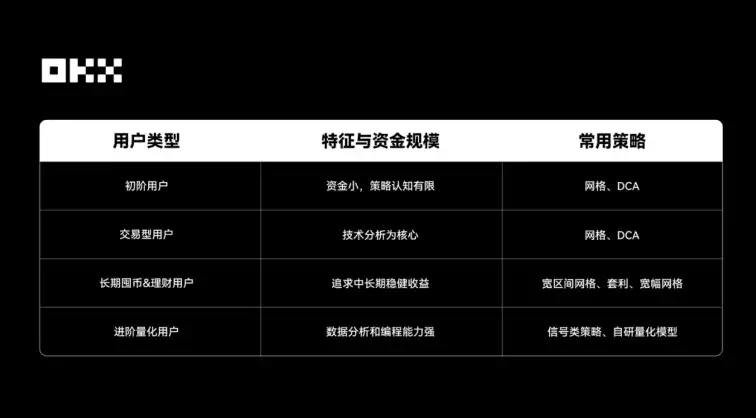
On the OKX platform, the average user simultaneously operates 4–5 strategies. Among them, most novice users only activate 1–2 strategies, conducting small-scale experiments to satisfy their exploratory and low-risk needs; active traders operate between 3–10 strategies to cover various market opportunities and trading logics.
For beginners, a small number of strategies are mainly used for "dipping toes" and understanding the market; for mature users, multiple strategies are used to simultaneously capture trend opportunities, arbitrage in choppy markets, and long-term investment returns. This behavior also indicates that automated trading is no longer the exclusive tool of a few advanced players but an increasingly important means for ordinary users to manage their assets on a daily basis.
For high-net-worth users, each strategy receives far more funding than the average level, but the number of strategies is usually kept under 10. The core pain point of these users is fund efficiency and risk management. A few high-quality strategies can ensure a high level of fund concentration, significant compounding effects, and avoid the complexity of execution and liquidity fragmentation caused by having too many strategies. They tend to prefer selectively high-probability, high-fund-efficiency strategies, such as large range grids or funding rate arbitrage, rather than pursuing the quantity of strategies itself. This behavioral pattern also explains why the performance of high-net-worth users is often superior to regular users, even with the same market volatility.
For professional traders or quantitative teams, they may run dozens of strategies simultaneously for cross-market arbitrage, grid trading with different parameters, and multi-timeframe dollar-cost averaging. This distribution logic directly addresses the user's pain point: the performance difference often lies not in market volatility itself but in the variance in the number of strategies, portfolio logic, and risk management capabilities.
Top 6 Annual Strategies
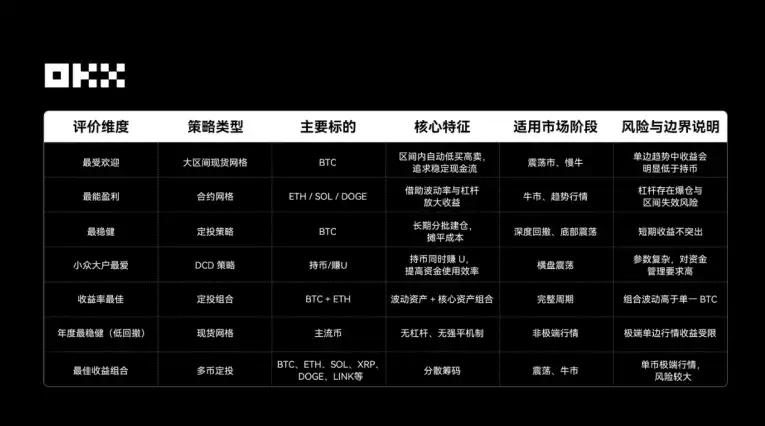
In 2025, the largest user-scale strategies all point to the same core demand: low error rate, predictability, and low drawdown. The reason why OKX's BTC Large Range Spot Grid has become the most popular strategy is consistent with BTC dollar-cost averaging and the annual low drawdown spot grid in logic. They do not require users to predict price directions or rely on timing abilities but instead reduce the risk of human decision-making errors through diversified execution and automated mechanisms. The value of these strategies lies not in how high short-term returns are but in the ability to cover the vast majority of market phases, making them suitable for long-term, continuous use by regular users.
Strategies that truly maximize returns are mainly found in scenarios of high-volatility assets overlapping contract grids such as ETH, SOL, DOGE. The high returns here do not come from "smarter judgments" but are the result of the combined effect of volatility itself and leverage mechanisms. In a bull market or trending market, these strategies can rapidly amplify profits. However, at the same time, risks are also amplified synchronously, and the returns are highly concentrated on a few users who can withstand volatility, understand ranges, and leverage boundaries. Therefore, they can be called the "most profitable" but cannot become the "most widely used" strategies.
In the long run, stable excess returns more often occur in situations where strategy combinations and cycles match. A BTC and ETH dollar-cost averaging combination achieved a 100% return in less than two years, fundamentally based on the stability of core assets and the resilience of volatile assets forming a superimposed effect within an appropriate cycle. The DCA strategy preferred by niche high-net-worth individuals reflects the same idea— as the fund size grows, the goal shifts from pursuing ultimate returns to enhancing fund efficiency and drawdown control. What ultimately determines the performance gap is not the individual strategy itself but whether its applicable boundaries are understood and respected.
The Three Most Classic Strategy Types and Parameters
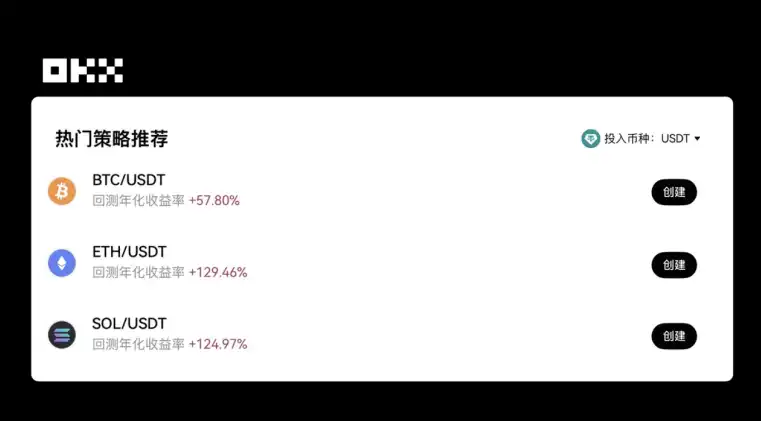
BTC Large Range Spot Grid (40K-400K, ~200 Grid Intensity)
This is currently the most validated and longest-running type of OKX grid setup. Real user preference data shows that the core of the BTC grid is not about "predicting direction," but about exchanging an ultra-wide price range for long-term survival rate. The 40K-400K range essentially covers the main oscillation zone of multiple bull and bear cycles. Paired with a grid intensity of around 200 grids, it can continuously capture BTC's structural volatility without frequent downtime or repeated restarts. The 200 grids is not a random number: too few grids would waste oscillations, while too many would be eroded by fees. This density strikes the optimal balance between trade frequency and cost. For most users, this type of strategy addresses a very practical pain point—being able to participate in BTC volatility long term without timing the market.
OKX Coin-Margined Perpetual Contract Grid (Typical: SOLUSD)
In a trending market, users' demand for grids shifts from "stable" to "amplification," which is also a scenario where coin-margined perpetual contract grids are commonly used. Represented by SOLUSD, coin-margined perpetual contract grids act as an amplifier for a bull market Beta: price uptrends not only bring grid spread income, but the position itself continues to appreciate in coin value. Real-world usage data indicates that this type of strategy is more commonly used in phased markets rather than year-round. Profitable accounts typically only enable it after the trend is clear and keep leverage low to avoid liquidation during oscillations. It addresses not "stable cash flow" but the most pressing concern for users in a bull market: how to maximize trend gains without frequent manual intervention. However, it is essential to note that coin-margined perpetual contract grids are still leveraged strategies, sensitive to market direction and volatility. Proper leverage and position control are necessary in case of trend misjudgment or violent market fluctuations to manage risk.
AI Parameter Recommendation (Automatic Matching for Three Strategy Types)
The reason why AI parameter recommendation has become the default choice for many users is not because it is "more aggressive" but because it is less prone to common mistakes. The OKX strategy system combines the current pair's volatility, trend structure, and historical range to automatically provide users with three grid schemes for long-term stability, medium-term oscillation, and short-term volatility. The core value lies in helping users take the most challenging step—setting a reasonable range and grid density. In reality, the majority of grid losses are not due to market issues but because the parameters were ineffective from the start: the range was too narrow, the grid was too sparse, or it was frequently breached. AI recommendation does not promise the highest returns but significantly reduces the probability of strategy failure due to the "start-stop-reset" cycle, hitting the core pain point for ordinary users.
BTC Spot DCA Strategy Backtest Annualizes Over 50%, ETH Over 120%
The essence of the OKX spot Martingale strategy is to incrementally invest during price retracements to lower the average cost, and take profits during trend rebounds. Compared to traditional dollar-cost averaging (DCA), it is better at capturing rebound profits, but it also carries higher risk, especially in a one-sided downtrend where multiple layers of position increments can quickly deplete funds. Its core value lies in combining market volatility and trend structure to achieve high-frequency cycle arbitrage, while overcoming the missed opportunity of solely holding assets and missing out on rebounds.
Using BTC as an example, the typical spot Martingale parameters are a 0.96% drawdown trigger for position increment, an increment coefficient of 1.05, a maximum of 7 position increments, and a 0.5% take profit target. Backtesting shows that the annualized return can exceed 50%. This strategy can quickly capture profits from BTC's long-term trend rebounds, while using multiple position increments during ranging markets to reduce costs. However, there is still a risk of funds depletion in a continuous downtrend or sideways market environment.
Using ETH as an example, due to higher volatility, a Martingale strategy with a 1.42% drawdown trigger, 1.05 increment coefficient, and 2.8% take profit target can backtest an annualized return of over 120%. The most successful consecutive doubling instance shows that starting with a $1000 USDT position, after triggering 7 consecutive position increments, overall take profit during the trend rebound period can achieve 2-3 times the returns. Compared to BTC, ETH's high-frequency volatility allows the Martingale strategy to more easily achieve multi-round position increments and profit-taking in a short period, but fund management and take profit settings are still key to the success of the strategy.
Conclusion: Combination and Risk Control Become the Mainstream Choice
By dissecting the annual trading behavior, it can be seen that most profitable accounts did not rely on aggressive single-point speculation, but rather on the combination of trading, strategic products, and earning tools, continuously accumulating returns under the premise of risk control. Users with different capital sizes and trading styles may have differences in specific execution methods, but the underlying logic is highly consistent: actively reducing reliance on a single market judgment and instead opting for a more replicable, scalable, and controlled drawdown revenue path.
This trend not only reflects the maturity of user trading concepts but also demonstrates the market's real demand for professional, systematic tools. As a trading infrastructure and product provider, OKX will continue to iteratively enhance product capabilities around real-world usage scenarios, improve overall coordination from trade execution, strategy management to profit tools, helping users more efficiently manage risk and seize opportunities in a constantly changing market environment. In the future, we also look forward to exploring with more users a more robust and sustainable way of trading, creating deterministic value in the long term.
Welcome to join the official BlockBeats community:
Telegram Subscription Group: https://t.me/theblockbeats
Telegram Discussion Group: https://t.me/BlockBeats_App
Official Twitter Account: https://twitter.com/BlockBeatsAsia

 Related Articles