$300 Billion New Blue Ocean: Three Main Themes of the Stablecoin Ecosystem

Original Title: "The $300 Billion New Blue Ocean: Three Main Trends in the Stablecoin Ecosystem"
Original Author: Louis, Biteye
Introduction: A Historical Turning Point for the Stablecoin Ecosystem
In the years 2024-2025, the global stablecoin market is experiencing an unprecedented explosion of growth. As of October, the total market value of stablecoins has exceeded $300 billion, up from $166.3 billion at the end of 2024, representing a staggering 82.9% annual growth rate. This growth not only breaks historical records but also signifies a fundamental shift of stablecoins from a fringe speculative tool to mainstream financial infrastructure.
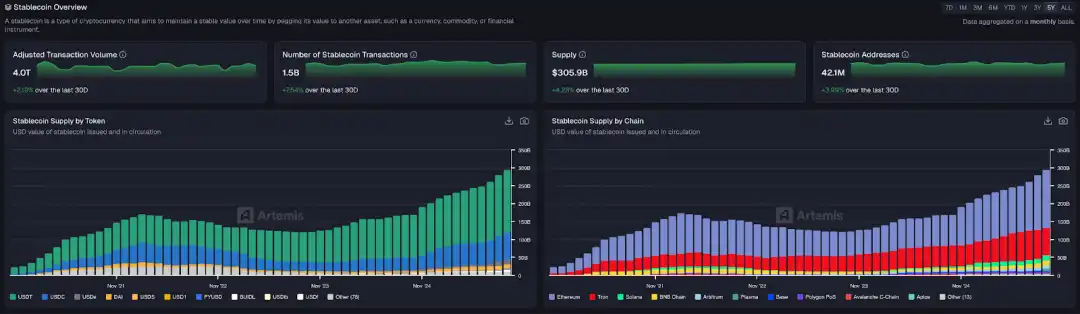
Current market stablecoin total supply and trading volume data: https://app.artemisanalytics.com/stablecoins
A historic breakthrough in the regulatory environment has provided strong momentum for this growth. In July 2025, the U.S. GENIUS Act was officially signed into law, establishing the first federal-level stablecoin payment framework. At the same time, the EU's MiCA regulation fully entered into force in December 2024, laying a solid foundation for the standardized development of the stablecoin industry.
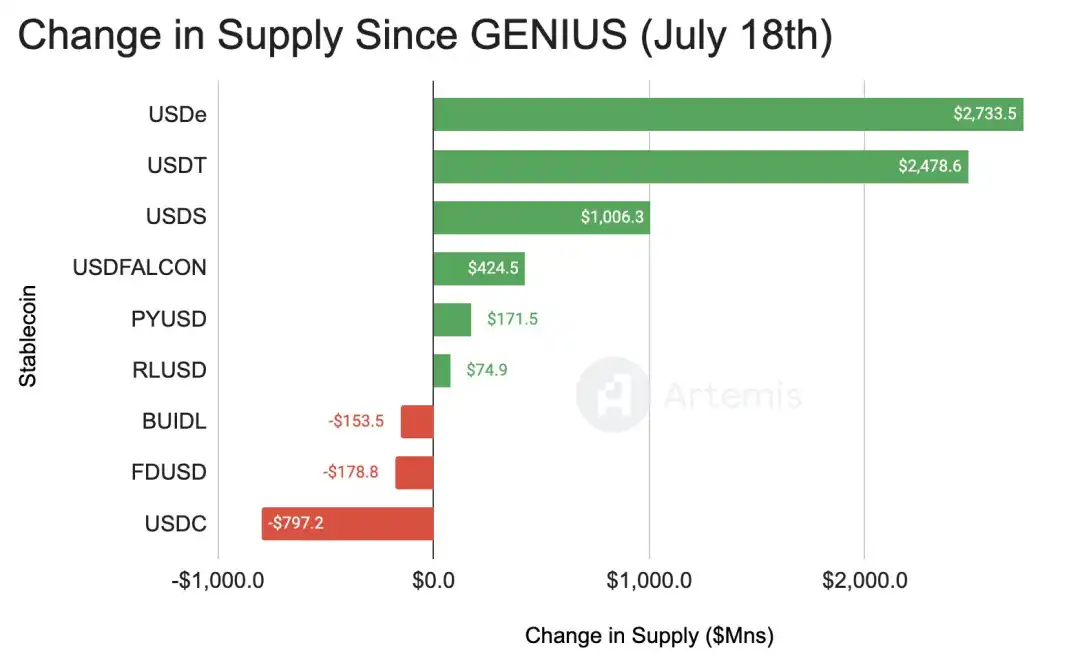
Post-GENIUS Act stablecoin growth: https://x.com/artemis/status/1952074174001795316
While USDT and USDC still dominate, their market share has decreased from 91.6% to 83.6%. The stablecoin market is quietly undergoing changes, with emerging stablecoin projects rising rapidly, such as:
· Ethena's USDe reaching a market value of $11 billion
· PayPal's PYUSD surpassing a market value of $27.6 billion
· RWA-backed stablecoins reaching a market size of $35 billion, with a 46% annual growth
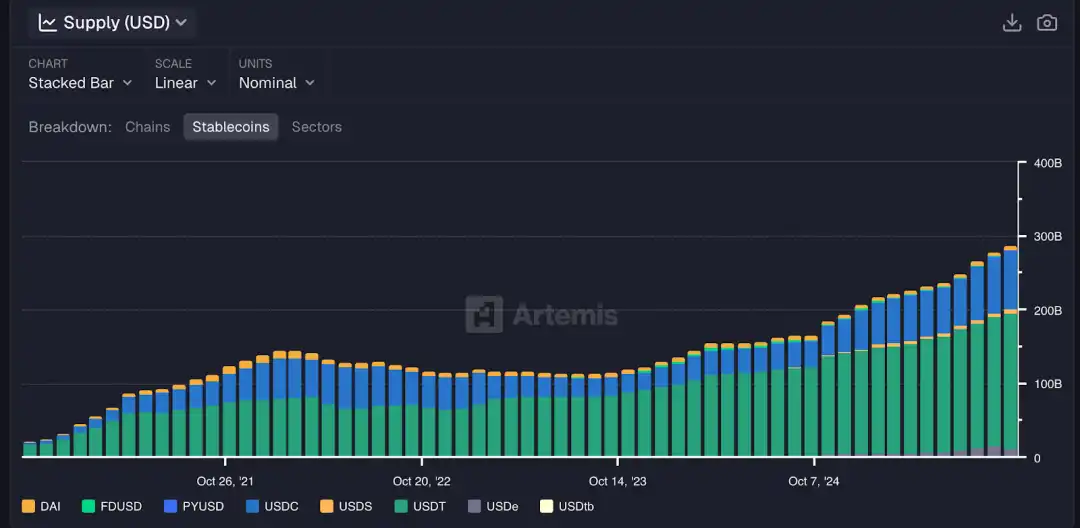
Stablecoin Market Share https://app.artemisanalytics.com/stablecoins?tab=stablecoins
Stablecoin Specialized Public Chains: Infrastructure Revolution
Traditional blockchains have shown significant pain points when processing stablecoin transactions: Ethereum's high gas fees often reach tens of dollars, transaction confirmation times range from seconds to minutes; although Tron has lower fees, it faces centralization risks and technical limitations.
The new generation of specialized stablecoin public chains has achieved a qualitative leap through technological innovation. These public chains widely support high throughput of 1000+ TPS, zero or very low fees, and sub-second transaction confirmation. More importantly, they have designed stablecoins as native gas tokens, completely eliminating the impact of cryptocurrency price volatility on user experience.
Plasma: Flagship Project in the Tether Ecosystem
As the leading project in the race track, Plasma has raised a total of $75.8 million, including a $20.5 million Series A funding led by Bitfinex and Framework Ventures in February 2025, as well as participation from prominent investors like Peter Thiel and Bybit. After the mainnet test launch on September 25, 2025, the TVL quickly reached $5.3 billion.
Technically, Plasma adopts a custom PlasmaBFT consensus mechanism, achieving sub-second finality and a processing capacity of over 2000 TPS. Its core innovation lies in the Paymaster system, enabling true zero-fee USDT transfers while supporting custom gas tokens and confidential payment features. The project has integrated the Chainlink oracle and built a complete DeFi ecosystem by bridging pBTC through a trustless Bitcoin bridge.
Stable: Institutional-Grade USDT Optimization Solution
Stable positions itself as the "real-world payment rail," focusing on institutional-grade USDT applications. The project secured a $28 million seed round investment in July 2025, jointly funded by Franklin Templeton, Hack VC, PayPal Ventures, and Bitfinex. The project utilizes the StableBFT consensus, supporting 10k TPS and sub-second finality, while maintaining EVM compatibility.
The technical innovation of Stable lies in using USDT as the native gas token, achieving zero-fee P2P transfers through account abstraction. Enterprise features include batch transfer aggregation, compliance-focused private transfers, and cross-chain USDT0 support. The project has integrated PayPal's PYUSD stablecoin, with a focus on fiat on/off ramps and debit card issuance business.
Arc: Circle's Exclusive Ecosystem
Arc, developed by Circle, is positioned as the "home of stablecoin finance," deeply integrated with the Circle ecosystem. The project uses USDC as the native gas token, ensuring a dollar-denominated predictable fee structure. Technically, it adopts the Malachite BFT consensus engine, supporting 3000 TPS and sub-second finality.
Arc's uniqueness lies in its built-in FX engine, supporting quote-based stablecoin conversions, optional privacy features for compliance, and exploring reversible USDC transactions to tackle fraud issues. It is also collaborating with the German Stock Exchange to drive adoption in the EU market.
In terms of funding size and technical progress, Plasma has taken a leading position with Tether ecosystem support and the earliest mainnet launch. Stable has built a differentiating competitive edge through institutional positioning and the PayPal partnership, while Arc relies on Circle's compliance advantage and USDC ecosystem status. All three projects adopt the BFT consensus mechanism, more suitable for payment scenarios compared to traditional PoS due to its probabilistic finality.
Interest-Bearing Stablecoins: Innovative Revenue Model
Interest-bearing stablecoins embed yield directly into the stablecoin, providing users with a yield experience beyond traditional bank savings.
Ethena USDe
USDe's market value surged from $86 million in January 2024 to $11.04 billion in October 2025, marking a staggering 13,750% increase, catapulting it to the world's third-largest stablecoin.
USDe's technical innovation lies in maintaining stability through a delta-neutral strategy, pledging assets like ETH and WBTC, while opening hedge futures positions on exchanges to create non-directional risk exposure. sUSDe provides holders with an annualized yield of 2.56% to 3.72%, sourced from Ethereum staking rewards, perpetual contract funding rates, and stablecoin fixed income.
Sky Ecosystem
The Sky Ecosystem (formerly MakerDAO) has reshaped the decentralized stablecoin lending market through a rebranding and product innovation. USDS, as a reward-based stablecoin, has reached a market capitalization of 8 billion USD, providing users with a 4.75% annualized yield through the Sky Savings Rate mechanism.
The yield is sourced from protocol surplus, including lending fees and liquidation proceeds, distributed to savings users through the SSR mechanism. The project has also introduced an Endgame plan for SubDAO restructuring, offering different services through specialized sub-protocols such as Spark, Grove, and Keel.
Stablecoin Payment Infrastructure: Global Financial Reshaping
By 2025, the stablecoin cross-border payment volume is projected to reach 46 trillion USD, equivalent to over 50% of Visa's throughput. The cost structure of traditional cross-border payments is typically 2-7%, including transfer fees, exchange rate differences, and intermediary charges, while stablecoins can reduce costs to 0.5-2%, saving 50-80% in high-frequency cross-border scenarios. More importantly, stablecoin settlement times have been reduced from the traditional 3-5 business days to under 3 minutes, significantly reducing pre-funding requirements and cash flow interruptions.
The Rise of BVNK
As a stablecoin infrastructure provider, BVNK experienced strong growth in its business by 2025, processing an annual transaction volume exceeding 20 billion USD, primarily serving corporate clients such as Worldpay, Flywire, and dLocal. In October 2025, Citi Ventures strategically invested in BVNK to support its global stablecoin payment track expansion. Concurrently, Coinbase and Mastercard are in talks to acquire BVNK, valuing it at 15-25 billion USD, making it the largest stablecoin acquisition in history and highlighting its core position in enterprise-grade stablecoin payments.
Stripe's Innovative Strategy
Stripe introduced a stablecoin subscription payment feature supporting automatic deductions in USDC on the Base and Polygon chains, catering to the needs of AI and SaaS companies. This feature halves settlement costs, with AI companies reporting a 20% shift in payment volume to stablecoins. Stripe also launched the Open Issuance platform to assist enterprises in issuing custom stablecoins and integrating AI-driven payment agent tools.
Stablecoin AI Integration Applications: Future of Finance
With the rise of AI Agent Economy, traditional API keys and subscription models are no longer sufficient to meet the needs of autonomous machine-to-machine transactions, leading to the emergence of payment protocols and infrastructures specifically optimized for AI agents.
KITE AI: Building Layer-1 for the Agent Internet
As a leading project in this field, KITE AI is dedicated to building the first Layer-1 blockchain optimized for the AI Agent Economy. KITE has secured a $18 million Series A funding round led by PayPal Ventures and General Catalyst.
The core innovation of the project lies in three major technological pillars: the Agent Identity Resolution (AIR), programmable permission management, and on-chain attribution-proof of AI (PoAI). AIR, serving as an agent app store, addresses the trust issue between AI agents, allowing developers to deploy custom agents and access the ecosystem market through a low-code interface.
Recently, KITE announced a strategic partnership with Brevis to enhance the transparency and autonomy of agent identity and payment modules using zero-knowledge proof technology. The initial modules of this collaboration are deployed on the BNB Chain and will later expand to KITE L1 to achieve cross-chain proof relay.
x402 Protocol: Rethinking the HTTP Payment Standard
The x402 Protocol, driven by tech giants like Coinbase, Google, and Cloudflare, aims to redefine the HTTP payment standard. When a client (such as an AI agent or application) accesses a protected resource, the server returns a 402 status code and JSON-formatted payment details, including amount, currency, and receiving address. The client then constructs a signed payment transaction and resubmits the request via an X-PAYMENT header. Third-party enablers like Coinbase validate on-chain payments, after which the server grants access to the resource. The entire process enables trustless execution, with payments settled on-chain to ensure auditability.
The technical advantage of x402 lies in its native HTTP integration and extremely low transaction costs. Settlements based on USD Coin (USDC) can be completed in 2 seconds, with gas fees below $0.0001 and zero protocol fees.
Investment Outlook and Risk Assessment
The stablecoin subsector is transitioning from concept to reality and from speculation to application. Among the four major emerging subsectors, dedicated stablecoin public blockchains demonstrate the clearest investment value. Plasma, with Tether ecosystem support and a $53 billion TVL, has validated market demand and shown a significant technological moat. With the explosion of enterprise-level payment needs, such infrastructure projects are poised to receive premium valuations. Enterprise payment solutions benefit from regulatory environment improvements, with BVNK's $15-25 billion acquisition valuation reflecting traditional financial giants' recognition of stablecoin infrastructure. While AI integrated applications are in early stages, the speed of technological innovation and validation of application scenarios exceeds expectations, making it suitable for investors with a higher risk appetite. The risk-return ratio of interest-bearing stablecoins is the most complex, and the risk of de-pegging in extreme market conditions should not be overlooked.
Regulatory risk remains the biggest variable. While the GENIUS Act and the MiCA regulations have provided a framework for industry development, the specific implementation details and enforcement standards are still evolving, and stablecoin track projects need to pay continuous attention to compliance costs and policy changes. Competition risk is intensifying as traditional financial giants enter the arena; the strategic layout of companies like Stripe, Visa, and Mastercard will reshape the market landscape, and emerging projects need to maintain a competitive edge in technological innovation and ecosystem development.
Investing in the new stablecoin track requires finding a balance among technological innovation, regulatory compliance, and market demand. With the continuous launch of key projects in 2025 and further clarification of the regulatory framework, this round of stablecoin infrastructure upgrades is expected to reshape the global payment landscape, bringing rich rewards to early participants.
Welcome to join the official BlockBeats community:
Telegram Subscription Group: https://t.me/theblockbeats
Telegram Discussion Group: https://t.me/BlockBeats_App
Official Twitter Account: https://twitter.com/BlockBeatsAsia