HTX Ventures Latest Research Report: Is Stock Tokenization a Pie in the Sky or a Pitfall? All You Need to Know (Part 2)

From stablecoins to stock tokenization, the crypto industry is attempting to bring the "dollar system" and "stock market" onto the blockchain, creating a global on-chain capital market with shadow dollars and shadow stocks. In the previous article, we have already dissected the origins of this logic: from early attempts by FTX and Binance, to Kraken, Bybit, and Robinhood's different strategies in the latest craze, and then comparing three typical models (real stock custody, CFDs, on-chain synthetics). It can be seen that technology and demand are not the main challenges; the real core lies in regulatory gamesmanship and institutional boundaries.
Seven, Global Regulatory Overview
United States: Securities Laws are a Hard Constraint
· Core Principle: Stock tokenization ≠ Non-Security. Simply mapping stocks to tokens and selling or offering services to U.S. users automatically triggers the SEC's securities regulatory requirements.
· Compliance Requirements: To issue and sell stock tokens, one must hold a Broker-Dealer license, an Alternative Trading System (ATS) license, and have a custody and disclosure framework compliant with securities laws. Typically, hiring a compliance legal team to review the offering documents is also necessary.
· Regulatory Attitude: The SEC's stance has always been clear — "Tokenization doesn't change the nature of the underlying asset."
· Lesson Learned: FTX, Binance, and others, when they launched stock tokenization attempts in 2020–2021 without holding complete compliance qualifications, were successively pressured by the SEC, FINRA, and Germany's BaFin, eventually being forced to delist the tokens.
European Union: Dual Application of MiFID II and MiCA
· MiFID II: Any product involving securities sales targeting retail or institutional investors must strictly comply with the Markets in Financial Instruments Directive, and cannot use the term "token" to circumvent existing securities regulatory obligations.
· MiCA: While mainly targeting crypto asset and stablecoin issuance, if stock tokenization is backed by real shares, it will also fall under the MiCA regulatory framework.
· Regional Practice: Robinhood Europe has already piloted in the EU, offering stock tokenization products using an SPV structure; once actual securities attributes are involved, additional exemption applications or full disclosure requirements must be met according to local regulations.
Asia/Middle East: Grayscale Pilot Program Relatively Active
· The Monetary Authority of Singapore (MAS), the Swiss Financial Market Supervisory Authority (FINMA), the UAE ADGM/DFSA, among others, have established regulatory sandboxes for Real World Asset (RWA) tokenization, allowing small-scale tokenization projects to pilot, with the condition that they mainly target non-US customers and regional qualified investors.
· Hong Kong takes a cautious approach to security tokenization, with RWA implementations currently focusing more on bonds, funds, structured notes, etc., and has not yet significantly approved stock tokenization businesses.
Chapter 8: Real User Scenarios|How Global Retail and Institutional Investors Can Participate
The actual implementation of stock tokenization is not only aimed at retail investors.
From individual retail investors to high-frequency traders, from small to medium-sized CEXs, regional wallets to traditional brokerages, DeFi protocols, all parties can find their own entry points and feasible paths in this track.
Retail Investors
· The most direct way to use is to buy xStocks in small amounts, connecting with USDT to trade stock tokens of companies like Apple, Tesla, etc., to track price fluctuations.
· The main need is to address the pain point of "not having a US stock account but wishing to test the waters with a low threshold."
· Core understanding: It is necessary to clearly understand that the tokens held do not represent actual shareholding status, dividends, or voting rights.
High-Frequency Traders
· The core appeal of this group regarding stock tokenization is short-term arbitrage and volatility.
· CFDs (Contract for Difference) are most suitable: they can leverage, hedge flexibly, and support T+0 closing.
· Core understanding: It is necessary to understand slippage, leverage risks, counterparty risk, and prevent liquidation or bankruptcy.
Small and Medium Exchanges / Regional CEXs
· If they do not have full brokerage qualifications, they can adopt a hybrid model of "CFD + affiliated tokenization."
· The front end provides spot/CFD matching, while the backend cooperates with issuers such as Backed, Dinari, etc., to introduce real asset-backed tokens, capture grayscale traffic, and earn fee sharing.
· Core understanding: It is necessary to reasonably define the service area to avoid high-pressure regulatory markets such as the United States.
Traditional Broker
· Legal and well-capitalized traditional brokers tend to prefer the "self-built chain + self-operated license" model.
· Robinhood and Bitstamp have explored this path in the European and American markets: through on-chain accounts and internal custody, they capture both matching and custody revenue.
· Key understanding: the need for a mature licensing system, compliant custody, and legal support in multiple countries.
Wallet / Agent
· In emerging markets, some wallet or OTC teams tend to adopt white-label tokenization products, attaching issuers' notes such as Kraken and Backed to their own front-end apps or mini-programs to earn traffic entry and matching commissions.
· Particularly suitable for regions with high retail account opening thresholds and strong grayscale demand, such as Pakistan and the Philippines.
· Key understanding: the need to find a reliable issuer and complete compliant docking to reduce regional regulatory risks.
DeFi Protocol
· Stock tokenized assets can be combined with on-chain bonds and stablecoins to become an essential building block of derivative products in the DeFi ecosystem.
· Typical scenarios include providing bilateral liquidity in LP pools or using them as collateral for lending protocols like Aave and Compound to leverage.
· Key understanding: the need to ensure the security of oracles and clearing mechanisms to avoid the oracle attacks or price failure risks experienced by projects like Mirror.
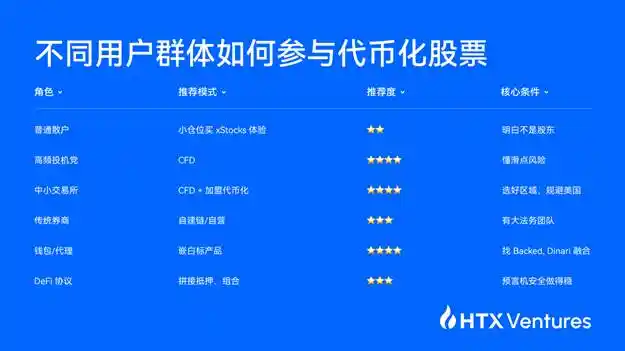
How Different User Groups Participate in Stock Tokenization
IX. Risk Points | Truths and Easy Pitfalls
Stock tokenization seems to provide a convenient channel for global users to speculate on stocks, but the hidden risk points and operational thresholds are often underestimated. Here are the top five typical risks worth noting:
Risk 1 | Most Tokens Do Not Have Shareholder Rights
Platforms like Robinhood, Backed, and Kraken have explicitly stated in their official FAQs: "This token does not represent actual shareholder rights." In other words, users hold only an on-chain voucher linked to the stock price, which is not equivalent to traditional shareholder rights.
· Unable to automatically receive company annual reports, AGM (Annual General Meeting) participation rights, or shareholder voting rights;
· Dividends are usually not included unless the issuer actively designs profit sharing, which is extremely rare in practice.
Therefore, the vast majority of users hold only a price shadow, not a real shareholder position.
Risk 2 | The Actual Share Redemption Process Is Much More Complex Than Imagined
Although most tokenized stock theoretically supports 1:1 redemption, the operational threshold is high:
· Usually set a minimum redemption threshold (such as at least 1 share, with some products requiring redemption starting from 100 shares);
· There is a cooling-off period, which can last up to 30–90 days;
· Users need to complete the KYC process again, submit address proof, and other documents;
· Most also require a fee, commonly at 0.5%–2% of the face value.
Therefore, for the vast majority of retail investors, the actual redemption process is rarely chosen.
Risk 3 | Insufficient Liquidity Can Lead to "Empty Pools"
Although tokenized stocks are mounted on on-chain liquidity pools or CEX, the actual order book depth is often limited:
· For example, Backed's AAPL, TSLA in the main LP pool on Solana usually amounts to only a few million dollars;
· Daily trading relies more on a few liquidity providers like Kraken, Bitstamp for order book support;
· Once mainstream market makers exit or the trading platform delists the token, users' holdings may only be traded through OTC or other non-mainstream channels, significantly increasing liquidity risk.
Risk 4 | Oracle Failure Is a Core Risk of On-Chain Synthetic Assets
Pure DeFi synthetic assets rely on oracles like Chainlink, Pyth to feed real-time stock prices. Once a flash loan attack, API data distortion, or oracle manipulation occurs, the accuracy of synthetic tokens generated by smart contracts is compromised:
· A typical case is the Mirror Protocol in the Terra ecosystem: After UST's peg break and LUNA's collapse, oracle failure caused large-scale resets of synthetic assets like mAAPL, mTSLA.
Risk 5 | Cross-Border Compliance Risk and Regulatory Blockage Could Be Triggered at Any Time
Once a stock tokenization project targets U.S. residents or triggers cross-border securities sales, it may trigger regulation by institutions such as the SEC and FINRA:
· Robinhood Europe launched unauthorized tokenized equities such as OpenAI and SpaceX in the EU, which was officially declared unauthorized by OpenAI and triggered a regulatory investigation;
· Precedents set by Binance, FTX, and others provide clear evidence, with the former being forced to delist assets and the latter ultimately filing for bankruptcy due to compliance issues.
Chapter 10 | Future Projection | Potential Evolutionary Paths
Stock tokenization, as part of Real World Asset (RWA) tokenization, is just the beginning. Over the next three years, it may evolve gradually along three main paths:
Scenario A | Broker Chainization, Self-Operated Closed Loop
In the future, Robinhood is highly likely to double down on an All-In approach: building its own blockchain, holding regulatory licenses, self-managing actual stock custody, issuing tokens on-chain, and integrating internal matching and settlement.
If the SEC provides more flexibility in the compliance process, Robinhood is expected to achieve a "Brokerage + Wallet + Chain" all-in-one solution.
If successful, this path can be seen as a "compliant version of Binance Smart Chain," with the key difference being that its underlying assets are actual stocks and ETFs, rather than purely encrypted native assets.
Scenario B | Regional Gray Market, Leading the Way
Regions such as Abu Dhabi, Singapore, and Switzerland have officially included RWA in their innovation pilot programs, allowing for early exploration of tokenized equities and other gray assets. In the future, more "regionally limited models" may emerge:
· The Americas and the EU with proprietary licensing systems and local brokerages taking the lead;
· Emerging markets in the Middle East, Southeast Asia, Africa, etc., are expected to become major global hubs for tokenized stocks.
Platforms like Kraken, Bybit, Ondo, etc., are expected to strategically focus on these gray markets, targeting non-U.S. user traffic and the window of opportunity brought by licensing flexibility.
Scenario C | DeFi Assembly and Modular Path
If the DeFi scene continues to heat up in the next cycle, tokenized stocks are likely to evolve into freely composable "financial Lego" components, becoming a key element of on-chain RWA assembly strategies.
errorOn July 25, a Nasdaq-listed company formerly known as SRM Entertainment officially rebranded to Tron Inc. and adopted a new stock ticker symbol, TRON. The company announced the divestment of its toy business and restructuring of its primary assets around the TRON DAO for TRX Treasury Strategy, using the TRON native token TRX as its core strategic reserve asset. It currently holds over 365 million TRX and engages in staking management and yield generation through on-chain protocols such as JustLend.
On the day of the announcement, Tron Inc.'s stock price surged over 55%, becoming a focal point of market discussion. This not only marked a "high-profile return" of a crypto project via a shell listing but also signaled a new path for on-chain native assets exploring compliant financial structures.
Notably, this is not the first time a traditional publicly traded company has disclosed its cryptocurrency holdings. Back in 2020, MicroStrategy became a representative of "holding company" by continuously purchasing BTC and including it in its financial reports; companies like Tesla, Block, and Coinbase have also disclosed their holdings of BTC, ETH, or stablecoins in their financial reports. However, Tron Inc. differs from these companies in that:
· It is one of the few publicly listed platforms with a public chain token (TRX) as a core asset, integrating on-chain ecosystem development into the company's strategy;
· The project team does not hold direct shares but exercises "shadow control" through DAO governance and advisory structures, attempting to graft on-chain governance onto traditional equity architecture within a compliant framework;
· Its asset operation relies more on on-chain protocols (like JustLend), and its revenue mechanism leans more towards Web3.
Such operations are no longer just capital operations but rather an active narrative reconstruction: transforming tokenized assets into financial units recognizable, valuated, and compliantly participatory in traditional financial structures. Following stablecoins and crypto bonds, this may be the next experimental ground for public chain ecosystems to connect with TradFi.
Therefore, we can see that tokenizing stocks and securitizing on-chain assets are forming a "bi-directional nesting":
· On one side, real-world assets such as US stocks and bonds are being put on-chain, enhancing the richness of on-chain finance and real-world anchoring;
· On the other side, native crypto assets are entering mainstream capital markets in reverse through compliant paths, gaining incremental liquidity and institutional endorsement.
This trend is no longer staying in the conceptual stage but is gradually taking shape through initiatives like stock tokenization on platforms such as Kraken and Bybit, as well as cases like Tron Inc.'s shell listing. Together, they outline an emerging "Wall Street on-chain": a connecting bridge between decentralized asset structures and traditional market frameworks.
Whether a closed loop can truly be formed in the future will depend on market capabilities, regulatory flexibility, and institutional design resilience. However, what can be affirmed is that the boundary between coin and equity is being redefined.
12. Conclusion | Pie or Pitfall, Depending on Closed Loop and Structural Design
From the real stock on-chain driven by Kraken, Bybit, Robinhood, to the compliance token issuance role undertaken by Backed, Dinari, Ondo, and further to the attempt of "on-chain asset reverse market entry" represented by Tron Inc., the core competitive advantage of this round of asset structure restructuring has never been just smart contracts or product forms but whether it can support a complete on-chain financial closed loop.
From a macro perspective, this model is a second-layer extension of the stablecoin system: stablecoins have allowed global retail investors to bypass the traditional banking settlement network; stock tokenization has enabled the shadow USD to connect to "shadow stocks"; the combination of the two has created an on-chain "Grey Wall Street," breaking down the closed capital market in the real world into a 24/7 composable and configurable on-chain market.
However, for this model to truly take root, there must be a clear chain of responsibility and stable regulatory endorsement: only with real equity support can arbitrage be avoided; only with transparency in custody and issuance can user trust be ensured; only with continuous market-making and liquidity can on-chain trading depth be supported; only with regional licenses and cross-border compliance mechanisms can regulatory constraints from the SEC, the EU, or various jurisdictions be mitigated.
Any loosening link in the chain could potentially render the notes in users' hands worthless, turning them into island assets with no rights and no redemption.
For retail investors, stock tokenization may just be a speculative channel to test the grayscale path, with the true meaning of shareholder identity and long-term benefits still generated within the traditional brokerage system.
For small and medium-sized CEXs, wallets, OTC desks, and DeFi protocols, this may be the fastest way to activate stablecoin liquidity stranded in wallets and quickly connect to the RWA track.
And in the opposite direction, Tron Inc. offers a radical yet realistic possibility: bringing coins into the traditional capital market and shaking hands with stocks institutionally.
Whether it's a pie or a pitfall ultimately depends on who can build a bidirectional, composable, and implementable closed-loop structure. Those who can truly pave the way may catch the next wave of asset and liquidity mainstream.
About HTX Ventures
HTX Ventures is the global investment arm of Huobi HTX, integrating investment, incubation, and research to identify the world's best and brightest teams. As an industry pioneer, HTX Ventures has over 12 years of blockchain development experience, excelling in identifying cutting-edge technologies and emerging business models within the field. To drive growth within the blockchain ecosystem, we provide comprehensive support to projects, including financing, resources, and strategic advice.
HTXVentures currently supports over 300 projects spanning multiple blockchain sectors, with some high-quality projects already trading on the Huobi HTX exchange. Additionally, as one of the most active FOF funds, HTX Ventures has invested in 30 top funds worldwide and partnered with leading global blockchain funds such as Polychain, Dragonfly, Bankless, Gitcoin, Figment, Nomad, Animoca, and Hack VC to jointly build the blockchain ecosystem.
This article is contributed content and does not represent the views of BlockBeats
Welcome to join the official BlockBeats community:
Telegram Subscription Group: https://t.me/theblockbeats
Telegram Discussion Group: https://t.me/BlockBeats_App
Official Twitter Account: https://twitter.com/BlockBeatsAsia

 Related Articles