HTX Ventures Latest Research Report: Is Stock Tokenization a Pie in the Sky or a Pitfall? All You Need to Know in One Article (Part 1)


Introduction
Stock tokenization is becoming the latest focus at the intersection of the crypto world and traditional finance. With platforms like Kraken and Robinhood entering the space, the market is now attempting to bring real-world assets such as US stocks and ETFs onto the blockchain, creating a global 7x24 on-chain capital market. As a leading industry trading platform, this trend is not isolated but rather a result driven by the popularity of stablecoins, the shadow banking system, and the logic of Real World Asset (RWA) tokenization.
The core logic is this: stablecoins have built a global shadow banking system, and stock tokenization is its natural extension, allowing non-US users to directly access "shadow stocks" with USDT, bypassing account opening, remittances, and cross-border settlements, forming an on-chain version of "Wall Street grayscale." This model not only brings new liquidity space but also brings regulatory and compliance risks to the forefront.
At the same time, another reverse path is also taking shape: on-chain assets are entering traditional markets through compliance restructuring. Recently, a Nasdaq-listed company renamed itself Tron Inc., incorporating the public chain ecosystem and TRX into its core strategy, sending a signal that the integration of crypto assets and mainstream finance is no longer just a concept but is gradually being implemented within institutional frameworks.
Pie in the sky or trap? The answer depends on whether the closed-loop can be successfully implemented:
· Can real stock backing and transparent custody be delivered?
· Can liquidity and market-making be sustained in the long run?
· Can regional compliance mechanisms keep pace with the pace of innovation?
This article is written by HTX Ventures and will focus on pattern dissection, player landscape, regulatory trends, typical risks, and future evolution to help you determine whether stock tokenization is the golden entrance of RWA or a grayscale trap in the capital market.
1. Why is the Crypto World Targeting Stocks?
Since the birth of blockchain technology, nearly all assets that can be tokenized have already been or are gradually being moved onto the blockchain. From the earliest stablecoins to traditional financial assets such as real estate, bonds, funds, and now the increasingly popular stock tokenization, each innovation attempts to eliminate the various obstacles and barriers of the real-world finance through blockchain.
The core logic of stock tokenization is to transform traditional stock assets in the financial market into digital tokens on the blockchain, enabling global 24/7 trading, fractional ownership, and more efficient cross-border transactions. This model has garnered significant attention because it directly addresses pain points faced by global retail investors, especially retail investors in emerging markets, such as account opening difficulties, remittance issues, and trading hour mismatches.
However, stock tokenization is not a new concept. It briefly emerged as early as 2020, with exchanges like FTX and Binance leading the way. Yet, these initiatives eventually failed under heavy regulatory pressure.
II. Lessons Learned from Stock Tokenization: FTX and Binance
In 2020, FTX, as one of the earliest platforms to attempt stock tokenization, partnered with the German securities company CM-Equity to purchase real stocks for custody. They then issued tokenized stocks in the form of ERC-20 tokens, such as Tesla, Apple, and Coinbase stocks, and sold them to global users on their platform.
FTX's initial foray showed promising results and attracted a significant number of retail investors from emerging markets. However, this model quickly drew the attention of European and American securities regulators. The German Federal Financial Supervisory Authority (BaFin) and the U.S. Securities and Exchange Commission (SEC) issued strong warnings, stating that such activities involved public offering of securities, required compliance with securities regulations, and obtaining the necessary licenses. FTX failed to meet these compliance requirements and was forced to swiftly delist its stock token products.
In 2021, Binance also attempted to launch similar products, trading tokenized versions of Tesla, Coinbase, and Apple stocks using nearly the same approach. However, Binance's endeavor also did not last long and was quickly halted under pressure from regulators in multiple countries.
The failures of FTX and Binance clearly conveyed a crucial message: the core challenge of stock tokenization business lies in compliance and regulation rather than technology.
III. Why Has Stock Tokenization Regained Focus?
Despite facing strong regulatory resistance, stock tokenization has once again become a focal point in 2024-2025, attracting market attention. The primary reasons for this resurgence can be attributed to four factors:
· Policy and Political Factors: In 2024, Trump openly supported the development of cryptocurrency, reigniting market expectations for potentially relaxed regulations. SEC official Hester Peirce also expressed interest in a regulatory sandbox approach, providing some policy gray areas.
· Entry of Traditional Financial Institutions: Traditional giants such as BlackRock and Franklin Templeton have begun tokenizing assets such as funds and bonds using blockchain. This has set a precedent for stock tokenization, prompting more traditional institutions to dip their toes into the water.
· Maturation of Technical Conditions: Unlike 2020, the rapid development of blockchain technologies such as Solana, Base, and Arbitrum has significantly reduced on-chain transaction costs, increased transaction speeds, and made liquidity easier to achieve.
· Strong Retail Demand Persists: Retail demand for US stocks remains high in regions such as Southeast Asia, South Asia, and the Middle East. Users in these regions hold a significant amount of USDT but struggle to access the traditional US stock market. Stock tokenization directly fills this market gap.
IV. Why is Stock Tokenization Closely Related to the Shadow Banking System and the Popularity of Stablecoins?
Stock tokenization is the "second-layer evolution" of stablecoin on-chain USD, turning shadow USD held by retail investors directly into shadow stocks, transforming RWAs from "static custody" to "composable dynamic assets." The hotter stablecoins become, the more traction this path gains, but regulatory concerns regarding shadow USD also intensify.
Stablecoins Essentially Form a Global "Gray Channel" for the Shadow USD System
· Dollar-pegged stablecoins (USDT, USDC) are no longer just "crypto payment tools" but a "USD replica" that bypasses traditional cross-border clearance networks.
· In many emerging markets, stablecoins represent locals' shadow claims to USD. In countries like the Philippines, Pakistan, Argentina, and Vietnam, residents may not have the local currency but possess stablecoins, which are equivalent to holding "USD."
· Therefore, from a retail perspective: "Having USDT ≈ Having USD Deposits," but with greater flexibility to trade in and out, directly swap for stock tokens, and more.
· With the emergence of stock tokenization, stablecoins naturally become a new destination: USDT/USDC directly become on-chain shadow price references for Apple/TSLA, rather than first converting to fiat before opening a US brokerage account.
With Higher Stablecoin Popularity, Real World Assets (RWAs) Gain Traction
· At one point, USDT's 2024 circulation surpassed $115 billion, making it the world's largest "USD substitute product," with circulation speed far exceeding traditional USD telegraphic transfers.
· With vast liquidity from stablecoins, on-chain RWAs (bonds, funds, real estate, stocks) naturally require new "liquidity pools." Otherwise, USDT can only stay on centralized exchanges for contracts and cannot be connected to real-world assets.
· Tokenized stocks are among the most easily understood and globally liquid RWAs, with retail investors familiar with the underlying asset, and market makers able to rely on real secondary market quotes, making them easier to trade than real estate, art, or accounts receivable.
Shadow Dollar System + Stock Tokenization, Making "US Stocks" an L2 On-Chain Dollar Asset
· From a regulatory perspective, stock tokenization + stablecoin pairing is essentially a "shadow dollar capital market":
· Stablecoins provide a shadow substitute for the US dollar;
· Stock tokenization shadows the equity ownership of US companies;
· The combination allows non-US residents to hold "shadow dollars" as "shadow US stocks" 24/7.
· This combination bypasses the US stockbroker system, SWIFT settlement system, and US direct tax reporting system (in theory).
· It is precisely because of this that regulators will maintain a high sensitivity to it, focusing on the "US dollar influence overflow" rather than just the token play.
This logical line explains why Kraken, Bybit, Robinhood, Backed dare to come back in 2024-2025
· Stablecoins have been validated by global users (fast transactions, convenient cross-border payments), and on-chain RWAs also have endorsements from giants (BlackRock, Franklin Templeton).
· Kraken and others are eyeing the opportunity brought by this shadow dollar system to bring retail investors out of the grayscale.
· Robinhood is testing the waters with stock tokenization in the EU, also bullish on non-US market USDT flow, using on-chain bills to reach a user base that was previously out of reach.
5. Three Main Models of Stock Tokenization
Although the concept of "stock tokenization" is only a few words, it is not a single path in actual implementation.
According to the differences in whether there is real stock custody, on-chain issuance and trading methods, the current mainstream practices in the market can be summarized into three types: one is real stock custody + on-chain token issuance, the second is the Contract for Difference (CFD) model, and the third is pure DeFi synthetic assets. Each of the three models has its own advantages and disadvantages, with significant differences in regulatory pressure, liquidity design, and user adaptation scenarios. Understanding the differences is the basis for understanding the entire stock tokenization track.
Pattern One | Stock Custody + On-Chain Issuance
This is the mainstream approach currently adopted by Kraken and Bybit, and is also considered the most prudent practice from a compliance perspective.
Operation Mechanism
· A licensed issuer or broker (such as Backed Finance, Dinari) purchases real stocks (such as Apple, Tesla) in the traditional secondary market.
· The stock assets are held by a compliant custodian (such as BitGo, Anchorage) to ensure quantity authenticity and verifiability.
· Based on the custodied shares, the issuer issues tokens on-chain at a 1:1 ratio, such as 1 share of Apple = 1 AAPLx (or bAAPL), deployable on networks like Solana, Base, etc.
· Users can purchase this token with USDT on exchanges like Kraken, indirectly obtaining on-chain assets pegged to real stocks.
Key Points of the Pattern
While this setup may seem ideal, it comes with the following limitations:
· Despite being pegged to real stocks, most tokens do not automatically come with voting rights or dividend rights. Platforms like Robinhood and Kraken explicitly state on their websites: "This is not shareholder rights."
· If users wish to redeem the tokens for real stocks, they typically need to complete rigorous KYC, follow the custodial redemption process, and may also have to pay additional fees. Some issuers may not even support retail fractional share redemption.
· Therefore, the vast majority of users buying these tokens are mainly looking to capture stock price fluctuations, with a very low proportion truly exercising shareholder rights.
Why Are Kraken and Bybit Still Actively Pursuing This?
· Compliance Buffer: Backed by real stocks, with transparent custody, in the face of regulatory pressure, most responsibilities can be transferred to the issuer (such as Backed).
· DeFi Composability: The tokens have on-chain transferability, usable for cross-chain compositions, such as transferring Kraken's AAPLx to a Solana wallet for LP on Jupiter or liquidity mining on Kamino.
· More Appealing to Retail Investors: Compared to pure CFDs or synthetic assets, the "realness" of stock-backed assets can lower the user's psychological barrier, making it easier for market education and user acquisition.
Special Case | Robinhood's "Full-Stack Integration" Strategy
Robinhood's approach is more aggressive, relying on its own US broker-dealer license, which already allows it to enable stock trading and custody. Currently, Robinhood is developing the Robinhood Chain to anchor stock accounts directly to the chain, achieving self-managed custody, on-chain issuance, and matching, and connecting to Bitstamp to provide global liquidity.
This model is akin to a "Brokerage Edition of Binance Chain," where Robinhood autonomously controls the entire process from asset issuance, market making to data circulation, with revenue sharing, users, and traffic all retained within its own ecosystem.
However, it should be noted that such a highly integrated compliance architecture and technological barrier is not something that general trading platforms or wallet service providers can replicate in the short term. Small players would find it challenging to bear the cost of building such a proprietary ecosystem.
Model Two | Contract for Difference (CFD): Simple Shell, Traditional Play
Compared to stock custody, CFDs (Contract for Difference) may seem the simplest, but it is currently one of the most widely adopted methods by trading platforms.
Operating Mechanism
· Typical players such as Bybit CFD, PrimeXBT, etc., all use similar structures.
· Users can use MT5, MT4, or Bybit's built-in CFD page to select "Apple CFD" and take a position on price movements.
· The platform itself or an external LP (liquidity provider) engages in a bet with the user. There is no need to actually hold the underlying stock or engage in physical custody.
· Spread, slippage, and leverage parameters are set by the platform itself. The essence of user trading is a price game with the platform or LP, with no stock delivery or shareholder registration involved.
Why is the CFD Model Popular?
· Fast Deployment: Simply connect to established LPs and introduce real-time stock prices to start trading.
· Relatively Lower Regulatory Pressure: In most jurisdictions, CFDs are classified as derivative trading. As long as there is no physical stock delivery involved, they do not fall under the strictest category of traditional securities laws.
· High User Acceptance: Cryptocurrency users are generally familiar with BTC and ETH contracts, so transitioning to stock contracts poses no learning curve, with consistent operational logic.
Bybit's Dual-track Strategy
Bybit's recent strategic moves are particularly noteworthy:
· On one hand, it has partnered with Backed to introduce xStocks (such as AAPLx, TSLAx), targeting users who prefer "stock-backed" products, directly competing with platforms like Kraken and Robinhood.
· On the other hand, it has maintained its traditional CFD product line to meet the needs of speculative traders for high leverage and round-the-clock arbitrage opportunities.
This dual-track hybrid model allows Bybit to simultaneously cater to conservative users looking for psychologically-backed stock products and high-frequency speculative traders seeking leverage, maximizing liquidity sources and user coverage within a unified trading system.
Risk Points: Common Pitfalls for Users to Beware
While the CFD model is user-friendly, the underlying risks should not be overlooked:
· No Shareholder Rights: CFDs do not confer any voting rights, dividend rights, or linkage to shareholder registers.
· Counterparty Risks from the Platform or Liquidity Provider (LP): User profits translate to platform losses, and if trades are too accurate, some platforms may mitigate risks through slippage or stop-out mechanisms, leading to possibilities of liquidation and widened slippage.
· Essentially a Regulated "Betting Market": Therefore, CFDs are more suitable for short-term volatility trading, lacking the consistent value attributes of stocks for long-term holding.
Pattern Three | On-chain Pure DeFi Synthetic Assets
Compared to the first two patterns, on-chain pure DeFi synthetic assets represent the most "orthodox" decentralized solution. Representative projects include the early Mirror Protocol and the still-operating Synthetix.
Operating Mechanism
· Users collateralize stablecoins (such as UST, sUSD, etc.) and stake them in smart contracts as collateral to mint synthetic assets.
· The protocol uses an oracle to fetch real-time stock prices, such as Apple at the current price of $180.
· Smart contracts automatically mint corresponding synthetic stock tokens, such as "mAAPL" and "sTSLA," based on oracle data. These tokens only track the stock price and do not represent actual stock ownership.
· Users can provide liquidity (LP) with the tokens on on-chain DEX platforms (such as Terraswap, Uniswap, Curve), freely trade them, or compose them into indices and apply leverage.
Key Advantages
· Fully on-chain: No reliance on centralized matching or custody; all issuance, circulation, and burning are automatically executed by smart contracts.
· Flexible composition: Can be combined with other modules within the DeFi ecosystem to enable various use cases such as derivative collateralization, lending, options, and structured products.
Limitations and Risks
· Lack of real stock backing: Synthetic assets entirely rely on oracle price feeds and lack real stock endorsement.
· Higher systemic risk: If the oracle is attacked or malfunctions, price anchoring fails, and the contract itself may lose its ability to pay out.
· Liquidity depletion risk: Unlike centralized market-making, on-chain LP depth relies on participants continuously placing orders and receiving rewards. Without ongoing incentives, liquidity can quickly dry up.
The failure of the Mirror Protocol is a typical example: following the collapse of the Terra ecosystem, UST broke its peg, and all Mirror on-chain synthetic stocks (mAAPL, mTSLA) collapsed to zero.
Although Synthetix is still operational, some sAAPL and sTSLA tokens remain staked in Optimism and the Synthetix main protocol for collateral or to build synthetic debt pools. However, the user base and TVL have significantly decreased compared to the peak, and the pure DeFi form of stock tokenization is far less popular than stablecoins and ETH leverage scenarios.
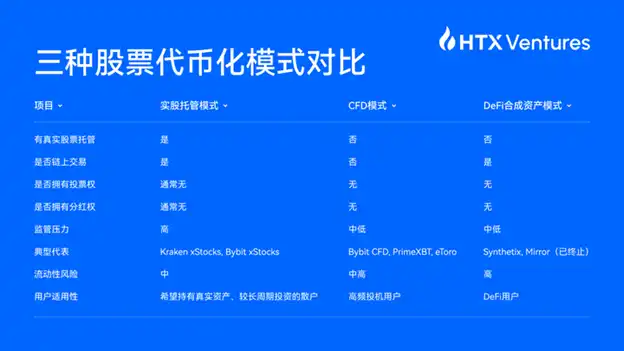
Comparison of Three Stock Tokenization Models
Six. Player Breakdown · Who's Driving This Chain
Behind this wave of stock tokenization has emerged a relatively clear upstream supply chain of issuance, custody, platform liquidity, and end-user distribution.
Backed Finance: Behind-the-Scenes Core Issuer
· Headquartered in Switzerland, it is one of the most representative stock token issuers in the industry, responsible for purchasing real stocks at traditional brokers and leveraging Chainlink's Proof of Reserve (PoR) to provide on-chain real-time custody disclosures.
· Key clients include Kraken, Bybit, Ondo, among others. The stock tokens provided by Backed are seen as "compliant, listable spot assets" that are quickly listed on CEX for retail investors.
· The key logic is: the issuer takes on the roles of securities compliance and custodian, while CEX only needs to handle front-end KYC/AML, seeking to avoid direct involvement in the responsibilities of the securities issuer.
Ondo & Securitize: Alliance Player and Traditional Digital Securities Service Provider
· Ondo spearheads the "Global Market Alliance," joining forces with Solana Foundation, BitGo, Fireblocks, Jupiter, and others to build cross-chain, custody, and liquidity standardization solutions.
· Securitize is an early typical player in the digital securities space, mainly providing share tokenization and accredited investor onboarding services to traditional enterprises, focusing more on the B2B market and not directly targeting retail investors.
Dinari: Trying to Tackle Compliance in the US
· Dinari is a U.S.-based team attempting to confront U.S. securities regulation head-on by applying for licenses such as Reg D, Reg CF, and ATS (Alternative Trading System) qualification, striving to create truly compliant stock tokenization product "dShares."
· Unlike Backed, Dinari hopes to offer users some optional shareholder rights in the future (such as dividends), but the challenge lies in the extremely high compliance costs in the U.S., requiring long-term investments in broker licenses, custody, and legal advisory teams.
· Currently, Dinari mainly takes the B2B route, partnering with wallets or trading platforms to white-label stock token products.
Kraken: Pioneer of a Long-Standing Compliant CEX
· Kraken has always positioned itself in the market as a compliant CEX, focusing on the trust of European and American users in licenses and compliance.
· Its xStocks module is linked with Backed: Real stock custody is handled by Backed, while Kraken provides matching, listing, wallet, and API integration services. PoR is publicly verifiable, on-chain transferable to networks like Solana, and can be combined with LP/DEX for secondary liquidity.
· Kraken particularly emphasizes compliance boundaries, implementing measures such as IP blocking for U.S. users, timezone KYC restrictions, etc., to avoid crossing the SEC's red lines as much as possible.
Bybit: Dual-track Hybrid, Balancing Spot and Derivatives
· The biggest difference from Kraken is that Bybit simultaneously operates two product lines: real stock tokenization and CFD (Contract for Difference).
· CFDs on Bybit are achieved through integration with external liquidity providers (such as IS Prime, Finalto) and the MT5 system to cover the needs of high-frequency speculative users, earning spreads and fees.
· The path to real stocks involves collaboration with Backed to list xStocks (such as AAPLx, TSLAx), catering to users preferring "stock endorsement," allowing both client bases to convert on the platform simultaneously.
Robinhood: Self-owned Brokerage Chain Integration
· Robinhood holds a U.S. Broker-Dealer license, enabling it to offer real stock trading and custody.
· Developing the Robinhood Chain, transforming stock accounts into blockchain-based ones, with an accompanying proprietary wallet and trading matching system, first tested in the EU region (Robinhood Europe), packaging 200+ stocks and ETFs as tokenized products for EU users to trade, avoiding U.S. regulations.
· Bitstamp provides liquidity bridge, allowing users to later collateralize tokens in the DeFi scene or create structured products.
· This "brokerage in-chain" solution enables Robinhood to have an all-in-one closed loop from issuance, custody, to matching and liquidity, significantly enhancing retention and data control. However, it requires robust compliance endorsement and investment, making it difficult for small and medium players to replicate in the short term.
Republic: Focus on Unlisted Rare Equity
· Different from other projects focusing on public stocks, Republic places its tokenization emphasis on rare equity of unlisted companies (such as SpaceX, OpenAI), typically using the SPV (Special Purpose Vehicle) bond model, allowing retail investors to indirectly invest in previously hard-to-reach equity targets.
· The risk lies in the fact that some private equity tokens may have authorization issues, such as OpenAI issuing a statement that the products launched on Robinhood Europe were unauthorized, and the SEC has also launched an investigation.
This article is a contribution and does not represent the views of BlockBeats.
Welcome to join the official BlockBeats community:
Telegram Subscription Group: https://t.me/theblockbeats
Telegram Discussion Group: https://t.me/BlockBeats_App
Official Twitter Account: https://twitter.com/BlockBeatsAsia

 Related Articles