OKX Ventures Research Report: Intelligent Retail Business Landscape Insight, Architecture, Trends, and Implementation Path

The wave of AI-driven transformation is quietly reshaping the foundations of the business world, as stated in 《AI 2027》: "It is expected that after 2025, artificial intelligence will increasingly resemble an autonomous entity rather than just a mere assistant." We are now at a turning point where intelligent agents are transitioning from unreliable mere tools to autonomous intelligent entities.

Keen readers following the AI and Fintech world will notice that since late 2024, internet, payment, and e-commerce giants such as Paypal, Visa, Mastercard, Stripe, Amazon, etc., have started to lay the groundwork for "Agentic Business" and "Agentic Payments." The underlying logic is quite clear: the traditional business world has seen an increasingly clear trend where the widespread adoption of intelligent agent interfaces will disrupt all business logic and production relationships built over 30 years on traditional GUI (Graphical User Interface) in the internet. On this basis, traditional e-commerce operations, advertising marketing, and financial payment settlement logic are being completely rewritten, and new categories may even emerge: Agentic Commerce (Intelligence Commerce).
Most users and traders in the Crypto world are still unaware of this paradigm shift, which is comparable to the transition from horse-drawn carriages to steam engines, or from PC internet to mobile internet. This transformation of Agentic Business is by no means just a simple intelligent extension of what many people perceive as "e-Commerce."
This report from OKX Ventures aims to provide readers (especially Crypto readers, as you actually have skin in the game!) with a panoramic view of Agentic Business, systematically outlining its technological structure and path, analyzing the business innovation of this transformation, and discussing the core challenges it faces in the ultimate realization process, ultimately arguing why Crypto could become its indispensable underlying infrastructure.
1. What is Agentic Commerce?
Here, we have comprehensively referenced the following companies: Stripe (which introduced Stripe Issuing), Visa (which proposed the concept of Intelligence Commerce and its accompanying API), Mastercard (which launched Agent Pay), and Coinbase (which introduced the x402 Payment Protocol) to describe Agentic Commerce and Agentic Payment, providing the following simple definition:
Agentic Commerce is a business model driven by AI agents, where AI agents can act on behalf of users to perform various tasks, including product search, option comparison, recommendations, and completing purchases. These AI agents can interact with e-commerce platforms, process transactions, and manage the entire shopping process, aiming to make the shopping experience more personalized, secure, and convenient. Amazon's "Buy for Me" feature (allowing AI agents to assist users in purchasing items from third-party brands) and OpenAI's "Operator" tool (automating online shopping tasks) are currently the most well-known examples.
Currently, Agentic Commerce is still an emerging field, with limited publicly available business or commercial data. According to a report by Gartner in 2024, less than 1% of e-commerce industry enterprises or businesses have adopted Agentic AI into their company operations or services, but there is a high market interest in this technology. According to a 2025 e-commerce survey, 90% of e-commerce businesses are willing to learn how to integrate Agentic AI into their businesses.
So why did traditional payment giants collectively aggressively launch various new intelligent-agent-enabled payment products last year and this year before Agentic Commerce has been widely applied on a large scale? What huge opportunity did they see behind the scenes?
1.1 Human User Role Shifted from "Executor" to "Principal," Key Business Decision Points Moved from the "Checkout Page" to the "Intent Layer"
Traditional online shopping is like browsing a carefully designed virtual supermarket: consumers personally browse shelves, compare products, and finally check out, with the entire process revolving around "active exploration." The merchant's optimization goal is to make this process as smooth as possible, reducing any user hesitation through beautiful interfaces, precise recommendations, and quick payments.
Now, imagine a new world of Agentic Commerce: you don't need to browse e-commerce websites one by one, compare prices, or manually place orders; you just need to say a vague command to your AI assistant, such as "help me buy a pair of running shoes." The AI assistant then kicks in, searching numerous merchants, filtering products, analyzing prices, reviews, and logistics, even considering the sustainability of the supply chain. Throughout the entire process, you may not have touched a screen or entered a password even once.
The key shift lies in the transformation of the user's role from an "executor" to a "delegator," where the core of business interactions evolves from a "click stream" to an "intent stream." Consumption is no longer a series of discrete choices but a holistic authorization towards the end goal (human users can directly tell an AI assistant, "I want to redecorate my house in Mediterranean style, help me choose the materials").
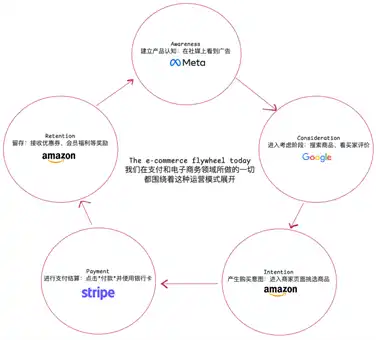
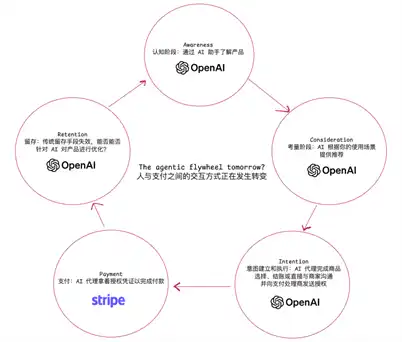
As commercial decision-making shifts from the "checkout page" to the "intent layer," the existing business ecosystem will face an avalanche-like impact. From marketing to user growth strategies, all the decades-old traditional e-commerce business logic based on human behavior analysis is being disrupted by AI intelligent agents' rational decisions:
· A/B Testing: AI can compare dozens of scenarios in milliseconds, rendering the two-week button color testing for conversion rate meaningless.
· Personalized Recommendations: Existing recommendation algorithms based on human browsing history are obsolete, and recommendation models need to be restructured based on AI decision logic.
· Cart Recovery: AI decisions will not involve human-like "hesitation" or "abandonment" due to various experiences or other subjective or objective reasons, making cart abandonment rates and corresponding optimization strategies a thing of the past (the current global average cart abandonment rate is 70%).
Traditional marketing relies on the "attention economy": beautiful images, emotional video ads, red buttons for "limited-time offers," all these strategies designed to stimulate impulsive human consumption are imbued with merchants' psychological tactics based on human behavior. In contrast, AI is not driven by impulses; it is an entirely rational decision agent that only cares if the data returned by an API is clear, and if the parameters are complete. It will coldly compare product specifications, historical prices, logistics efficiency, user reviews, and even the supply chain's carbon footprint, thereby eliminating any "user mindshare."
The future of Agentic Commerce marketing is no longer about creating eye-catching ads but about building a "machine-readable trust record." "Product-Agent Fit" will replace "Product-Market Fit." Whether your product can be easily indexed, understood, and recommended by mainstream AI intelligent agent ecosystems (such as MCP servers, A2A protocols) will determine its market survival.
However, as the intelligent agent rapidly engages in reasoning and decision-making based on human delegation and "intends" to swiftly move toward the ultimate goal of "business transaction completion," the agent will hit a hard stop—the traditional payment system.

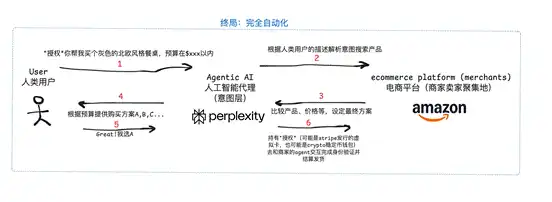
2. Fatal Incompatibility: Why the Traditional Financial System Acts as a Speed Bump for Agentic Commerce
The intelligent agent can flawlessly perform information gathering, analysis, and decision-making. However, when it reaches the final stage of the business loop, it encounters a solid barrier, and that barrier is the decades-old human-centric financial payment system we have built.
The entire modern payment and risk control system is fundamentally an "anti-automation system." Its core design philosophy is to assume that automation equals fraud.
Consider every step in our current payment process:
· Graphic CAPTCHA: Presenting a challenge that is difficult for a machine to solve to prove you are "human."
· SMS OTP/Two-Factor Authentication (2FA): Assuming you have a physical device capable of receiving text messages and can manually input the OTP, a task deemed highly challenging for a program.
· 3D Secure Authentication: It forces a redirect to a new bank page, requesting a separate transaction password, completely disrupting any automated flow.
· Risk-based Behavioral Analysis: Advanced risk control systems even analyze your mouse movement trajectory, typing speed, device fingerprint, and other "human characteristics" to assess transaction authenticity.
All these "security measures" have turned into "shackles" in the era of Agentic Commerce: various interrogations like "Are you human?" have hindered the autonomous intelligent agents we've deployed.
Therefore, the future of payments is no longer just a "Checkout Page" but must be a "Protocol." This marks a revolution in trust and authorization mechanisms. We need a brand-new digital credential system that allows users to securely issue a "programmable authorization" to their AI intelligent agents with clear scope, validity, and amount restrictions.
Agentic Payment is part of this protocol, representing the final payment settlement stage in Agentic Commerce, where AI agents use secure and efficient methods (such as tokenized credentials) to execute transactions on behalf of users. This ensures a seamless and secure payment process, often with user-defined limits and controls, to maintain trust and security. Mastercard's "AgenticTokens" support AI agents in completing subscriptions and recurring payments, PayPal's AgentToolkit aids AI agents in handling the payment process, and Visa, Stripe, among others, offer similar tools. A recent experiment between Stripe and Perplexity combines the two, where users can use Perplexity as an interface to directly command full-fledged suggestions for decorating their new home and specific products. Upon user confirmation of the preferred option, the agent uses Stripe's pre-established Agent payment backend to complete automated payment settlement and delivery.
By now, you probably understand why giants like VISA and Mastercard are eager to launch corresponding payment solutions adapted for Agentic Commerce. This is because they are all gambling on who will be the rule-setter for the next-generation "machine-native" payment protocol. It is a game to control the underlying infrastructure of the future commercial world, and the endpoint of this transformation is to bring payments back to their essence — seamless flow of value.
3. What are the specific challenges in building a smooth experience financial infrastructure for Agentic Commerce? How to do it?
3.1 Core Challenge: Trust, Intent, and Automation
The dilemma of building an Agentic Payment system is not just a simple technical implementation but rather solving fundamental challenges arising from paradigm shift.
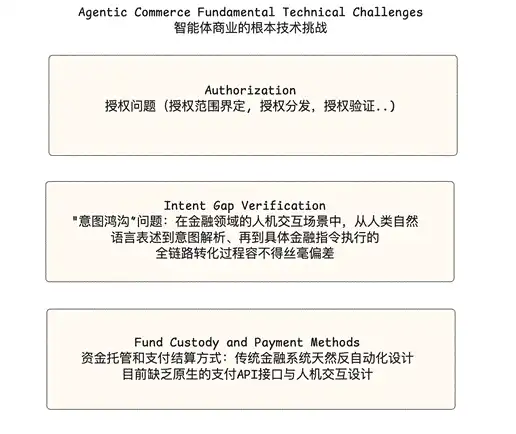
1. "Who Can Do": From traditional payment authentication to Agentic Commerce agent authorization challenge
In the payment field, when we talk about end-users, we usually focus on authentication rather than authorization. If you click "Purchase" on an e-commerce website, you are explicitly authorizing it, and there is little room for objection (as you entered credit card information and explicitly clicked the button). Therefore, the core of traditional payment revolves around "identifying individuals," with the soul-searching question being: "How do I confirm that the operator is you?" — that is, authentication.
However, in the upcoming era of AI-driven business, there will be a significant shift in the payment field: Authorization is becoming a key part of the payment process. This issue of authorization now appears to be more complex and interesting because user instructions for authorization are not as straightforward as the simple "click to buy" scenario in traditional e-commerce. Human users can express payment intent in multiple ways. Another complexity is, when a payment request is made, who are we authorizing? Is it the human user, the AI agent, or the company developing the AI agent?
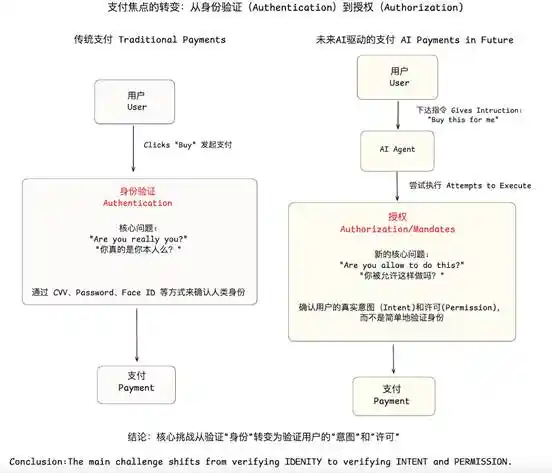
Currently, in the scenarios of AI agent payments that we can think of, the issue of authorization is:
·Phantom Identity: Who is this "transaction requester" supposed to be, a human end-user, an AI model, an app developer, or the server running it? We lack a set of verifiable identity standards designed for "machines," which could lead to a security vulnerability at every step
·Authorization Boundary: How can financial authority be securely delegated to an AI? How can the authorization boundary (amount, time, merchant) be precisely defined and strictly enforced, and how can we ensure that the authorization itself is not tampered with or abused, is also a new issue
·Liability Assignment: When an intelligent agent makes a mistake or is maliciously exploited to cause loss, determining who is responsible is a very tricky issue. Ambiguity in rights and responsibilities is the biggest obstacle to large-scale application
2. "What to Do": The Intent Verification Gap
The intent verification issue is actually a derivative of the authorization issue, and the probabilistic nature of LLM is inherently contradictory to the deterministic requirements of finance. Although the payment layer cannot fix the AI's "illusion," a well-designed financial system must be able to bridge the gap between AI output and user's true intent.
From Instruction to Intent: Traditional payment processing deals with "payment instructions" (Pay 50 to Merchant X), assuming that this instruction is correct. On the other hand, AI payments need to deal with "transaction intent" ("Help me buy a medium oat milk latte"). The payment system needs to be able to verify the final payment instruction against the original natural language intent.
AI Behavior Constraints: What we need is not a payment system that can understand AI thoughts but a system with strong "guardrails." It can constrain AI behavior through structured data, strict rules at the API level, or even smart contract logic to ensure that the execution results are within the user's preset "safe zone." For example, a rule that only allows transactions under $10 at Starbucks can effectively prevent high-value or erroneous transactions caused by AI "illusions."
3. Machine-Native Fund Custody and Payment Settlement
As mentioned earlier, traditional payment systems inherently have an "anti-automation" gene, and all security measures designed for traditional GUIs will become obstacles to full automation in an agentic commerce scenario. Therefore, we need a brand-new set of payment APIs and settlement networks designed natively for machines, which may include the following traits:
·Programmatic-First: All interactions should be done through structured APIs rather than simulating human clicks on a GUI.
·Frictionless Settlement: Transactions should be able to be completed with near-zero latency and cost, especially for microtransactions crucial to supporting the machine economy.
·Data Portability: Transactions should carry rich, structured metadata for automated reconciliation, auditing, and building advanced financial services, rather than having just a simple transaction amount and merchant name like traditional payments.
3.2 The Path to Disruption: Three Stages to Autonomous Finance
Facing the challenges mentioned above, the industry is exploring an evolutionary path from "Assistive" to "Agentive" and ultimately to "Autonomous." These three stages clearly demonstrate how far we are from a true smart-body economy.
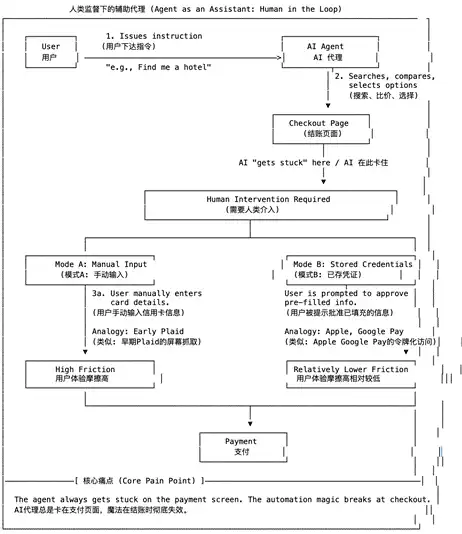
First Stage: Human-Supervised Assistive Agent
This is the most mainstream current model, where AI acts as a sophisticated "form-filling tool" handling all the tedious front-end work but "hits the brakes" at critical moments, handing back the final decision-making power to humans.
· Implementation: The smart agent can complete tasks such as search, price comparison, and information entry, but at the crucial payment step, it "stops" and relinquishes control to humans. For example, it automatically fills in credit card information but requires you to manually enter the CVV code, or it guides you to the login page of PayPal or Stripe for you to personally complete the final authorization.
· Technological Core: Essentially browser automation (simulating human actions) or using stored credentials (such as Apple Pay/Google Pay) for prefilling.
· Key Challenge: The major pain point is the fractured experience, where the efficiency gains brought by the smart agent abruptly end at the last step, failing to achieve true "end-to-end automation."
Second Stage: Controlled Agent within Authorization Scope
This is the battleground where payment giants like Visa, Mastercard, Stripe are fiercely competing. They are trying to create a "controlled digital wallet" for smart agents, with the core being virtual cards and dedicated payment APIs. Users can generate one or more highly restricted virtual cards for their smart agents. Virtual cards can be set with per-transaction/total spend limits, specify available merchant categories (e.g., only for purchasing flights), set expiration dates, etc.
· Implementation: The AI agent initiates the payment by calling this virtual card through a dedicated API (such as Stripe's Order Intent API), with virtually no user intervention throughout the process. The collaboration between Perplexity Pro and Stripe is a typical example.
· Technical Core: The trust relationship is shifted from "trusting an uncertain AI" to "trusting a deterministically parameterized payment tool controlled by the issuing institution." This is a clever risk transfer.
· Core Pain Point: We believe this is currently the most suitable solution for large-scale applications because traditional merchants accessing the credit card system do not need to make any changes, and users, as they do not hold a virtual card, have little perception of the overall process change. However, as the Agentic nature of intelligent agent businesses (such as B2B Agentic Business) grows to another level in the future, this solution will be constrained in terms of the programmability of authorization information and the limitation of information data on the bank card. In addition, some industry researchers have suggested that similar to the Stripe virtual card solution, it still relies on the "manual input of card information" in this traditional system. Although it can be made more seamless through screen scraping or headless browser automation of GUI interaction, these methods still belong to higher risk solutions in terms of technology and compliance. Furthermore, Stripe's fee structure is not very suitable for micropayments (with a fixed $0.35 transaction fee + an additional 2.5% fee).
We take the collaboration between Stripe and Perplexity in this year's launch of Agentic Commerce as an example (users can directly order AI to find products in the Perplexity interface and complete the payment and purchase through the corresponding Agentic Payment service launched by Stripe).
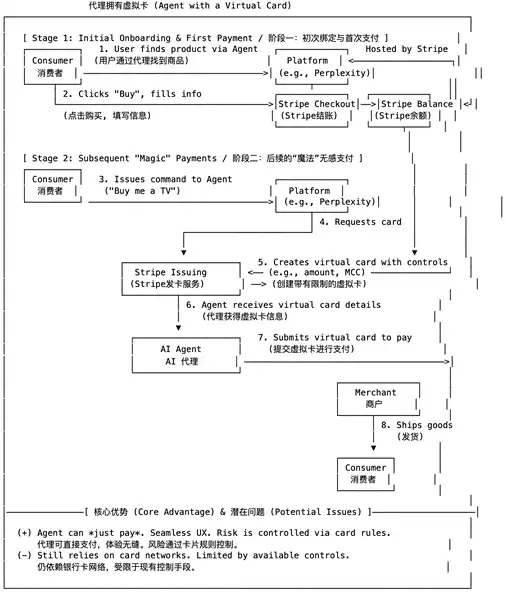
Phase One (Initial Binding): The user first goes through a standard Stripe Checkout process, not only completing the purchase but more importantly, providing their payment information and authorizing funds to the platform (settling to the Stripe Balance). Phase Two (Subsequent Seamless Payments): This is the core process. When the user places an order again, the platform (such as Perplexity) no longer bothers the user but directly requests a one-time-use virtual card from Stripe Issuing (Stripe's card issuing service) with strict risk control rules (amount, merchant category, etc.). Stripe's role in the entire chain:
·Stripe Checkout: Serving as the initial entry point, securely capture user payment information and authorization.
·Stripe Balance: Serving as the platform's fund pool, subsequent virtual card payments are disbursed from here.
·Stripe Issuing: This is the "engine" of the entire process, generating controlled payment instruments (virtual cards) on demand, transforming an uncertain AI behavior into a deterministic, controllable payment event.
·Merchant Verification Mechanism (How Merchants Verify AI is User's AI): Merchants do not directly verify "AI is you" but rely on Stripe's backend validation. Stripe checks if the virtual card is valid (within limits, not expired); if the transaction is initiated by the authorized platform; in case the platform (such as Perplexity Pro) is hacked, Stripe's Webhook and limit controls can detect anomalies and pause transactions.
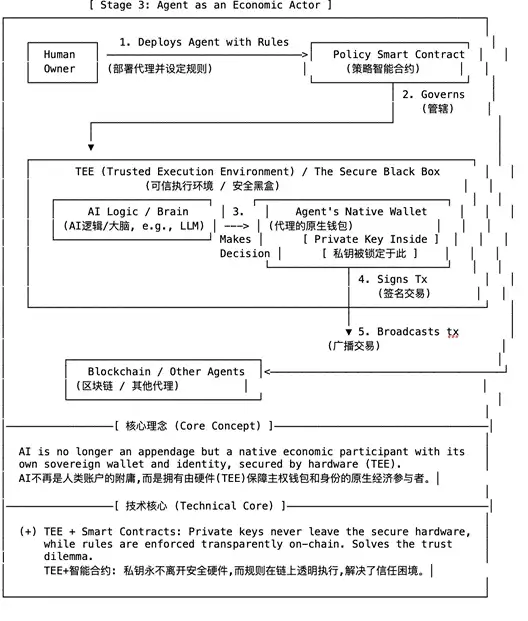
Phase Three: Autonomous Economic Agent with Native Wallet (Agent as an Economic Actor)
This is the ultimate form of Agentic Commerce and the stage where Crypto plays a core role. AI is no longer a subordinate of a human account but a native digital economic participant with its independent wallet and identity. It can autonomously engage in a brand-new economic network designed for machines. Let's imagine this technological solution based on the concept "Agents can live inside the stablecoin wallet" proposed by Fintech Brainfood. The implementation is as follows:
·Authorization — Rule Governance/Policy Layer: Humans authorize smart contracts. Humans do not directly interact with AI for authorization. The authorization method shifts to humans deploying a rule governance/policy smart contract, setting boundaries for AI's execution behavior (e.g., when conditions X, Y, Z are all met, the AI agent can access the funds).
·Core Vault (TEE and Similar Technologies): AI's decision-making brain and the AI's native on-chain wallet private key are encapsulated in a Trusted Execution Environment (TEE), a secure hardware black box inaccessible to the external world. TEE internal process: When the AI brain makes a payment decision, it will transmit this decision to the wallet module within TEE, and the wallet module will sign the transaction with the internal private key.
· Transaction Execution & Settlement: The signed transaction is broadcasted from the TEE, sent to the blockchain, or interacts with other AI agents (such as merchants, who will also have their own AI agents in the future).
4. Analysis of Agentic Payment Project, a Seed Player in the Future Intelligent Business Financial Infrastructure
Within the intelligent agent business field, when comparing these projects, we can see that each has chosen a different path and focus in building the future Agentic Payment infrastructure. Overall, these innovations revolve around three core issues: how to securely and effectively authorize, how to ensure AI agents act within user-defined boundaries, and how to achieve payment settlement. Below is a brief analysis of the three projects: Skyfire, Payman, and Catena Labs.
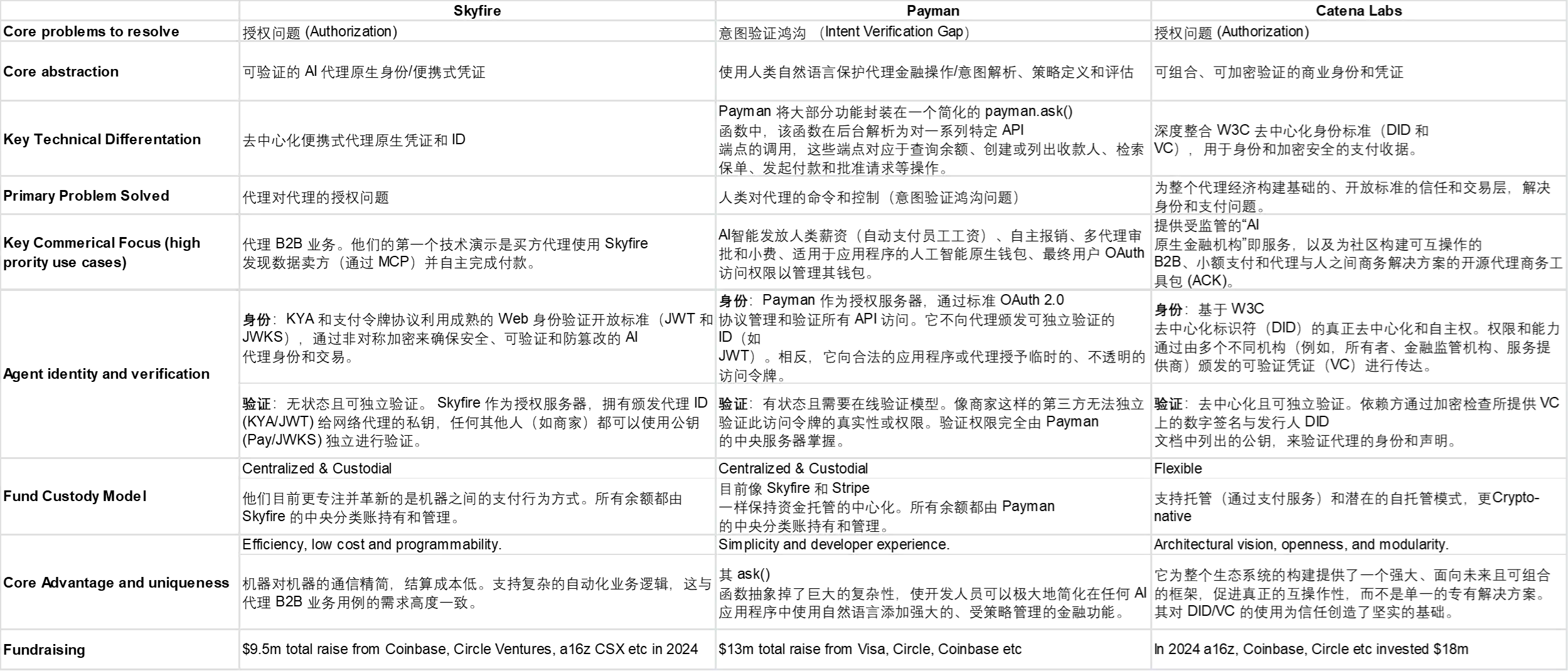
Skyfire aims to define a standardized "authorization" protocol for Agentic Commerce. The team focuses more on prioritizing future B2B agentic application scenarios. They found that the biggest obstacle to autonomous B2B transactions between future AI agents (such as purchasing data, API calls) is the lack of a widely verifiable, machine-native identity. Therefore, Skyfire's core product is an machine-native authorization protocol developed based on mature and open internet identity verification standards JWT/JWKS. The rough technical implementation logic of this protocol is as follows: Skyfire, as a trusted centralized institution, issues an encrypted, time-limited, and scope-restricted "payment credential" to all agents registered on its network. This credential can be independently and offline verified by any third-party service, thus achieving efficient, low-cost, programmable machine-to-machine business interaction without compromising security, laying the foundation for an open Agentic B2B network.
Unlike Skyfire, which focuses on agent-to-agent protocols, Payman chooses to focus on solving the "instruction and control of humans to agents," which is a pain point closer to the agentic application layer, addressing the Intent Verification Gap mentioned earlier. The team clearly sees that with the explosion of AI applications, developers' most urgent need is not for a new transaction protocol but for a "financial capability layer" that can simplify complex financial operations to the extreme and securely embed them into any application. The core product that Payman has developed is an abstract function payman.ask() and a set of complex financial intent definitions and financial transaction capabilities. The rough technical logic behind this is: through a powerful natural language interface, all "boring dirty work" such as intent parsing, policy execution, risk control, and bank integration are encapsulated, allowing developers to empower their AI assistants or automation tools with powerful financial capabilities with just one line of natural language code. The currently mentioned application scenarios mainly include AI payroll, automatic expense reimbursement, multi-agent approvals, and more.
Catena Labs also focuses primarily on addressing the authorization issues of agentic commerce. The team is dedicated to building an open, compliant, and encryption-native trust and transaction infrastructure for an agentic economy. They believe that to fully address the "identity crisis" and "transaction barriers" of AI agents, reliance cannot solely be placed on credentials issued by centralized institutions but must revert to a more foundational, truly decentralized identity standard. To this end, Catena Labs' core product is an open-source protocol framework called the Agent Commerce Kit (ACK) (deeply integrating W3C's decentralized identifiers and verifiable credentials), which mainly includes two sets of standards: an identity layer (ACK-ID) and a payment layer (ACK-Pay). Interestingly, their authorization layer solution is more decentralized in the authorization issuance scheme rather than defined by a single institution.
5. Exploration in Blue Oceans: The Commercialization Model of Intelligent Agent Commerce
Intelligent agent commerce will structurally impact the two foundational pillars of the internet in the past two decades—e-commerce and search engine advertising. We need a new theoretical framework to understand this transformation, which can be called "The Intent Layer Theory."
In the past, value was generated in two places: the entry point of discovery (such as Google search) and the endpoint of transaction (such as Amazon's checkout page). Ben Thompson's "Aggregation Theory" perfectly explains how platforms that aggregate users (traffic) have gained immense pricing power. In the era of intelligent agents, the core of value is shifting upstream from "discovery" and "transaction" to "expression and execution of intent," and the new center of this pricing power is the "intent layer"—the interaction interface between the user and their preferred AI assistant. All the business logic and production relationships built over 30 years on the traditional GUI (Graphical User Interface) are being disrupted, and a brand-new multi-layered business ecosystem is emerging.
Companies with mainstream AI assistants like OpenAI, among others, that hold the entry to user intent are the "gatekeepers" of the new business ecosystem. There has been much discussion in the market about their business models, with main focuses on transaction commissions/affiliate marketing, premium feature subscriptions, and platform API as a product. This area is not the main focus of this article, so it will not be elaborated on too much.
5.1 Challenges and Opportunities for Merchants and Service Providers in the Intelligent Agent Business
For businesses selling goods and services, the competitive focus will shift from "operating users" to "serving machines," which will directly weaken the direct connection between consumers and brands. Future loyalty may no longer be directed towards a specific e-commerce platform or brand, but towards the AI assistant that knows the consumer best and the company behind it.
· From "UX Optimization" to "API (MCP) Optimization": The focus of merchant competition will no longer be the visual design or user experience of a website but rather the "AI readability" of its products and services. Is your product data structured? Are your APIs stable, efficient, and well-documented? Can pricing and inventory information be accurately accessed by AI in real-time? These will become the new moats, and merchants will need to encapsulate their business into protocols that are easier for machines to read in order to be discovered, compared, and called upon by AI intelligent agents (those interested in MCP have already engaged in various discussions this year).
· Pay-for-Performance Bidding: Merchants will no longer purchase keyword ads but instead pay intent layer platforms to become the "preferred vendor" or "certified vendor" in a specific domain (e.g., "buying economy class airline tickets" or "booking Michelin-starred restaurants"). Merchants will only need to pay when the AI assistant adopts their solution and generates actual sales or valid leads.
· API-First Services: Companies can package their core business capabilities (such as logistics, design, content creation, legal consulting) into standard APIs and sell them directly to other AI intelligent agents for on-demand use, becoming a "functional module" in the machine economy, with payment on a per-use basis.
The business barriers of companies in the traditional business chain that have already built "network effects" may be pierced, making the market more open. Stronger market dynamics will lead to changes in business pricing models, with more dynamic, flexible pricing models emerging. Intelligent agents will need clear cost-benefit information to make decisions, and traditional pricing models in the business world will also be altered.
5.2 Financial & Trust Infrastructure Providers' Business Path
In Agentic Commerce, the primary challenge lies in pre-transaction authorization and intent verification. On one hand, the system must address the "Agent-to-Agent" trust issue, providing a verifiable digital identity for AI agents to ensure the legitimacy and security of interactions. Most agentic payment companies currently focus on addressing this aspect of the problem. This could potentially give rise to business models such as "AI Identity Authentication as a Service," where service providers may charge for issuing and verifying AI identity credentials or offer enterprise-level AI identity management platforms for subscription revenue. On the other hand, the system needs to bridge the "Intent Gulf" between human ambiguous instructions and machine-executable financial operations, securely transforming natural language into precise API calls. This has led to the "Financial-Capability-as-a-Service" model, where service providers can encapsulate this capability into APIs or SDKs, charge based on usage or transaction volume, or provide solutions for specific scenarios (such as AI-driven automatic expense reports).
Aside from authorization and intent verification, the final challenge is to build a payment settlement and trust infrastructure truly native to machines, supporting automated transactions. The traditional financial rails are designed for humans and face cost and efficiency bottlenecks when dealing with AI-driven, high-frequency, small-value, programmable transactions. While each company's technical approach may vary (whether through virtual card solutions, payment APIs, or enabling agents to have on-chain wallets), their business logic may converge around providing incentives and trust for automated value flows (transaction revenue sharing, pay-per-use). Furthermore, offering value-added services may enhance the moat, such as providing programmable, AI behavior-targeted dynamic risk management strategies, automated compliance and auditing tools, or cross-asset liquidity management solutions.
6. Ultimate Infrastructure: Why is Crypto the Perfect Partner for Agentic Commerce?
6.1 Solutions from Traditional Payment Companies like Stripe, Visa, etc., May Not Be the Endgame
As mentioned earlier, major U.S. payment company giants are deploying solutions more tailored to intelligent agents without requiring major changes to existing financial infrastructure (we categorize them into the second stage: controlled agents within the authorization scope). The most representative example is Stripe's virtual card solution, Stripe Issuing, but these solutions, which are more like a Middle Ground, still fall short of the fully autonomous intelligent agent payment envisioned in the End Game:
· Lack of a native payment API interface and human-computer interaction design: Currently, there is no direct way to make payments through API calls. Although virtual cards have potential, they have not addressed this gap. The virtual card API supports the issuance and management of virtual cards but still relies on manually entering card information (such as card number, expiration date, CVV) into the merchant's payment interface. The payment system is fundamentally based on human-centered interaction design rather than programmatic execution. Relying on screen scraping or simulating human actions using a Headless Browser is legally ambiguous and is considered technically fragile by the industry, making it not only a technical challenge but also a compliance challenge.
· Widespread presence of anti-automation mechanisms and anti-fraud mechanisms: Currently, most websites still use complex anti-bot systems like CAPTCHA to prevent automated interactions. These mechanisms make it difficult for proxies or scripts to complete transactions, requiring manual intervention to bypass them. At the same time, automated transactions are often flagged by anti-fraud algorithms, which can result in payment rejection, account locking, or even banning.
· Compliance challenges with a human-centric design and blurred responsibility attribution: The business processes and compliance systems established over decades are based on explicit human consent and responsibility. Every e-commerce or self-service API purchase is carried out through a graphical user interface designed for humans, meaning that everyone needs to manually accept the purchase at the point of sale, including signing terms and conditions and completing certain business agreement processes. Automating these processes often violates the website's terms of service. In addition, traditional PCI compliance would not favor storing credit card numbers (virtual cards are also credit cards) in the behavior of intelligent agent software because PCI has strict management regulations for the handling, storage, and transmission of card data.
In summary, the core challenge of solutions similar to traditional payment companies like Stripe, Visa, etc., is that these companies attempt to fit machine behavior into a framework designed for humans and fail to provide a fundamentally "machine-native" solution.
6.2 Crypto Providing Native Infrastructure for Agentic Commerce
Cryptographic technology, particularly self-sovereign wallets and the public-private key system, provides a "machine-native" solution to the core challenge of Agentic Commerce. First, through open standards such as decentralized identifiers (DIDs), it gives every AI agent an independent, verifiable digital identity, fundamentally addressing the "identity ghosting" issue in traditional centralized systems. Building on this foundation, authorization no longer relies on rigid, opaque backend rules but is upgraded through smart contracts to a programmable, granular, and fully transparent mechanism. Users can set authorization instructions for AI agents containing specific amounts, merchant categories, valid timeframes, and other conditions that cannot be tampered with, surpassing the control granularity of traditional financial tools and significantly reducing trust risks.
When payment is triggered, an AI agent with an on-chain wallet can achieve true automation and seamless transactions. It no longer needs to simulate human behavior to fill in credit card information but interacts directly with the blockchain through an API, eliminating a significant amount of friction in traditional payment processes. Low-cost transactions driven by stablecoins enable high-frequency, small-value payments between AI agents economically viable, a feat that is challenging to achieve in the traditional payment rails. More critically, on the blockchain, payment and settlement occur as a synchronous atomic operation, not only eliminating the complex reconciliation processes in traditional finance but also laying the foundation for real-time economic interactions between AI agents. All transactions are recorded on an immutable ledger, forming a publicly auditable trail, providing unprecedented transparency and trust guarantees for post-transaction traceability and dispute resolution.
6.3 Implementation and Risks of AI Agents Owning Crypto Wallets
When an AI agent is endowed with the ability to manage a crypto wallet, a series of profound technical and operational risks follows. The most direct threat arises from attacks on the AI system itself, such as tampering with the AI agent or its operating environment, or even directly stealing the managed private keys. The core approach to addressing this challenge is to avoid letting AI agents directly safeguard complete private keys and instead utilize technologies like MPC, TEE, etc., to distribute or programmatically control key management and transaction authorization, thereby eliminating single-point risks. Furthermore, attacks may also occur in other links of the interaction chain, such as tampering with the user's authorization intent during the transmission process or theft of the wallet used by the user for authorization. Hence, establishing robust intent verification mechanisms and introducing multi-factor authentication during critical operations are essential for building end-to-end security safeguards.
In addition to technical security challenges, a more fundamental obstacle arises from the ambiguity in legal and regulatory domains. The legal framework designed for human actors struggles to define the legal status of AI agents, resulting in a "responsibility vacuum." When a smart contract has a vulnerability or an AI agent makes an erroneous decision due to "hallucination," leading to asset loss, determining liability (whether it falls on the user, AI developer, or platform provider) becomes a thorny issue. To achieve large-scale applications, the transparency of Crypto and the traceability of transactions provide a solid data foundation, but the industry must closely collaborate with regulatory bodies to explore new legal and compliance frameworks suitable for the "machine-to-machine" economy.
7. Further Thoughts
Starting from first principles, what does it take to create a sovereign economic agent?
A sovereign identity: an identity it owns and controls itself, rather than one issued and revoked by centralized platforms. This is what DIDs provide.
A Sovereign Wallet: The ability to hold and transfer value without intermediary permission. This is what public-private key cryptography and self-custody wallets provide.
A Set of Sovereign Rules: The ability to operate under a set of transparent, immutable, and programmable rules. This is what smart contracts provide.
Based on the above deduction, we can make the following predictions about the future:
Next 3-5 Years: Solutions led by companies like Stripe and Visa will dominate the early market
Solutions led by companies like Stripe and Visa, known as "controlled agents" (such as virtual cards), will achieve success in the short term. The reason is simple: they have unparalleled backward compatibility, and AI agents can immediately start transacting with millions of globally accepted credit card merchants without waiting for any ecosystem changes on the other end. This solves the early market's "chicken and egg" problem, enabling the quickest conversion of AI execution capabilities into business value. For most application developers seeking rapid deployment, this is the least resistant and fastest effective option. However, this may only be an early-market education phase before the arrival of a new business paradigm to embrace the machine economy fully.
5 Years and Beyond: The value of Machine Economy native solutions will become evident and reach a turning point
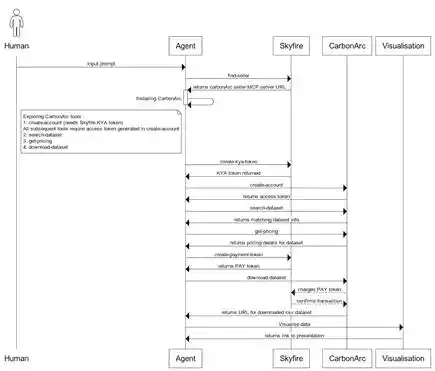
Skyfire's agent for Company A in a B2B scenario purchasing data services from Company B's Agent. Business Demo
As Agentic Commerce scales exponentially, the "core pain point" of the second-phase solutions—the dependence on traditional card networks—will become increasingly intolerable. Various limitations of adapting to the new agentic-native economy (B2B agentic, A2A) will be highlighted: a lack of programmable authorization systems (we've extensively discussed the importance of the authorization issue earlier), the challenge of building identity information robust enough and portable as an agentic ID, high transaction costs (especially for trillions of microtransactions), and slow cross-border settlements will become significant obstacles to the entire intelligent-body economic development. At that time, the market's focus will naturally shift towards alternative solutions more in tune with the machine-native economy. The infrastructure provided by Crypto—stablecoins, smart contracts, decentralized identities, verifiable credentials—will no longer be just a "better payment channel" but the only technology paradigm capable of providing the necessary "sovereignty" for a truly autonomous economic entity.
Disclaimer:
This article is for reference only. It represents the author's views and not those of OKX. The article does not intend to provide (i) investment advice or investment recommendations; (ii) an offer or solicitation to buy, sell, or hold digital assets; (iii) financial, accounting, legal, or tax advice. We do not guarantee the accuracy, completeness, or usefulness of this information. Holding digital assets (including stablecoins and NFTs) involves high risk and may experience significant volatility. You should carefully consider whether trading or holding digital assets is suitable for you based on your financial condition. For your specific situation, please consult your legal/tax/investment professionals. Please take responsibility for understanding and complying with local applicable laws and regulations.
This article is contributed content and does not represent the views of BlockBeats
Welcome to join the official BlockBeats community:
Telegram Subscription Group: https://t.me/theblockbeats
Telegram Discussion Group: https://t.me/BlockBeats_App
Official Twitter Account: https://twitter.com/BlockBeatsAsia

 Related Articles