GENIUS Act Turns Stablecoins into U.S. Treasurys 'On-Chain ATM'

Original Title: "Yang Ge Gary: GENIUS Bill and On-Chain Shadow Currency"
Original Author: Yang Ge Gary, Incubator Investor of CICADA
Written on May 26, 2025, in Washington
During the North American Crypto conferences around Q2 2025, on the 19th, the GENIUS Bill (Guidance and Establishment of the U.S. Stablecoin Nation Innovation Act) was approved in the U.S. Senate with 66 votes in favor and 32 against, as the push for it. In less than a week, various financial and Crypto institutions rapidly iterated with each other, as a friend put it, the entire market was in a frenzy.
The uniqueness of this bill lies in its significant impact on both global short-term and long-term financial economies. From shallow to deep, it will have many layers that stack up, much like a major earthquake close to the surface. If the GENIUS Bill is successfully implemented, it will cleverly resolve the impact of Crypto on the U.S. dollar and U.S. bonds' existing financial status and in turn link the dollar to Crypto Market value and liquidity growth, essentially utilizing the existing advantage of the dollar price anchor to transform it into the long-term advantage of a value anchor, aptly named Genius.
Combining the discussions from last week's New York conference, the following related issues were preliminarily summarized:
tl;dr
1. The fundamental reasons for the decline in traditional U.S. dollar dominance
2. Recognizing the trade-offs and regressive decisions under the trend of Crypto driving a drastic change in the global monetary system
3. The nominal and substantive purposes of the GENIUS Bill
4. DeFi Restaking insights for the fiat world and the currency multiplier of shadow currency
5. Gold, the U.S. Dollar, and Crypto Stablecoins
6. Global market feedback after the bill takes effect and the drastic changes in financial transactions and assets
1. The fundamental reasons for the decline in traditional U.S. dollar dominance
The decline in the global influence and control of the U.S. dollar has many dimensions, with the long-term background showing the depletion of various resource bonuses from the age of exploration to World War II. From a short-term perspective, the effectiveness of economic policy regulation is gradually diminishing. However, the main factors causing the current situation are mainly as follows:
i) The rapid rise of the global economy and national power, decreasing the necessity of using the U.S. dollar as the sole global trade and financial settlement currency. More countries and regions are establishing independent trade and currency settlement systems separate from the U.S. dollar;
ii) During COVID-19 (2020-2022), the U.S. has issued more than 44% of the total volume of dollars, with M2 growing from $15.2 trillion to $21.9 trillion (Federal data), leading to an irreversible process of declining dollar credibility after the pandemic;
iii) The Federal regulation of monetary and fiscal policies within the U.S. system has seen an increase in entropy, with severe capital efficiency and wealth distribution asymmetry, failing to adapt to the needs of the digital and AI new paradigm for driving economic growth;
iv) The decentralized cryptocurrency financial system has rapidly emerged, amplifying the above environmental background, disrupting the traditional financial economic system globally since the Bretton Woods system based on national credit.
It is worth mentioning that veteran financial entrepreneurs represented by Ray Dalio and some politicians have shown doctrinal inertia errors in understanding the Thucydides Trap when facing the above environment. Many people have believed over the past decade that the Thucydides Trap still exists or is about to occur between the U.S. and China, even using this topic as a lobbying or investment strategy basis. In fact, the issues faced by the U.S. and China are completely consistent and should be attributed to the same side of the Thucydides Trap, while the other side is the Crypto currency financial system and the production relations of decentralized governance in the cryptographic digital age. How to deal with this inevitable trend of transformation is the transitional issue that the new era paradigm upgrade of the Thucydides Trap should address. Obviously, this time the GENIUS Act gets the point.
2. Understanding the Trade-offs and Retreat-for-Advancement Decision in the Face of the Drastic Transformation Trend Driven by Crypto in the Global Monetary System
Based on the above, the essence of the GENIUS Act's decision is fundamentally a trade-off and a trade-off, a desperate move to retreat in order to advance: marking the start of the Federal acceptance of the reality of declining influence and control of the traditional dollar in the existing financial system, proactively further delegating the issuance and settlement rights of the dollar (Note: The majority of the offshore U.S. dollars in fiat currency itself come from the off-balance sheet credit expansion of offshore banks, belonging to shadow banking. The authenticity of issuance and settlement is controlled based on an access system and a compliance network and endorsed and redeemed by sovereign-level central banks), facing the inevitable trend of Crypto financial development head-on, taking a "take it or leave it" approach. Drawing on the advanced gameplay of DeFi Restaking combined with the offshore expansion of credit in the foreign bank system using the offshore U.S. dollar in the fiat currency, through encouraging compliant institutions to issue stablecoins to form a new "on-chain offshore structure" model of "on-chain shadow currency," further magnifying the monetary multiplier effect of the circulating layer of the dollar.
The following table compares the characteristics of the US Dollar and various types of Shadow Dollar at different levels and attributes:
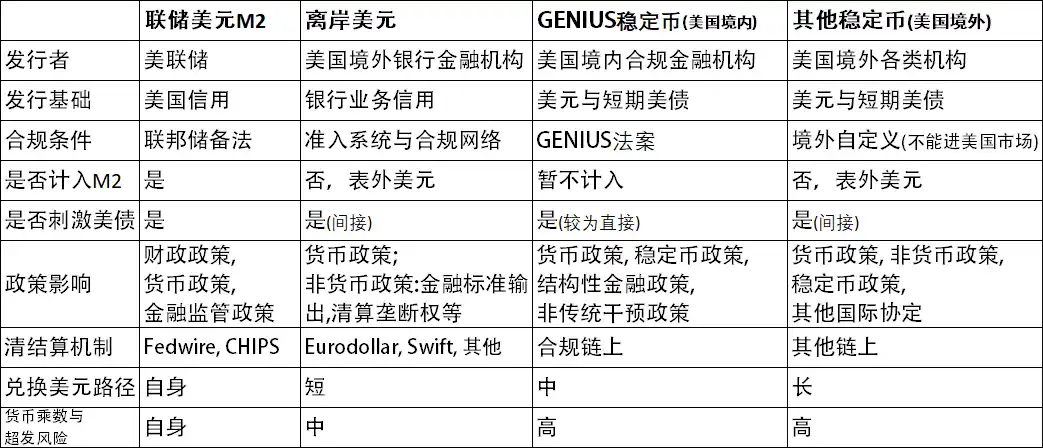
The decision and actions of the GENIUS Act will significantly help the US Dollar to effectively "re-anchor." This will not only restore confidence to US Treasury and US Dollar asset holders but also further enable off-balance-sheet US Dollar expansion through the growth of the Crypto Market, achieving a dual purpose of risk mitigation and rapid expansion.
3. Nominal Purpose and Substantive Purpose of the GENIUS Act
The nominal purpose and substantive purpose of the GENIUS Act are clearly different. Simply put: internally, it is named regulatory compliance, but externally, it is essentially a demonstration. It provides a policy template for financial regulatory authorities in other countries and regions globally, setting an example for enforcement for financial institutions in other countries and regions using the US market as a model, accelerating the global adoption of US Dollar-pegged stablecoins in the Crypto Market.
In the short term internally, the focus is on direct regulatory management to ensure stability during the rapid development of the Crypto Market that is challenging traditional financial markets, which is a routine operation of the US financial legal system. In the long term externally, this has achieved a significant demonstrative effect, maximizing the inherent advantage of the US Dollar as a price anchor in the traditional financial system. It cleverly addresses the pain point in the Crypto Market that, apart from the US Dollar, there is no other stablecoin price anchor. Through a semi-compliant, semi-open approach—specifically mentioning restrictions on foreign issuers in the Act: foreign stablecoin issuers not approved by US regulatory agencies are not allowed to operate in the US market, which is essentially a hint that they can operate in overseas markets—to stimulate and confirm global further reliance and use of US Dollar stablecoins in the Crypto Finance upgrading process.
On May 21, the Hong Kong Legislative Council passed the <Stablecoin Bill>. Soon, the Japan Financial Services Agency (JSA), the Monetary Authority of Singapore (MAS), and the Dubai Financial Services Authority (DFSA) are expected to respond with policies. Due to the particular importance of the stablecoin ecosystem and the rapid iterative changes triggered by the GENIUS Act, this poses a significant challenge to jurisdictions with pioneering legislation. It is crucial to strike a balance between boundaries and flexibility. Being too loose may lead to market chaos and management difficulties, while being too stringent may quickly lead to losing the competitive advantage in the next stage of finance, payments, and asset management in the face of the Crypto Market. Additionally, the quality of the regulations directly determines the extent of the peg to the US Dollar stablecoin in the next stage. An overly deep peg may rapidly compromise the financial market independence of the stablecoin itself (Note: Due to the globalization, high liquidity, and high interactivity of the Crypto Market, the independence of other fiat-pegged stablecoins compared to the US Dollar stablecoin may be more challenging to achieve, and the peg may become more rigid). Furthermore, the situation for jurisdictions with follow-up legislation will not be any better; they will also face a dilemma of market chaos due to rapid paradigm shifts and difficulties in governance, leading to conservatism and loss of competitiveness.
4. DeFi Restaking: Insights for the Fiat World and the Currency Multiplier of Shadow Money
A fund partner told me last week that the next stage of global finance faces a significant challenge and requires a dual understanding and crossover between traditional finance and crypto; otherwise, it will quickly be eliminated by the market. Indeed, in the development of DeFi over the past two cycles, the Crypto Market has independently evolved a digital, protocolized professional economic science system, surpassing the traditional financial system in protocol logic, Tokenomics, financial analysis methods and tools, and the complexity of business models. Although Crypto & DeFi is different from traditional finance, it still constantly needs the experiential system of traditional finance for calibration and comparison. The two learn from each other, develop rapidly, continuously couple, and form a new financial system.
The introduction of the GENIUS Act this time has a high degree of similarity with Staking, Restaking, and LSD in past cycles of DeFi, or it is another extension of the same methodology in the fiat world. In DeFi, for example, one can use ETH to obtain rebase stETH through Lido, stake stETH in AAVE to obtain 70% of the staked value in USDC, then use the obtained USDC to continue buying ETH in the market. The ideal model of this repeated operation is a geometric series loop with a q=0.7 multiplier, ultimately achieving a 3.3x currency multiplier.
Shortly after the GENIUS Act, the above process can be implemented based on fiat stablecoins: Suppose a Japanese financial institution outside the U.S. issues USDJ by pledging U.S. bonds based on compliance conditions, obtains JPY through an off-ramp and exchange, acquires USD through purchase of U.S. bonds to form a loop. In the repeated operation of this process, there are several assumed multipliers: first, the collateralization rate (which may be full, discounted, or over-collateralized); second, the on/off-ramp and exchange wear and tear; third, market loss rate. After calculating all of these, a single-loop geometric multiplier q is obtained, and ultimately, the currency multiplier 1/(1-q) is calculated. This multiplier represents the ideal condition of financial amplification of currency based on the GENIUS Act and subsequent stablecoin acts regarding the amount of USD and U.S. bond holdings.
Of course, this does not take into account the over-issuance by some non-standard institutions, as well as the other shadow assets obtained through further asset tokenization and re-staking after stablecoin asset injection. The flexibility of stablecoins will far exceed the derivatives market in the fiat world, and the "Stablecoin Asset Nesting" will undoubtedly bring unimaginable shocks to the traditional financial market.
5. Gold, US Dollar, and Crypto Stablecoins
In the earlier article "The Dramatic Changes in the Landscape After Trump's Victory," it was mentioned about the succession of faith in the anchor assets of the three generations of the financial system. The anchor assets of the three generations of finance are: Gold, US Dollar, and Bitcoin, from a macro perspective. However, from a micro perspective, each of the three financial generations needs a daily settlement unit that can be held in hand. In the past, it was a gold nugget, a US banknote. What will it be in the future?
It was mentioned earlier that in the Crypto Market, apart from the US Dollar (Stablecoin), there is no native cryptocurrency or asset that can serve as a pain point for stablecoin price anchoring. The reason is: pricing is crucial. In real-world transactions, for a commodity, a service, there needs to be a relatively stable amount to serve as an intuitive reference price. It cannot be a cup of coffee priced at 0.000038 BTC yesterday and 0.000032 BTC today. This would make consumers and traders lose their ability to judge value. The most important feature of a stablecoin is stability, helping consumers and traders understand value through pricing. Price stability acts as a dynamic regulator around price fluctuations to balance purchasing power and economic development.
Why the US Dollar (Stablecoin)?
First, the US Dollar has established relative universality in the fiat currency world. Second, it is difficult to redefine a better consensus. Of course, I have discussed this issue with several friends: a global currency stablecoin. Suppose its issuance is a more reasonable pricing mechanism based on the total historical GDP and annual GDP increment. Even if it has a more optimized economic and financial efficiency than the current US Dollar, it is also difficult to achieve consensus to replace the position of the US Dollar stablecoin in social development. This is like the invention of Esperanto 140 years ago, even if the algorithm has been maximally optimized, it is still challenging to replace the dominance advantage of English worldwide. Many countries with their native languages eventually chose English as their official language in later development, such as India, Singapore, the Philippines. Although they use English, the standards have long been independent of British English guidelines. It can be said that this "shadow English" operates entirely independently. The indirect influence control rights expanded through the issuance authority decentralization under the GENIUS Act for the US Dollar stablecoin after the GENIUS Act is very similar to this example of English.
The proposal of the GENIUS Act has hit the need at this historical turning point, utilizing the irreplaceability of the US Dollar's existing advantage as a global price anchor to convert it into the long-term advantage of a value anchor in the Future Crypto Market through the form of a US Dollar stablecoin, which is a clever innovative design that maximizes historical advantages to leverage future advantages. Fundamentally, the proposal of pledging the US Dollar and issuing US debt to create a US Dollar stablecoin is, in fact, a bold attempt to upgrade the US Dollar and US debt issuance into a second-level gold.
6. Global Market Response and Financial Asset Transformation After Implementation of the Bill
The full implementation of the GENIUS Act will take some time, as will stablecoin legislation in other countries and regions. Some markets have begun to respond in asset prices to early feedback driven by short-term sentiment.
In the short term, the introduction of stablecoin legislation will cause drastic changes in financial institution assets, RWA, and Crypto assets. Opportunities come with restructuring, chaos, and coexistence of development expectations. The adjustment uncertainty in traditional finance further increases, leading to a normal phenomenon of some asset price pullback. The confidence in the return to anchoring of U.S. Treasury Bonds will act as a reverse multiplier, supporting the current market. The advantage of open decisions will lead to a USD asset multiplier effect on Crypto growth, forming a second curve development specific to USD assets, offsetting some short-term restructuring panic with the expectation lead obtained, creating a rather complex superimposed environment.
From the perspective of the Crypto Market, this undoubtedly opens an excellent window for further asset management and financial innovation. RWAFi will have more landing channels and asset forms, benefiting all long-term established projects such as CICADA Finance that do Real Yield Asset Management, facilitating a rapid transition and development in the DeFi, PayFi, and RWAFi industries.
This article is contributed and does not represent the views of BlockBeats.
Welcome to join the official BlockBeats community:
Telegram Subscription Group: https://t.me/theblockbeats
Telegram Discussion Group: https://t.me/BlockBeats_App
Official Twitter Account: https://twitter.com/BlockBeatsAsia