Trump Cryptocurrency Dinner: Per-Person Cost Exceeds One Million Dollars, and 70% of Participants Are Not Even American?
Original Article Title: Trump's crypto dinner cost over $1 million per seat on average
Original Source: NBC News
Original Translation: Bitpush News
On Thursday, more than 200 wealthy, mostly anonymous crypto enthusiasts gathered in Washington to dine with U.S. President Donald Trump. According to data analysis from blockchain analytics company Nansen, the price of entry to this event was steep, with these "winners" spending anywhere from $55,000 to $37.7 million on Trump's official cryptocurrency token, $TRUMP.
The organizers of the dinner determined eligibility for a seat based on how much $TRUMP token a participant held at a specific point in time. Nansen found that these "winners" collectively spent $394 million on Trump's official cryptocurrency, despite some selling off part or all of their holdings after the competition concluded. Of course, there was a significant disparity in spending: the top seven spent over $10 million each, while the bottom 24 spent less than $100,000 each.
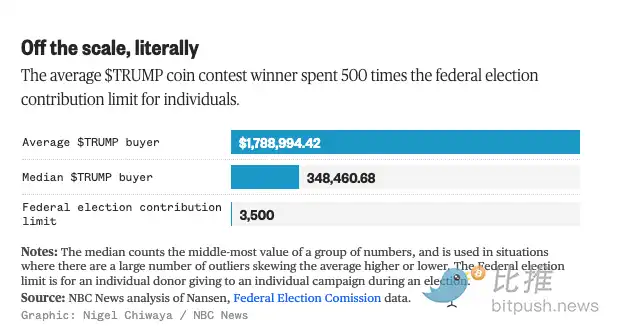
Research revealed that one-third (67 individuals) of the "winners" spent over $1 million, with an average spending per "winner" of $1,788,994.42.
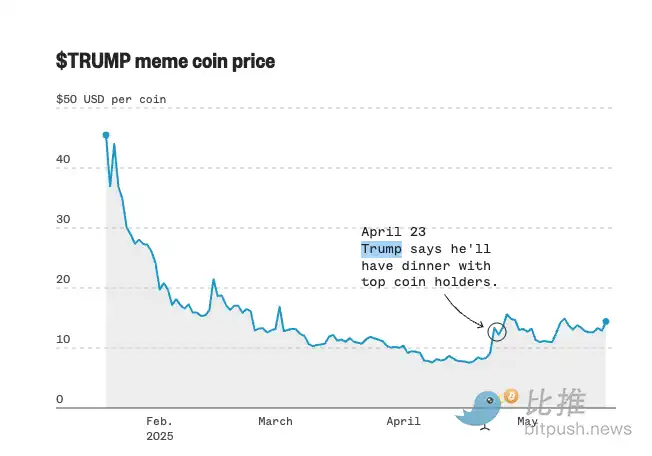
According to CoinMarketCap, which tracks cryptocurrency prices, the value of $TRUMP, like many meme coins, experienced substantial volatility. Nansen tracked how much each "bidder" spent when purchasing $TRUMP. These 220 buyers were invited to attend the dinner held at the Trump National Golf Club in Washington, D.C. While the competition website claimed that Trump "will attend the event as a guest and is not fundraising for this," it also noted that 80% of the $TRUMP token project is owned by two companies related to Trump—CIC Digital and Fight Fight Fight LLC.
This individual cryptocurrency and associated bidding event, which concluded last Monday, added to appearances of Trump leveraging his presidency for personal gain. His business interests are held in a trust fund controlled by his son, Donald Trump Jr., and he has intertwined many family businesses with his presidential activities, including hosting events at his social clubs (such as this cryptocurrency dinner) and making exclusive political statements on his social media app, Truth Social.
Trump's cryptocurrency also generated revenue for his affiliated companies through trading. Each $TRUMP token transaction incurs a transaction fee. Another cryptocurrency research firm, Chainalysis, estimates that in the first two days after the competition was announced, the $TRUMP token generated nearly $900,000 in transaction fees.
Dan Weiner, Director of the Election and Government Program at the Brennan Center for Justice, told NBC News that while most federal employees are legally prohibited from using their positions for financial gain, the president largely receives exemptions.
Dan Weiner stated: "The President is not subject to the broad conflict-of-interest prohibitions that apply to almost all other federal government employees." He said, "By and large, even by the standards of the first Trump administration, it's pretty crazy, with all sorts of people doing business at the President's hotel. This goes far beyond that now, but it doesn't necessarily mean he is breaking the law."
White House spokesperson Anna Kelly said in a statement: "The President is working hard to secure better deals for the American people, not for himself. President Trump acts only in the best interest of the American public—that's why, despite facing years of lies and false accusations from the fake news media about him and his businesses, the vast majority of the American public re-elected him to this position."
Even the lowest-spending winner, spent far more than the legal limit on direct donations by U.S. citizens to political candidates—$3,500.
This Tuesday, the top spender was revealed to be cryptocurrency entrepreneur Justin Sun, who had told Forbes in March that he had become a citizen of the Caribbean island nation of St. Kitts and Nevis. Justin Sun had been sued by the U.S. Securities and Exchange Commission (SEC), but this case was suspended during the Trump administration.
The identities of most other competition winners are still undisclosed, known only by their pseudonyms and cryptocurrency wallet addresses. However, according to independent cryptocurrency researcher Molly White's analysis, most participants appear to be foreign nationals. Molly White tracked the transactions of each winning wallet on different cryptocurrency exchanges and noted that the holders seemed to be using exchanges not allowed for use by U.S. citizens.
Molly White told NBC News, "Out of the 220 wallets associated with bid winners, 158 (72%) appear to be foreign wallets." An investigation by The New York Times reported that the winners' list included representatives from cryptocurrency companies in Singapore and Australia. Dan Weiner pointed out that the high proportion of non-U.S. citizens among bid winners is noteworthy because non-U.S. citizens are usually prohibited from donating to U.S. political candidates.
He said, "This is an incredibly stark contrast. We have very strict laws prohibiting foreign nationals from making campaign donations. So, the huge irony here is that many of the people buying this currency were not eligible to donate $100 to the presidential campaign in the first place. We have a series of laws designed to prevent exactly these kinds of things from happening, which are actually legitimate things that both parties agree should be avoided. However, this situation is unfolding."
Welcome to join the official BlockBeats community:
Telegram Subscription Group: https://t.me/theblockbeats
Telegram Discussion Group: https://t.me/BlockBeats_App
Official Twitter Account: https://twitter.com/BlockBeatsAsia