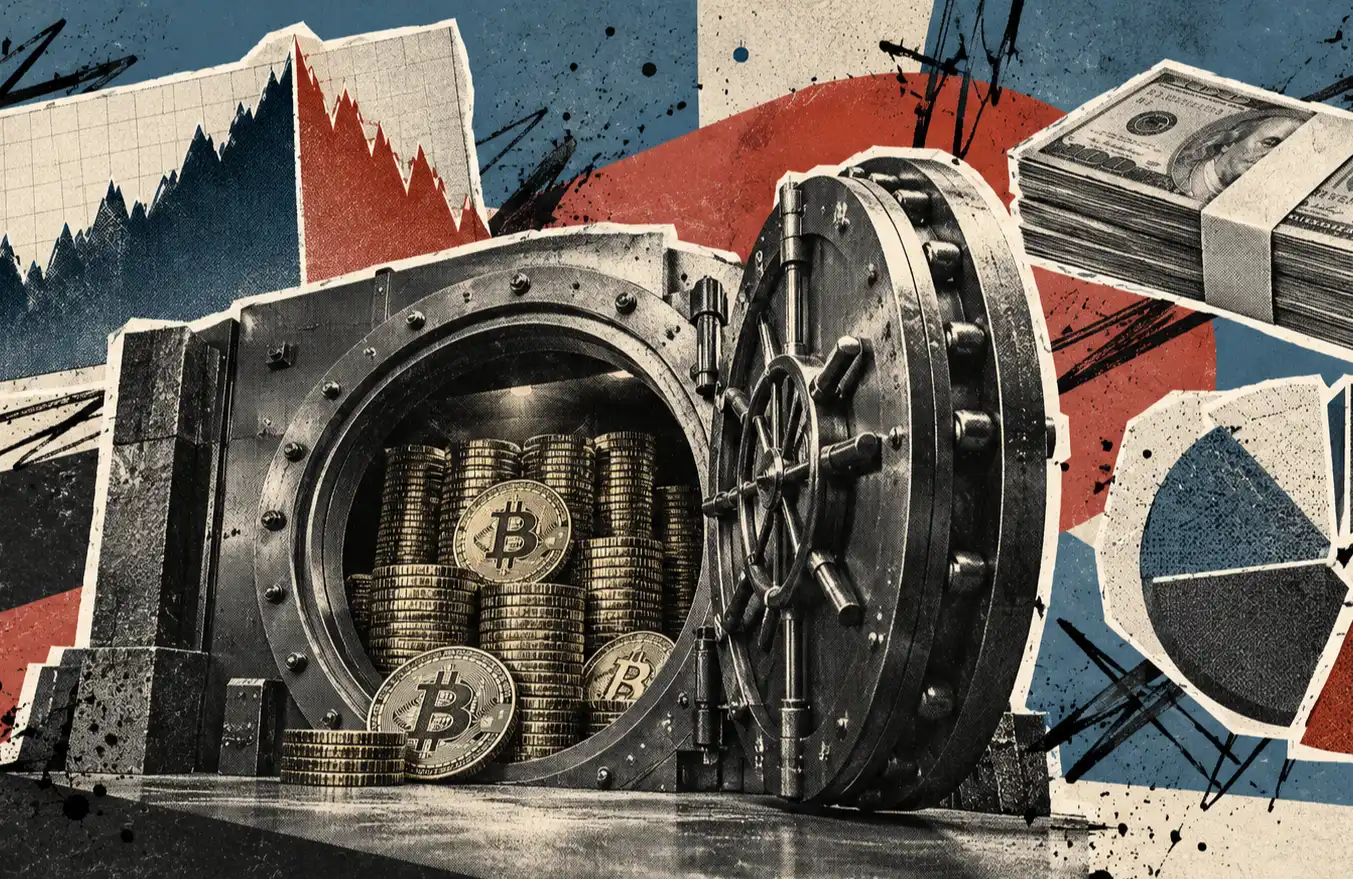
OKX Security Series | PoR Chapter: Code as Constraint, Breaking the Traditional Financial Black Box
Source: OKX

On March 12, 2023, Silicon Valley Bank, the 18th largest bank in the United States, suddenly went bankrupt, with over 95% of customer deposits not covered by insurance. However, just a week before the bankruptcy, its financial report still showed compliance with capital adequacy requirements. This crisis exposed the flaws in the traditional financial trust system—lagging regulation and opaque auditing. Meanwhile, OKX has pioneered a new path in the crypto industry: by utilizing Proof of Reserves (PoR), it has reconstructed the triple-bottom-line logic of financial security, enabling on-chain verifiability of asset ownership, mathematical proof of solvency, and real-time autonomous risk monitoring.
This is not only a technological innovation but also a revolutionary paradigm shift in financial power dynamics—from "institution-defined security" to "code-bound security," transforming users from "passive risk bearers" to "active security validators."
1. Asset Ownership: From "Custodial Trust" to "On-chain Control"
The core of the traditional financial system is trust in institutions. When users deposit money into a bank or brokerage, they hand over control to the institution. This behavior essentially relies on the trust that the institution will not misappropriate your assets, but this trust is not unfounded; it relies on the dual guarantees of national credit endorsement and regulatory framework.
When customers deposit currency into a bank account, they are legally considered creditors, and the bank effectively has the right to control these funds. Most of the funds in a bank account are lent by the bank to other banks or individuals, with the bank maintaining cash reserves according to the legally required reserve ratio to meet immediate withdrawal needs, known as the fractional reserve model. In addition, funds held in investment banks or brokerages are in separate accounts at trusted banks known as "segregated accounts."
However, fully entrusting asset ownership to institutions or intermediaries does not mean that users are free from the risk of asset loss. In fact, traditional finance also has its own risks of "going under!"
In the traditional financial system, institutions, to achieve profitability, may invest customer funds in long-term, high-risk assets. This model can trigger a chain reaction during market fluctuations: when assets significantly depreciate, institutional balance sheets shrink, market confidence collapses, leading to a liquidity crisis or even bankruptcy. For example, in 2023, Signature Bank faced regulatory takeover due to a run on its assets caused by overinvestment in crypto-related assets and long-term bonds, during drastic interest rate fluctuations. Despite all its indicators being "regulatorily compliant" before bankruptcy, the liquidity crisis was inevitable.
It is evident that traditional finance has always faced a fundamental contradiction between profit pursuit and user security assurance. Users can only choose to fully trust institutions' self-regulation and the multilayered regulatory system behind them (banks, insurance, government).
In contrast, the crypto industry is exploring another path: OKX pioneered the Proof of Reserves mechanism after the FTX scandal, verifying the adequacy, liquidity, and solvency of platform assets to global users through on-chain verifiable public records.
Public Holdings: Exchanges publicly disclose all cold/hot wallet addresses (e.g., OKX has opened asset queries for 22 currencies on the chain), allowing anyone to verify the 1:1 anchoring relationship between reserves and user liabilities.
Transparent Fund Flows: Most assets are stored in cold wallets, eliminating opaque and maturity mismatch operations and effectively preventing a run on the exchange.
Compliant crypto custodians do not misappropriate or re-lend users' crypto assets, usually maintaining a 1:1 full reserve. Unless authorized by the user, they will not lend out or invest user assets. At the same time, OKX has implemented a series of data protection and account security measures, truly achieving on-chain transparency of asset control.
II. Evolution of Financial Transparency Mechanism: From Financial Statement Audit to On-Chain Consensus
In the traditional system, the security and health of financial institutions rely entirely on regulatory requirements (such as regular financial statements) and external audits to ensure compliance. Banks or brokerages must strictly adhere to Generally Accepted Accounting Principles (GAAP/IFRS), regularly disclose audited financial statements by the "Big Four" accounting firms to ensure fair and accurate data. Regulatory bodies (such as the Fed, FDIC) then assess institutional risk through stress tests, on-site inspections, and monitoring liquidity metrics (such as Capital Adequacy Ratio (CAR), High-Quality Liquid Assets (HQLA)).
However, can financial statements and audits really guarantee absolute and true "security"? Where are the limitations of the traditional system?
Post-event audits and periodic disclosures: Users can only obtain data through lagging reports and cannot monitor asset conditions in real time. For example, Silicon Valley Bank met the capital adequacy ratio but still went bankrupt due to interest rate risk;
Opaque data: The book value of traditional finance may have unfair valuations, and the audit system also has flaws.
Liquidity risk: Structural issues such as maturity mismatches, over-leverage, can lead to a run or liquidity crisis (such as bank failures).
It is evident that there is still significant room for improvement in user rights protection and systemic risk prevention in the traditional financial system. Users need more than just numbers on a report and inaccurate data metrics; asset health needs a more transparent truth. The future of finance requires real-time data monitoring and high asset transparency, relying on technology and consensus to reconstruct financial power dynamics.
The Proof of Reserves (PoR) introduced by cryptocurrency exchanges is a way to break free from traditional limitations and build a security system that users can independently verify:
(1)On-chain Assetization
Public Transparency: Exchanges disclose cold/hot wallet addresses, and all reserve holdings are visible on-chain (OKX covers 22 assets).
Redeemability: Ensuring exchange reserves ≥ user assets, capable of handling extreme runs on the bank.
Self-Verification: Anyone can verify the adequacy of reserves, without relying on delayed audit reports, to prevent exchanges from misappropriating user funds or manipulating data.
(2)Liability Verification (Based on Zero-Knowledge Proof Technology)
zk-STARKs:
1. Aggregating user assets into a global liability sheet, ensuring data immutability.
2. Users can anonymously verify whether their assets are included in the liability sheet.
3. Preventing exchanges from overestimating or concealing debts (e.g., forging user numbers or asset scales).
Negative Balance Constraint:
1. Using mathematical constraints to ensure that user asset net worth is not negative, avoiding liquidation risks.
2. Preventing system-wide crises caused by high-leverage liquidations (similar to the Archegos high-leverage trading loss event of approximately $36 billion).
(3)Transparent Pricing of Digital Assets
1. Digital assets priced according to real-time market values to prevent discrepancies between book value and actual value.
2. Proof is the state, preventing issues with fuzzy estimation models and room for manipulation.

When the reserve of each token becomes a mathematically verifiable fact, financial security transitions from passive trust to active consensus.
III. Reconstruction of Trust: From "Centralized Trust Intermediary" to "User-Driven Verification"
With the application of Proof of Reserves (PoR), the focus of trust has shifted from reliance on institutions to emphasizing technology and mathematical proofs. Users no longer need to blindly trust an institution's security; instead, they can use verifiable data to gain risk transparency.
In the past, ordinary users were nearly impossible to independently verify the asset-liability situation of exchanges or banks. Traditional financial transaction records were only stored in institutional internal ledgers and regulated clearing systems, not made public. Data shared with the market is often processed and aggregated. Only authorized regulators and auditors can have a comprehensive view of a bank's transaction details and ledger data.
This semi-closed and semi-transparent financial data essentially undermines the user's right to risk awareness. While protecting trade secrets, it limits systemic risk monitoring capability to a few institutions, preventing users from penetrating to validate the institution's true risk exposure. When a crisis erupts, users are often the last to know and become the risk bearers.

Trust in traditional finance is built on audit reports and regulatory documents, while the crypto industry is restructuring the security paradigm through cryptographic proof and on-chain verifiability. The Proof of Reserves (PoR) mechanism has established a complete trust structure—on-chain verifiable assets, publicly visible wallet addresses, and user-verifiable, constituting a new paradigm of asset security in the crypto era. The industry standard has upgraded from a "trust model" to a "verification model."
PoR serves as OKX's real-time asset security dashboard and is a proof of the exchange's solvency. Users do not need to rely on third-party audits; they can penetrate to verify asset security through OKX's provided self-verification tool. In addition, OKX's PoR full code has passed third-party audits and is fully open source. User confidence in fund security is built on verifiable facts, providing not only a sense of user participation and trust but also ongoing supervision of the OKX platform.
Conclusion:
The vulnerabilities exposed by the traditional financial system are not simply technical flaws but systematic limitations of a centralized trust model—when asset security relies on institutional self-restraint and regulatory ex post intervention, users are essentially at the end of the risk transmission chain.
Crypto exchanges are using technology to establish structural security safeguards: fundamental unification of asset control, solvency transparency, and risk manageability. In a blockchain-transparent ledger and user-verifiable trading platform, trust no longer comes from institutional credit endorsement and regulation but from technology and consensus. Users are not only participants but also co-builders of the risk control system.
At OKX, security is not a percentage figure in an audit report but a verification right that every user can exercise. We believe that true financial security is "visible with your own eyes and verifiable with your own hands"!
Disclaimer
The information provided in this article is for reference only and should not be construed as (i) investment advice, trading advice, or investment recommendations; (ii) an offer or solicitation to buy or sell digital assets; or (iii) financial, accounting, legal, or tax advice. We do not guarantee the accuracy, completeness, or usefulness of such information. Digital assets (including stablecoins and NFTs) involve high risks and may depreciate or become worthless. Digital assets are not insured. Past performance is not indicative of future results. You should carefully consider whether trading or holding digital assets is suitable for you based on your financial situation, investment objectives, experience level, and risk tolerance. For your specific circumstances, please consult your legal, tax, and investment professionals. You are solely responsible for understanding and complying with local applicable laws and regulations.
This article is a contributed piece and does not represent the views of BlockBeats.
Welcome to join the official BlockBeats community:
Telegram Subscription Group: https://t.me/theblockbeats
Telegram Discussion Group: https://t.me/BlockBeats_App
Official Twitter Account: https://twitter.com/BlockBeatsAsia

 Related Articles