Fighting phishing: Understand the four risky transaction blocking functions of OKX Web3 wallet in one article
Scam Sniffer released a 2024 mid-year phishing report showing that in the first half of 2024 alone, 260,000 victims lost $314 million on the EVM chain, of which 20 lost more than $1 million per person. Sadly, another victim lost $11 million, becoming the second largest theft victim in history.
According to the summary of the report, most ERC20 token thefts currently stem from signing phishing signatures, such as Permit, IncreaseAllowance, and Uniswap Permit2. Most of the large thefts involved Staking, Restaking, Aave mortgages, and Pendle tokens. Victims were mostly directed to phishing websites through phishing comments impersonating Twitter accounts.
Phishing attacks are undoubtedly still the hardest hit area for on-chain security issues.
As an entry-level product that meets the basic transaction needs of users, OKX Web3 Wallet insists on focusing on strengthening security measures and user education. At the product level, the team has recently upgraded the risk transaction interception function mainly around high-frequency phishing scenarios, and stated that it will continue to increase the identification of more risk scenarios to prompt users.
This article aims to explain the scenarios in which the four major risk transaction interception functions newly upgraded by OKX Web3 Wallet are applicable, and at the same time popularize the operating principles of some stolen cases, hoping to be helpful to you.
1. Malicious authorization to EOA account
On June 26, a user signed multiple phishing signatures on a fake Blast phishing website and lost $217,000; on July 3, ZachXBT reported that address 0xD7b2 had become a victim of Fake_Phishing 187019 phishing, resulting in the loss of 6 BAYC NFTs and 40 Beans (worth more than $1 million); on July 24, a Pendle user had PENDLEPT re-pledged tokens worth about $4.69 million stolen due to multiple Permit phishing signatures 1 hour ago.
In the past two months, there have been many incidents and single amounts of losses caused by various types of signature phishing, which is already an important scenario where security issues frequently occur. Most of the scenarios are to induce users to authorize hackers' EOA accounts.
Malicious authorization to an EOA account generally refers to hackers inducing users to authorize through various welfare activities, and authorizing their user addresses to the signature of an EOA address.
EOA stands for Externally Owned Accounts, which is also translated as "external account". It is an account type on the Ethereum-based blockchain network. Unlike another account type on Ethereum, the Contract Account, EOA is owned by the user and is not controlled by the smart contract. When players surf on the chain, they generally authorize the smart contract account of the project party rather than the EOA account owned by the individual.
Currently, there are three most common authorization methods: Approve is a common authorization method that exists in the ERC-20 token standard. It authorizes a third party (such as a smart contract) to spend a certain number of tokens in the name of the token holder. Users need to authorize a certain number of tokens for a smart contract in advance, and then the contract can call the transferFrom function at any time to transfer these tokens. If the user accidentally authorizes a malicious contract, these authorized tokens may be transferred immediately. It is worth noting that the authorization traces of Approve can be seen in the victim's wallet address.
Permit is an extended authorization method introduced based on the ERC-20 standard, which authorizes third parties to spend tokens through message signatures instead of directly calling smart contracts. In simple terms, users can approve others to transfer their tokens by signing. Hackers can use this method to attack. For example, they can set up a phishing website and replace the button for logging into the wallet with Permit, so as to easily obtain the user's signature.
Permit2 is not a standard function of ERC-20, but a feature introduced by Uniswap for user convenience. This feature allows Uniswap users to pay only one Gas fee during use. However, it should be noted that if you have used Uniswap and you have authorized an unlimited amount to the contract, you may become a target of Permit2 phishing attacks.
Permit and Permit2 are offline signature methods. The victim’s wallet address does not need to pay Gas. The phisher’s wallet address will provide authorization for on-chain operations. Therefore, the authorization traces of these two signatures can only be seen in the phisher’s wallet address. Now Permit and Permit2 signature phishing has become a disaster area in the field of Web3 asset security.
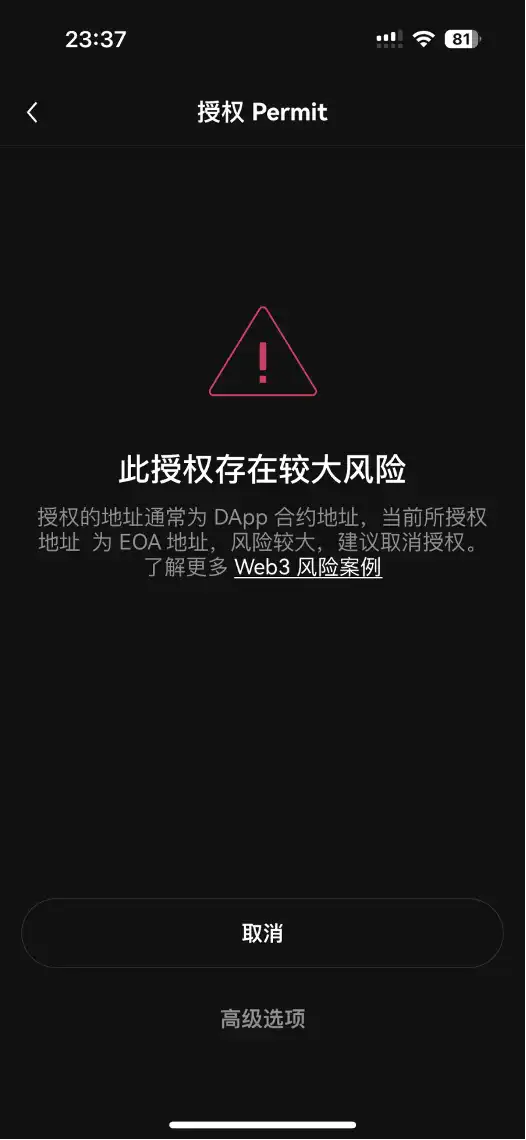
In this scenario, how does the OKX Web3 wallet interception function work?
OKX Web3 wallet will perform pre-analysis on the transaction to be signed. If the analysis finds that the transaction is an authorized behavior and the authorized address is an EOA address, it will alert the user to prevent the user from being phished and causing asset losses.
2. Malicious change of account owner
Malicious changes to account owner usually occur on public chains such as TRON and Solana, where the underlying mechanism is designed with account owner. Once a user signs, he will lose control of the account.
Take TRON wallet as an example. TRON's multi-signature permission system has designed three different permissions: Owner, Witness and Active. Each permission has specific functions and uses.
Owner permission has the highest permission to execute all contracts and operations; only with this permission can other permissions be modified, including adding or removing other signers; after creating a new account, the account itself has this permission by default.
The Witness permission is mainly related to Super Representatives. Accounts with this permission can participate in the election and voting of Super Representatives and manage operations related to Super Representatives.
The Active permission is used for daily operations, such as transferring and calling smart contracts. This permission can be set and modified by the Owner permission. It is often assigned to accounts that need to perform specific tasks. It is a collection of several authorized operations (such as TRX transfers and pledged assets).
One situation is that after a hacker obtains a user's private key/mnemonic, if the user does not use the multi-signature mechanism (that is, the wallet account is controlled by only one user), the hacker can authorize the Owner/Active permission to his own address or transfer the user's Owner/Active permission to himself. This operation is usually called malicious multi-signature.
If the user's Owner/Active permission is not removed, the hacker uses the multi-signature mechanism to jointly control the account ownership with the user. At this time, the user has both the private key/mnemonic and Owner/Active permissions, but cannot transfer his own assets. When the user initiates a request to transfer assets, both the user and the hacker's address need to sign in order to execute the transaction normally.
Another situation is that the hacker uses TRON's permission management design mechanism to directly transfer the user's Owner/Active permissions to the hacker's address, causing the user to lose Owner/Active permissions.
The results of the above two situations are the same. Regardless of whether the user still has Owner/Active permissions, he will lose actual control of the account. The hacker address obtains the highest permission of the account, and can change account permissions, transfer assets, and other operations.
In this scenario, how does the OKX Web3 wallet interception function work?
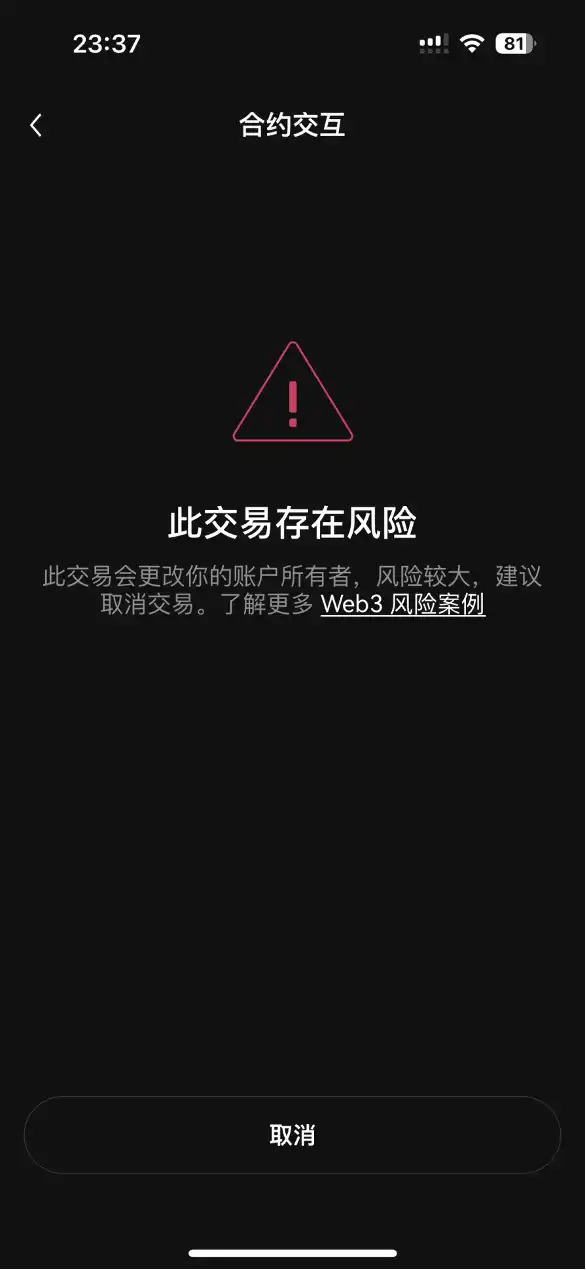
The OKX Web3 wallet performs a pre-analysis of the pending transaction. If the analysis finds that there is a change in account permissions in the transaction, it will directly intercept the transaction for the user, preventing the user from further signing from the root, causing asset loss.
Since this risk is very high, the current OKX Web3 wallet directly intercepts and does not allow users to conduct further transactions.
3. Malicious change of transfer address
The risk of maliciously changing the transfer address mainly occurs when the DApp contract design is not perfect.
On March 5, @CyversAlerts detected that the address starting with 0xae7ab received 4 stETH from EigenLayer, with a contract value of 14,199.57 US dollars, which was suspected to be a phishing attack. At the same time, he pointed out that many victims have signed the "queueWithdrawal" phishing transaction on the mainnet.
Angel Drainer targeted the nature of Ethereum staking. The approval of the transaction is different from the conventional ERC20 "approval" method. It specifically wrote an exploit for the queueWithdrawal (0xf123991e) function of the EigenLayer Strategy Manager contract. The core of the attack is that the user who signed the "queueWithdrawal" transaction actually approved the malicious "withdrawer" to withdraw the wallet's staking rewards from the EigenLayer protocol to the address of the attacker's choice. Simply put, once you approve the transaction on the phishing page, the rewards you staked in EigenLayer will belong to the attacker.
In order to make it more difficult to detect malicious attacks, the attacker used the "CREATE2" mechanism to approve these withdrawals to empty addresses. Since this is a new approval method, most security providers or internal security tools do not parse and verify this approval type, so in most cases it is marked as a benign transaction.
Not only this case, this year, some mainstream public chain ecosystems have seen some poorly designed contract vulnerabilities that have caused some users' transfer addresses to be maliciously changed, resulting in financial losses.
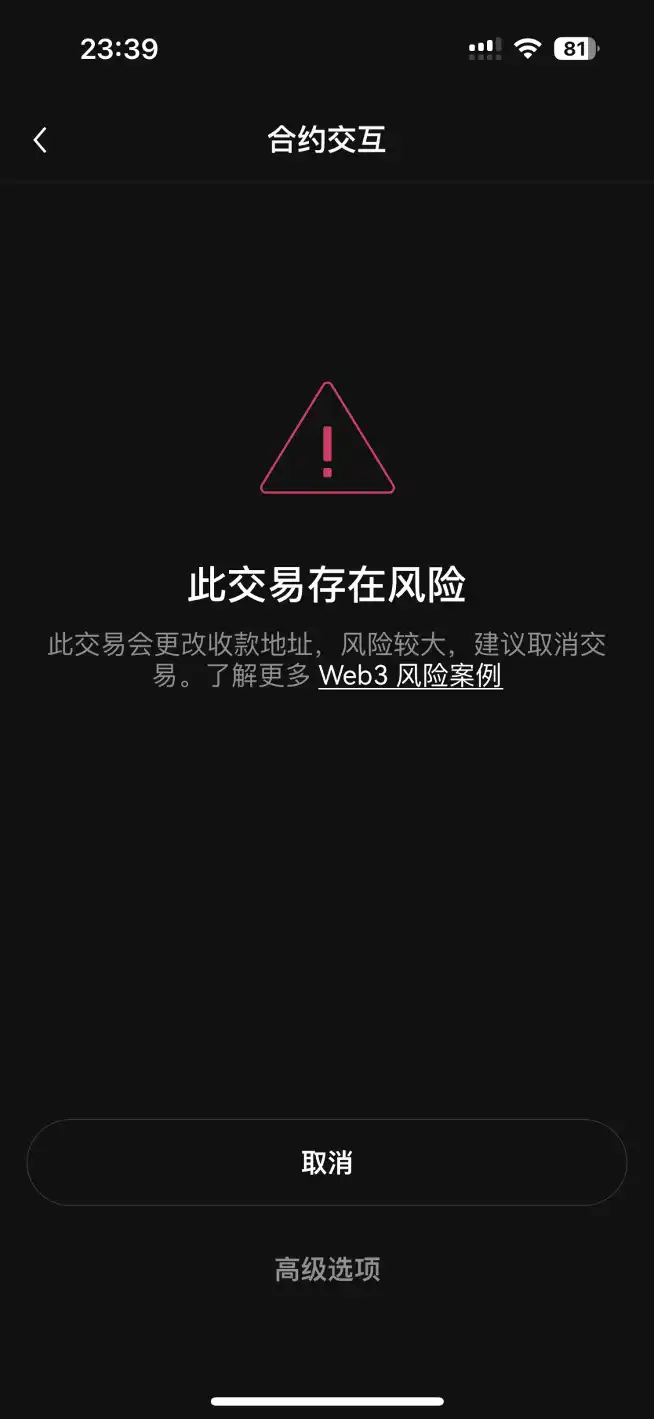
In this scenario, how does the OKX Web3 wallet interception function work?
For the phishing attack scenario of EigenLayer, OKX Web3 wallet will parse the relevant transactions of "queueWithdrawal". If it is found that the user is trading on an unofficial website and withdrawing money to an address other than the user's own, the user will be warned and forced to confirm further to prevent phishing attacks.
4. Transfers to similar addresses
The attack method of similar address transfers deceives the victim into using a fake address that is very similar to their real address, so that the funds are transferred to the attacker's account. These attacks are usually accompanied by complex obfuscation and concealment techniques. The attacker uses multiple wallets and cross-chain transfers to increase the difficulty of tracking.
On May 3, a giant whale encountered a phishing attack with the same first and last address, and was lured away with 1,155 WBTC, worth about 70 million US dollars.
The logic of this attack is that the hacker generates a large number of phishing addresses in batches in advance. After the batch program is distributed and deployed, the hacker launches a phishing attack with the same first and last digits to the target transfer address according to the dynamics of the users on the chain. In this incident, the hacker used an address whose first 4 digits and last 6 digits after removing 0x are the same as the victim's target transfer address. After the user transferred the money, the hacker immediately used the phishing address that was collided (about 3 minutes later) to follow a transaction (the phishing address transferred 0 ETH to the user's address), so that the phishing address appeared in the user's transaction record.
Since the user is used to copying the latest transfer information from the wallet history record, after seeing this trailing phishing transaction, he did not carefully check whether the address he copied was correct, and as a result, 1,155 WBTC were mistakenly transferred to the phishing address.
In this scenario, how does the OKX Web3 wallet interception function work?
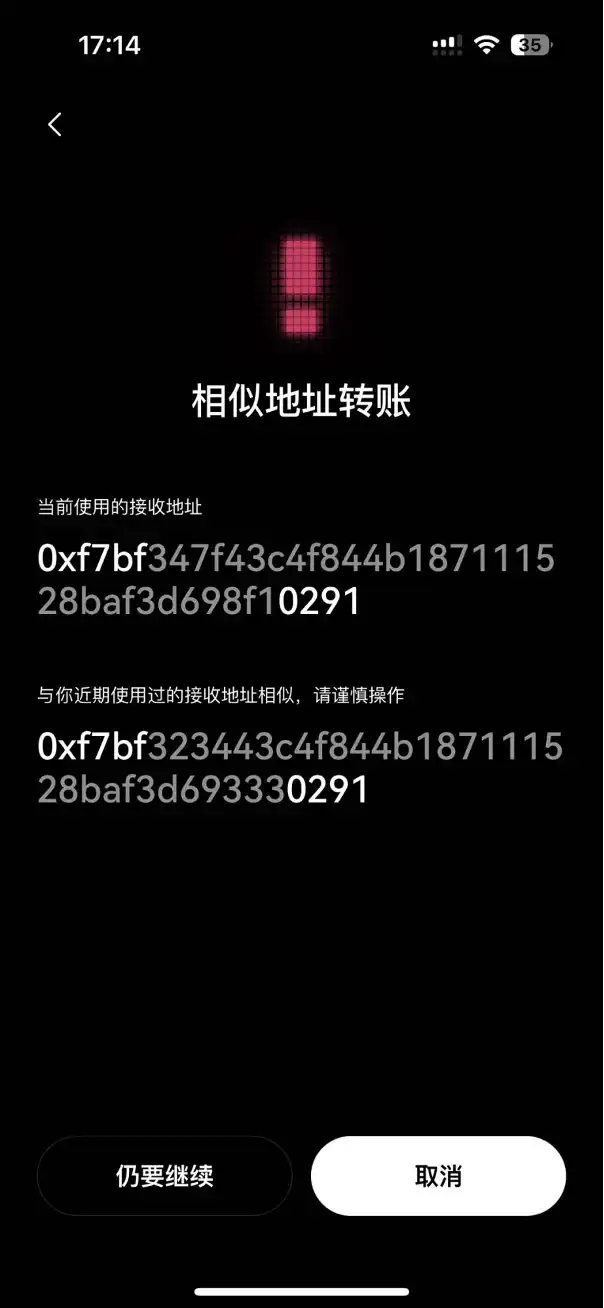
OKX Web3 wallet continuously monitors transactions on the chain. If it finds that a suspicious transaction not triggered by the user occurs on the chain shortly after a large transaction occurs, and the interacting party of the suspicious transaction is extremely similar to the interacting party of the large transaction, the interacting party of the suspicious transaction will be determined to be a similar address.
If the user subsequently interacts with a similar address, OKX Web3 will intercept and remind you; at the same time, on the transaction history page, transactions related to similar addresses will be directly marked to prevent users from being induced to paste and cause asset losses. (Currently supports 8 chains)
Conclusion
In general, in the first half of 2024, security incidents such as airdrop phishing emails and hacking of official project accounts are still frequent. While users enjoy the benefits brought by these airdrops and activities, they are also facing unprecedented security risks. Hackers use means such as phishing emails disguised as official ones and fake addresses to trick users into leaking private keys or making malicious transfers. In addition, some official project accounts have also been hacked, resulting in user fund losses. For ordinary users, in such an environment, the most important thing is to raise awareness of prevention and learn security knowledge in depth. At the same time, try to choose a platform with reliable risk control.
Risk Warning and Disclaimer
This article is for reference only. This article only represents the author's views and does not represent the position of OKX. This article does not intend to provide (i) investment advice or investment recommendations; (ii) offers or solicitations to buy, sell or hold digital assets; (iii) financial, accounting, legal or tax advice. We do not guarantee the accuracy, completeness or usefulness of such information. Holding digital assets (including stablecoins and NFTs) involves high risks and may fluctuate significantly. You should carefully consider whether trading or holding digital assets is suitable for you based on your financial situation. Please consult your legal/tax/investment professional for your specific situation. Please be responsible for understanding and complying with local applicable laws and regulations.
Welcome to join the official BlockBeats community:
Telegram Subscription Group: https://t.me/theblockbeats
Telegram Discussion Group: https://t.me/BlockBeats_App
Official Twitter Account: https://twitter.com/BlockBeatsAsia
 Related Articles