An In-Depth Look at the OP Superchain Popular Project Mode Network
Original Title: "In-Depth Analysis of the OP Superchain Popular Project Mode Network"
Original Authors: Linke, Biteye
01 Introduction
Mode Network is a modular Layer2 based on the OP Stack focusing on the Defi track, adopting the Optimism Bedrock upgrade, with fees reduced by over 95% compared to the Ethereum mainnet.
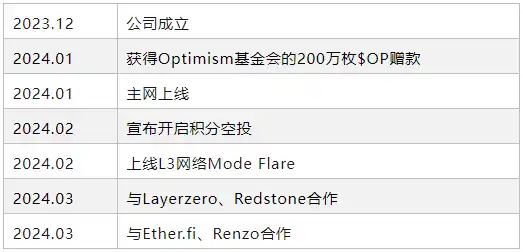
The project received a $5.3 million donation from the Optimism Foundation in January 2024 (distributed in the form of OP tokens), and Mode will also donate a portion of sequencer revenue to the Optimism Collective. Mode maintains a good relationship with the Optimism Foundation, which is beneficial to the project's development.
02 Current Development
Steady Growth, Leading TVL
Mode launched its mainnet on January 31, 2024, and began a token airdrop in February.
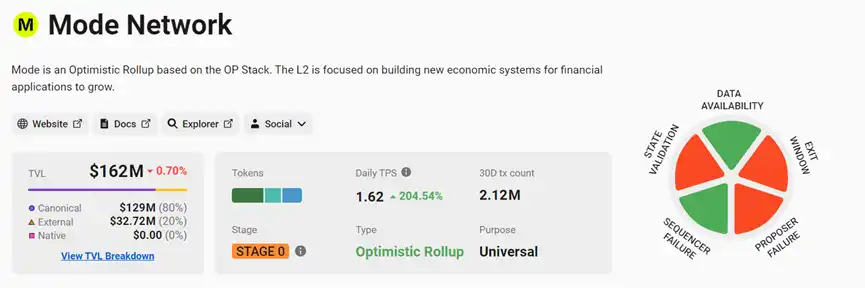
Since the mainnet launch, the TVL has been steadily increasing. As of March 19, 2024, Mode ranks 13th in TVL among all Layer2 networks, with a TVL of $162 million, a daily average TPS of 1.62, a GAS median of 0.001Gwei (equivalent to less than $0.01 in actual cost), and a total of 2.12 million transactions in the past thirty days.
Airdrop in Progress, Interaction Guide
The total token supply of Mode is 10 billion, with 5.5% allocated for airdrops, and the specific tokenomics are yet to be released.
Mode started the token airdrop in February, with the coin distribution expected in April. Users will accumulate points to receive airdropped tokens. By participating now, users can earn rewards in less than a month.
Currently, there are three ways to earn points:
· Old User Reward: Web3 old users will receive initial points based on their original blockchain interaction records when connecting wallets. Activating these points is possible by cross-chaining some assets (no amount requirements);
· User Referral Reward: Users can receive their exclusive invitation code after activating points, and the referrer will receive a 16% points reward from the invitee;
· Ecosystem Interaction Reward: Interaction with Mode ecosystem applications can also earn points, with different types of projects receiving different points rewards.
For developers, Mode implements:
· Sorter Income Reward
· Developer Airdrop Reward
· Optimism RPG Funding Reward
The developer-specific airdrop reward consists of 500 million tokens, accounting for 5% of the total token supply. The developer airdrop is unrelated to most users and therefore will not be elaborated on.
Specific User Interaction Process:
1. Visit the airdrop event page (https://ref.mode.network/MDCKN9), check the initial points, and if no points are visible, it will display "INELIGIBLE TO CLAIM," indicating the user is in an IP-restricted state and needs to switch IP addresses.
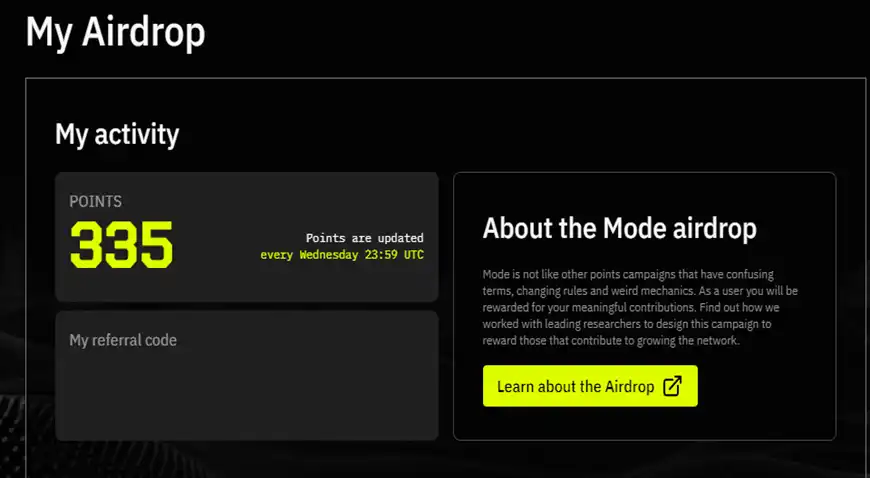
2. Asset Bridging: Users need to bridge assets from other networks to activate points, requiring ETH for the airdrop event gas fee. Asset bridging can be done using the official bridge or a third-party bridge. Utilizing the official bridge only allows asset bridging from the mainnet, incurring higher gas fees and a seven-day asset withdrawal waiting period. Alternatively, users can opt for third-party cross-chain bridges such as MiniBridge (https://minibridge.chaineye.tools/) to bridge assets from other Layer 2 networks to Mode, incurring lower bridging fees.
Community admins suggest using the official bridge at least once. It is recommended to use the official bridge first before utilizing third-party bridges.

3. Application Interaction: Users can interact with applications on Mode to earn points. Different applications offer varying points rewards. Additionally, Mode has partnered with the lrt projects ether.fi and renzo. lrt projects have a considerable TVL, ample funds, and are beneficial for increasing Layer 2 TVL.
Implementing the "kill two birds with one stone" strategy, users can bridge weETH and ezETH tokens to Mode to simultaneously earn staking rewards, Eigenlayer points, lrt protocol points, and Mode points, enhancing capital utilization.
03 Project Multi-dimensional Analysis
Team Background

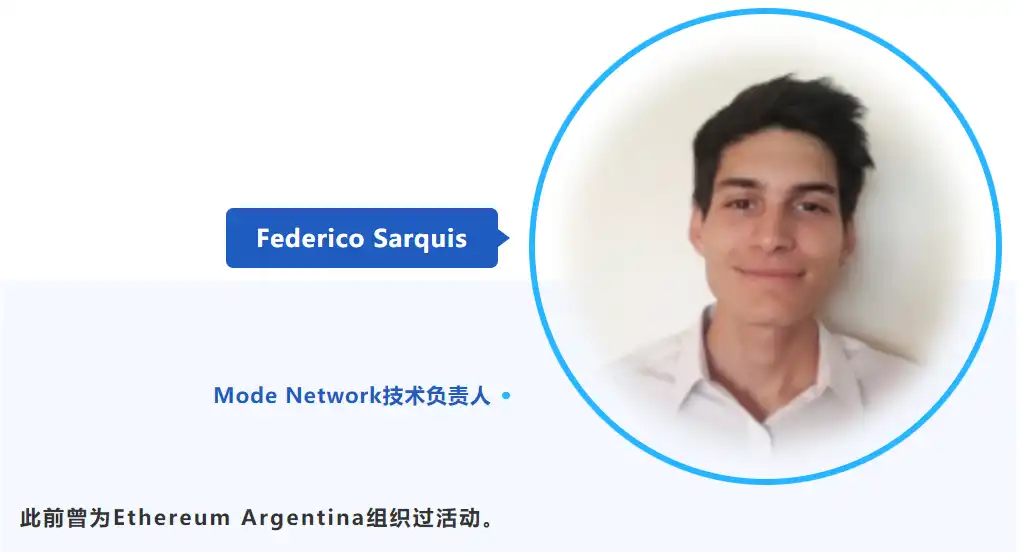
On the team side, Mode's LinkedIn page has a total of 15 employees, but the number of core team members is not large. From the employees' locations, they may be adopting a remote work approach. Founder James Ross has the ability to invest in eigenlayer and ethena, indicating that he has a good industry network.
Technical Aspect
Mode is a modular Layer2 network based on the OP Stack. It has launched the Layer3 network Mode Flare supported by Optimism and Celestia, suitable for developing on-chain games and trading platforms. From a technical perspective, in addition to the "modular" concept, you also need to understand OP Stack and Mode Flare.
1. Modular Blockchain
A modular blockchain focuses on handling a limited set of tasks and outsources the rest to one or more independent layers of the blockchain.
The goal of modularity is to address the blockchain trilemma, namely security, decentralization, and scalability. This theory was proposed by Ethereum's founder Vitalik and is considered one of the standards for evaluating public chain projects.
We can see that the three most well-known projects in the public chain race, Bitcoin, Ethereum, and Solana, have different emphases in the blockchain trilemma. Bitcoin has the strongest security and decentralization in the blockchain industry, but almost 0 scalability. Solana definitely has the lowest security and decentralization, but it has the best scalability.
Modularity mainly involves assigning responsibilities for the consensus layer, execution layer, and data availability layer to different chains. For example, settling on Ethereum, using Celestia for data availability, and executing on Solana using SVM. Through layered dissociation, different requirements can be implemented on different blockchains to minimize the impact of the "blockchain trilemma."
Modular Layer2 solutions like Mantle, Eclipse, Boba Network, etc., have some gaps from the top projects of Layer2, but they have gained some new development opportunities through modularity.
It can be said that modularity is one of the key narratives of this bull market cycle.
2. Op Stacks
A Stack service introduced by Layer2 pioneering project Optimism, Op Stacks have been adopted by many prominent projects, such as Layer2 Base developed by Coinbase, Debank Chain developed by asset management app Debank, and Farcaster Stack developed by social media flagship protocol Farcaster. Op Stack has found applications in multiple project domains, aligning with the original Op Superchain vision when Op Stack was initially unveiled.
The Op Superchain refers to a network of disparate Layer2s forming a cohesive ecosystem where all Layer2s share security, a communication layer, and an open-source technology Stack. These chains must adhere to specific standards to enhance inter-chain operability. Layer2 projects utilizing Op Stack services are often considered part of the Op Superchain.
According to L2beat data, as of March 10, 2024, the top five Layer2 projects by TVL are Arbitrum, OP Mainnet, Blast, Manta Pacific, and Starknet, with Optimism ranking 29th in cryptocurrency market cap and Arbitrum ranking 47th. The TVL rankings do not correspond with token market cap rankings, primarily due to many projects adopting Optimism's Stack service while Arbitrum has not, illustrating the narrative value brought by Stack services. Therefore, joining the Op Superchain should be beneficial for project development in the current landscape.
3. Mode Flare
A Layer3 network supported by Optimism and Celestia, Mode Flare is designed for developers to deploy application-specific chains, boasting high throughput, rapid deployment, EVM compatibility, and a flexible tech stack, with transaction fees below $0.005. Three projects are currently gearing up to launch on Mode Flare, namely:
1) DEDPRZ, a cryptocurrency casino built using the $USA token and DEDPRZ NFTs
2) Liq Market, a decentralized derivatives exchange
3) Macaw, a prediction market for betting on political events or current affairs news
Previously, some Layer2 projects have launched Layer3 projects, such as Xai by Arbitrum. These Layer3 projects are mainly designed for lower gas fees and higher throughput, targeting highly interactive gaming applications. Their application value is somewhat inferior to Layer2, but their scalability is not low as a development direction.
Mode Ecosystem
Next, let's take a look at some of the ecosystem projects that Mode has already launched.
Ether.fi is a liquidity re-collateralization protocol in the Eigenlayer ecosystem based on the Ethereum mainnet. It allows users to re-collateralize ETH or other liquidity-rebased tokens to generate lrt tokens and receive eETH at a 1:1 ratio.
Ether.fi is a leading protocol in the liquidity re-collateralization track with a TVL of $26.7 billion. It has raised a total of $32.3 million in two rounds of financing, with investors including CoinFund, North Island Ventures, OKX Ventures, among others.
Renzo is a liquidity re-collateralization protocol in the Eigenlayer ecosystem based on the Ethereum mainnet. Users can re-collateralize ETH or other liquidity-rebased tokens to generate lrt tokens and receive ezETH at a 1:1 ratio. Renzo ranks third in the liquidity re-collateralization track, with Ether.fi in first place and Puffer Finance in second, with a TVL of $9.9 billion. It raised $3.2 million in a seed round, with investments from Binance Labs, OKX Ventures, IOSG Ventures, Robot Ventures, and other well-known institutions.
Kim Exchange is Mode's native decentralized exchange, community-driven, providing a customizable protocol, and offering users greater incentives through Mode's sequencer fee-sharing mechanism. The TVL is $6.45 million.
IONIC is a lending protocol on Mode, supported by Metacartel Ventures, Ohm, and Mode. Ionic aims to provide the best rates on Mode and has designed a targeted economic model to balance the interests of both borrowers and lenders, with a TVL of $61 million. The founder is Henri Mahal, with investment from MetaCartel Ventures.
Mode Name Service is a domain service provided by Space ID, with the domain format being .MODE. As of March 10, 2024, a total of 75.7k domains have been registered, with 70.3k total holders.
LogX is a perpetual contract exchange that transacts using Bitcoin and Ethereum, designed as a large aggregator to aggregate liquidity from different chains. Users do not need to manage Gas fee tokens or perform multiple transactions for each operation, with a TVL of $11.21 million.
Poolshark is a decentralized protocol for targeted liquidity that has launched on Mode, Arbitrum, and Scroll's Layer2, enabling liquidity providers to create only-sell positions through targeted liquidity. Poolshark can provide limit order trading for professional traders on dex, with a TVL of $595k.
Layerbank is a full-chain lending protocol that ventures into multiple areas such as LSD, RWA, and LRT. It has currently launched on various Layer2s like Manta, Bsquared, Mode, Linea, and Scroll, with a total value locked of $414 million, where Mode's TVL is $10.11 million.
Overall, Mode's ecosystem is primarily composed of Defi projects, relatively emphasizing interoperability. Mode is currently working on collaborating with liquidity re-staking projects, benefiting both parties – Mode can gain more users and funds, and the tokens of liquidity re-staking projects will have more utility.
04 Modular Layer2 Competitive Landscape
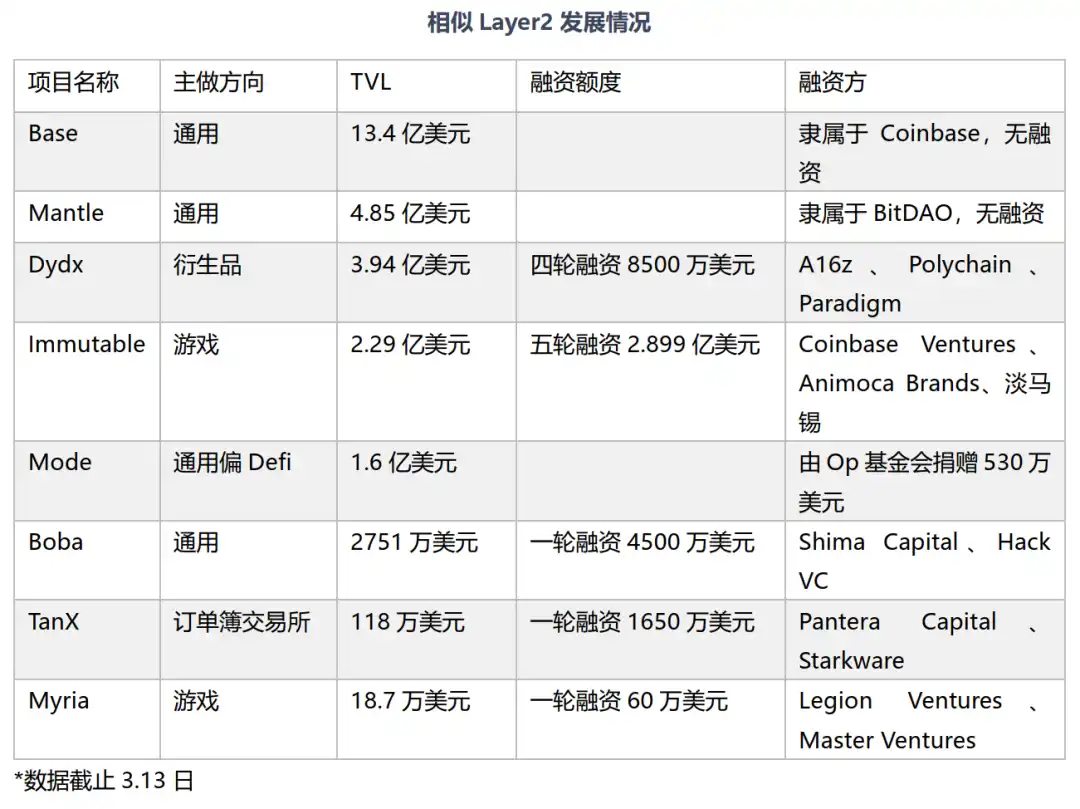
Mode is a modular Layer2 utilizing Op Stack services, hence selecting other projects adopting Stack services or modular Layer2 as comparative objects.
05 Conclusion
Mode is a modular Layer2 project using Op Stack and focusing on the Defi track. The Op Superchain created by Op Stack has attracted many well-known projects, facilitating user attraction to grow the ecosystem. Moreover, modularity is one of the key narratives of this bull market cycle. The enhancement of public chain performance cannot solely rely on a single public chain. Through modularity, it is advantageous to leverage the strengths of various public chains, and hence modular leading projects have shown impressive performances.
Overall, Mode aligns well with the current development path of Layer 2, and its project achievements are promising. In terms of the competitive landscape, Mode has also performed relatively well among similar projects, aiming to become the DeFi Hub of the OP Super Chain. Its future development is worth noting.
References:
[1] "New Modular Public Chain Mode Point Activity Participation Tutorial"
https://mirror.xyz/0x30bF18409211FB048b8Abf44c27052c93cF329F2/gGTssu0OL9PNCDKxp_erSH7OuIlpXyTKvYbEEzG1rX4
[2] "Binance Research Report: OP Stack Ecology and Innovation"
https://www.theblockbeats.info/news/45691?search=1
Original Article Link
Welcome to join the official BlockBeats community:
Telegram Subscription Group: https://t.me/theblockbeats
Telegram Discussion Group: https://t.me/BlockBeats_App
Official Twitter Account: https://twitter.com/BlockBeatsAsia

 Related Articles