The halving is bullish, but betting on BTC is no longer good?
Original Title: Bitcoin halvings may be bullish—but returns have shrunk every cycle
Original Author: David Canellis
Original Translation: Mary Liu, BitpushNews
The current rise of Bitcoin is the combination of two bullish narratives: within less than eight weeks, the halving will reduce the newly added supply by half, while the speed of spot ETFs accumulating Bitcoin has been faster than the mining speed.
除了现货 ETF 的新需求之外,减半通常被视为比特币价格大幅上涨的催化剂。
Apart from the new demand for spot ETFs, halving is usually seen as a catalyst for a significant increase in Bitcoin prices.However, in the past two cycles, the biggest beneficiary has been cryptocurrencies, not Bitcoin. Starting from the year before each halving, the peak rise of Bitcoin has been:
· In the year 2012, growth increased by 50,000% six months after halving.
· In the year and a half since the halving in 2016, it has grown by 8,500%.
· 2020 halving, 1.5 years later, increased by 1,000%.
For those with mathematical thinking, an interesting discovery is that the increase in Bitcoin after being halved is approximately the previous cycle's number divided by 6 to 8 (50,000%/8,500%; 8,500%/1,000%). If history repeats itself, then the peak increase of Bitcoin this time will be less than 170% - and currently, it has already realized most of the gains.
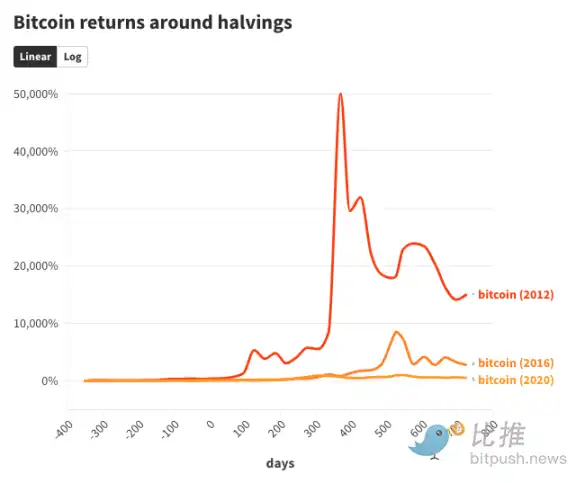
Considering that the market value of Bitcoin has exceeded $1 trillion, all of this is understandable. The price of Bitcoin cannot rise 500 times in two years like it did in 2012, when its market value was less than $200 million.
Bitcoin (BTC) currently accounts for about half of the entire cryptocurrency market, but there are tens of thousands of other cryptocurrencies, which tend to "ride the wave" when Bitcoin rebounds the most vigorously.
In fact, tokens other than Bitcoin always gain more profits from the Bitcoin bull market. In the year before the 2016 halving, the total value of cryptocurrencies excluding Bitcoin was $64.9 million.
One year after the halving event, during the peak of the bull market in 2017-2018, this number increased by over 6,000 times to reach $421 billion, mainly due to the rise of XRP, Ethereum, and Bitcoin Cash.
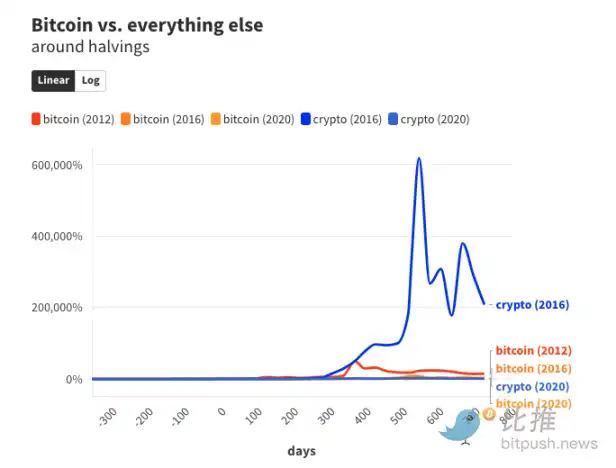
Similarly, in the previous cycle of cryptocurrency (2019 to 2021), cryptocurrencies other than Bitcoin had a valuation of $71.6 billion in the year before the 2020 halving.
One and a half years later, when Bitcoin approached its historical high, the value of all other cryptocurrencies was $1.7 trillion - an increase of over 2,000%, exceeding Bitcoin's growth rate of 1,000%.
Four-year cycle is not unique to Bitcoin
This article reiterates that the sample size of three halvings is too small to draw any meaningful analysis.
Such a small sample size means that factors beyond halving may also play a role in forming the seemingly regular four-year market cycle of Bitcoin.
Global liquidity cycle tracks the amount of cash flowing in the global economy, and its correlation with the rise of Bitcoin may be even closer than halving.
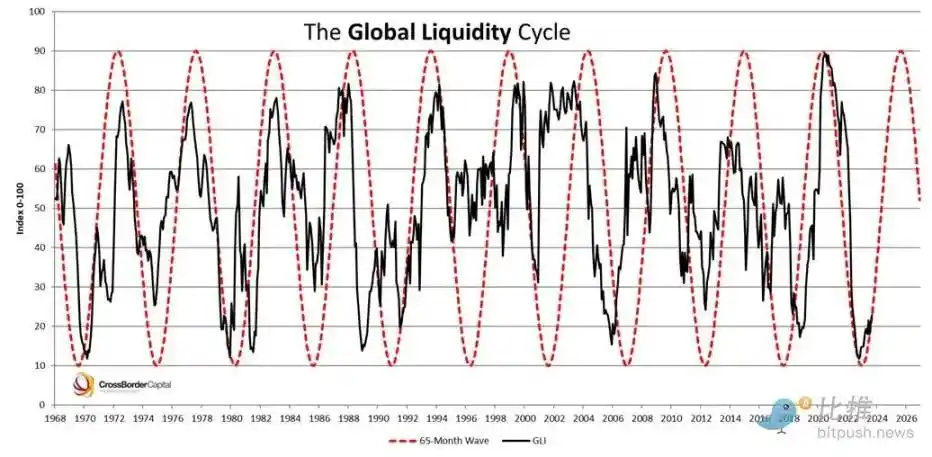
It has been proven that global liquidity also operates in cycles of four years.
Like halving, proving that the explosive growth of Bitcoin due to the global liquidity wave is actually unscientific, which is likely to be a mixed effect of the two: as global liquidity deepens and supply decreases, it spills over into speculative asset categories such as cryptocurrencies, thereby boosting demand.
Excluding the day of net outflow of spot ETF last week, the average daily purchase of Bitcoin by US physically-backed funds was nearly 6,350 BTC (362 million USD).
Bitcoin miners mine an average of 147 blocks per day, each of which earns a reward of 6.25 BTC (US$356,600). This is the way new coins are distributed on the network.
Therefore, the miners extract less than 920 bitcoins (worth $52.5 million) from the blockchain every day. Bitcoin funds, led by BlackRock, Fidelity, and Ark/21Shares, have purchased nearly six times the amount of funds.
Many aspects of the Bitcoin market exceed the supply of Bitcoin. This year, an average of about 35,000 BTC (2 billion USD) flows into cryptocurrency exchanges every day, indicating potential Bitcoin sales that are 37 times higher than the daily mining volume.
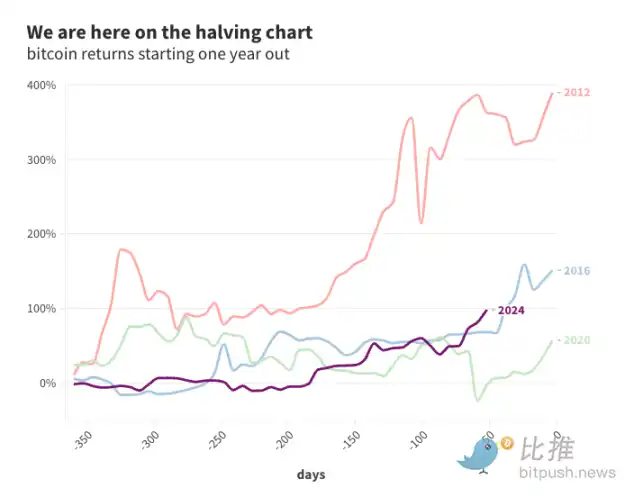
Even considering the recent price increase of Bitcoin, assuming there is enough supply to meet demand and only a small portion of Bitcoin miners sent to exchanges are eventually sold, the price will not immediately skyrocket.
Despite this, as the halving approaches - expected on April 19th or 20th - it's easy to see how they've captured the imagination of the entire market. Cryptocurrency native companies such as Bitwise, Bitfinex, and CoinShares have already attempted to unveil their mysterious veil, as have financial institutions such as JPMorgan and Standard Chartered Bank.
On a practical level, the Bitcoin halving will fundamentally and completely change the economics of Bitcoin mining. CoinShares predicts that if Bitcoin does not stay above $40,000 (so far, the situation is good), several major operators will be in trouble.
Standard Chartered Bank has become known in recent years for its bold cryptocurrency price predictions. At the same time, the bank is still maintaining its goal of reaching a price of $100,000 per cryptocurrency by the end of this year, in part due to the potential impact of halving on supply and demand.
Welcome to join the official BlockBeats community:
Telegram Subscription Group: https://t.me/theblockbeats
Telegram Discussion Group: https://t.me/BlockBeats_App
Official Twitter Account: https://twitter.com/BlockBeatsAsia

 Related Articles