Detailed explanation of the background, ecology and future prospects of the DA track. Who will be the final king?
Original Title: "Huobi Research | Who is the final champion of the DA track? Background, ecology and future prospects of Data Availability War"
Source: Huobi Research
Overview:
On the market, DA (Data Availability) projects have sprung up like mushrooms, among which competitive projects include Celestia, EigenLayer, Avail, NearDA, and Covalent.
According to the analysis of Huobi Research Institute, the DA (Data Availability) of the core content is not that difficult. The simplest single machine can do DA, and the most complex one, such as Celestia, uses a sampling mode for decentralization. Simply put, DA is storage, which is also very expensive. If you don't strictly require Ethereum-level security services, choosing which DA to use is a balance between cost and security.
The most important principle of using the DA layer is: the more valuable the service, the more secure the DA should be.
This research report by Huobi Research analyzes the background, ecosystem, and future prospects of the Data Availability War, including an inventory and review of various DA projects in V God's eyes. Based on a comprehensive analysis of the DA track, Huobi Research believes that future DAs may be decentralized, and that 7-8 major DAs may be sufficient for the future market.
1. Data Availability
1.1 What is DA
In simple terms, data availability refers to the act of block producers publishing all transaction data of a block to the network, so that validators can download it. If a block producer publishes complete data and makes it available for download by validators, we say that the data is available. If it withholds some data, making it impossible for validators to download complete data, we say that the data is unavailable.
1.2 Two Key Points of DA Issues: Security and Cost
Therefore, combining with the definition of DA, we can see that DA includes the following two aspects:
One is to ensure the security of the verification mechanism, and the other is to reduce the cost of publishing data.
○ Issues related to ensuring the security of verification mechanisms.
In order to ensure the security of verification, current L2 sequencers generally publish both the state data and transaction data of L2 on the more secure Ethereum network, relying on Ethereum for settlement and data availability.
Therefore, the data availability layer is actually the place where L2 publishes transaction data. Currently, most mainstream L2s use Ethereum as the data availability layer.
○ Reducing the cost of publishing data.
L2 simply moves data availability and settlement onto Ethereum, which comes with significant security but also significant costs. This is also the second challenge that L2 faces, which is how to reduce the cost of publishing data.
2. Cost Structure in DA & Directions for Cost Reduction and Efficiency Improvement
From the introduction in Chapter 1, we can see that an important issue that DA focuses on is how to reduce costs.
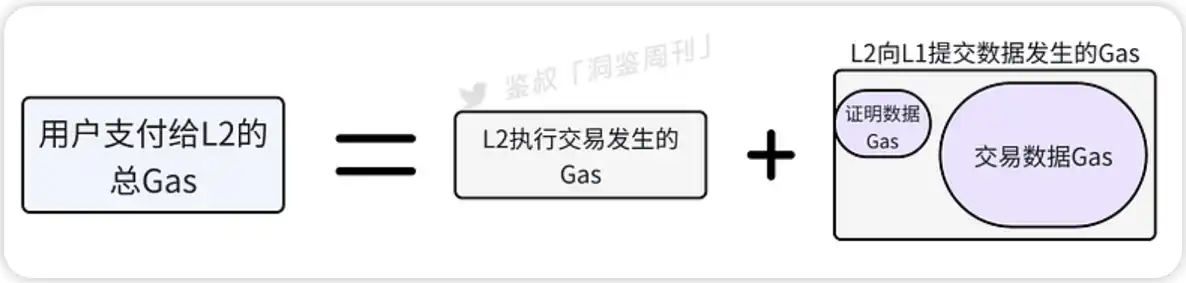
To make L2 more affordable overall, the cost of publishing data must be reduced. So, how can costs be lowered? There are two main methods:
○ Reduce the cost of publishing data on L1, such as the upcoming EIP-4844 upgrade on Ethereum.
○ Following Rollup, the execution of transactions is separated from L1, and data availability can also be separated from L1 to reduce costs, which means not using Ethereum as the data availability layer.
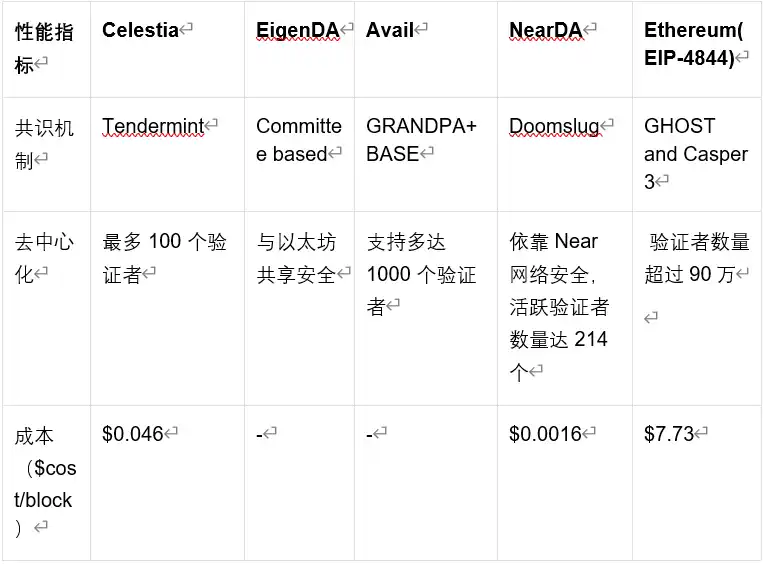
Therefore, all parties have made a lot of efforts to reduce costs. From the current DA schemes, Near DA has the lowest cost, at approximately $0.0016/block. The next lowest cost options include Celestia, EngenLayer, EIP4844, and so on.

3. V's perspective on DA
3.1 Non-DA solutions are not true Layer2 without Ethereum Foundation and Vitalik Buterin's first counterattack
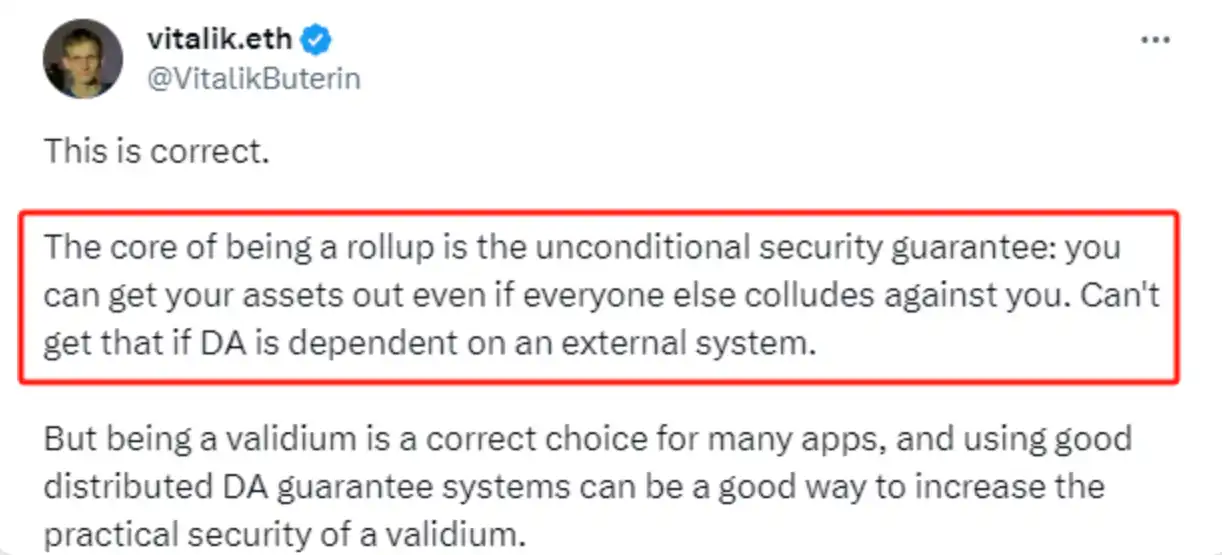
After the Celestia incident, Vitalik Buterin hinted that "Ethereum's layer2 projects must use data availability on ETH." Subsequently, Dankrad Feist, a member of the Ethereum Foundation, also made a statement. He pointed out that those who do not use ETH as the data availability layer for Rollup or Ethereum Layer2 are not truly Rollup or Ethereum Layer2.
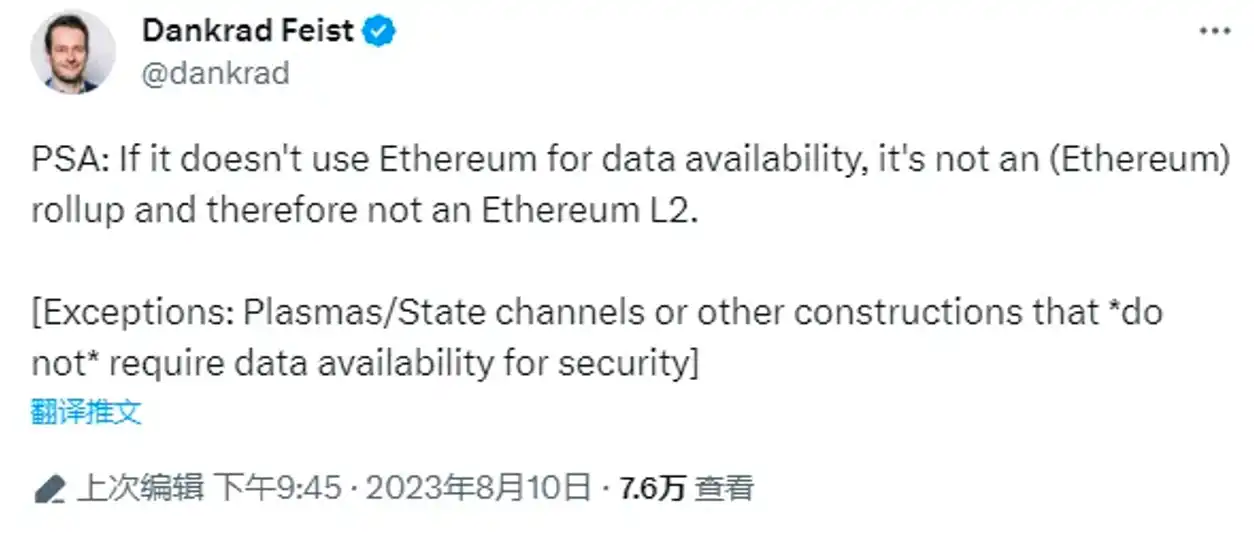
In this case, both Arbitrum Nova and Mantle will be "delisted" from the Layer2 list because they only disclose transaction data outside of ETH (on a off-chain DA network called DAC).
Meanwhile, Dankrad also stated that solutions like Plasmas and state channels, which do not require on-chain data availability to ensure security, are still considered Layer2, but Validium (ZKRollup without using ETH as the DA layer) is not considered Layer2.
3.2 Use non-Ethereum as DA, then it is Ethereum Validium--V God's compromise
Later, V God replied in his Twitter stream, stating that "being a validium is a correct choice for many apps, and using good distributed DA guarantee systems can be a good way to increase the practical security of a validium".


4.2 Celestia
4.3 EigenDA

• Development Potential
○ Backed by the diverse ecosystem of Eigenlayer, including sorters, cross-chain bridges, oracles, and more.
4.4 Other DA Projects
4.4.1 Avail
Avail can efficiently sort and record transactions, provide storage for data and verify data feasibility. It supports a blockchain compatible with the Ethereum Virtual Machine (EVM) and allows Rollup to publish data directly to Avail. Its lightweight client network verification mechanism (described below) allows Rollups on Avail to verify state without relying on smart contracts and underlying layers. Additionally, due to its modular nature, developers can store data on Avail and choose other networks for settlement.
• Decentralization:
○ Avail uses Polkadot's nomination proof of stake (NPoS), supporting up to 1000 validation nodes. NPoS also has effective reward distribution to reduce the risk of equity centralization.
○ Avail has the ability to sample data from its lightweight client's P2P network, providing Avail with an efficient and reliable backup mechanism that ensures data availability even in the event of failures.
• Validity proof: Avail uses KZG polynomial commitment.
Current situation: The mainnet has not yet been launched.
4.4.2 Near DA
• Cost advantage: 100kB calldata on NEAR costs $0.0033.
• Current situation: NEAR DA has integrated with Polygon CDK for developers to build Ethereum ZK Rollups.
4.4.3 Covalent
The blockchain data query service platform Covalent can standardize data from multiple blockchains, and its unified API allows developers to reuse queries in supported networks, solving the problem of difficult access to blockchain data.
After the upgrade of Cancun, the Ethereum mainnet will only keep the state data submitted by L2 for one month, and then discard it. Celestia also periodically discards the state data submitted by L2 to maintain the decentralization of the network and the establishment of the DAS light node mechanism. However, Covalent launched the long-term DA service EWM (Ethereum Time Machine) at the end of last year, which permanently saves the L2 state data discarded by Ethereum. Covalent is responsible for reading L2 state data.
Moreover, Covalent will index and structure this data, integrating it into its on-chain data API service, providing services and support for professional blockchain data websites, government regulatory agencies, and artificial intelligence research teams.
• Current situation: As of December 2023, Covalent supports over 210 blockchains and plans to support over 1000 blockchains by the end of 2024. According to a recent Covalent data availability report released by Messari, Covalent has billions of data points and is currently the most suitable service provider for applications that require universal and widely applicable data.
4.4.4 zkPorter
zkPorter is a chain-offline data availability solution for decentralized optimization launched by the Ethereum expansion plan zkSync. It uses a hybrid method combining zkRollup and sharding ideas to process data availability. zkPorter introduces an optional validator mechanism, where zkSync token holders can stake tokens to verify and sign blocks. Although zkPorter's product progress has not been disclosed to the outside world for a long time, it is speculated that zkPorter may be launched before the Layer3 application chain GRVT on zkSync goes live on the mainnet in Q1 of this year, based on the fact that GRVT plans to store data on zkPorter.
4.5 DA Project Comparison
Technical aspect:

Performance:
Summary
• The competitive projects among the above DA projects are Celestia, EigenLayer, Avail, and NearDA, while Covalent takes a unique approach and opens up unique demand for it in DA applications.
• Among all the solutions for data availability, data availability sampling combined with KZG polynomial commitment is the most popular solution, which can reduce node costs, improve proof efficiency, and ensure data availability.
• From a technical perspective, Ethereum's Danksharding and Celestia are the most decentralized because they both use sampling techniques, which reduces the performance requirements of nodes while achieving high bandwidth. EigenDA is second, also using sampling, but EigenDA is parasitic on Ethereum, with its node count being a subset of Ethereum. Other DA projects are unlikely to use sampling, such as NearDA, which has a decentralization level similar to that of the Near Protocol.
• The landing threshold of Celestia's selected Optimistic Proof is lower compared to KZG polynomial commitment, with higher technological maturity. However, its future technological limit is not as good as KZG polynomial commitment. Compared with similar projects such as Avail and EigenDA, Celestia's development progress is currently faster and will be one step ahead in landing on the mainnet. However, Celestia will also face direct competition from Ethereum after the Cancun upgrade.
• As a Layer2 developer, the only tradeoff in front of us is the tradeoff between DA orthodoxy and chain development cost. DA orthodoxy is relatively passive in the commercial market, and it is suitable for comprehensive Layer2 projects that are more concerned about security consensus issues, have certain brand background and market foundation. However, some new and small Layer2 chains, especially those based on OP Stack for one-click chain development, will try their best to squeeze costs to the lowest. For them, third-party DAs like Celestitia are a better choice. However, Eigenlayer still cannot reduce the actual development cost of L2 for project parties.
• However, for DA layer projects, their scenarios are single and in the B2B mode. These projects cannot attract a large amount of liquidity by relying on ToC scenarios to attract DAPPs like a comprehensive public chain (such as Solana). If they cannot successfully attract the adoption of many Rollup projects, their ecological construction will weaken. Moreover, Celestia seems to lack a very strong capital promoter. Although its technical narrative itself makes sense, if it cannot take root well in the Ethereum ecosystem, its grand blueprint may become a castle in the air.
5. DA Layer and Modularization of Blockchain
DA layer has always existed, whether it's BTC, ETH, or Solana. For example, in the Bitcoin network, data is directly stored on the block. 15 years ago, Satoshi Nakamoto published the Bitcoin whitepaper and limited the block size to 1MB, which limited the amount of transaction data that could be accommodated in each block. Later, SegWit, Taproot, and Ordinal protocols were introduced to enhance the data availability of the BTC network to some extent.
And in the Ethereum network of Pre-4844, data transmitted from Layer2 to Layer1 is stored in Calldata. Although Rollup moves the secure computation to L2, storage still remains in L1. Due to the limited storage capacity of L1, it restricts the capacity of Rollup on Ethereum. The Ethereum Blocksize is about 150K - 250K, even if all the space is used for Rollup, the storage space is still limited, which limits the throughput of L2. Therefore, Ethereum adopts Proto-Danksharding to enhance data availability by introducing new transaction types containing Blobs.
Therefore, it can be said that the DA layer is a layer abstracted from the development and evolution of blockchain technology, similar to the refinement of social division of labor in the process of human development, which is accompanied by the expansion demand of various blockchains and the higher requirement for data availability. Modular blockchain, on the other hand, decouples a functional layer from a single blockchain and outsources it to other blockchain networks for responsibility, thus further achieving division of labor and improving efficiency.

Welcome to join the official BlockBeats community:
Telegram Subscription Group: https://t.me/theblockbeats
Telegram Discussion Group: https://t.me/BlockBeats_App
Official Twitter Account: https://twitter.com/BlockBeatsAsia