What happens when Uniswap turns on the fee switch? [翻译]:
Original author: Ben Giove
Translated by: LlamaC
Did you know that Uniswap has no profit in terms of technology?
This is impossible? Calculated by fees, it is the largest application on Ethereum, bringing in millions of dollars in revenue for liquidity providers every day.
From CryptoFees' graph
However, the profit margin is 0% because the Uniswap fee switch has not been turned on.
This may ultimately change!
After months of debate, a recent governance proposal seems to finally open the profit faucet - only for three liquidity pools.
What happens when Uniswap does this?
Will they lose market share to their competitor DEX? How much profit will they gain? What if they switch to turning on the fee switch for each pool?
This article answers all of these questions for us today.
So far, one of the most obvious examples of a disconnect between protocol success and token performance in the encryption industry is Uniswap.
Uniswap is the largest decentralized exchange on Ethereum L1 in terms of trading volume, accounting for 67.9% of the market share. The protocol is a cash cow, generating $1.20B for its LPs in the past year.
On some days, its daily revenue even exceeds that of Ethereum itself.

Uniswap market share - Source: Dune Analytics
Despite its dominant position and being the largest company by market capitalization, UNI's performance has lagged significantly, losing 51% of its value against ETH in the past year.
Despite significant market volatility, a common argument for poor performance in the cryptocurrency industry is that Uniswap is unable to activate the "protocol fee switch".
By switching fees (which can only be done through governance voting by UNI holders), the Uniswap DAO is able to accumulate 10-25% of the fees earned by liquidity providers on a per-pool basis.
This is the way that the Uniswap protocol itself can be monetized.
Since the launch of Uniswap V3 in May 2021, the fee switch has not been activated. However, this situation may soon change as the proposal put forward by PoolTogether founder Leighton Cusack to open the fee switch for three pools has passed the first two stages of Uniswap governance.
The impact of this proposal cannot be underestimated: if it passes, it will demonstrate to the market that Uniswap governance can turn on the fee switch.
It also raises some key questions:
-Can Uniswap turn on the fee switch without losing market share?
- How much profit can be obtained from this proposal through this agreement?
- How much money can they earn by activating the cost switch of all mining pools?
-What does this mean for the UNI token?
Let's explore a bit.
Proposal Status
Before delving into the analysis, let's take a look at the details of the cost conversion proposal itself.
This proposal suggests collecting a 10% LP fee for three pools in the Ethereum deployment of Uniswap. This is the lowest possible collection rate, as the protocol allows for a reduction of 10-25% in LP fees on a per-pool basis.
The selected pool and its cost levels are as follows:
ETH-DAI (0.05%)
ETH-USDT (0.30%)
ETH-USDC (1%)





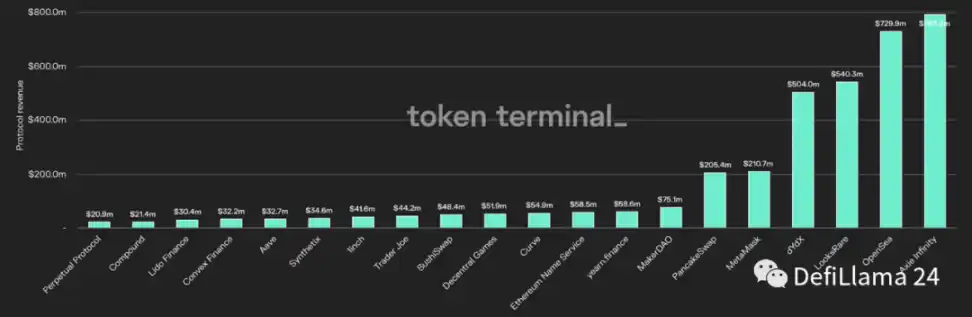
This will be significant because it will transform UNI from a purely "valueless governance token" to a productive asset.
For the purpose of our discussion, let's assume that Uniswap DAO chooses to distribute 50% of all revenue generated from fee conversions through a mechanism where UNI holders can stake their tokens to receive these USD earnings.
To be conservative, we also assume that 75% of circulating UNI will be staked to earn this yield, as some supply still remains on centralized exchanges or is used for liquidity on DEXs.
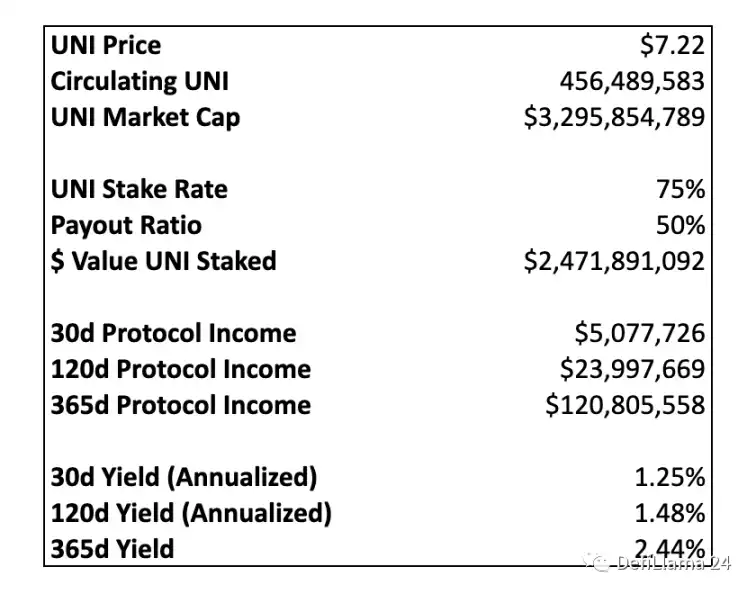
If all the fee conversions of the mining pools are in active status, then UNI yield.
As we can see, if the fee conversion of all mining pools on Uniswap is active at a rate of 10%, assuming the same 75% pledge rate and 50% payment rate, UNI holders will receive any returns between 1.25% and 2.44% based on the past 30, 120, and 365 days of trading activity.
Although the return on investment may be lower than that of other DEX tokens such as veCRV and GMX, which typically pay yields of 4-8% in 3CRV and ETH respectively, the return may still be attractive to investors given Uniswap's clear position as a leader in the industry.
More Comprehensive Picture
As we can see, the impact of turning on the Uniswap fee switch is significant.
The activation of the three pools only scratches the surface of its monetization capabilities. The widespread activation of fee conversion immediately turned Uniswap into one of the most profitable applications in the entire Web3.
In addition, if DAO guides some of the profits to token holders, UNI tokens will become attractive productive assets, although they are at the lower end of the DeFi industry, they will still surpass many mature traditional space enterprises.
Of course, these numbers are backward-looking - they use historical data and do not take into account any potential (and expected) future growth.
Perhaps more importantly, given its status as the most famous protocol in DeFi, Uniswap has successfully turned on the fee switch, which sends a signal to the market that "valueless governance tokens" can actually capture value.
Original article link
Welcome to join the official BlockBeats community:
Telegram Subscription Group: https://t.me/theblockbeats
Telegram Discussion Group: https://t.me/BlockBeats_App
Official Twitter Account: https://twitter.com/BlockBeatsAsia

 Related Articles