Dialogue with Monad Lianchuang Keone: Committed to the innovation and optimization of EVM
Original author: Snownad & Danny
Original translation: Deep Tide TechFlow
Monad Labs CEO and Co-founder Keone Hon and Developer Relations Engineer Kevin G participated in the third episode of The Pipeline podcast, discussing the work of the Monad Labs team over the past two years.
Guest Introduction:
Keone is the CEO and co-founder of Monad Labs. Prior to this, he worked as a quantitative analyst at Jump Trading, focusing on high-frequency trading (HFT).
James Hunsaker is the co-founder and Chief Technology Officer of Monad.
Kevin G is a core developer at Solana Labs. He previously worked at Apple, focusing on local system engineering design for Airpods.

Why choose Monad? In an environment where L2 and other scaling solutions are so popular, why would you want to modify the EVM?
Keone:
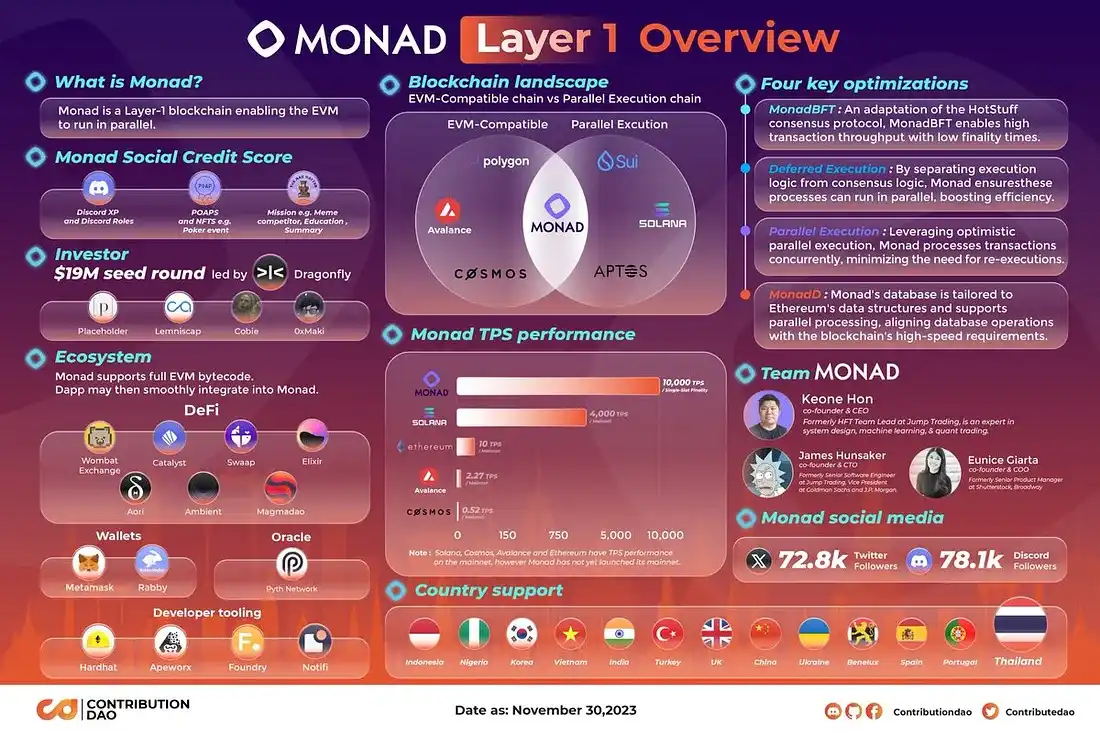
A few years ago when we first started, many people asked us, "Why not establish an L2?" Our answer then and now is the same: we believe that someone needs to focus on improving the performance of the EVM execution stack. By introducing optimizations such as parallel execution, custom state databases, pipeline execution, and support for asynchronous IO, Monad can better utilize hardware to achieve more efficient and decentralized systems.
As time goes by, it becomes increasingly clear that many bottlenecks in the Ethereum virtual machine can be solved and optimized by a competent team of engineers. Back in 2020, when Monad was first conceptualized, there weren't many teams focused on these optimizations, especially compared to the efforts put into other infrastructure such as rollups, STARKs, and data availability.
As the leading standard for smart contracts, the EVM chain has the highest TVL, the largest developer and research network, and an incredible community that has stood the test of time (and multiple bear markets). This makes optimization even more important as we seek to expand adoption and support more complex applications.
"Significantly improving the performance of EVM is indeed an interesting and challenging problem. I am glad that our team started working on this project at that time. This makes me very excited and looking forward to showcasing it to the world in the coming months."

EVM performance meets the scalability of Monad
Kevin G:
Monad is doing a lot of things that apply the best practices of computer science to blockchain networks. This is possible because the team has such a deep background in this field.
Not every development team can solve the fundamental problems of protocols and propose high-performance solutions. These optimizations are not only exciting, but also ambitious.
You are how to select a team that can meet this challenge?
Keone:
I just feel very lucky to have an amazing team of talent in engineering, growth, marketing, community building, and business development here at Monad Labs. We have about 25 people and try to keep a super lean team so we can focus on the problems that need to be solved.
As time goes by, our team will continue to grow to support the scale and adoption we are trying to achieve. This certainly requires broader skills and additional manpower.
Most engineering teams have rich experience in building high-performance, low-latency systems. A common pattern for developing a truly high-performance foundational layer system is that you need to have an understanding of the performance of the entire system. Sometimes you need to dive deep into the kernel level to get the optimization you need. Ultimately, blockchain is actually a database itself.

Some beloved Monad characters have solidified their positions in community legends.
Why do builders come to see Monad?
Keone:
One key advantage lies in the potential of Monad, which may facilitate extensive composability, surpassing the limitations of existing Ethereum and even outperforming higher-performance systems such as Solana.
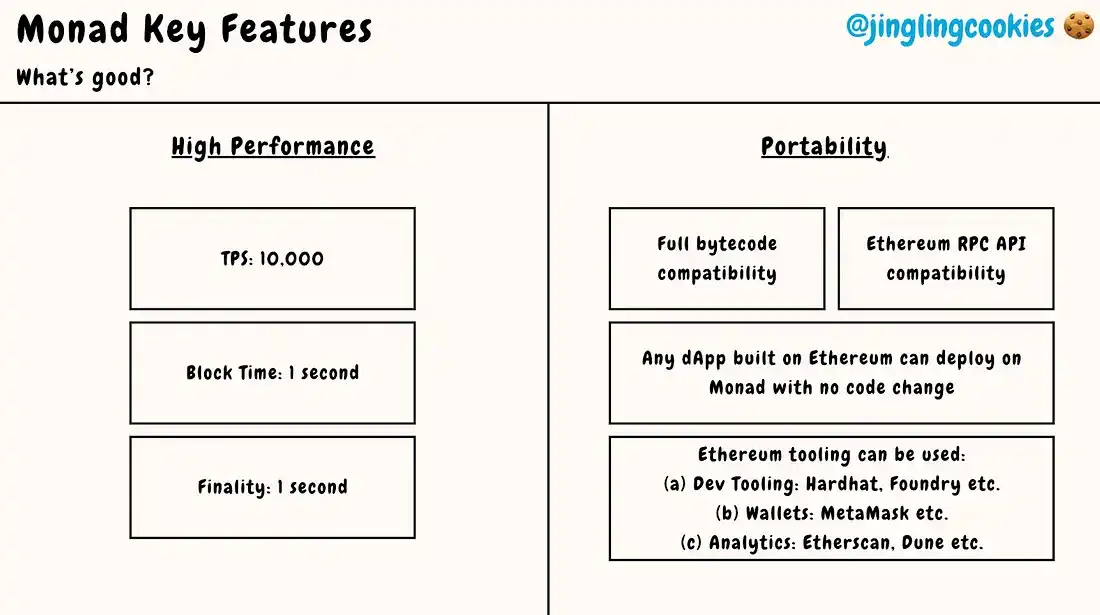
Because Monad is compatible with EVM bytecode and RPC, the learning curve for engineers is much lower than in many other environments. We are pleased to be able to leverage a wealth of research and tools that have paved the way for the thriving development of EVM, allowing developers to build higher-performing, scalable applications in an environment they already know and trust.
What is Monad's strategic positioning in the wider Layer 1 solution field?
Keone:
The ultimate goal is to create a more scalable and cost-effective platform for building diverse applications, eliminating the limitations that hinder composability in the existing blockchain ecosystem.
Against the backdrop of Ethereum's initial design: the goal was to enable builders to create anything within its ecosystem. Monad is the accelerated development of this concept, breaking free from the limitations that have existed for over a decade. We can use the transition from gasoline cars to electric cars as an analogy, marking a paradigm shift in what can be achieved when introducing new technology.
Considering the practical challenges faced by Ethereum developers, such as Gas limits. Without these restrictions, there would be more applications and features on Ethereum, but they are disabled due to high fees. One of the main goals of Monad is to liberate existing EVM applications from the current Gas limits.

Keone:
DeFi
Keone:
Kevin G:
Keone:

Keone:
Keone:
Welcome to join the official BlockBeats community:
Telegram Subscription Group: https://t.me/theblockbeats
Telegram Discussion Group: https://t.me/BlockBeats_App
Official Twitter Account: https://twitter.com/BlockBeatsAsia