After Ethiopia becomes a new "refuge" for Chinese miners, who has the upper hand in terms of benefits and risks?
Original Title: "The Great Migration of Chinese Bitcoin Mining Farms in Ethiopia"
Original Author: Gong Fenni, Investment in Ethiopia
01 Notice on Regulating "Mining" Activities

China's Bitcoin mining output once accounted for two-thirds of the world's total.
From September 2019 to April 2020, the network hash rate of Chinese miners accounted for more than 71% of the total. Abundant and cheap electricity and hardware equipment have made China a popular destination for cryptocurrency companies.
Previously, Bitcoin mining was mainly concentrated in provinces such as Sichuan, Inner Mongolia, Xinjiang Uygur Autonomous Region, and Yunnan, where these provinces have abundant and inexpensive electricity resources.
On April 14, 2021, the price of Bitcoin reached a historical high of approximately $64,870 per coin. However, just over a month later, the price of this globally popular digital currency plummeted to $34,259.
The sharp drop in the price of Bitcoin in a short period of time is closely related to the Chinese government's crackdown on "mining" activities of virtual currencies. One important reason behind the plunge in Bitcoin prices is that China has started a comprehensive crackdown on the cryptocurrency industry due to concerns about related financial risks and excessive energy consumption. The process of mining Bitcoin consumes a lot of energy, and the specialized integrated circuits (ASICs) used to mine Bitcoin consume a large amount of energy.
In May 2021, the Chinese government announced at a State Council meeting that it plans to "crack down on Bitcoin mining and trading activities". Subsequently, local governments took swift action, revoking licenses of companies involved in cryptocurrency mining, cutting off power supply to mining facilities, and even giving some companies only 7 days to shut down their operations. By the end of June, 90% of Bitcoin mining centers in China had gone offline.
In September 2021, the National Development and Reform Commission and other departments issued a notice on the rectification of virtual currency "mining" activities, listing virtual currency "mining" activities as eliminated industries, and strictly prohibiting the conduct of virtual currency "mining" activities in the name of data centers.
Afterwards, Bitcoin mining companies that had nowhere to go began searching for suitable locations for their machines worldwide. Chinese Bitcoin mining companies quickly shifted their operations to countries such as the United States, Canada, and Kazakhstan.
02 Texas Channing Mine

Chinese investors are flocking to the United States to invest in cryptocurrency mining, with investments worth hundreds of millions of dollars. Texas was the first state in the US to open its doors to cryptocurrency businesses. The governor of Texas hopes that the state will become the new global center for Bitcoin mining. BIT Mining, headquartered in Shenzhen, China, has also invested $26 million in a 57-megawatt facility in the state.
According to The New York Times, at least 12 states in the United States, including Arkansas, Ohio, Oklahoma, Tennessee, Texas, and Wyoming, have discovered Bitcoin mines owned or operated by Chinese individuals. These mines consume energy equivalent to the electricity used by 1.5 million households.
However, starting from 2022, several Bitcoin mining facilities operated by Chinese individuals have been exposed in the media, which not only raised concerns from the US government about the impact on the energy system, but also triggered national security doubts.
2022年,当一家有中国背景的公司在怀俄明州夏延动工进行加密货币采矿时,微软一个评估国家安全威胁的团队拉响了警报。
Translation:In 2022, when a company with Chinese background was mining cryptocurrency in Cheyenne, Wyoming, a team at Microsoft that evaluates national security threats sounded the alarm.
This mining farm is located adjacent to a Microsoft data center that provides support for the Pentagon, and is only 1.6 kilometers away from an Air Force base that controls intercontinental ballistic missiles carrying nuclear weapons.
Microsoft's team wrote in a report submitted to the Committee on Foreign Investment in the United States in August 2022 that this location could allow Chinese people to "conduct comprehensive intelligence collection operations". The committee is a federal agency responsible for monitoring threats from overseas investors.
Microsoft's warning did not fall on deaf ears. It is said that the US government has since begun tracking actions in Wyoming.

And then, the example of 23-year-old "rich second generation" international student Yu Jie from New York University brought the case of Chinese companies setting up cryptocurrency mines in the United States into the spotlight.
According to The New York Times, Yu Jie owns a little-known cryptocurrency mine worth 6 million yuan in a small town in Texas. However, the identity of Yu Jie and his cross-border wealth transfer methods were unexpectedly exposed due to the contractor's failure to receive payment and subsequent lawsuit against the mine.
Yu JieRui is living a full-fledged "second-generation rich" life in the United States. The shared apartment he lives in Manhattan, New York was purchased for $8 million. Later, he bought the majority of the shares of the Channing cryptocurrency mine in Texas for $6 million. However, these transactions were all conducted through cryptocurrency instead of banks. The transaction process was not only anonymous but also transferred overseas to avoid anyone knowing the source of the funds.
Such highly confidential transactions allow Chinese investors to bypass the US banking system, evade supervision by federal regulators, and bypass various Chinese measures to control capital outflows.
The employment of contractors by Jerry's company has resulted in a series of lawsuits due to non-payment. Various information was exposed, revealing the means by which Jerry's multinational wealth was transferred, making it known to the public.
The Channing mine is built on a spacious site with dozens of buildings that house 6,000 specialized computers for 24/7 Bitcoin mining. The investment record of the Jerry mine can only be traced up to the cryptocurrency trading platform Binance, with transactions completed overseas through Tether.
After these Chinese Bitcoin mining farms were exposed in the United States, the days of quietly printing money have become increasingly uneasy. As a result, another large-scale migration of Chinese Bitcoin mining farms is beginning to brew.
03 Bitcoin miners' new "shelter"
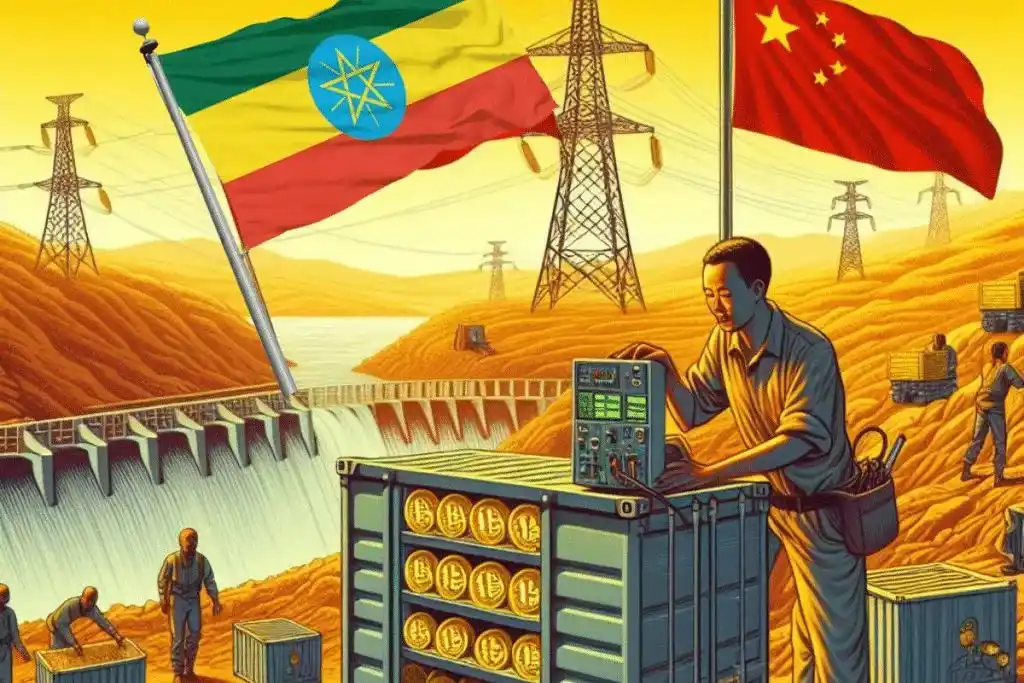
Finally, on the other side of the earth, Chinese Bitcoin miners have found a new "refuge" - Ethiopia.
Cheap electricity and friendly relations with China have made this "Horn of Africa" country the preferred destination for Chinese Bitcoin miners.
Last spring, shipping containers began to appear near the newly built Grand Ethiopian Renaissance Dam in Africa. Inside were a bunch of powerful and energy-consuming computers.
This sign indicates that Chinese Bitcoin miners have arrived in the "Horn of Africa". Since the Chinese government expelled them from China in 2021, Chinese Bitcoin miners have been running from one country to another in search of cheap electricity and relaxed regulations.
Welcome to join the official BlockBeats community:
Telegram Subscription Group: https://t.me/theblockbeats
Telegram Discussion Group: https://t.me/BlockBeats_App
Official Twitter Account: https://twitter.com/BlockBeatsAsia
 Related Articles