Continued hot trend of re-staking, LRT war panorama and participation guide.

Original Title: "Navigating the LRT Wars and What's at Stake."
Original Author: IGNAS | DEFI RESEARCH
Translated by: Joyce, BlockBeats
Editor's Note:
Recently, since RSTK has attracted attention from the community, the re-staking track has emerged with strong players such as Eigenlayer, ether.fi, Puffer Finance, etc., attracting a large amount of liquidity from the community. Among many players, who has more development potential? In this article, crypto researcher Ignas starts with the potential of the LRT track and analyzes the "LRT War" in terms of scoring mechanisms, revenue models, token economics, and other aspects, and finally provides his own strategy manual. Translated by BlockBeats as follows:
Did you know that Rocket Pool started preparing for ETH staking as early as 2017, and despite Lido only appearing a month before the launch of Ethereum PoS in 2020, it quickly captured 70% of the market share, while Rocket Pool's rETH market share was only 4.6%.
Lido has taken a leading position in the field of liquidity staking tokens (LST), but the competition for liquidity re-staking tokens (LRT) has just begun! This indicates that the most promising area in the cryptocurrency industry will face a challenging competition.
In this blog post, I will share why I am optimistic about LRTs, explore their main differences, and conduct exclusive interviews with the top five LRT protocols to gain a deeper understanding of their perspectives.
The optimistic outlook for LRT
This is the second article about restaking navigation. In the first article, I discussed the use case of Eigenlayer's "Active Validation Service" to better understand each building block (and its risks) of restaking. I also discussed my bullish stance on re-registering + LRT in September 2023, and my bullish argument has only gotten stronger. Sentiment analysis shows that bullish sentiment is exploding.
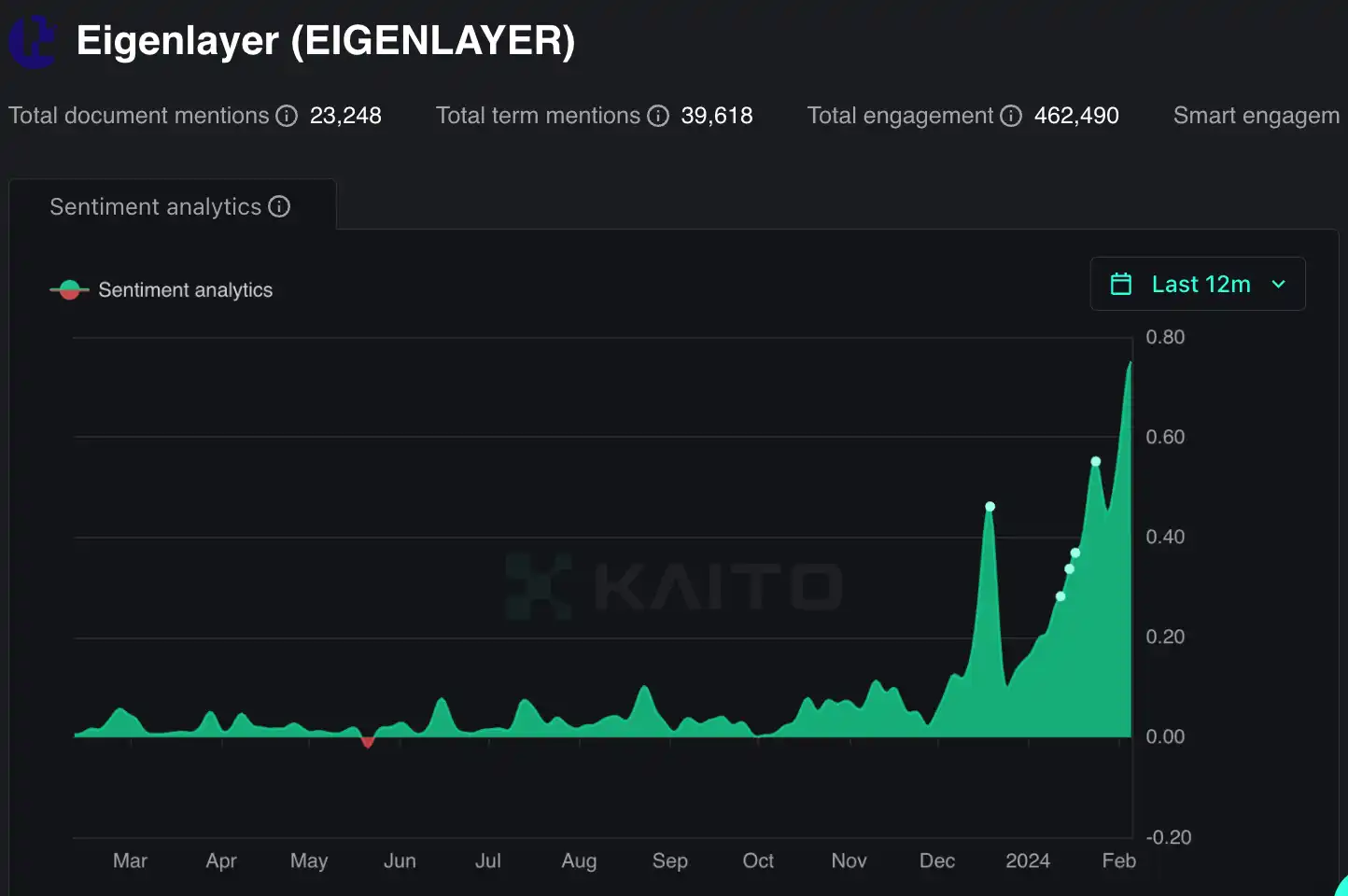
Emotion analysis uses artificial intelligence on the Kaito platform to analyze encrypted Twitter tweets, assigning an emotional score to each tweet to determine the overall emotional score of a specific token weighted by trading volume during a given period.
I am bullish on the description of staking + LRT because it has the 3 key elements I am looking for in the ecosystem: 1) innovative technology 2) printing opportunities 3) engaging narrative.

I even believe that further collateralization and implementation of LRT will make ETH an attractive, worthwhile asset to buy and hold. In turn, this will lead to ETH catching up to BTC and altcoins. However, it is important to note that this is not a risk-free return. You must understand that you are layering one asset on top of another, thus increasing your risk proportionally.
What is LRT and why do we need it?
Let's take a step back and understand the meta-trend of LRT (Liquidity Re-Pledging Tokens) that I previously shared here.
The re-staking model of EigenLayer has a significant drawback for DeFi: once your liquidity staking tokens (LSTs) are locked on EigenLayer, they become illiquid. You cannot trade them, use them as collateral, or use them anywhere else in DeFi.
LRTs unlock liquidity again by adding another layer, releasing this liquidity once again. You can choose to re-stake your LSTs through a liquidity re-staking protocol instead of directly depositing them into EigenLayer. Since I first introduced re-staking, the TVL integrated with LRT has grown to $1.8 billion. Just a week ago, when I shared this article on AVS, the number was still $1.8 billion...

Bullish Element:
LRT provides higher ETH yield. With LRT, we can obtain Ethereum staking yield (~5%) + Eigenlayer re-staking reward (~10%) + LRT protocol token emission (~10% and more). When Eigenlayer is fully launched, we expect the yield of ETH to reach about 25%. You have already earned a 40% annualized return on Pendle.
Airdrop: Eigenlayer+ AVS + LRT protocol token airdrop, AltLayer is just the first.
Simplicity: Holding LRT (Liquidation Ratio Token) can simplify management, as you do not need to directly handle delegation to operators, compound interest, and keep track of all related developments, while only paying about 10% of the fees.
I believe that the liquidity unlocked by LRTs (which was originally locked in EigenLayer) will have a greater leverage effect in the DeFi field, which may drive up TVL and ETH prices like the DeFi summer of 2020. This could ultimately lead to new market fluctuations.
Currently, we are still in the early stages and EigenLayer is still in the second phase of testing. I believe that when EigenLayer is fully launched, the real excitement will just be beginning.
LRT War
积分、积分、积分……
translates to
积分、积分、积分……
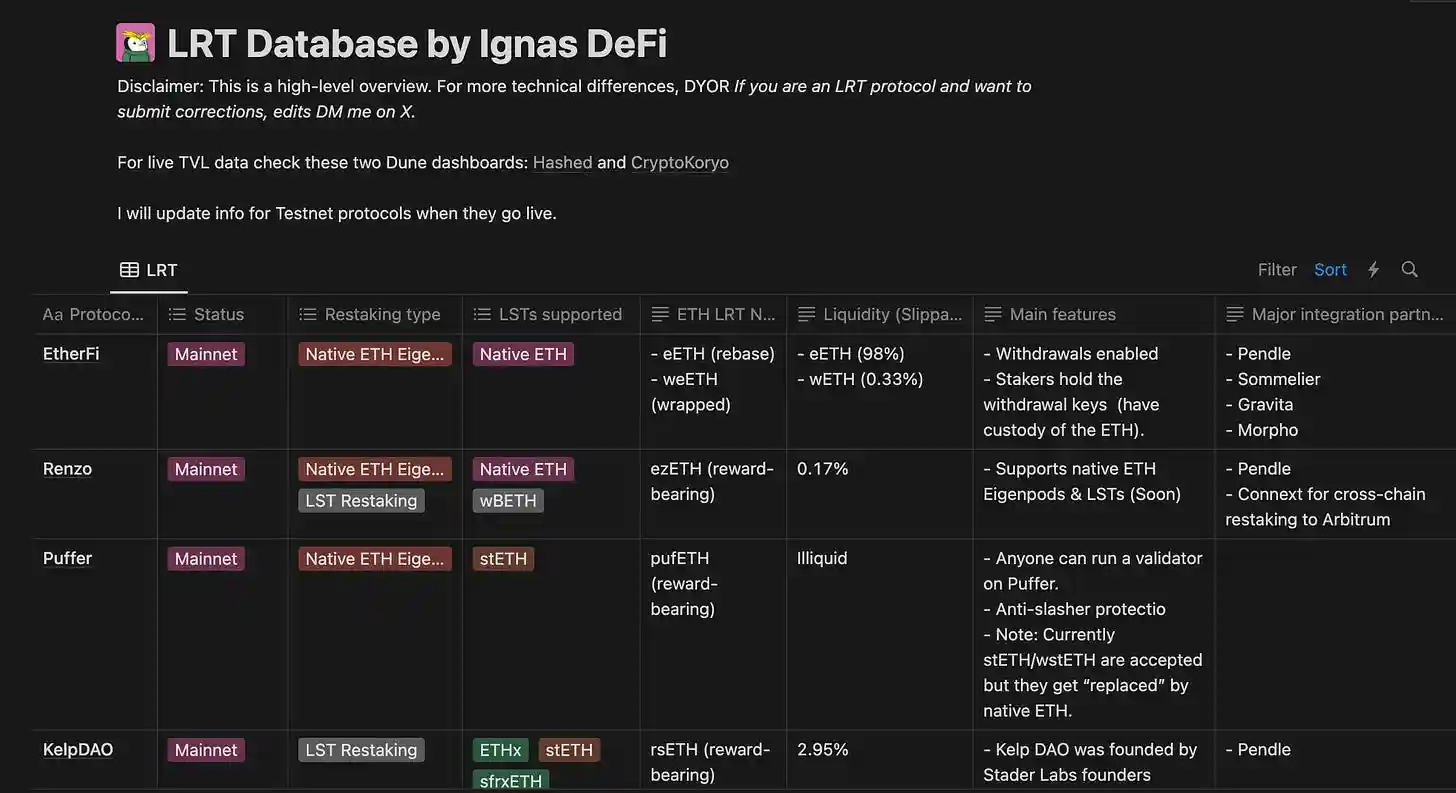
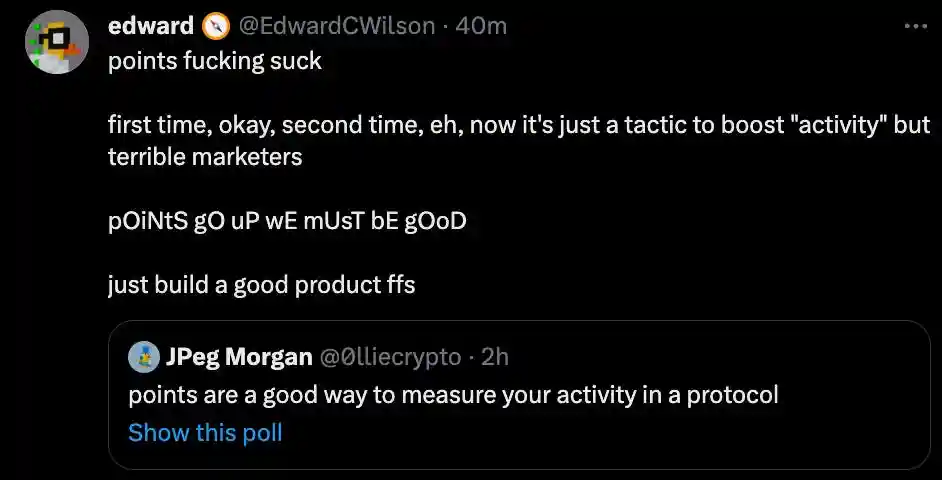
in English.This war will be divided into several stages. Currently, the first stage is underway. Due to the fact that few people understand the differences between these LRT protocols (can you?), points have become the main weapon of this stage.
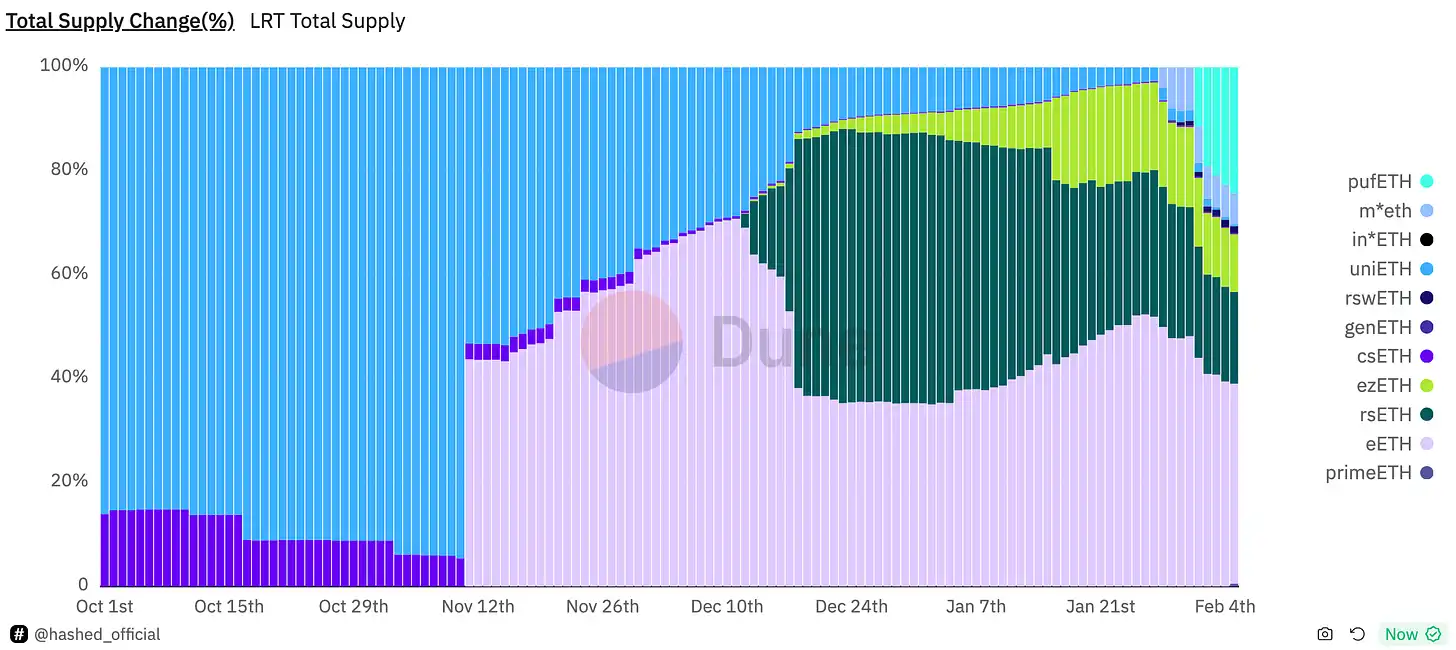
Currently, EtherFi (eETH) holds a leading position in the Liquidity Re-Pledging Token (LRT) market, with a market share (MS) of 39%. In fact, the total locked value (TVL) of eETH in Eigenlayer even exceeds that of stETH.
The dominant market share position largely depends on who launches first, but Puffer (pufETH) as a latecomer quickly climbed to second place with a market share of 22%. Why is that? The answer is: points!
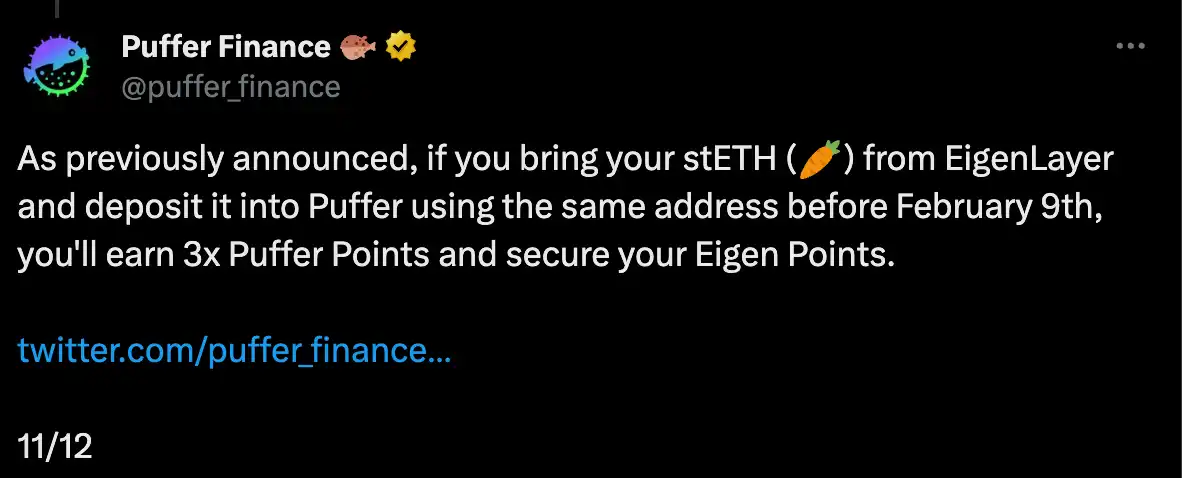
The Puffer protocol recently announced that it has received investment from Binance. It provides triple points for those who extract stETH from Eigenlayer and deposit it into Puffer for re-staking. This incentive measure may be a key factor in Puffer's rapid market share growth. By offering higher point rewards, Puffer has successfully attracted investors seeking to maximize profits, resulting in rapid market share growth in a short period of time.
Eigenpie, although a latecomer to the industry, quickly accumulated a total locked value (TVL) of $184 million, with a market share of 6%.
Eigenpie provides the following incentive measures:
Within the first 15 days (until February 12th), users can receive double bonus points.
The points will be used for airdropping EGP tokens, accounting for 10% of the total supply.
Integral points are a necessary condition for participating in the EGP token's initial coin offering (IDO), with a fixed market value (FDV) of $5 million.


LRT Protocol Token Economics
For example, AltLayer will require ETH to enable its three AVS Restaked Rollup services. They can attract them by offering their own token rewards to Eigenlayer's large-scale stakers and retail investors. However, lobbying the LRT protocol, which already has a large amount of re-staked ETH, may be simpler and more cost-effective.
This dynamic has in turn increased demand for LRT tokens, especially those that have successfully attracted a large amount of re-staked ETH. As we have seen in the "Curve Wars," with more AVS launches, competition for DAO voting among AVSs may become fierce. It may not be initially, but competition will be inevitable with more AVS launches.
Actually, there is very little information, if any, about the native token of the LRT protocol. However, some teams have agreed to share some alpha with Ignas' blog readers:
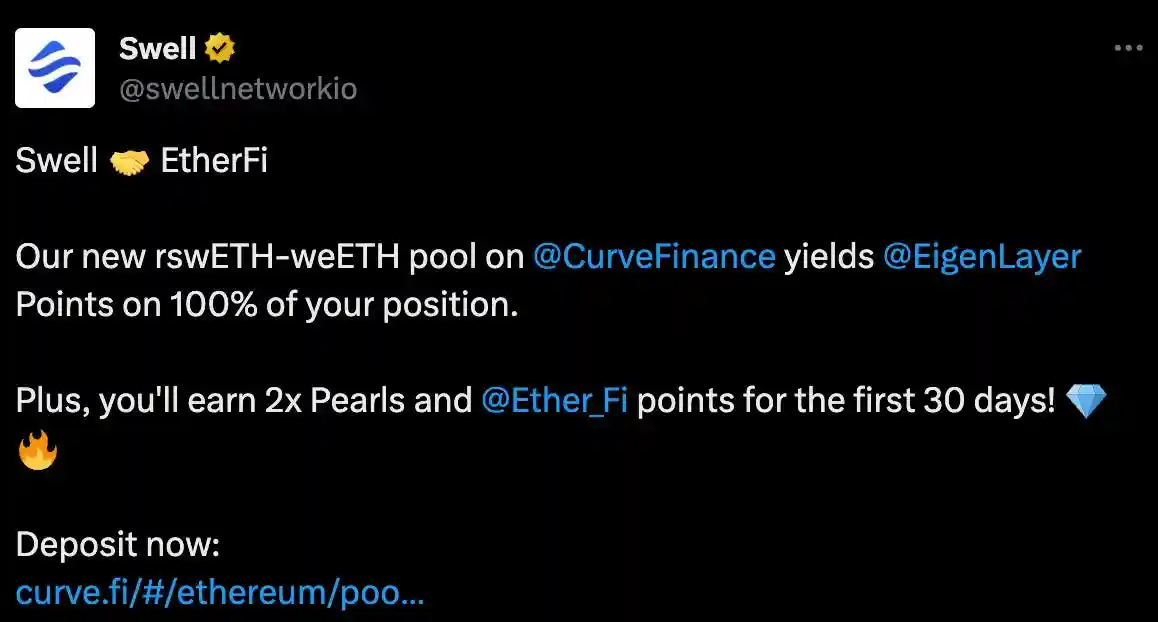
Swell will adopt veTokenomics: Swell will implement a voting custody and measurement flywheel system similar to Curve within its ecosystem. In this way, SWELL will be used to reward the most loyal community members and empower them with the ability to guide reward flows.
Although other teams did not share specific details, they all mentioned that the token will be used for voting on operators/AVS. "PUFI holders ultimately decide which [re-staked operators] are whitelisted and how the protocol's re-staked ETH is deployed to them." - Puffer Community Manager.
Therefore, if Eigenlayer is fully launched and there is no corresponding token, I would be very surprised.
In short, the stability of our valuable ETH assets and the DeFi ecosystem. For stakeholders like us, as well as DeFi protocols and the entire ecosystem, the risks are enormous.
During conversations with the LRT protocol team, some teams revealed their plans to charge a 10% commission, which will accumulate to the DAO. Considering that billions of dollars worth of ETH will be re-staked in the future, such a source of income will help to increase the value of their native tokens.
In the DeFi and Ethereum fields, re-staking can significantly increase overall returns. As more lending protocols adopt LRTs, lending yields will rise. At the same time, with the growth of TVL, we can anticipate the emergence of a new wave of innovative dApps, all thanks to the contribution of AVSes.
However, risks are also increasing in sync. Risks such as decoupling, smart contract vulnerabilities, and hacker attacks are accumulating, and we may encounter some bad days. Hopefully, these risks will not evolve into fatal blows. For us, while pursuing maximum points, it is crucial to protect the security of ETH assets. With so many additional point activities, my ETH is almost running out...
Therefore, this is the updated version of the strategy that I shared in September. This is my approach:
Due diligence: I will test every LRT protocol by depositing a small amount of ETH. I will examine their supporters and investors, and join Discord anonymously to ask questions to ensure that I understand their operation.
Market dynamics: Pay attention to which LRT protocol has gained the most TVL and successfully integrated into existing DeFi infrastructure, as well as their liquidity in the secondary market. Initially, I thought the LRT market would closely resemble the LST market, with a 70% dominant position, but with more AVS launches and design differences in the LRT protocol, only a few LRTs may share most of the ETH.
Risk management: Protecting my ETH principal through conservative mining. Originally, I planned to invest only 5% of my total ETH holdings in each protocol, but now it has increased to 10% for each protocol... a bit risky.
Token strategy: I bet on LRT governance tokens with attractive "Ponzi token economics" that can build a self-sustaining flywheel. These tokens should provide attractive staking rewards, real yield rewards, and voting rights on which AVS to receive re-staked ETH. In addition, they need to have a low enough inflation rate to offset any selling pressure.
Exit strategy: During the prosperous period of the market, when everyone is talking about how LRT and LRT governance tokens generate new "generational wealth", I will cash out and reinvest in ETH. It is best to sell in batches and gradually sell as the price rises.
Review and Adaptation: We hope that the market will provide some new things that we have not seen before. If you see a WTF moment that confuses everyone but is constantly discussed in CT (even if it is negative), pay attention, learn, and adapt. Those are the best investment opportunities.
I will summarize with a quote from Rok Kopp, and I agree with his viewpoint:
"The LRT market is still in such an early stage, which is why it is so exciting! We have just seen the first batch of AVS enter the market. We believe that over time, there will be various different ways of re-staking. Ultimately, we believe that re-staking may become the most important thing on Ethereum, because Ethereum itself is."
Why was Lido able to win despite appearing later? Mainly because of timing and incentives. So don't be too quick to give up points.
Welcome to join the official BlockBeats community:
Telegram Subscription Group: https://t.me/theblockbeats
Telegram Discussion Group: https://t.me/BlockBeats_App
Official Twitter Account: https://twitter.com/BlockBeatsAsia

 Related Articles