



Bankless: How to use Clusters for cross-chain identity management.
Original Title: "Set Your Cross-Chain Identity with Clusters"
Author: William M. Peaster; Bankless
Translation: Joyce, BlockBeats
Editor's Note:
When it comes to cross-chain interaction, the convenience of identity management is a common concern for users and developers. To address this issue, on February 1st, Delegate, an Ethereum infrastructure, and LayerZero, a cross-chain interoperability protocol, jointly launched Clusters, a multi-chain domain name service. Clusters aims to solve problems such as address fragmentation, wallet management complexity, and domain name grabbing. Clusters will support EVM networks, Solana, and Bitcoin to ensure that users maintain the same identity across multiple chains and simplify user interaction with DApps.
William M. Peaster, author of Bankless, introduces the principles and usage of Clusters. The following is the translation by BlockBeats:
Clusters: Simplifying Cross-Chain Interactions
If you are excited about the future of cross-chain technology, but find it difficult to determine which wallet belongs to you on each network, Clusters may be the service you need. Clusters is a new cross-chain naming service created by the Delegate and LayerZero teams, which allows users to bid on and register wallet names that are valid on both Ethereum and non-Ethereum chains.
The slogan of this service is: "All chains, all wallets, one name." This means that no matter which blockchain network your friend is on, you can use the same name to identify their wallet, simplifying the complexity of cross-chain interactions.

与 ENS 有何不同?
What is the difference between ENS?
Clusters is similar to Ethereum Name Service (ENS) in that both protocols provide readable blockchain domains that support multiple chains. The fundamental difference between these projects lies in their architecture.
ENS uses a custom multi-chain address resolution system within its protocol, allowing ENS names to record and point to addresses on different blockchains. In contrast, Clusters is the first application based on the new V2 version of LayerZero, an interoperability protocol designed to enable projects to run seamlessly and securely on different blockchains.

Clusters 如何防止域名抢注?
How can Clusters prevent domain name hijacking?
In order to reduce domain name grabbing behavior, Clusters has adopted a demand-driven periodic pricing mechanism, which is a concept previously discussed by Vitalik Buterin. Unlike ENS, which relies on fixed annual fees (e.g. $5 per year for five-character domain names), Clusters will dynamically adjust the annual fees of domain names based on market demand.
This mechanism allows anyone to bid on a domain name. If the bidding lasts for a period of time, the annual fee will be determined based on a certain percentage of the floating valuation. In this way, the domain name owner either accepts a high-priced sale or pays a higher fee to reduce the phenomenon of domain name grabbing.

Usage Tutorial
On February 1, 2024, Clusters launched its beta version by introducing its auction system.
At this stage, participants can start bidding on highly sought-after names. The highest bidder will get the domain name they want, ensuring transparency. Clusters is also developing a refund system for unsuccessful bidders, so those who did not win can get their money back.
In addition, Clusters has created an enhanced multiplier system to complement its auction. In other words, having the corresponding ENS domain name, relevant Twitter username, and activity on social media can significantly enhance your bidding and provide a competitive advantage for your target name.
After the beta version, Clusters plans to improve its auction mechanism and transition to a fully open first-come, first-served (FCFS) registration system. This transition is expected to occur in the coming months.
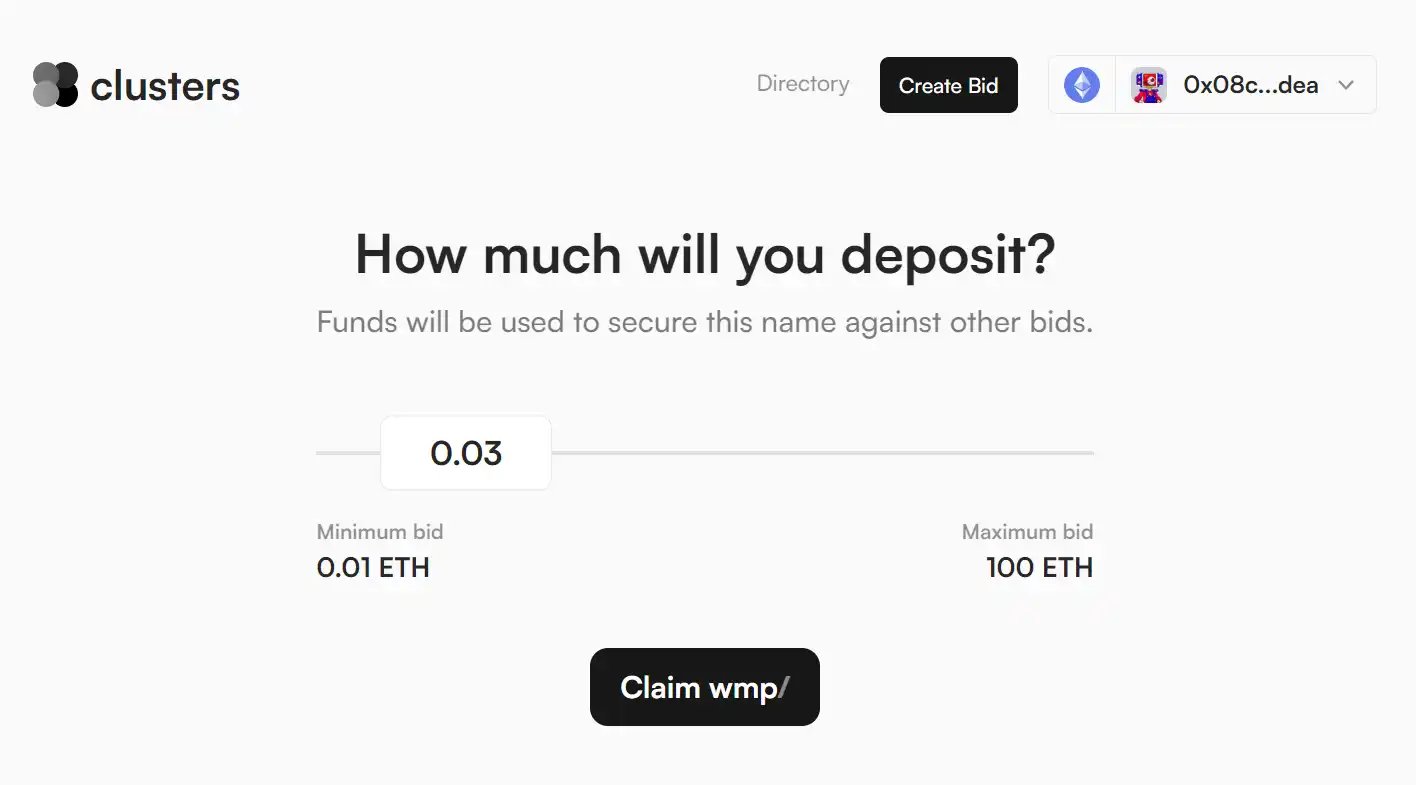
Before you start using Clusters, you need to prepare some ETH to bid on the name you choose. Once your funds are ready, you can follow these steps:
Go to clusters.xyz and connect your wallet. Click "Create Bid" at the top of the page and enter the name of the Cluster you want to bid on. On the following page, enter the amount you wish to bid - for reference, many bids so far have been in the range of 0.02-0.06 ETH.
Click "Claim" and confirm the deposit transaction through your wallet. Start customizing your Cluster by importing your personal avatar from Twitter and adding other wallets, as shown below:
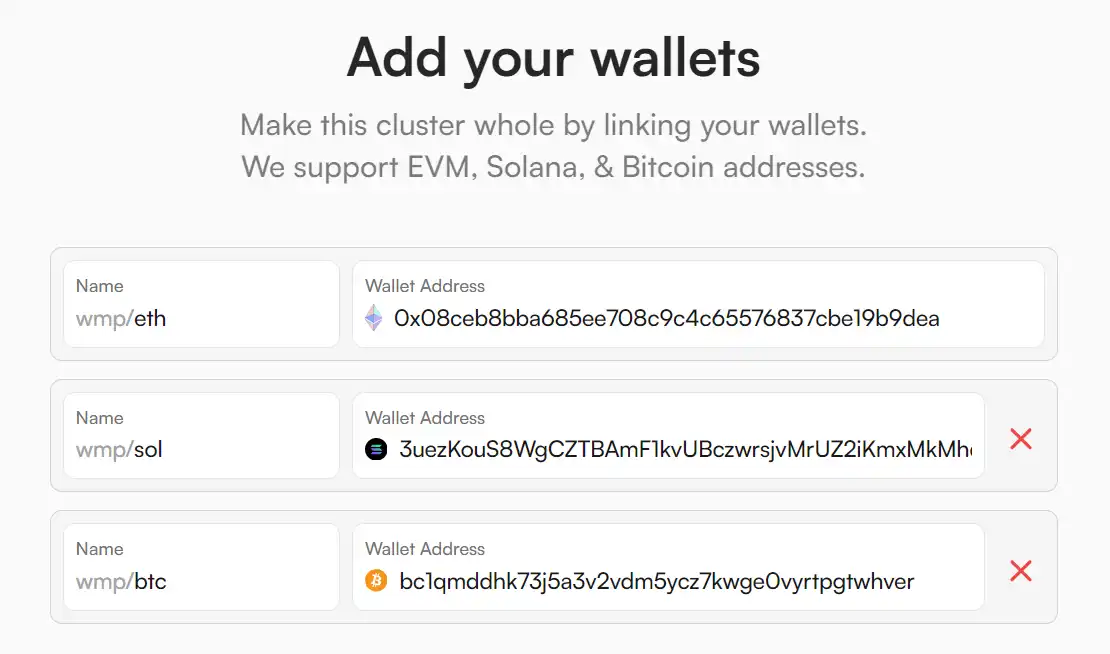
When you have finished customizing, click "Complete Setup" to finish the configuration process. At this point, you can go to the "My Profile" tab on the Clusters website to track your bidding status, edit your wallet information, or copy your custom referral link to share on social media for enhanced multiplier benefits.
If any of your bids fail to win, please note that Clusters' refund system will be launched in the coming weeks.
Clusters aims to create a secure and user-friendly cross-chain identity management system. By integrating auction and demand-driven pricing strategies with enhanced multipliers, Clusters is committed to simplifying the connection between different blockchains. In the future, the project will expand its support to more chains, such as those in the Cosmos ecosystem. Stay tuned for its development.
Welcome to join the official BlockBeats community:
Telegram Subscription Group: https://t.me/theblockbeats
Telegram Discussion Group: https://t.me/BlockBeats_App
Official Twitter Account: https://twitter.com/BlockBeatsAsia







