Bitcoin L2 Battle Royale: Why CKB is so highly anticipated?
Source: Bytecoin CKB
Author: Bytecoin
Last year, the birth of the Bitcoin network's Ordinals protocol broke the bear market's slump, like a fire in the winter, igniting the Bitcoin ecosystem that had been lukewarm and not attracting much attention. From Ordinals to BRC-20, and then to Atomicals, a series of innovative inscription protocols and asset standards continue to inject new vitality into the Bitcoin ecosystem.
The popularity of inscription assets such as ORDI and SATS has not only pushed Bitcoin inscription to an unprecedented craze, but also marked the advent of a new era. Prior to this, the Ethereum ecosystem was leading the way, but after the popularity of Bitcoin inscription, more and more users, developers, and funds began to pay attention to and participate in the Bitcoin ecosystem. One of the most obvious signals of this change is the emergence of numerous Bitcoin sidechain and Layer2 projects. Currently, there are more than 34 projects on the market that have publicly announced their intention to do Bitcoin Layer2, many of which have already completed huge financing. If those that have not yet been made public are included, it is expected that there will be more than 100 participants in the competition.
The battle of Layer2 in Bitcoin industry will inevitably be chaotic at the beginning, but after the tide recedes, some projects will inevitably stand out. Some of these projects may excel in marketing, while others may rely on solid technology, and they will be the winners of the different technical architecture solutions in the Bitcoin Layer2 track. Among these winners, Nervos CKB will undoubtedly occupy a place. However, before analyzing the advantages of CKB, we need to clarify a question: what problem does Bitcoin Layer2 need to solve?
What problem does Bitcoin Layer2 aim to solve?
Ethereum's Layer2 has been developing for so many years, from the initial Sharding, to later State Channel, Plasma, and finally Rollup became mainstream. The core of these Layer2 solutions is to improve the performance of Ethereum Layer 1, that is, to pack most of the transactions of Layer 1 into the Layer2 network to relieve the pressure on the main network.
The transaction processing speed (TPS) of Bitcoin is approximately 7 transactions per second, which is a very low starting point. Therefore, any form of Layer2 technology will undoubtedly greatly improve its performance. The biggest problem with Bitcoin currently is that it is not Turing complete and does not support the feature of smart contracts, which limits the development of more complex ecological businesses. With the emergence of protocols and standards such as Ordinals, BRC-20, and Atomicals, asset issuance on the Bitcoin chain is no longer a problem. The current pain point is how to create more application scenarios or more ways to play with these assets.
Therefore, the primary task currently facing Bitcoin Layer2 is to expand the very limited programming capabilities of Bitcoin, which we often refer to as "Layer 1 sends assets, Layer 2 does applications". This programming capability will be solved by the Layer2 network.
Currently, the Bitcoin Layer2 track can be roughly divided into several directions based on different technical architectures, including state channels, client-side validation & one-time sealing, Rollup, and sidechains.
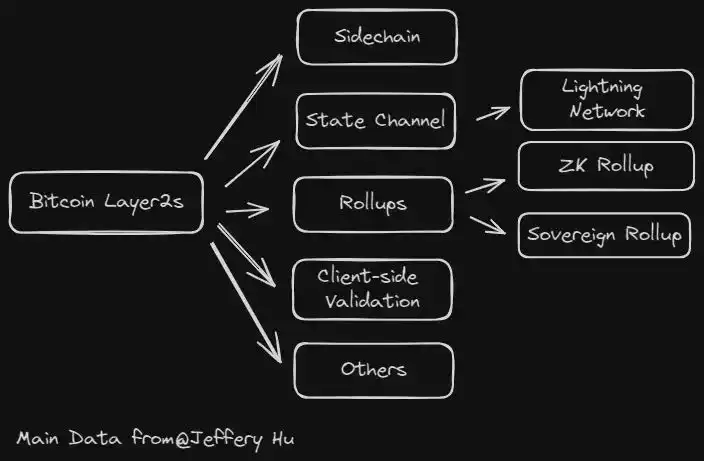
Image: Classification of Bitcoin Layer2; Source: https://medium.com/@Janenico
Among them, state channels represented by Lightning Network achieve low cost, high speed, and high scalability transaction confirmation by conducting transactions off-chain (in the channel), and are only submitted to the main chain when the channel is closed. However, the development progress of state channels is relatively slow, and the complexity of channels may cause uncertainty. Client-side validation and one-time sealing, represented mainly by RGB, store off-chain data and make on-chain commitments with client-side validation, but the drawback is slow progress and inability for smart contracts to interact. Rollup, represented by BitVM, Bison, and others, has the disadvantage that, due to the characteristics of Bitcoin, there is currently no project that can perfectly reproduce the verification method of Rollup on Ethereum.
Sidechain is an independent blockchain with its own consensus mechanism and a set of independent verification nodes. It is connected to the main chain through a two-way cross-chain bridge or 2WP. Compared to other technical architecture solutions, the progress of sidechain solutions will be faster. Therefore, in this round of Bitcoin Layer2 battle, sidechain solutions will become the main battlefield, with the most intense competition, the most projects, and the easiest to see results. In this direction, CKB is the most anticipated.
CKB, the most anticipated Bitcoin Layer2
CKB was launched in November 2019, adopting the PoW consensus mechanism and UTXO model, which are completely identical to Bitcoin. In addition, CKB also has the Axon framework, which can achieve "one-click chain issuance".
In the current Bitcoin Layer2 battle, especially in the sidechain track, the reason why CKB is the most anticipated is because it has unparalleled advantages in security, expanding Bitcoin programming capabilities, technical accumulation, ecology, and other aspects compared to other sidechain solutions.
First of all, security is the top priority. Sidechains are independent blockchains that do not inherit the security of the main chain, so many sidechain projects often suffer from centralization due to too few nodes. CKB has adopted the same PoW consensus mechanism as Bitcoin from the very beginning, which has been tested over time, to maximize security and decentralization.
CKB's mining algorithm is independently developed Eaglesong. After April 2020, CKB smoothly transitioned to the era of ASIC mining machines, successfully overcoming the most dangerous moment of the PoW chain. The mining machines currently used by CKB are produced by the world's largest ASIC mining machine manufacturer, Bitmain. The current network hashrate of CKB is approximately 158 PH/s, and it successfully experienced the first halving of mining output in November last year.
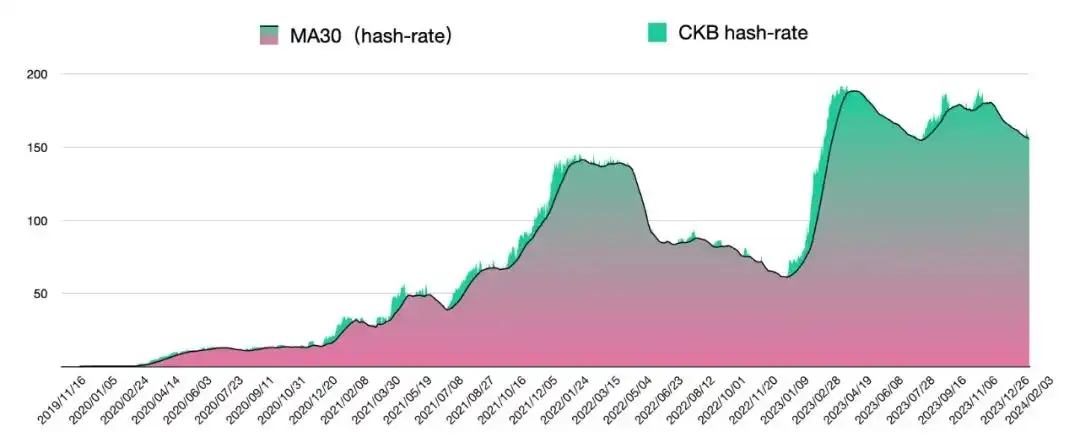
Image: CKB computing power; Source: https://talk.nervos.org/t/ckb-weekly/7306
Regarding the expansion of Bitcoin programming capabilities, CKB has generalized the UTXO model and named it the Cell model. Like UTXO, Cell is also a transaction output, but Cell generalizes the amount in UTXO and corresponds to capacity and data, thus turning the original space for storing integers into a space that can store any data. In addition, the Cell data structure also includes LockScript and TypeScript. The former mainly reflects ownership, while the latter can customize many rich functions, such as implementing Covenant (restrictive clauses) that are not yet available on Bitcoin. In the script of Cell, developers can also specify cryptographic primitives according to their needs, which is very flexible. In short, the Cell model continues the basic philosophy of Bitcoin UTXO, making it easy for CKB to inherit the simplicity and security of Bitcoin, and through clever modifications, allowing Cell to support smart contracts.
In addition to the highly flexible Cell model, CKB's virtual machine is also very powerful. It uses the open instruction set RISC-V, which supports developers to develop smart contracts in any language. As long as it is compiled into RISC-V binary format with a suitable compiler, it can be executed efficiently. Various cryptographic algorithms, whether it is the most primitive Secp256k1 of Bitcoin or the later introduced Schnorr, can be directly ported to run on the CKB blockchain.
In terms of user experience, the CKB mainnet is fully compatible with BTC addresses and wallets, allowing users from the Bitcoin ecosystem to seamlessly enter the CKB ecosystem. The Omiga protocol on CKB already supports the Bitcoin wallet UniSat, allowing Bitcoin ecosystem users to directly deploy, mint, and transfer NFT assets on the CKB chain using the UniSat wallet. In contrast, for EVM sidechains with an account model, users have to switch wallets when switching from the Bitcoin ecosystem to the EVM sidechain, which is very fragmented in terms of user experience.
One of the reasons why CKB deserves attention is the more than four years of technical accumulation and the gradual improvement of infrastructure. On the one hand, CKB has the "one-click chain issuance" Axon framework, which allows various Bitcoin script communities, such as Ordi, Sats, and Rats, to easily issue their own BTC Layer3 on CKB. On the other hand, CKB's development tools are also increasingly sophisticated. In addition to various toolkits and SDKs contributed by the core development team, community teams are also actively contributing, such as the PW SDK developed by the Lay2 team for building CKB dApps, and the Kuai developed by the MagickBase team, which aims to significantly reduce the threshold for dApp development.
In terms of ecology, CKB is far ahead of other sidechains. JoyID wallet uses biometric technology (fingerprint/face recognition) to create and manage wallets, allowing users to use it without any blockchain knowledge. It also supports multiple chains and is more powerful in functionality than MetaMask wallet, and is not inferior to Web2 applications in terms of user experience. CKB has its own DID system (.bit), which also supports multiple chains and Passkey. It is more powerful in functionality than Ethereum's domain name service ENS, with better compatibility, and has already received $13 million in Series A financing. The Mingwen protocol Omiga and the NFT protocol Spore Protocol, which stores data completely on the chain, have been launched. Other infrastructure such as DEX and cross-chain protocols are already in the testnet phase and will be launched soon. Khalani, a decentralized full-chain liquidity protocol that provides infrastructure for Defi, is also in the testnet phase.
In short, CKB, with its outstanding security, innovative technical solutions, rich technical accumulation, and increasingly perfect ecosystem, will become the most anticipated Bitcoin Layer2. CKB will not only provide new possibilities for expanding Bitcoin's programming capabilities, but also provide developers and users with a secure, flexible, and friendly blockchain environment. With the further maturity of technology and the continuous development of the ecosystem, CKB will undoubtedly play an increasingly important role in exploring the forefront of Bitcoin Layer2.
This article is from a submission and does not represent the views of BlockBeats.
Original article link
Welcome to join the official BlockBeats community:
Telegram Subscription Group: https://t.me/theblockbeats
Telegram Discussion Group: https://t.me/BlockBeats_App
Official Twitter Account: https://twitter.com/BlockBeatsAsia

 Related Articles