Weekly review|Binance Web3 wallet launches inscription market; Solana’s new token standard Tiny SPL (DN) sparks heated discussion
BlockBeats will summarize the industry's key news content for the week (1.29-2.04) in this article, and recommend in-depth articles to help readers better understand the market and industry trends.
Weekly News Recap
Updates and Progress of OKX and Binance in Web3 Wallet Direction
Binance Web3 Wallet officially launches Inscription Marketplace
On February 1st, Binance announced the launch of the Binance Inscription Marketplace, which is integrated into the Binance App's self-hosted wallet - Binance Web3 Wallet. This platform provides users with a convenient and user-friendly platform for trading and minting a series of Inscription tokens. The Binance Inscription Marketplace offers features such as trading or engraving tokens, one-click token transfer, and smooth transactions.
Binance Mingwen Market has integrated UniSat's API (a pioneer in ordinal and inscription fields) to bring users UniSat's deep liquidity and over 60,000 BRC-20 tokens, while also maintaining the simplicity, convenience, and security of the Binance Web3 wallet.
OKX Web3 Wallet to integrate ARC-20, SRC-20, Runes, and DRC-20 token standards
On January 29th, OKX Web3 Wallet will be the first to integrate four new token standards: Atomicals (ARC-20), Stamps (SRC-20), Runes, and Doginals (DRC-20) for Dogecoin, becoming the first and most advanced one-stop token ecosystem platform in the Web3 industry. Starting from February 5th, OKX Web3 Wallet will integrate the Bitcoin token standard SRC-20, allowing users to view and transfer these tokens, and will integrate ARC-20, DRC-20, and Rune Alpha by the end of February. At the same time, OKX NFT Marketplace will also integrate DRC-20 and ARC-20 standards by the end of February, providing millions of users with zero-cost DRC-20 and ARC-20 token trading functions. The integration of Runes will be launched after the Bitcoin halving.
Jupiter updates JUP token economics, with an initial circulation of 1.35 billion, of which 1 billion is used for airdrops
On January 30th, Meow, the co-founder of Jupiter, updated the JUP token economics on their social platform. The initial circulation of JUP will be 1.35 billion, of which 1 billion will be used for airdrops, 250 million for launchpool, 50 million for CEX market-making, and 50 million for on-chain LP demand. According to the official white paper, the total supply of JUP is 10 billion, of which 40% is used for community growth, and it is expected to conduct 4 rounds of airdrop distribution. Jupiter (JUP) has been listed on Binance, Bitget, and Bithumb. Read more: "How to interact deeply with Jupiter and qualify for future airdrops"
Various re-staking protocols emerge one after another, and corresponding point plans are launched
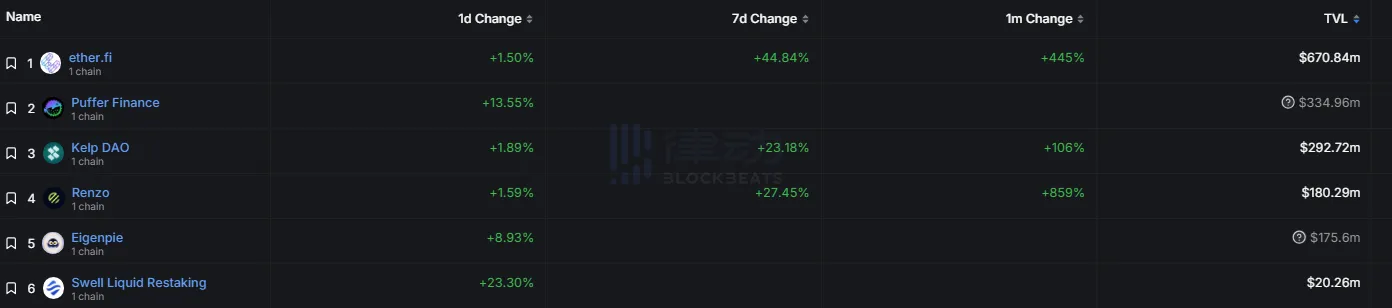
At the beginning of this year, various airdrops dazzled people and also triggered a wealth effect. However, unfunded projects have become the focus of everyone's attention. Among them, the ETH staking protocol Eigenlayer has become the first choice for users. With the increase in expectations for Eigenlayer's funding, many projects have come up with the idea of "nested dolls", and restaking projects have emerged one after another. So, facing the numerous LRT protocols, which one should you choose to maximize your profits? What strategy is best suited to my needs? On February 5th, Eigenlayer will briefly open LST deposits, which is bound to trigger a new Gas War and LRT protocol competition. Related reading: "Eigenlayer LRT emerges one after another, which one should you choose to maximize your profits?", "Inventory of 47 Restaking projects, who can finally break through the siege?"
Binance Labs Invests in Ethereum Liquidity Staking Protocol Puffer Finance
On January 30th, Binance Labs announced its investment in Ethereum liquidity staking protocol Puffer Finance. Puffer Finance is a protocol built on EigenLayer and has been supported by multiple well-known investors, including Brevan Howard Digital, Jump Crypto, and Lightspeed Faction. Binance Labs' investment will be used for the development of Puffer's Layer 2 network and the launch of its native liquidity staking token pufETH. On February 2nd, the TVL of LSD protocol Puffer Finance has exceeded 160 million US dollars. Since its launch for staking yesterday, Puffer Finance has attracted more than 7.8k users who have deposited more than 69k stETH (worth about 160 million US dollars) in total, with an average staking amount of 8.36 stETH and a median of 0.77 stETH. Related reading: "Puffer Finance: LSDfi Protocol Lowering the Barrier to Entry for Independent Validators"
Solana's new token standard Tiny SPL goes live on AMM, and DN (Deez Nuts) token's significant surge attracts attention
On January 27th, Solana's new token standard Tiny SPL went live on AMM trading. Subsequently, its DN (Deez Nuts) token's floor price surged by 185% in 24 hours, attracting attention. The community first noticed Tiny SPL because it was retweeted and pinned by Solana co-founder Anatoly on his Twitter homepage. BlockBeats previously introduced Tiny SPL in an article published on January 5th titled "What is the new token standard Tiny SPL that was pinned by Solana's co-founder on Twitter?". Deez Nuts was initially available for free minting, but after the minting was completed, its floor price rapidly dropped to less than 0.001 SOL after breaking through 0.2 SOL. With the recent launch of AMM trading, Deez Nuts' liquidity has been activated, and Tiny SPL has once again attracted attention. Related reading: "After doubling in value on AMM, Solana co-founder's pinned "peanut" Deez Nuts is reborn".
FTX is expected to fully pay customer claims in bankruptcy liquidation, but will not restart
On February 1st, according to Reuters, FTX bankruptcy lawyers stated that FTX is expected to fully repay cryptocurrency customer assets in bankruptcy liquidation. In addition, due to the lack of buyers, FTX has also abandoned plans to restart. As FTX has decided to fully compensate user assets, many users are particularly concerned about the compensation terms and amounts. In addition, FTX platform coin FTT was affected by this news, and the price "halved" and fell below $2. Related reading: "FTX Abandons Restart Plan, How to Compensate Becomes the New Focus"
Hong Kong Launches Investigation into WorldCoin's Alleged Violation of Collecting Customer Iris Data
On January 31st, Hong Kong launched an investigation into WorldCoin's alleged violation of collecting customer iris data. The Hong Kong authorities searched six locations of "Worldcoin" in Hong Kong, including Yau Ma Tei, Kwun Tong, Wan Chai, Cyberport, Central, and Causeway Bay, based on a court order. The Hong Kong authorities urge citizens to be vigilant and not to provide personal biometric data for identification purposes easily.
Binance Labs clarifies that it did not participate in the latest round of financing for SkyArk Chronicles, whose interface is suspected to be associated with "Taiwan independence"
On January 12th, the 3A game platform SkyArk announced that it had completed a $15 million financing round led by Binance Labs. On January 29th, Binance Labs clarified that it did not invest in the latest round of financing for SkyArk Chronicles, sparking community discussion. Binance Labs stated that "SkyArk Chronicles is a project incubated and invested by Binance Labs in the third phase of the Binance Labs incubator in 2021; Binance Labs did not participate in the latest round of financing announced by the project this year." Binance Labs once again stated that the financing news of SkyArk Chronicles was announced without their knowledge. In response, the founder of SkyArk explained that "there was indeed a $15 million financing, which was a multi-round financing of coin rights and equity. Only one round of coin rights financing was conducted, in which Binance Labs participated and held the largest share. Binance Labs may have misunderstood that SkyArk conducted another round of coin rights financing."
Other than that, what has sparked heated discussions in the community is the SkyArk Chronicles website's suspected "Taiwan independence" interface, which was subsequently deleted. Related reading: "SkyArk's clever move, playing a good hand to ruin".
Bitcoin Layer 2 network Merlin Chain will officially launch in February this year and will introduce incentive activities
On January 29th, NanFeng, CEO of Lumoz (formerly Opside), spoke at the "Bitcoin Layer 2 Year, How to Layout?" themed space hosted by BlockBeats, stating that the Bitcoin Layer 2 network Merlin Chain will officially launch in February this year and will introduce some incentive activities. Merlin Chain will adopt a fair launch approach. It is reported that Merlin Chain is a Bitcoin Layer 2 network released by Bitmap Tech, focusing on the native assets, protocols, and user ecology of Bitcoin Layer 1, and innovating and amplifying the asset potential of Layer 1 on Layer 2. The team's main products include Bitmap.Game (Bitmap Metaverse), BRC-420 protocol (asset protocol based on modular data), and Recursiverse (product matrix based on recursive protocol). Related reading: "Merlin Chain founder Jeff talks about Bitcoin L2: breakthroughs and challenges in the ecological wave"
This Week's Popular Articles
Beginner's Advice from Godfish: What You Need to Do in the Crypto Market from $1000 to $100 Million
With the expansion of the cryptocurrency industry market value, the wealth scale of each user has undergone varying degrees of changes. In the journey of personal wealth growth, the amount of funds held and investment strategies vary. This article summarizes the advice given by Cobo co-founder and CEO Shenyu to newcomers on Weibo two years ago, which still has many valuable insights today. Recently, he also reposted this sentiment on X. It should be noted that at that time, the DeFi craze was in full swing, so Shenyu mentioned the importance of paying attention to DeFi project airdrops multiple times in this article. However, the Crypto market has undergone significant changes this year, so novice users should consider the changes in the market environment when learning and not blindly follow the advice given in this article.
A Summary of Potential Airdrops in 2024, Have You Claimed Them All?
In January, we have already received the ZKF and MANTA airdrops, and confirmed the airdrop plans for ALT, NAM, DYM, SAGA, and FRAME. Don't ask about "Wen" anymore, the answer is 2024. This article covers some relatively credible potential bearish information for this year.
Why is only BRC-420 rising when the Bitcoin ecosystem is generally down?
In the past few weeks, with the decline of Bitcoin, the inscription market seems to have entered a small "low tide" again. Fortunately, the news of several protocols launched on OKX in recent days has made several related inscription assets active and increased in value. Some time ago, a table of the rise and fall of Bitcoin community assets on January 24th, organized by the community, was widely spread. It is obvious that on that day, the BRC-420 asset rose against the trend when all the inscription ecological assets were falling.
Vitalik's 30th Birthday Reflection: It's Time for the Next Generation to Take Over My Mantle
On Vitalik's 30th birthday, he published a long article titled "The end of my childhood". Vitalik expressed his thoughts on various topics such as the technology of Ethereum, the current state of the crypto world, the Russia-Ukraine war, life and death, growth and experience. At the same time, he also stated: "I am now playing a different role, and it is time for the next generation to take over what used to be mine."
The data availability layer has become an important component of modular architecture, serving as a plug-in component to reduce costs and expand the blockchain. The core function of the DA layer is to ensure that on-chain data is available for use and access by all network participants. Historically, each node had to download all transaction data to verify its availability, which was an inefficient and costly task. This is how most blockchains currently operate and is a barrier to scalability, as the amount of data required for verification increases linearly with block size. End users suffer here: data availability costs account for 90% of the transaction costs incurred by users trading on Rollup (currently, the cost of sending transaction data to Ethereum on Rollup is $1300-1600/mb).
SkyArk's amazing operation, playing a good hand to pieces
On the afternoon of January 29th, Binance Labs suddenly stated on Twitter that they have never invested in the 3A game platform SkyArk Chronicles, sparking community discussions. Previously, on January 12th, SkyArk announced on X platform that they had completed a $15 million financing round led by Binance Labs. However, in today's tweet, Binance Labs wrote that "SkyArk Chronicles is a project incubated and invested by Binance Labs in the third phase of the Binance Labs incubator in 2021; Binance Labs did not participate in the latest financing round announced by the project this year." This has left many users who participated in the SkyArk IPO confused.
AMM doubled after launch, and "Peanut" Deez Nuts, endorsed by Solana founder, is reborn
Deez Nuts was initially available for free minting, but after being fully minted, the floor price of DN rapidly dropped to less than 0.001 SOL after breaking through 0.2 SOL. Recently, with the launch of AMM trading, the liquidity of Deez Nuts has been activated, and Tiny SPL has once again attracted attention.
明牌「抢项目」,L2 蛋糕还没做大就开始内卷了
Translation:
From Fellowship to Stack, and now to RaaS, the competition between L2 has reached the gaming industry. On January 30th, Ben Jones, co-founder and chief scientist of Optimism, proposed that Treasure join the Optimism Superchain and build the Treasure Chain based on the OP Stack. Shortly thereafter, Omar, the BD manager of Matter Labs, the developer of zkSync, proposed in the TreasureDAO community that Treasure Chain use ZK Stack as Layer2.
超 36 亿美元的以太坊再质押,套娃年来了
Translation:
Over 3.6 billion US dollars of Ethereum re-staked, the year of "toad" has come
According to Dune data, the total amount of ETH staked on the Ethereum beacon chain has exceeded 29.42 million, accounting for 24.53% of the total ETH supply. Since the Shanghai upgrade of Ethereum, the net inflow of staking has reached 9.5513 million ETH, indicating that native ETH staking is in full swing. However, the market seems to be no longer satisfied with the risk-free staking rewards in the primary market. As a result, more and more re-staking protocols have emerged, and major staking platforms have launched their own re-staking protocols.
Blast testnet goes live, what projects are already in the ecosystem?
This week, as Blast's user base surpassed 100,000 and TVL exceeded $1.3 billion, the Blast testnet officially launched and the BIG BANG competition began simultaneously. Blast stated that the winning DApps will be promoted to Blast users after the mainnet launches at the end of February. As a result, winning teams can use Blast airdrops to incentivize the development of their DApps on the Blast mainnet and gain core advantages such as liquidity guidance from the start.
Blast 被质疑抄袭 OP 代码,「流水线 L2」背后一地鸡毛?
Translation:
Blast accused of plagiarizing OP code, what's behind "Pipeline L2"?
Last week, Blast's testnet officially launched and the BIG BANG competition began, attracting many cryptocurrency enthusiasts and developers, as Blast's user base exceeded 100,000 and TVL surpassed $1.3 billion. Among these competitors, EVM security engineer @0xKaden discovered issues with Blast's codebase. On February 1st, @0xKaden tweeted that Blast changed Optimism's MIT license to BSL. Gaslite co-founder @PopPunkOnChain subsequently compared Blast's and Optimism's codebases. It can be seen that in the original Optimism codebase, the first line reads "// SPDX-License-Identifier: MIT", while in Blast's submission interface, "MIT" was changed to "BSL".
Welcome to join the official community of BlockBeats by LuDong
Telegram subscription group: https://t.me/theblockbeats
Welcome to join the official BlockBeats community:
Telegram Subscription Group: https://t.me/theblockbeats
Telegram Discussion Group: https://t.me/BlockBeats_App
Official Twitter Account: https://twitter.com/BlockBeatsAsia

 Related Articles