Binxin Ventures: Why did we invest in DLC.Link?
Source: Binxin Ventures
Introduction
As an early BTC holder and staunch supporter, Bixin Ventures has always been committed to the BTC ecosystem. We believe that BTC assets should play a greater role in excellent DeFi protocols on various chains and earn more profits. Therefore, efficient cross-chain bridges are necessary, so we invested in DLC.link in early last year.
With the rise of inscription assets and the expansion of the Bitcoin data flow network, there are more and more Bitcoin applications. In the face of its limited native smart contract functionality, Bixin Ventures sees DLC.Link as an innovative solution. After the collapse of FTX, the market urgently needs a secure and decentralized Bitcoin alternative. DLC.Link is in line with our vision and is committed to establishing a secure and trustless ecosystem, promoting the application of Bitcoin in various scenarios.
DLC.Link Technical Analysis
DLC Technology: How to Use Schnorr Signatures in Taproot Upgrade
Bitcoin introduced Schnorr signatures in the Taproot upgrade, which is a more secure alternative to ECDSA for creating and verifying keys. Schnorr signatures have linear properties, allowing for efficient verification of multiple transactions by combining public keys and signatures [1]. Discreet Log Contracts (DLC) make full use of the Schnorr and PTLC technologies already implemented in Tarproot. Since these two technologies are native to the Bitcoin network, DLC does not rely on L2 or sidechains. Instead, DLC is protected by the computing power of the entire Bitcoin network, making it more secure and reliable.
In the scenario of using DLC technology for lending, we usually use Schnorr signatures to process conditional outcomes. In this process, each party generates a unique key, combines it with their respective long-term keys to form a "public key", and prepares signatures for each potential outcome, such as repayment or liquidation. Next, a decentralized witness network confirms real-world results through careful log numbering, unlocks the prepared signatures, and triggers contract execution on the blockchain [2]. This demonstrates the universality, flexibility, and security of DLC technology in practical applications.
DLC technology ensures the security of on-chain Bitcoin without validators
The Discreet Log Contract (DLC) no longer requires external validators, but instead directly inherits the security of Bitcoin to ensure on-chain security [2]. In the DLC.Link architecture, the Attestor network is an innovative design as witnesses (Attestors), as off-chain service providers, actively monitor the blockchain and publicly announce DLC events in JSON format through smart contracts. After obtaining the corresponding results from the data source (another smart contract on another blockchain), the witnesses prove and sign them. To enhance security, DLC.Link uses a 5-of-7 witness multi-signature to reduce the risk of collusion between witnesses and contract parties. DLC.Link manages contracts by randomly selecting untrusted witnesses from a whitelist [3]. The design also allows third parties to operate witness nodes, further promoting decentralization. The decentralized witness network avoids single points of failure and effectively promotes the creation and signing requests of DLCs. This comprehensive design not only protects the integrity, security, and flexibility of Bitcoin transactions, but also proves that DLC.Link is the ideal infrastructure for integrating BTC with decentralized finance (DeFi).
FROST Signature: How to Enhance the Security of DLC Technology
DLC.Link also integrates FROST (Flexible Round-Optimized Schnorr Threshold Signatures) to enhance security and simplify attester management. FROST's key sharing feature gives the attester network dynamic management capabilities, allowing for rapid adjustments of participants without affecting service integrity [4]. When setting or changing attesters, the system collaboratively generates keys. The entire process simultaneously creates shared keys and individual keys for each attester. The flexibility of this key generation mechanism ensures that the attester network can be safely modified in the future without interrupting service.
When a blockchain event triggers the creation of a DLC contract, the coordinator among the witnesses broadcasts the "create-dlc" command, which generates a consensus-supported DLC announcement. Similarly, when it is time to close the DLC, a blockchain event prompts the coordinator to arrange for the final witnesses to be created, with each witness's signature ensuring the contract's security and verifiable conclusion. This advanced upgrade introduces the ability to dynamically adjust the witness network and significantly reduces computational complexity while maintaining strict security standards.
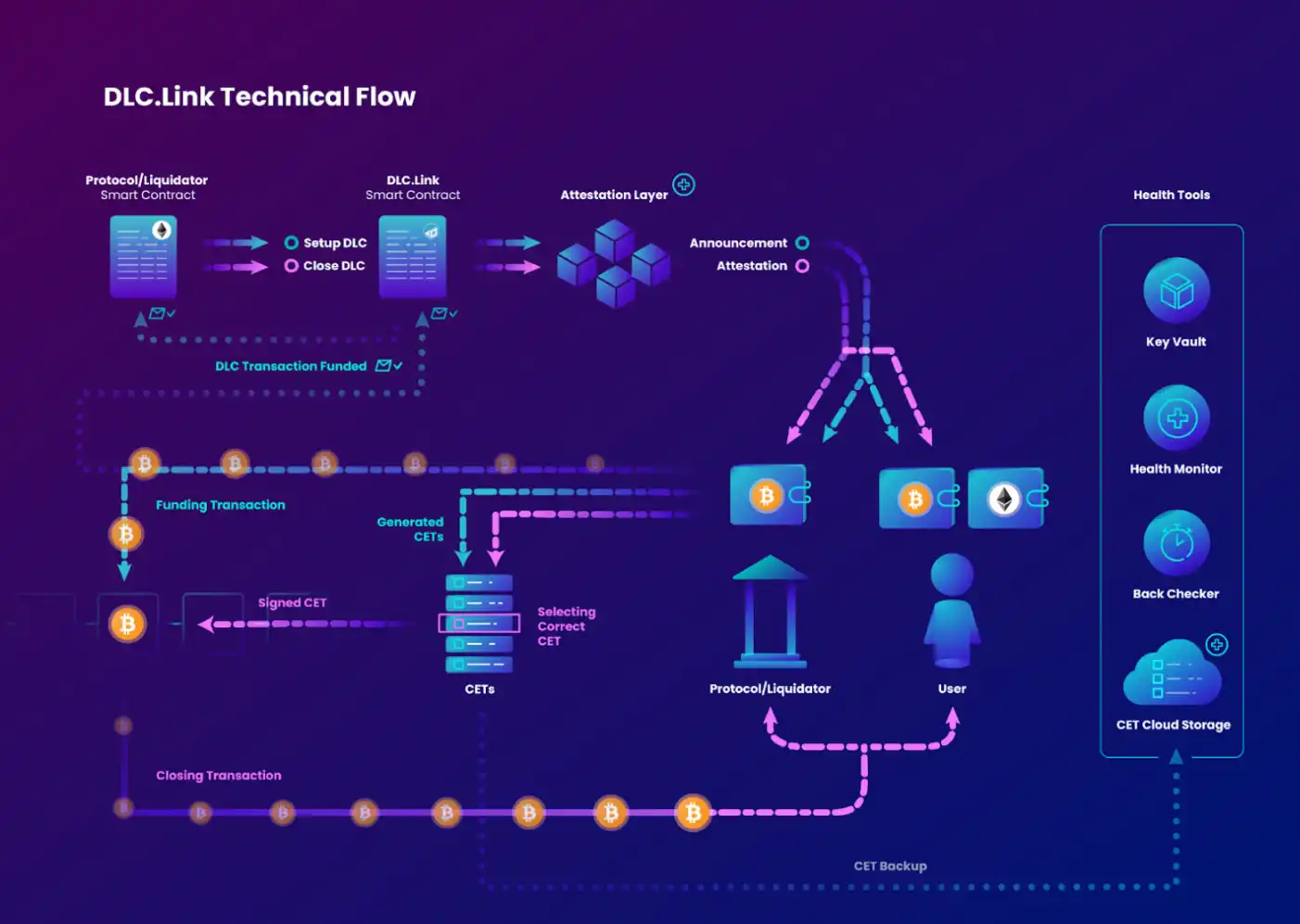
Figure 1. DLC.Link Technology Process
DLC.Link Product Introduction
dlcBTC
dlcBTC will be launched in early 2024, standing at the forefront of decentralized finance (DeFi), providing non-custodial Bitcoin on the Ethereum network through careful log contracts (DLCs). With dlcBTC, users can "self-escrow" deposits, locking BTC themselves and having the locking mechanism protected by an oracle. dlcBTC depositors do not send BTC to DLC.Link or any third party.
During this groundbreaking process, users securely lock their bitcoins into DLC.Link to create equivalent dlcBTC. DLC serves as a digital safe on the Bitcoin blockchain, establishing pre-signed contracts between users and protocols. Even more secure, key distribution uses a 2-of-2 multisignature UTXO mechanism, where one key is held by the user and the other key is intelligently distributed in a trusted proof-of-stake node network.
Due to many vulnerabilities, cross-chain bridges have a bad reputation. DLCs are a unique solution because they solve the problem of cross-chain communication without the security issues of bridging. Unlike bridged assets such as wBTC, dlcBTC does not require intermediaries and instead chooses to have the entire hash rate of the Bitcoin network protect the asset. dlcBTC v1 will be launched in Q1 2024, introducing features such as whitelist access, strict security measures, multi-functional trading pairs, and seamless integration with existing DeFi protocols, marking a significant advancement in the decentralized finance field [5].
We believe that after Bitcoin, the most decentralized network is Ethereum. Therefore, through dlcBTC, we are committed to bringing native BTC into the Ethereum network's DeFi without building another small, untested, and more dangerous L2 or solution. The minted dlcBTC tokens are used as collateral on well-known DeFi platforms (such as Curve and AAVE) and enable users to actively participate in DeFi activities such as investing, lending, and hedging.
DLC.Link's extensive application in the Bitcoin ecosystem
DLC.Link is a force for change in the wider Bitcoin ecosystem, offering a range of applications through its Discreet Log Contract (DLC). This innovation is particularly significant for various parties, including credit trading desks, chief brokers, digital asset custodians, exchanges, and over-the-counter trading desks. This integration allows custodians to extend financial services to self-custodied Bitcoin clients, supporting custody of local Bitcoins and conditional instant transfers, as well as providing lending services to miners and other self-custodied Bitcoin clients.
DLC.Link plays an equally extensive and influential role in decentralized finance (DeFi). Its integration promotes the development of on-chain Bitcoin collateralized loans and stablecoins, providing advantages for lending protocols. Additionally, DLC.Link can seamlessly expand to cross-chain protocols to transfer local Bitcoins between different blockchains. Currently, BRC-20 assets are popular, and DLC.Link can also accept them for cross-chain bridging [6]. Furthermore, it supports the trading and lending of inscribed assets in NFT markets (such as OpenSea) and other smart contract-based platforms, bringing new use cases to DeFi.
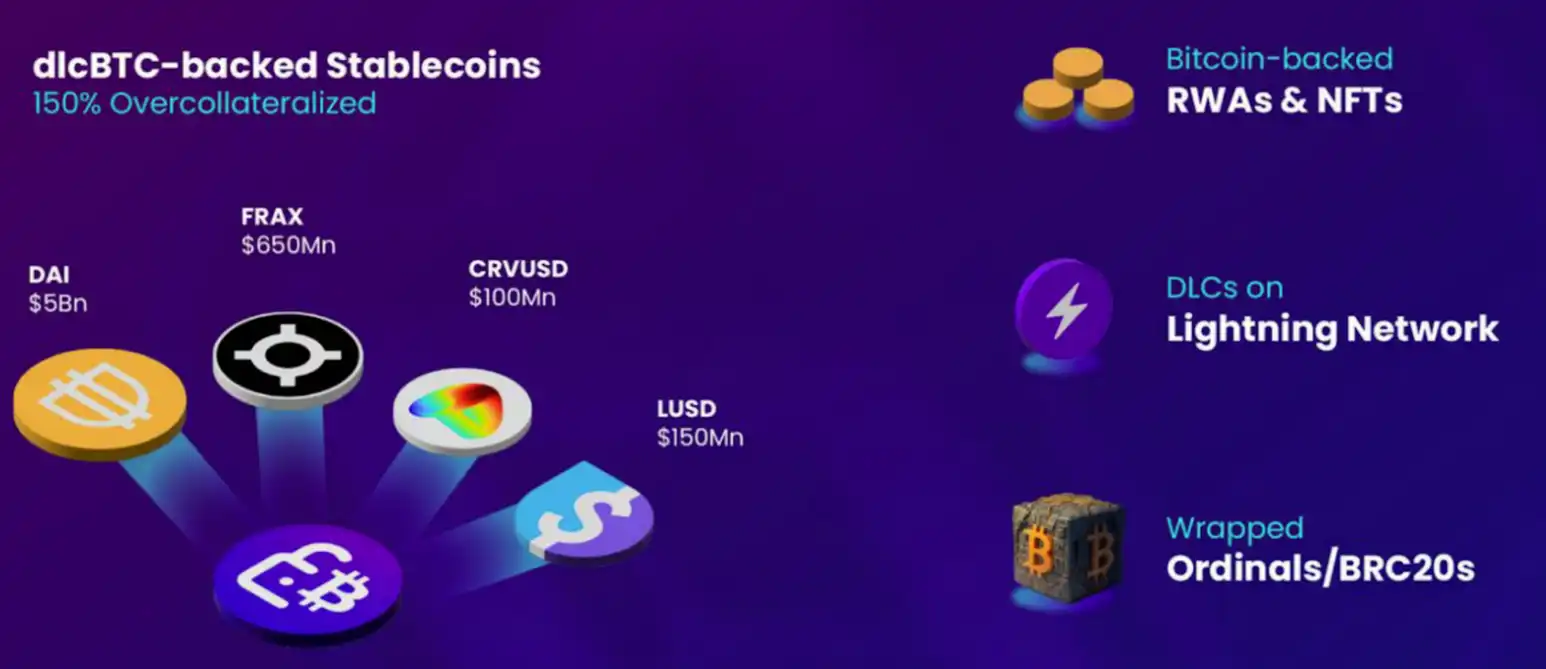
Figure 2. DLC.Link Use Cases
Conclusion
Bixin Ventures strategically invested in DLC.Link in the early seed round, hoping for its seamless integration with decentralized finance (DeFi) to help solve the challenges facing the Bitcoin ecosystem. DLC technology overcomes the limitations of Bitcoin's smart contracts, better utilizing Bitcoin's powerful security to provide a more secure solution. The recent Schnorr Signatures in the Taproot upgrade further enables DLC.Link to establish a network of witnesses, while the integration of FROST further improves the dynamic management of witnesses. The launch of dlcBTC also responds to the growing demand for secure, decentralized self-wrapped Bitcoin. In addition, DLC.Link also has huge potential in other product applications, including self-custody deposits in CeFi and cross-chain inscriptions in DeFi. Bixin Ventures' strategic investment in DLC.Link demonstrates its commitment to shaping decentralized finance (DeFi). We recognize DLC.Link's innovative contribution in the crypto field and foresee its critical role in providing Bitcoin liquidity for the entire wider crypto ecosystem.
References:
[1] Namcios. Why You Should Care About Taproot, The Next Major Bitcoin Upgrade. Bitcoin Magazine. Retrieved from https://bitcoinmagazine.com/technical/short-bitcoin-taproot-explainer
[2] Dryja, T. Discreet Log Contracts. Retrieved from https://adiabat.github.io/dlc.pdf
[3] DLC.Link. How DLCs Secure Bitcoin On Chain without Validators. Retrieved from https://www.dlc.link/blog/how-dlcs-secure-bitcoin-on-chain-without-validators
[4] Komlo, C., & Goldberg, I. FROST: Flexible Round-Optimized Schnorr Threshold Signatures. Retrieved from https://eprint.iacr.org/2020/852.pdf
[5] DLC.Link. DLC.Link Introduces dlcBTC. Retrieved from https://www.dlc.link/blog/dlc-link-introduces-dlcbtc-a-game-changing-bitcoin-bridge-for-trustless-defi-operations
[6] DLC.Link. DLC.Link Docs Generic Use Cases. Retrieved from https://docs.dlc.link/applications/generic-use-cases
This article is from a submission and does not represent the views of BlockBeats.
Welcome to join the official BlockBeats community:
Telegram Subscription Group: https://t.me/theblockbeats
Telegram Discussion Group: https://t.me/BlockBeats_App
Official Twitter Account: https://twitter.com/BlockBeatsAsia

 Related Articles