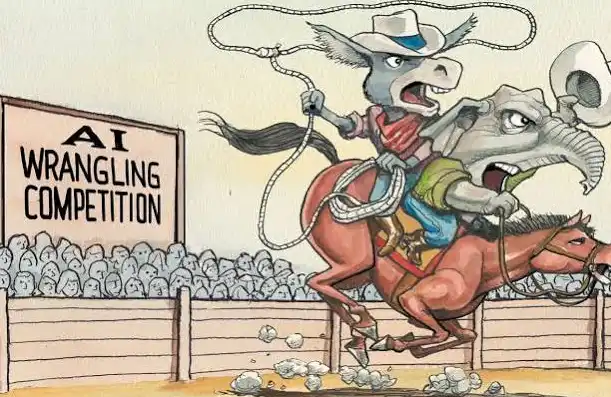
In the cryptocurrency industry, having patience will increase your chances of success.
Original author: 0XKYLE
Translated by: Deep Tide TechFlow
One of my core goals for 2024 as a practitioner in the encryption industry is to begin shifting trading frequency from a few hours to a few days.
I believe there are several core principles in the financial market: I believe that simplicity is key, and investors should focus on their own areas. Trading too frequently is actually detrimental to their trades.
Many people who are familiar with my articles know that I adopt a very "high conviction betting" trading style. I like to bet on asymmetric opportunities and I like to double down. The problem with these types of trades is that they are often capital-intensive and have a very long lock-up period before the trade pays off.
Now, this is not a problem in itself. This is what I believe is the essence of trading: you wouldn't think there's a problem just because venture capital firms have long transaction cycles. You wouldn't say "this money could be used for something else" because that would mix different trading styles and maximize profits.
The problem is that when your investment portfolio is small, capital efficiency is the key factor to pay attention to. You simply cannot operate at the same funding level as venture capital firms, and your goals are vastly different.
Turning 10,000 into 100,000 and turning 1 million into 100 million are very different, and there are many articles that discuss the different risk preferences that people with different net assets should adopt. For example, if your funds are less than five figures, your focus should be on airdrops and memes. If your funds are in the range of A5-A6, you should look for coins with medium market value in the market. If your funds are A6 or above, you can pursue coins with high market value.
Of course, this is purely hypothetical advice. But you understand my meaning - in situations where funds are limited, the general consensus is that you should maximize the risk curve indicators and pursue high risk, high return strategies like Degen.
So what should I do?
I won't say what is right or wrong, because as far as I know: the investment world is full of subtle differences. A person never steps into the same river twice, because it is not the same river, and he is not the same person. Similarly, a trade will not remain the same, because it is not the same trade at different points in time.
Back to my trading principles: I believe that simplicity is key, and investors should focus on their own field. Trading too frequently is actually detrimental to one's own trading.
This means that I believe in trading your strengths. If your strength is high-frequency trading, then focus on high-frequency trading and don't worry about other things.
I believe that 99% of cryptocurrency Twitter articles make this issue too complicated. High-frequency trading does not involve fancy strategies or complex financial derivatives. I believe the solution is much simpler. That is - just be patient and wait.
What about the higher opportunity cost of other trades? If your advantage is having a higher trading success rate over a longer period of time, earning more money, then why would you do anything else?
Just like if you're not a singer, why bother trying so hard to become good at singing? Did Buffett try to master algorithmic trading? Did Cheetah try to become better at swimming? No, they didn't!
If your advantage is high-frequency trading, then stick with it! This is also why I advocate that most people should not become day traders. They should have a decent-paying job and treat the financial markets as a hobby.
The next question is: What if I am not good at high-frequency trading? My answer is simple: the essence of the market is long-term bullish.
For the past 20 years, people have been advocating "Dollar-Cost Averaging into the S&P 500" as an investment strategy, and this method works! The key point is that the view that "the market will rise in the long run" is a fact.
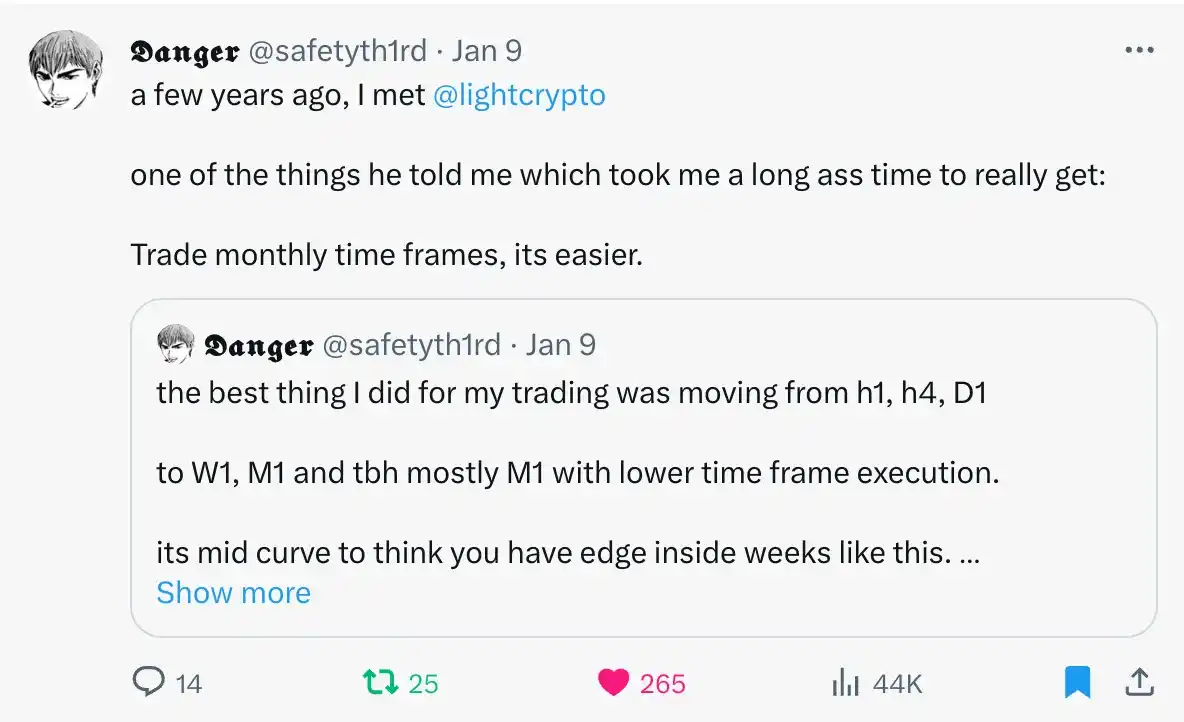
If you frequently go long on Bitcoin on the hourly candlestick chart, your success rate will only be 50%. However, if you go long on a monthly time frame, your success rate should be as high as 70%. Of course, the longer the time frame you go long on Bitcoin, the higher your success rate will be.
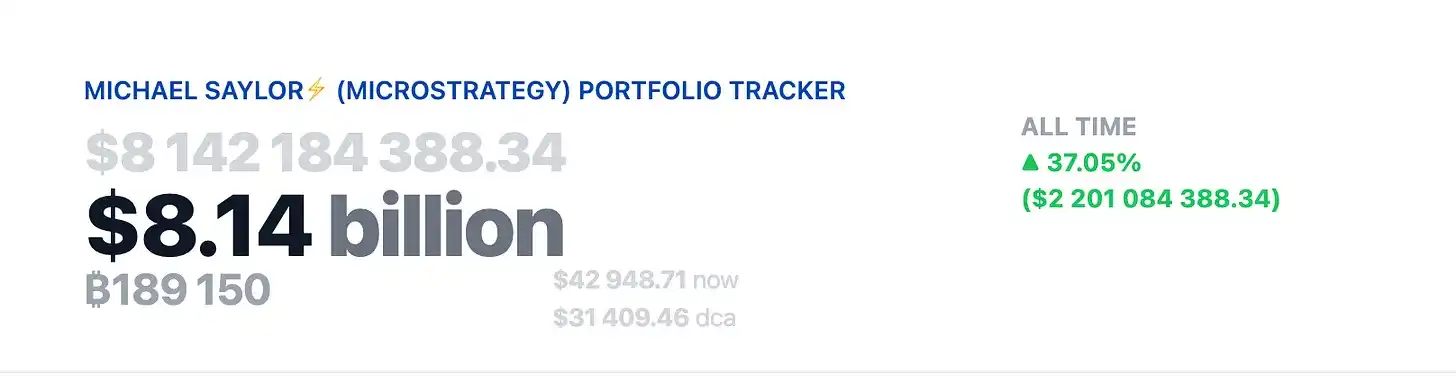
Michael Saylor (CEO of MicroStrategy) is a great example. He bought Bitcoin at 69,000 and also at 30,000. Every time he bought, people laughed at him. But looking at the current price, his profit has reached 2 billion US dollars.
Conclusion Thinking
Even if your net worth is only A5, I still believe that you can become a long-term trader, it just takes more time. I know this because it's what I do and what I will continue to do. Of course, maybe my time frame isn't as long as decades - they're more like days to months. But even so, I find that I am making more profits.
Overworld is a 3-week operation that earned me 3 times the profit.
Node Monkes is an operation that has been ongoing for a month, and currently the profit and loss are balanced.
TAO is the cryptocurrency that I have held for several months, and I have earned twice the amount.
What I truly discovered is that patience is an advantage, because few people truly possess it.
Original article link
Welcome to join the official BlockBeats community:
Telegram Subscription Group: https://t.me/theblockbeats
Telegram Discussion Group: https://t.me/BlockBeats_App
Official Twitter Account: https://twitter.com/BlockBeatsAsia