Vitalik’s 30-year-old life experience: It’s time for the next generation to take over the mantle that once belonged to me
Original author: Vitalik Buterin
Original translation: TechFlow
Introduction
Thirty years old.
Today is Vitalik's 30th birthday. At this important node in his life, he also published a long article titled "The end of my childhood".
Looking through the full text, Vitalik expressed his feelings on many topics such as Ethereum's technology, the current state of the crypto world, the Russian-Ukrainian war, survival and death, growth and experience. At the same time, he also said:
"I am playing a different role now, and it's time for the next generation to take over the mantle that once belonged to me."
As a core figure in the crypto world, Vitalik has also traveled around the world in the past, practicing his technical ideas as a digital nomad. At the same time, he has gained more insights and sense of responsibility when facing different cultures around the world.
"Cryptocurrency is not just a financial story, it can be part of a broader story of creating better technology."
This long article can be said to be a comprehensive review and outlook of Vitalik's personal experience and the entire crypto world when he was 30 years old. It is rich in content and true in emotion.
Deep Tide TechFlow compiled the full text and shared it with all readers:
One of my most profound memories over the past two years is speaking at hackathons, visiting hacker houses, doing Zuzalu in Montenegro, and seeing people who are a full decade younger than me take on leadership roles in various projects as organizers or developers: crypto auditing, Ethereum layer 2 expansion, synthetic biology, and more. One of the memes of the Zuzalu core organizing team is 21-year-old Nicole Sun, who invited me to visit a hacker house in South Korea a year ago: a gathering of about 30 people, and I remember it was the first time I was the oldest person in the room.
When I was the same age as the current hacker house residents, I remember a lot of people praising me as one of the awesome, young prodigies who was changing the world like Zuckerberg.
Now I cringe a little bit at this, both because I don't like the attention and because I don't understand why people had to translate "Wonder Boy" into German when it works just fine in English. But watching all these people who are further along than I was and younger than I was made it clear to me that if that was my role, it's not anymore. I play a somewhat different role now, and it's time for the next generation to take up the mantle that was once mine.
Path to the Hacker House in Seoul, August 2022. Photographed because I couldn’t tell which house I was supposed to enter, and I was communicating with the organizers to get that information. Of course, the house ended up not being on this path at all, but in a more prominent spot about twenty meters to the right of it
1
As a proponent of life extension (meaning, conducting medical research to ensure that humans can actually live for thousands or millions of years), people often ask me: isn’t the meaning of life intimately tied to the fact that it’s finite: you only have a small portion of it, so you have to enjoy it?
Historically, my instinct has been to dismiss this idea: while from a psychological perspective we tend to value things more if they’re finite or scarce, it’s simply absurd to think that a long-standing grudge could be so bad that it’d be worse than literally ceasing to exist. Besides, I sometimes wonder if even if immortality turns out to be that bad, we could always simultaneously increase our “excitement” and decrease our lifespans by simply choosing to have more wars. The fact that the non-sociopaths among us reject this option today strongly suggests to me that we would reject it as well once it became an actual option, as it does in terms of biological death and suffering.
However, as I’ve gotten older, I’ve realized that I don’t even need to argue any of this.
Whether our lives as a whole are finite or infinite, every good thing in our lives is finite. Friendships you thought were eternal slowly fade away into the mists of time. Your personality can completely change in 10 years. Cities can completely change, for better or worse. You can move to a new city on your own and start the process of familiarizing yourself with the physical environment all over again from scratch. Political ideologies are finite: you might build an entire identity around your views on top marginal tax rates and public healthcare, and ten years later feel completely lost once people seem to stop caring about those topics altogether and instead spend all their time talking about “wokeness,” “bronze age mentality,” and “e/acc.”
A person’s identity is always tied to their role in the wider world they inhabit, and over a decade not only does a person change, but the world around them changes as well. One change in my thinking that I’ve written about before is that it involves less economics than it did a decade ago. The main reason for this shift is that I spent a good portion of the first five years of my crypto career trying to invent mathematically provably optimal governance mechanisms, and I ended up discovering some essentially impossible results that made it clear to me that:
(i) what I’m looking for is impossible, and (ii) the most important variables that determine the success of existing flawed systems in practice (often the degree of coordination between subgroups of participants, but also other factors that we often simplify as “culture”) are variables that I don’t even model.
Math used to be a major part of my identity: I was heavily involved in math competitions in high school, I started doing a lot of coding on Ethereum, Bitcoin, and elsewhere soon after I got into crypto, I got excited about every new cryptographic protocol, and economics seemed to me to be part of a broader worldview: it was a mathematical tool for understanding and figuring out how to improve the social world. All the pieces fit together neatly.
Now, the pieces fit together less often. I still use math to analyze social mechanisms, although the goal is more often to come up with rough first guesses about what might work and mitigate worst-case behavior (in the real world, this is often done by robots rather than humans) than to explain average-case behavior. I write and think more now, often using very different arguments even when supporting the kind of ideals I supported a decade ago.
One of the things that fascinates me about modern AI is that it lets us engage mathematically and philosophically in different ways with the hidden variables that guide human interaction: AI can make "resonance" legible
All these deaths, births, and rebirths, whether of collections of minds or people, are ways that life is finite. These deaths and births will continue to occur in a world where we live two centuries, a thousand years, or the same planet as the main sequence. If you personally feel that life doesn't have enough finiteness, death, and rebirth, you don't have to start a war to add more: you can also make the same choice as I did and become a digital nomad.
2
Grads are falling in Mariupol.
I still remember that at 7:20 p.m. local time on February 23, 2022, I was anxiously looking at my computer screen in my hotel room in Denver. For the past two hours, I had been simultaneously scrolling Twitter for updates and repeatedly contacting my father, who had the same thoughts and fears as me, until he finally sent me that decisive response. I sent a tweet that made my position on the issue as clear as possible, and I kept following it. I stayed up late that night.
The next morning, I woke up to see the Ukrainian government’s Twitter account desperately asking for donations in cryptocurrency. At first, I thought it couldn’t be real, and I was very worried that the account had been opportunistically hacked: someone, perhaps the Russian government itself, was taking advantage of everyone’s confusion and desperation to steal some money. My “safety mentality” instinct took over, and I immediately began tweeting warning people to be careful while looking through my network for people who could confirm or deny whether the ETH address was real. An hour later, I was convinced that it was, in fact, real, and I publicly relayed my conclusion. About an hour later, a family member sent me a message stating that given what I had done, it would be best for my safety not to return to Russia.
Eight months later, I watched the crypto world go through a very different kind of turmoil: the public demise of Sam Bankman-Fried and FTX. At the time, someone posted a long list of “crypto protagonists” on Twitter, showing which ones had fallen and which ones were still intact. The casualty rate for this list is high:
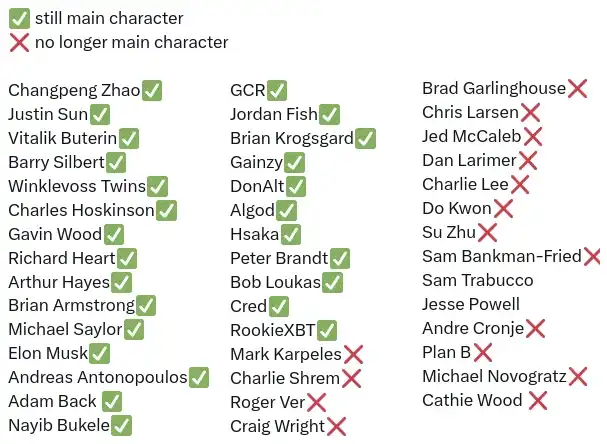
SBF The situation was not unique: it was a mix of MtGox and several previous upheavals that engulfed the crypto world. But this was a moment of realization, of understanding that most of the people I had once looked to as the guiding lights of the crypto world, the people I had been comfortable following since 2014, were no longer around.
People who watch me from afar often assume that I am a high-achieving person, presumably because that is what you would expect from a “protagonist” or “project founder” who is a “college dropout.” In reality, however, I am anything but. The virtues I cherished as a child were not the virtues of being creative in starting a unique new project, or showing courage when it was needed, but rather the virtues of being a good student who showed up on time, did his homework, and earned a 99% average.
My decision to drop out of school wasn’t a brave step taken out of conviction. It started in early 2013 when I decided to take a paid internship to work for Ripple over the summer. When US visa complications prevented that, I instead spent the summer working with my Bitcoin Magazine boss and friend Mihai Alisie in Spain. At the end of August, I decided I needed to spend more time exploring the world of crypto, so I extended my vacation to 12 months. It wasn’t until January 2014, when I saw hundreds of people cheering for my Ethereum talk at BTC Miami, that I finally realized I had chosen to leave college for good. Most of my decisions in Ethereum have involved responding to pressure and requests from others. When I met Vladimir Putin in 2017, I didn’t try to arrange a meeting; rather, it was suggested by someone else and I pretty much said “sure.”
Now, five years later, I have finally come to realize that (i) I had been complicit in legitimizing a genocidal dictator, and (ii) I no longer have the luxury of sitting back and letting the mysterious “Others” run the show in the crypto space.
Both events, though they differed in the type and scale of tragedy, burned similar lessons into my mind: I actually have responsibilities in the world, and I need to be intentional about how I operate. Doing nothing, or living on autopilot and allowing myself to simply become part of someone else’s plans, is not an automatically safe, or even blameless, course of action.
I am one of the mysterious Others, and it is up to me to play that role. If I don’t, and the crypto space either stagnates or becomes dominated by opportunistic money grabbers, then I have no one to blame but myself. So I decided to be cautious about accepting other people’s plans and be more high-profile about my own: fewer ill-considered meetings with random powerful people who were only interested in me as a source of legitimacy, and more doing things like Zuzalu.
Zuzalu flag in Montenegro, spring 2023
3
On to happier things—or at least challenges that are more like math puzzles than falling down on a run and needing to walk 2 kilometers to get medical attention with a bloody knee. The author won’t share any more details, noting that the internet has gotten pretty good at turning a photo of a rolled-up USB cable in his pocket into a meme suggesting something entirely different, and he certainly doesn’t want to give those people more ammunition.
I’ve talked before about the changing role of economics, the need to think differently about motivations (and coordination: we’re social animals, so the two are actually deeply connected), and the idea that the world is becoming a “dense jungle”: big governments, big corporations, big mobs, and pretty much anything “big” will continue to grow, and the interactions between them will become increasingly frequent and complex. I haven’t talked much about how many of these changes will affect the crypto space itself.
The crypto space was born in late 2008, in the wake of the global financial crisis. The genesis block of the Bitcoin blockchain quotes this famous article from the UK’s The Times:
The early memes about Bitcoin were heavily influenced by these themes. Bitcoin was about abolishing banks, which is a good thing, because banks are unsustainable monoliths that constantly create financial crises. Bitcoin exists to abolish fiat money, because the banking system cannot exist without underlying central banks and the fiat money they issue — and besides, fiat money makes it possible to print money, thereby financing wars. But in the fifteen years since then, the wider public discourse as a whole seems to have largely moved beyond caring about money and banks. What is considered important now? Well, we can ask my copy of Mixtral 8 x 7 b running on my new GPU laptop:
Once again, AI makes the vibes clear
There is no mention of money and banks or government control over money. Trade and inequality are listed as global concerns, but from what I can tell, the problems and solutions being discussed happen more in the physical world than in the digital world. Is the original “story” of cryptocurrency increasingly behind the times?
There are two sensible responses to this conundrum, and I believe our ecosystem would benefit from both:
· Remind people that money and finance still matter, and do a good job in this niche serving the world’s underserved
· Go beyond finance and use our technology to build a more holistic vision of an alternative technology stack that is freer, more open, more democratic, and how to build a broader better society, or at least tools to help those excluded from mainstream digital infrastructure.
It’s important to note that I think the crypto space is uniquely positioned to provide value there. Crypto is one of the few truly highly decentralized tech industries, with developers spread across the globe:
Source: Electric Capital’s 2023 Crypto Developer Report
Having visited many of the new global crypto hubs over the past year, I can confirm that this is indeed the case. An increasing number of large crypto projects are headquartered in locations around the world, or even nowhere else. Furthermore, non-Western developers are often uniquely positioned to understand the specific needs of crypto users in low-income countries and to be able to create products that address those needs. When I talk to many people from San Francisco, I get the distinct impression that they think AI is the only thing that matters, that San Francisco is the capital of AI, and therefore that San Francisco is the only place that matters. “So, Vitalik, why haven’t you settled down in the Bay with an O1 visa yet?” Crypto doesn’t need to play this game: it’s a big world out there, and it only takes a visit to Argentina, Turkey, or Zambia to remind yourself that many people still have important issues related to access to money and funding, and that there is still opportunity to do the complex work of balancing user experience and decentralization to truly solve those issues in a sustainable way.
Another vision is what I outlined in my recent post, “Making Ethereum Cypherpunk Again”. Instead of focusing only on money, or becoming the “internet of value”, I think the Ethereum community should expand its vision. We should create a complete decentralized technology stack — one that is independent of the traditional Silicon Valley technology stack to the same extent as e.g. China’s tech stack is — and compete with centralized tech companies at every level.
Reposting this tech stack comparison chart again:
After I published that article, several readers reminded me that an important missing piece of the puzzle is democratic governance technology: tools for people to make decisions collectively. This is something that centralized technology really tries to provide, since it’s assumed that every company is run by a CEO, and oversight is provided by… uh… a board of directors. Ethereum has benefited from very primitive democratic governance technology in the past, when a series of controversial decisions, such as the DAO fork and several rounds of issuance reduction, were made in 2016-2017, a team from Shanghai made a platform called Carbonvote where ETH holders could vote on decisions.
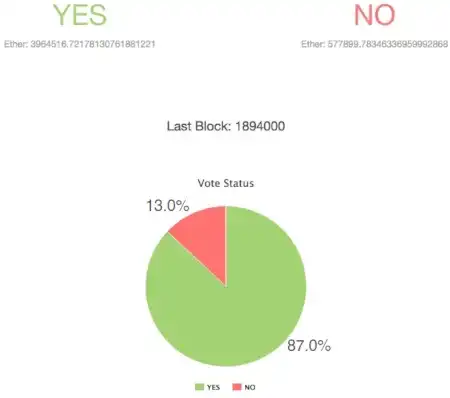
ETH Vote on DAO Fork
Voting is advisory in nature: there is no hard and fast agreed outcome that will determine what happens. However, they help core developers have the confidence to actually implement a series of EIPs, knowing that the community at large will support them. Today, we can get much richer proofs of community membership than token holdings: POAP, Gitcoin Passport scores, Zu stamps, etc.
Together, we can begin to see a second vision for how the crypto space can evolve to better meet the concerns and needs of the 21st century: creating a more comprehensive, trustworthy, democratic, and decentralized technology stack. Zero-knowledge proofs are key to expanding the scope of what such a stack can offer: we can move beyond the false binary of “anonymous and therefore untrustworthy” vs. “verified and KYCd” and prove more granular statements about who we are and what permissions we have. This allows us to simultaneously address concerns about authenticity and manipulation — guarding against “Big Brother outside” — and concerns about privacy — guarding against “Big Brother inside.” In this way, crypto becomes more than just a financial story, it can be part of a broader story of creating better technology.
4
But how do we get there, beyond just telling a story? Here we return to some of the questions I raised in my post three years ago: the changing nature of motivations. Often, those who focus too heavily on theories of financial motivations — or at least a theory of motivations in which financial motivations can be understood and analyzed, while everything else is treated as some mysterious black box we call “culture” — are confused by this space because a lot of behavior seems to run counter to financial motivations. “Users don’t care about decentralization,” yet projects often strive to decentralize anyway. “Consensus is built on game theory,” yet successful social campaigns to drive people out of dominant mining or staking pools have worked in Bitcoin and Ethereum.
I recently realized that no one I’ve seen has attempted to create a foundational, functional map of the crypto space that works “as intended” and attempts to include more actors and motivations. So let me quickly try it now:
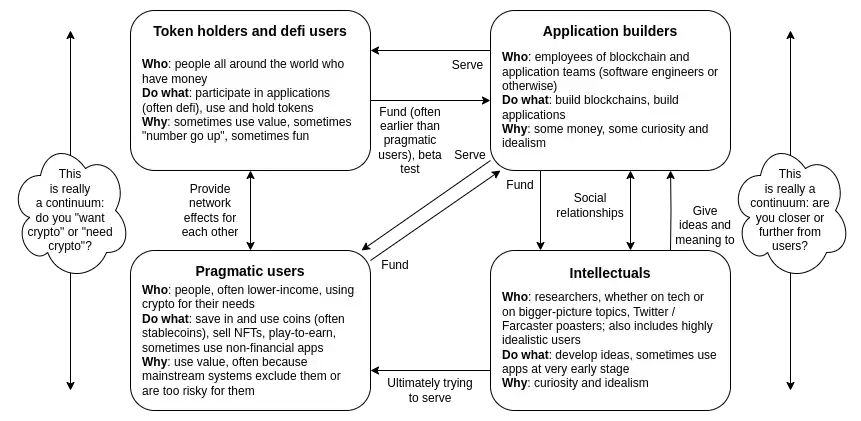
The map itself is an intentional 50/50 mix of idealism and “describing reality”. It’s meant to show the four main components of the ecosystem that can support and have a symbiotic relationship with each other. In practice, many crypto institutions are a mix of these four.
Each of these four components provides something critical to the whole machine:
· Token holders and defi users contribute greatly to the financing of the whole thing, which is key to bringing technologies like consensus algorithms and zero-knowledge proofs to production quality.
· Intellectuals provide ideas to ensure that the space is actually doing something meaningful.
· Builders bridge the gap and try to build applications that serve users and put ideas into practice.
· Pragmatic users are the people we ultimately serve.
Each of the four groups has complex motivations, and these motivations interact with the other groups in various complex ways. There are also "dysfunctional" versions of each group: applications may be exploitative, DeFi users may inadvertently strengthen the network effects of exploitative applications, pragmatic users may deepen dependence on centralized workflows, and intellectuals may be too obsessed with theory and focus on trying to solve all problems by blaming people for "inconsistency" without recognizing that financial incentives (and de-incentivizing factors of "user inconvenience") are also important and can and should be solved.
Often, these groups have a tendency to laugh at each other, and sometimes I do play a role in this. Some blockchain projects are openly trying to move away from what they see as naive, utopian, and distracting idealism and focus directly on applications and usage. Some developers disparage their token holders and their sordid love for making money. Others disparage pragmatic users and their sordid willingness to use centralized solutions when it’s more convenient for them.
But I think there’s an opportunity to increase understanding between these four groups, with each side understanding that it’s ultimately dependent on the other three, working to limit its own excesses, and recognizing that in many cases their dreams are not as far off as they think. I think that’s a form of peace that’s actually possible, both within the “crypto space” and between it and adjacent communities whose values align closely.
5
The beauty of the global nature of cryptocurrency is that it has provided me with a window into all sorts of fascinating cultures and subcultures around the world and how they interact with the crypto world.
I still remember all the bright and hopeful signs I saw when I first visited China in 2014: exchanges scaling to hundreds of employees even faster than in the US, massive GPU and later ASIC mining pools, and projects with millions of users. Meanwhile, Silicon Valley and Europe have long been the main engines of idealism in the space, with two very different flavors. Almost from the beginning, Ethereum development was de facto headquartered in Berlin, and it was in Europe’s open source culture that many of the early ideas about how Ethereum could be used for non-financial applications emerged.
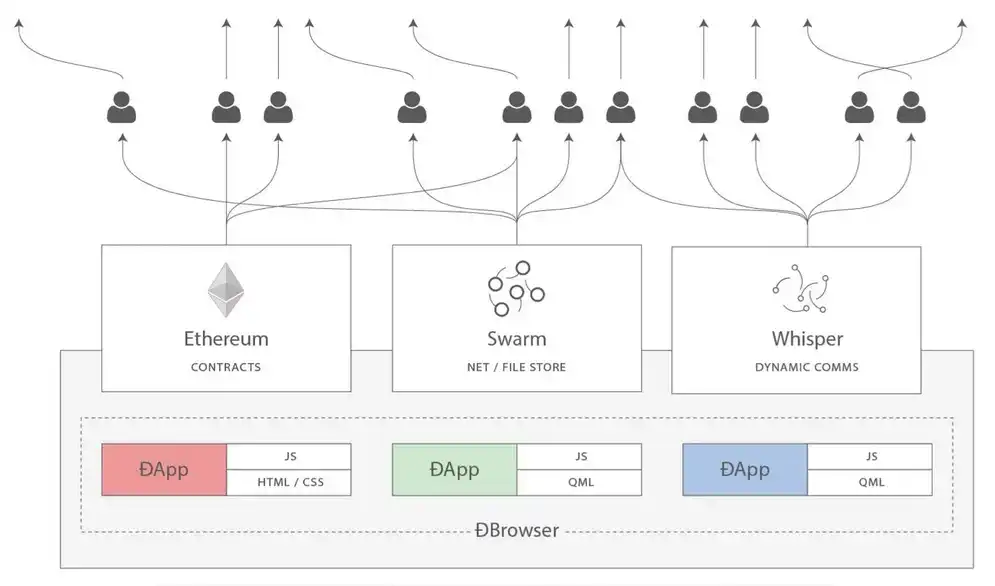
Diagram of Ethereum and two proposed non-blockchain sister protocols Whisper and Swarm, which Gavin Wood used in many of his early talks
Silicon Valley (by which I mean the entire San Francisco Bay Area, of course) was another hotbed of early cryptocurrency interest, mixed with various ideologies such as rationalism, effective altruism, and transhumanism. In the 2010s, these ideas were new and they felt “crypto-adjacent”: many of the people interested in them were also interested in crypto.
Elsewhere, getting regular businesses to take crypto for payment was a hot topic. In all sorts of places around the world, people were found accepting Bitcoin, even Japanese waiters taking Bitcoin as a tip:
These communities have been through a lot of changes since then. China has experienced multiple cryptocurrency crackdowns, in addition to other broader challenges, leading to Singapore becoming the new home for many developers. Silicon Valley is split: rationalists and AI developers, essentially different factions of the same team until Scott Alexander was doxed by the New York Times in 2020, and have since become separate, dueling factions of optimism vs. pessimism about the default path for AI. Ethereum’s zone makeup has changed significantly, especially during the introduction of brand new teams for proof of stake in 2018, though more through the addition of new teams than through the demise of old ones. Death, birth, and rebirth.
There are many other communities worth mentioning.
When I first visited Taiwan on one of my many visits in 2016 and 2017, what struck me most was the combination of self-organization and willingness to learn from the people there. Whenever I wrote a document or blog post, I would often find that within a day a study club would form on its own and begin excitedly annotating every paragraph of the post on Google Docs. More recently, members of Taiwan’s Digital Matters were similarly excited about Glen Weyl’s ideas on digital democracy and “plurality,” and soon posted a full mind map of the space (which included many Ethereum applications) on their Twitter account.
Paul Graham once wrote about how every city has a message: In New York, “You should make more money.” In Boston, you really should go read all those books. In Silicon Valley, “You should be more powerful.” When I visited Taipei, the message I thought of was “You should rediscover your inner high school kid.”
Glen Weyl and Audrey Tang speak at a study session at Nowhere Bookstore in Taipei, where I gave a talk about community notes four months ago
When I visited Argentina many times over the past few years, I was struck by the hunger and willingness to build and apply the technology and ideas offered by Ethereum and the wider crypto world. If places like Silicon Valley are the frontier, full of abstract thoughts about a better future, then places like Argentina are the front lines, full of positive momentum to meet the challenges that need to be addressed today: in Argentina's case, hyperinflation and limited connections to the global financial system. Crypto adoption there is off the charts: I get recognized more often on the streets of Buenos Aires than in San Francisco. There are also many local builders, with a surprisingly healthy mix of pragmatism and idealism, working to solve people's challenges, whether it's crypto/fiat conversion or improving the state of Ethereum nodes in Latin America.
Me and a friend at a coffee shop in Buenos Aires, we’re paying with ETH
There are many others worth mentioning: the cosmopolitan and highly international crypto community based in Dubai, the growing ZK community across East and Southeast Asia, the vibrant and pragmatic builders in Kenya, the public goods-oriented solar punk community in Colorado, and so many more.
Finally, Zuzalu ended up creating a very different, beautiful sub-community of liquidity in 2023 that will hopefully flourish on its own in the years to come. This is a big part of what attracts me to the Cyber Nation movement: culture and community are not just something to defend and protect, but something that can be actively created and developed.
6 A person learns a lot of lessons as they grow up, and different lessons are different for different people. For me, some are:
· Greed is not the only form of selfishness. Cowardice, laziness, spite, and many other movies can bring a lot of harm. Moreover, greed itself can take many forms: greed for social status is often just as harmful as greed for money or power. As someone who grew up in my gentle Canadian upbringing, this is a big update: I felt like I was taught to believe that greed for money and power is the root of most evil, and that if I made sure I didn't greed for these things (e.g., by repeatedly campaigning to reduce the top 5 "founders" share of the ETH supply), I was fulfilling my responsibility to be a good person. This is of course not true.
· You are allowed to have preferences, without having to have a complicated scientific explanation for why your preferences are truly, absolutely good. I generally like utilitarianism and find it often unfairly maligned and wrongly equated with callousness, but here I argue that ideas like excessive utilitarianism can sometimes lead humans astray: there are limits to how much you can change your preferences, so if you push too hard, you end up making up reasons why every single thing you like actually objectively best serves the general flourishing of humanity. This often leads to unnecessary conflict as you try to convince others that these ill-conceived arguments are correct. A related lesson is that a person may not be a good fit for you (in any context: work, friendship, or whatever) without being a bad person in some absolute sense.
· The importance of habits. I intentionally limit many of my daily personal goals. For example, I try to run 20km once a month, and “do whatever I can” beyond that. This is because the only habits that work are the ones you actually keep. If something is too hard to maintain, you’ll abandon it. As a digital nomad who frequently hops continents and takes dozens of flights a year, any kind of routine is difficult for me, and I have to deal with this reality. Even though Duolingo’s gamification, which pushes you to keep a “streak” going by doing at least something every day, actually works for me. It’s hard to make positive decisions, so it’s better to make positive decisions that will have the longest-term impact on your mind, by reprogramming your mind to default to a different mode.
· Everyone learns these very long tails, and in principle I could go longer. But there’s also a limit to how much you can actually learn from just reading about other people’s experiences. As the world starts to change faster, the lessons learned from other people’s narratives also become outdated at a faster rate. So, to a large extent, there’s also no substitute for simply doing things the slow way and gaining personal experience.
7
Every good thing in the social world—a community, an ideology, a “scene,” a nation, or a very small company, a family, or a relationship—was created by people. Even in the few cases where you can write a plausible story about how it has existed since the dawn of human civilization and the Eighteen Tribes, someone had to actually write that story at some point in the past. These things are finite—both the thing itself, as part of the world, and how you experience it, a fusion of the underlying reality and your own way of conceiving and interpreting it. As communities, places, scenes, companies, and families disappear, new ones must be created to take their place.
For me, 2023 is the year of watching many things, big and small, fade into the distance of time. The world is changing rapidly, the frameworks I am forced to use to try to understand the world are changing, and the role I play in influencing it is changing as well. There is death, a truly inevitable type of death that will continue to be with us even after the blight of human biological aging and death has been purged from our civilization, but there is also birth and rebirth. It is the task of each of us to continue to be active and create new things to the best of our ability.
Original link
Welcome to join the official BlockBeats community:
Telegram Subscription Group: https://t.me/theblockbeats
Telegram Discussion Group: https://t.me/BlockBeats_App
Official Twitter Account: https://twitter.com/BlockBeatsAsia