The 'Axelar + Wormhole cross-chain solution' received 81% of the votes in the BNB Chain cross-chain bridge temperature check conducted by Lido DAO.
Blockchain protocols often pride themselves on being "permissionless" - anyone, anywhere can build on top of the protocol without requiring explicit approval.
However, in practice, sometimes seeking permission is a wiser choice.
According to the Snapshot interface, in the temperature check vote for the "Solution and Team Selection for Cross-Chain wstETH on BNB Chain" released by Lido DAO, 81.13% of the votes were cast for the "Axelar + Wormhole Cross-Chain Solution".
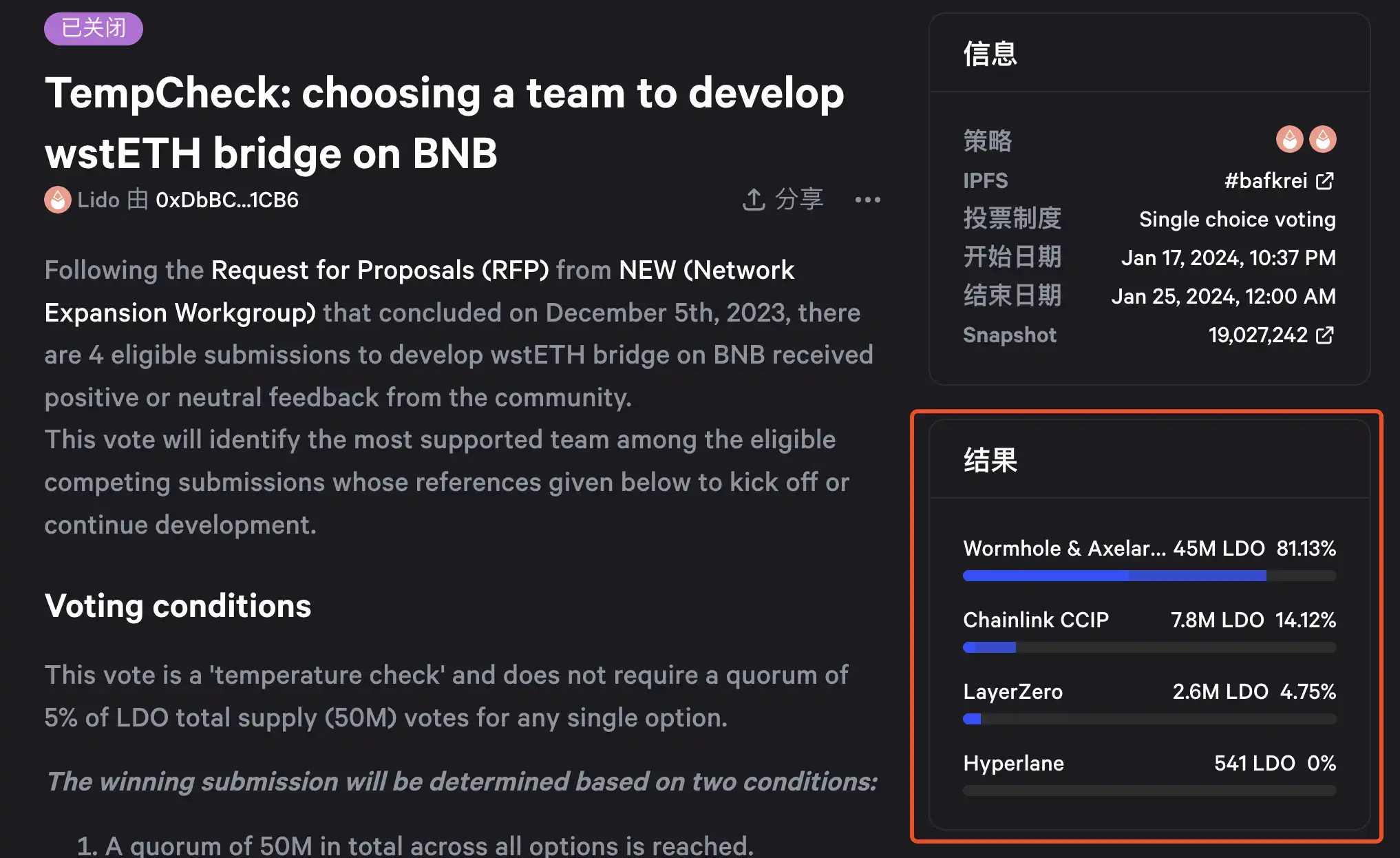
Image source: Snapshot
According to Axelar's official introduction, this cross-chain solution was proposed by Axelar Foundation and Wormhole in collaboration. It is open source and scalable, with no vendor lock-in. This means that Lido DAO can flexibly add or remove other cross-chain bridge providers and conduct cross-chain governance in the future.
Initially, the contract for the bridge will be operated by validators from the Axelar network, contributors from the Wormhole Foundation, and BNB Chain's multi-signature. Once cross-chain governance is implemented, ownership will transfer to the Aragon smart contract operated by Lido DAO. Axelar Foundation and Wormhole will bear the cost of development and auditing, deploying the bridge as a public product at zero cost.
(Joint resistance of multiple encryption infrastructures to LayerZero's improper behavior)
It is worth noting that LayerZero deployed a cross-chain bridge for stETH in October last year. Although LayerZero had requested recognition from Lido DAO (the community that manages the protocol) before this, it deployed the bridge before receiving formal approval from the organization. Critics believe that LayerZero was trying to impersonate an official partner of Lido without DAO's approval. At that time, a joint statement signed by multiple encryption infrastructure providers indicated that LayerZero seemed to be improperly using its first-mover advantage to "lock" users by adopting unfair means to lead competitors. In this temperature check vote, the LayerZero proposal only received 4.75% of the votes.
Robinson Burkey, Chief Business Officer of Wormhole Foundation, said: "In my opinion, this is more about principles than actual technology, which is more important than normal governance voting. Being able to convey the feelings of you as a token holder is in the best interests of the protocol. If you deprive token holders of their power, you are weakening the foundation of the power distribution."
Welcome to join the official BlockBeats community:
Telegram Subscription Group: https://t.me/theblockbeats
Telegram Discussion Group: https://t.me/BlockBeats_App
Official Twitter Account: https://twitter.com/BlockBeatsAsia

 Related Articles