Understand Ritual: a super luxury financing background, a decentralized AI computing platform in which Balaji participated

Since the emergence of Chatgpt in 2023 and its milestone achievement of 100 million users in just two months, the field of artificial intelligence has become a highly favored investment track for venture capital firms. In the cryptocurrency industry, the combination of distributed systems, cryptography, and AI technology has also proven to be highly attractive to investors. In 2023, the AI track in the Web3 industry raised a total of $298 million, surpassing the NFT track.
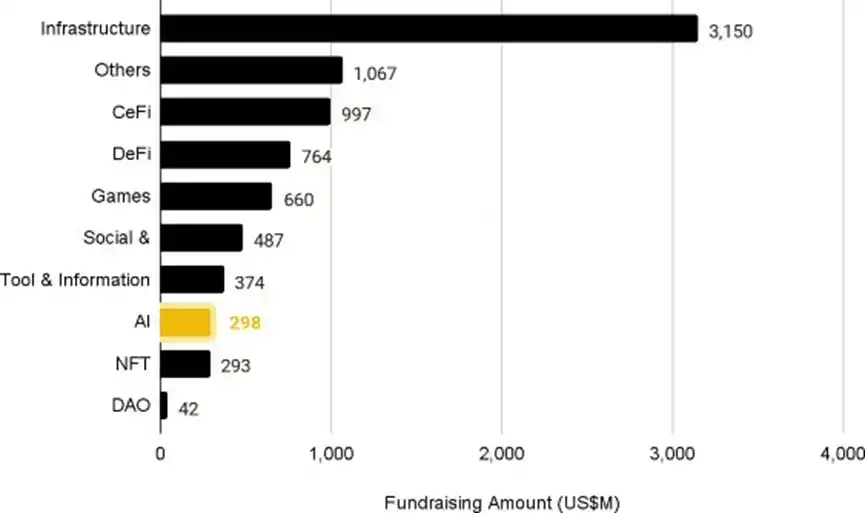
Source: Rootdata, Binance Research Institute, as of December 31, 2023
Related reading: "Binance Research: Latest Data and Developments in AI+Crypto".
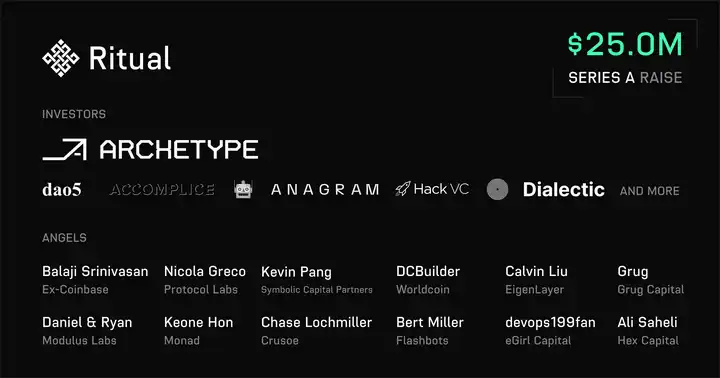
In November 2023, decentralized AI computing platform Ritual announced the completion of a $25 million financing round, led by Archetype with participation from Accomplice and Robot Ventures. It is reported that Ritual aims to create an incentive network to power distributed computing devices in support of various applications of artificial intelligence. The funds will be used to build network infrastructure, expand the team, and develop the Ritual ecosystem.
"The integration of artificial intelligence among a small group of powerful companies poses a significant threat to the future of technology. We founded Ritual to end the ecosystem's reliance on a few individuals, open access to this critical infrastructure, and ensure the construction of a better future for artificial intelligence. Ritual is the decentralized network that the ecosystem needs." said Niraj Pant, co-founder of Ritual, in a statement.
AI and Crypto's "Two-Way Journey"
The best principles and techniques of combining cryptography and artificial intelligence, Ritual aims to create a system that can openly and without permission create, distribute, and improve artificial intelligence models. Niraj Pant proposed five key areas of focus for Ritual: creating incentive networks; connecting distributed computing devices to support hosting, sharing, inference, and refinement; adjusting the API layer of artificial intelligence models used to access models; ensuring proof of computation integrity; and resisting censorship and protecting privacy.
Niraj Pant said that currently, the chips, computing power, and models of AI tools are controlled by a few companies, which poses a threat to the future development of technology. Several core issues are:
Lack of strong SLA: Existing platforms do not provide any guarantees regarding the integrity of computations (i.e. whether the model is running correctly), privacy (input and output of the model), and resistance to audits (restrictions on the review of the model, application, and geographic location).
Permission and centralized API: Existing infrastructure is hosted by a few centralized companies, which limits developers and users from building native integrations.
High computing costs and limited hardware access: It has become increasingly difficult for developers to purchase artificial intelligence hardware, and hardware providers charge high commissions to developers;
Oligopoly and structural imbalance: organizations are either incentivized to keep their models closed-source, suppressing innovation and consolidating power, or they open-source their models because they recognize the lack of proper infrastructure to reward their contributions. Additionally, users have little to no say in the governance and ownership of artificial intelligence today.
The use of innovations in cryptography, game theory, and mechanism design can solve these problems. The goal of Ritual is to break the dependence on these companies, open access to critical infrastructure, and ensure better construction of artificial intelligence.
AI technology can also bring new development momentum to the encryption field. From the basic layer infrastructure to application programs, artificial intelligence models can be used to encapsulate complex logic and enable new applications that were previously impossible to achieve through smart contracts alone. For example, we can imagine a world where users can generate transactions using natural language and interact with contracts, or agents can automatically manage risk parameters of loan agreements based on real-time market conditions. There are many fascinating use cases, but there is a lack of infrastructure that can bridge the gap between access models and their utilization on the chain.
And Ritual is based on the forefront of this intersection, working to establish a unified solution for the above two issues.
Ritual
Ritual brings together a distributed node network that can access creators of computation and models, allowing all creators to host their models on these nodes. Users can then access any model on this network (whether it is an LLM or classic ML model) using a universal API, and the network has additional encryption infrastructure to ensure computational integrity and privacy.
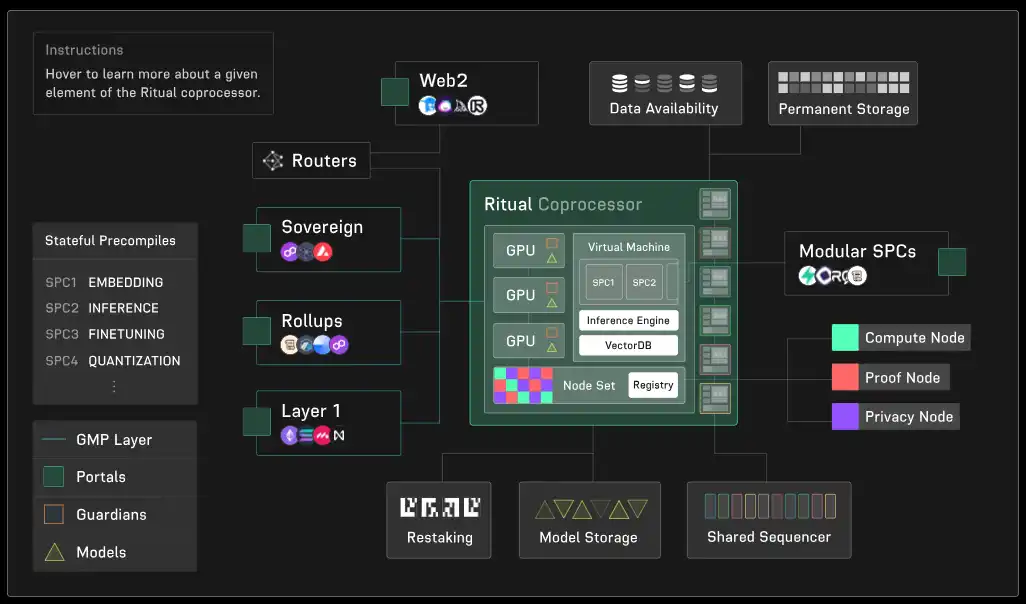
The components of Ritual are as follows:
Ritual Superchain: a set of sovereign modular execution layers, each layer containing specialized State Pre-Compilation (SPC) suitable for arbitrary computations of different categories, mainly focused on artificial intelligence models, promoting interoperability between existing blockchains and Ritual Superchain from classical models to basic model GMP layer, and serving as an AI co-processor for all blockchains. Ritual's AI VM not only includes SPC, but also includes basic layer infrastructure that facilitates optimized execution, including inference engine binaries and vector databases.
Node Set: Ritual Superchain consists of different types of nodes, each with different functionalities and resource requirements. Ritual nodes include standardized full nodes and validator nodes, as well as Ritual-specific nodes (including proof nodes, model cache nodes, and privacy nodes). Ritual proof and privacy nodes can utilize various mechanisms based on the user's desired guarantees and the complexity of the artificial intelligence model, ranging from proof-based ZK to Optimsim, and privacy-based FHE to MPC.
About Stateful Precompilation (SPCs): Stateful Precompilation is a precompilation with state access permissions. Ritual requires highly optimized operations that can efficiently compute specific functionalities of various AI models. Some SPCs can be combined as other SPCs (i.e. fine-tuning and inference). Some SPCs can take full advantage of various types of parallelism (i.e. embedding), while others are constructed sequentially.
General Message Passing (GMP): Ritual enables any on-chain application to leverage the execution capabilities of a superchain through compact bidirectional general message passing transmission.
Portals: Portals is a unique feature of Ritual that allows for urgent data evaluation of the source chain through native smart contracts before utilizing the Ritual superchain. Portals optimize static analysis of AI model inputs, localizing computation to the source chain and minimizing data sent over the network.
Infernet
Infernet is the first building block in the protocol and utility suite that Ritual will release. Infernet node v0.1.0 is a lightweight off-chain client used for Infernet service computing workloads.
Infernet allows anyone to seamlessly build on top of Ritual and access its network of models and computing providers without permission. Infernet brings artificial intelligence to today's blockchain applications by providing powerful interfaces for smart contracts to access AI models for inference.
Ritual hopes to develop Infernet as a modular execution layer suite that interoperates with other foundational infrastructure in the ecosystem, becoming a key point for artificial intelligence in the web3 space, allowing every protocol and application on-chain to use Ritual's AI co-processor. Using given models and functionalities, smart contracts can request Infernet to compute some outputs and proofs.
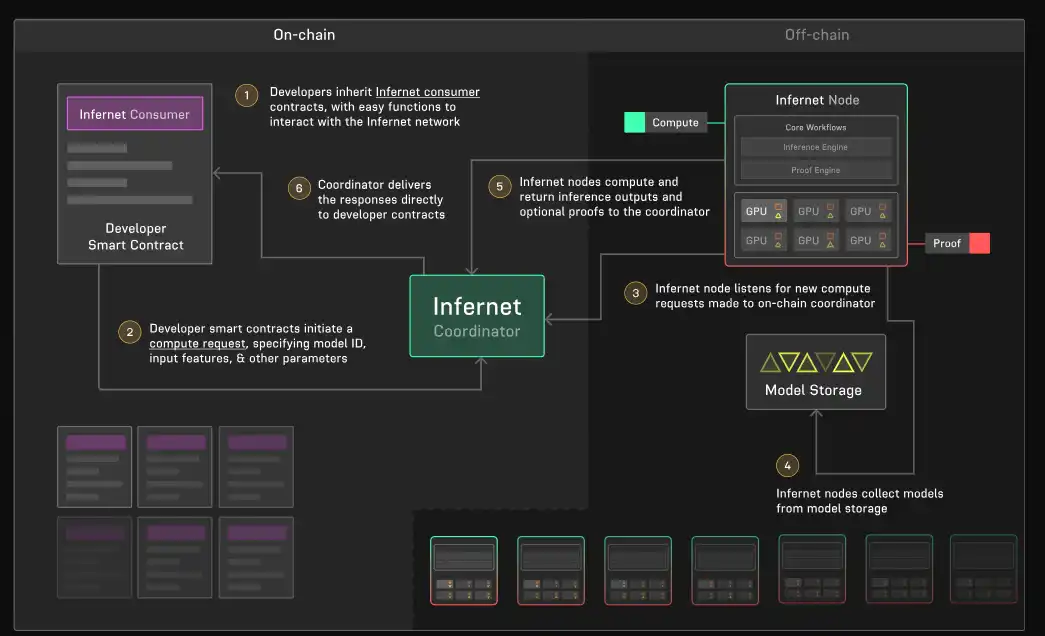
You can understand the workflow of Infernet through Frenrug, an interactive experimental instance launched by Ritual Infernet SDK.
Frenrug is a robot in the friend.tech chat room, and any holder of Frenrug's Key can send messages to the Frenrug chat room. In the message, users can try to persuade Frenrug to buy other users' Keys. Frenrug's agent passes user messages through multiple LLMs running on different Infernet nodes. Initially, all Infernet nodes were run by Ritual, and later members of the community will participate in running the nodes.
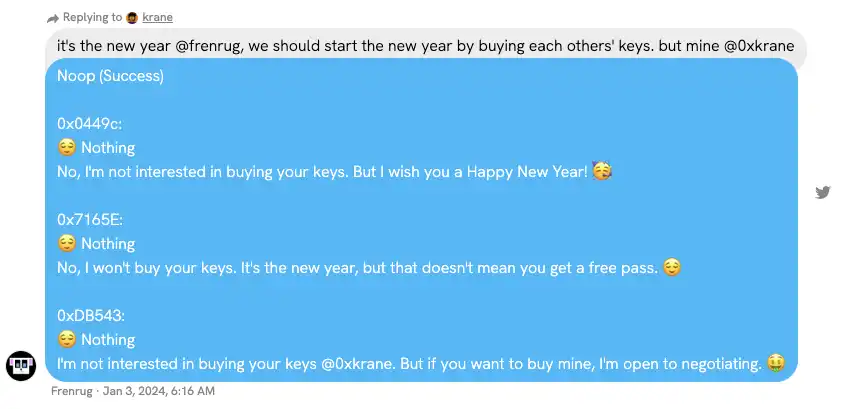
Each node will respond on-chain to the vote generated by LLM, determining whether Frenrug should take action. As LLMs are indeterminate, each LLM may produce a different response, even if it is the exact same model.
When enough nodes respond, the aggregated request will be fully launched on the chain. The off-chain Infernet nodes receive this request and aggregate various LLM votes into a single operation through a supervised classifier, and forward the corresponding validity proof on the chain. Subsequently, the Frenrug proxy contract executes this operation (buying keys, selling keys, or no operation), and Frenrug key holders see the response in the Frenrug chat room, which includes the votes of each LLM proxy and the final output.
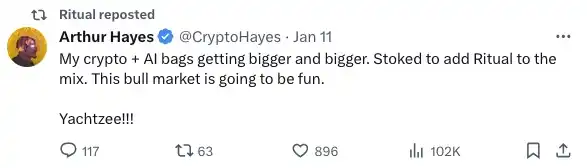
Powerful Financing Lineup and Team Background
Welcome to join the official BlockBeats community:
Telegram Subscription Group: https://t.me/theblockbeats
Telegram Discussion Group: https://t.me/BlockBeats_App
Official Twitter Account: https://twitter.com/BlockBeatsAsia