Bitcoin Spot ETF approved, how much capital inflow can we expect in the long term?

Original Title: "Three Years, $500 Billion, How Much Short-term and Long-term Funds Will Bitcoin Spot ETF Bring?"
Original Author: Nan Zhi, Odaily Planet Daily
How is the Short-term Inflow Expected?
Bloomberg ETF Analyst: $40 Billion on the First Day
Bloomberg Senior ETF Analyst Eric Balchunas stated that BlackRock may inject $20 billion on the first day of trading for its Bitcoin spot ETF, breaking the first-day inflow record. Seed funding may fuel BlackRock's competition in the field of 11 Bitcoin spot ETFs.
Eric Balchunas believes that all these Bitcoin spot ETFs could raise up to $40 billion on the first day of trading and gather $500 billion in funds within two years.
On January 9, BlackRock has seeded its Bitcoin spot ETF with $10 million. In addition, VanEck has seeded with $72.5 million, and Bitwise has an even larger seed fund of $200 million.
(Odaily Planet Daily Note: Seed funding typically refers to initial or startup capital used to create and launch an ETF. When an ETF is initially launched, it needs a certain amount of funds to purchase underlying assets, establish a portfolio, and cover other startup costs such as legal, administrative, and marketing expenses.)
Valkyrie Co-founder: Reaching $50 Billion Within a Few Weeks
Valkyrie Investments Co-founder Steven McClurg stated that Valkyrie expects $2 billion to $4 billion inflow into its ETF in the first week; it is expected that the first batch of 10 ETFs will launch simultaneously, and the entire market's inflow in the initial weeks of trading will reach $40 billion to $50 billion.
VanEck Research Head: $25 Billion in the First Quarter
VanEck's Director of Digital Asset Research, Matthew Sigel, also previously shared similar data, having learned from a source that over $20 billion is waiting to be poured into the first week of trading for the Bitwise Bitcoin spot ETF by existing Bitcoin holders looking to accumulate. However, Matthew Sigel noted that the first-day $20 billion figure would be an overestimate, with his prediction being $25 billion in quarterly volume, a figure derived from historical inflows into the first gold ETF adjusted for the U.S. money supply. Similar analyses suggest we may have a $400 billion market opportunity within two years.
Galaxy Digital Research Head: $14.4 Billion in the First Year
Galaxy Digital's Research Head, Alex Thorn, expects that in the first year, a Bitcoin spot ETF could attract $14.4 billion in inflows based on their analysis of the wealth management industry. They further predict that the second-year inflows could grow to $26.5 billion. Alex emphasizes that these inflows are considered net incremental funds, meaning that without the ETF, these funds would not flow into the Bitcoin market. Alex notes that the ETF's inflows do not happen all at once but gradually increase. In their analysis, as the Bitcoin market grows, the monthly impact multiplier will gradually decrease as Bitcoin's share in investment vehicles increases with the market's total value.
Previously, Cathie Wood also mentioned in a CNBC interview that if a Bitcoin spot ETF is approved, it will not be a case of diminishing returns. She stated, "Over a five-year period, we think that the money flowing into this new asset class, particularly institutional money, will be quite significant. Institutions don't need much of a weighting in Bitcoin to drive its price up a lot, as it becomes a scarce asset." However, she did not provide a specific amount prediction.
Current Market Size
According to Galaxy data, as of September 30, 2023, the total amount of Bitcoin held by Bitcoin investment products (including ETPs and closed-end funds) is 842,000 BTC (approximately $217 billion).
Additionally, according to 1kx Research, the largest cryptocurrency ETP by AUM is the ProShares Bitcoin Strategy ETF, a U.S.-based futures ETF product, with assets under management of $1.68 billion as of January 2, 2024.
As shown in the table below, of the top 14 cryptocurrency ETPs by asset size, 9 track Bitcoin (64%), while the remaining five track 3 Ethereum, 1 Solana, and 1 BNB.
The total AUM of these top 14 ETPs is approximately $9.5 billion, with Bitcoin spot ETF expected to be significantly larger than this figure.
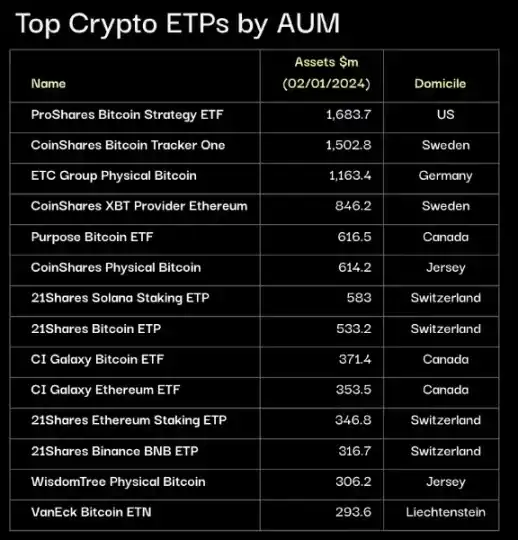
Long-Term Funding Potential
Previously, Bloomberg Senior ETF Analyst Eric Balchunas and VanEck Director of Digital Asset Research Matthew Sigel both mentioned the long-term market size, with the former suggesting a funding potential of $50 billion within two years and the latter anticipating $40 billion inflow within two years.
Standard Chartered Bank, however, provided a more optimistic outlook, stating that if a Bitcoin spot ETF is approved, 2024 could see $50-100 billion of inflows. This would drive the Bitcoin price to $200,000 by the end of 2025. Standard Chartered Bank arrived at this conclusion through a comparative analysis of Bitcoin spot ETFs and gold ETFs.
(Note: As of the time of posting, Bitcoin's circulating market capitalization is
Galaxy In-Depth Analysis: 3-Year $390 Billion , Ultimate Goal $4.5 Trillion
Galaxy researcher
(
Galaxy selected U.S. wealth management consolidators using $48.3 trillion as the baseline
With the opening of the channel, the Bitcoin
Galaxy assumes the
Based on these market size estimates, if we assume that 10% of the assets available in each wealth channel are allocated to Bitcoin, with an average allocation of 1%, we estimate that in the first year after the launch of a Bitcoin ETF, there will be a $14 billion inflow, increasing to $27 billion in the second year, and further increasing to $39 billion in the third year.
In the short term, Galaxy expects other global/international markets to follow the United States in approving and offering similar Bitcoin ETF products to a wider range of investors. In addition to ETF products, various other investment tools may incorporate Bitcoin into their investment strategies.
In the long term, the target market for Bitcoin investment products may further expand to all third-party-managed assets (approximately $126 trillion in AUM according to McKinsey's data) and even more broadly to global wealth (estimated at $454 trillion according to UBS). Some believe that as Bitcoin becomes monetized, it will systematically reduce the currency premium applicable to other assets such as real estate or precious metals, significantly expanding Bitcoin's TAM.
Based on these market sizes and keeping our adoption/allocation assumptions constant (10% of funds adopting Bitcoin with an average allocation of 1%), Galaxy estimates that over a long period, the potential incremental inflow into Bitcoin investment products could range between $125 billion and $450 billion.
Summary
Regarding short-term inflows, there are significant differences in market views, with the shortest expecting a $4 billion injection in a matter of days, and the longest considering it on an annual basis. However, there is consensus among all parties about its long-term impact, with the inflow over three years estimated to range from $40 billion to $50 billion. Most importantly, the approval of a Bitcoin spot ETF signifies a gradual opening of the global allocation channel, and with each country's increasing openness and acceptance, the future is boundless.
Original Article Link
Welcome to join the official BlockBeats community:
Telegram Subscription Group: https://t.me/theblockbeats
Telegram Discussion Group: https://t.me/BlockBeats_App
Official Twitter Account: https://twitter.com/BlockBeatsAsia