Will BRC-20 fork? What are the potential impacts?

As the third day of 2024 approaches, a tweet from @domodata, the founder of BRC-20, has caused a stir and brought the fork dispute of BRC-20 to the forefront.
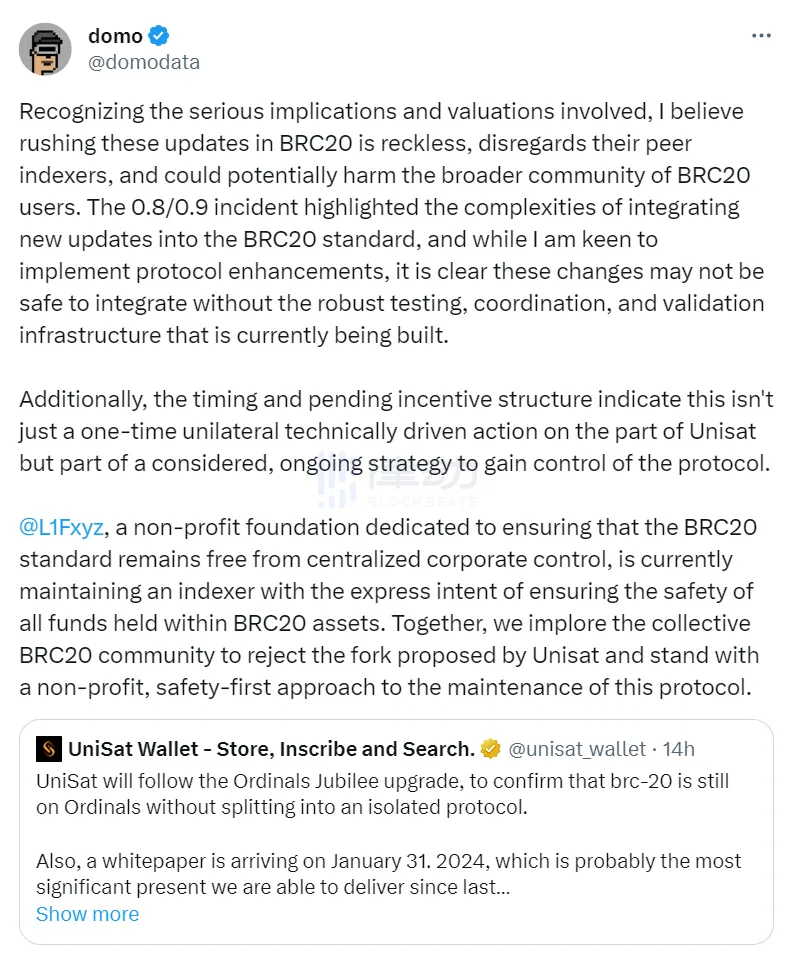
Domo made serious accusations against UniSat in this tweet. Domo claimed that UniSat's upgrade of the Ordinals protocol indexed by BRC-20 to version v0.13.0 was a "fork" of BRC-20, a "unilateral" technical action by UniSat, and a struggle for control of the protocol.
How to quickly understand the "fork" dispute this time? The "fork" dispute this time is like we all hold the same asset (BRC-20 Token). Previously, we had no problem storing/trading in various places such as UniSat, Magic Eden, OKX, etc. because they all used the same accounting system. Now, UniSat wants to upgrade the accounting system. If other places do not follow the upgrade, there may be differences in the rules of the accounting system, and the results of the accounting (the BRC-20 Token in everyone's hands) may have different balances in different places, which may cause confusion.
So, why did such a disagreement arise? What are the attitudes of the various parties involved in the continued development of the BRC-20 protocol towards this disagreement? What potential impacts will this disagreement have?
Why is there such a difference?
On November 9th, 2023, with the production of a Bitcoin block with a height of 816,000, the BRC-20 index specification "Freeze" proposal will officially take effect.
The "Freeze" proposal for the BRC-20 index specification was proposed by domo, the founder of the BRC-20 protocol, on October 26th. Domo named the proposal "Freeze" because its content is that the BRC-20 protocol has decided to standardize (maintain) the indexing standard of BRC-20 at v 0.9.0 to maintain the stability of the index.
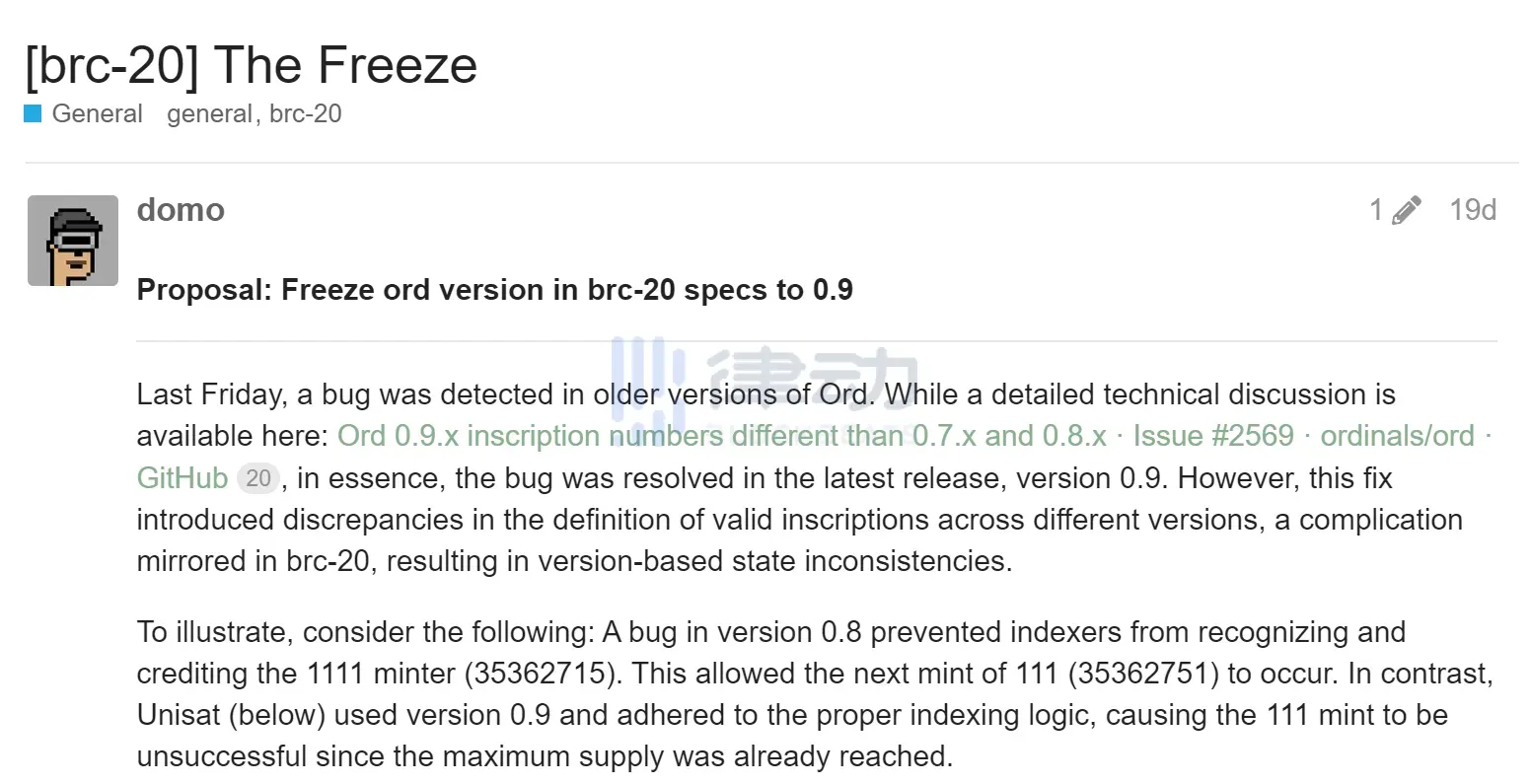
In October 2023, it was discovered that Inscriptions #35321413 and #35329860 can be indexed by the Ordinals protocol version v 0.9.0, but not by versions v 0.7.0 and v 0.8.0. Due to different markets adopting different versions of the Ordinals protocol, some inscriptions cannot be correctly indexed in certain markets, resulting in a factual inscription number offset.
For BRC-20, the problem is even bigger. A bug in the Ordinals protocol in version 0.8.0 will make double spending between exceeding the maximum supply and differences in Ordinals protocol versions in different markets a huge risk. This is also why Magic Eden briefly suspended BRC-20 trading in November 2023 - Magic Eden did nothing wrong, but the version they adopted happened to be affected, and suspending trading in a timely manner was a responsible action for their users.
BRC-20 is a protocol that "parasitizes" on the Ordinals protocol. Whether its index should follow the upgrade of the Ordinals protocol is a dilemma at this stage. On the one hand, the Ordinals protocol is still being updated rapidly, and more and more new features are being added to the protocol, especially the "Jubilee" upgrade, which will be activated at block height 824544. The original way of generating curse inscriptions will be fixed, which means that curse inscriptions with negative numbers will be assigned in version 0.9.0 of the Ordinals protocol, and curse inscriptions with positive numbers will be assigned in version 0.13.0. The version difference of the Ordinals protocol will cause significant differences in the numbering of subsequent new inscriptions. In addition, the modified version of the BRC-20 protocol, CBRC-20, which uses the new version of the Ordinals protocol and brings performance optimization, has also posed certain challenges to the development of BRC-20. (Recommended reading: CBRC-20, a modified version of BRC-20, explains why foreigners are FOMOing)
On the other hand, as an asset protocol that has already been born with numerous quantities and a large market value, BRC-20 has also become a top priority to maintain stability during its development process. If pursuing new features causes asset losses for users, it will undoubtedly cause huge damage to the BRC-20 ecosystem.
On this issue, there have been differences among the parties who have a say in the BRC-20 protocol, which is the reason for the "forking" dispute facing BRC-20. The so-called "forking" dispute is whether to upgrade the Ordinals version running on the BRC-20 index from version v0.9.0.
Attitudes towards "Forking" from All Parties
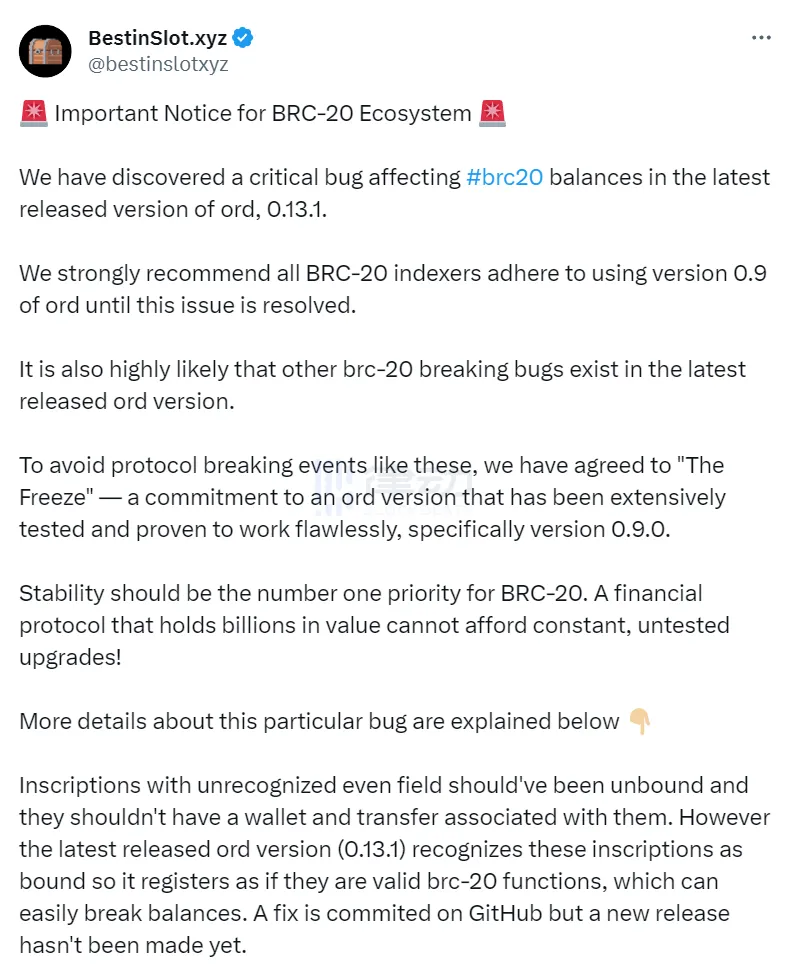
Not recommended: domo, Best in Slot-led Layer 1 Foundation
The attitude of Domo has been mentioned at the beginning of this article. Best in Slot also tweeted yesterday that a "serious vulnerability" that affects the correctness of BRC-20 balance was found in the Ordinals protocol version 0.13.1, strongly urging BRC-20 index to keep the operating version at version 0.9.0 to maintain protocol stability. Best in Slot also stated in the tweet that there may be other bugs affecting the BRC-20 protocol in version 0.13.1, and "stability" is the top priority of BRC-20. The already large-scale BRC-20 protocol cannot withstand continuous and untested upgrades.
Approval: UniSat
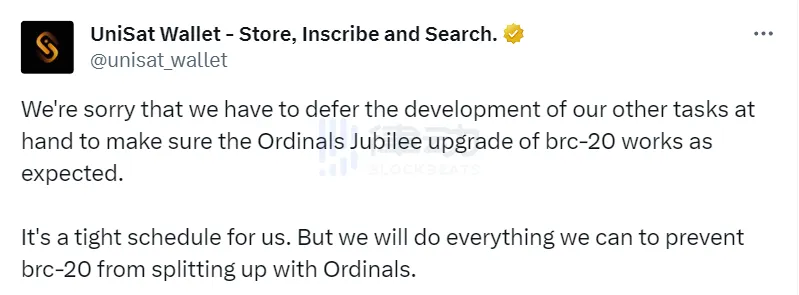
UniSat has always been committed to promoting the development of BRC-20 quickly. From the development of the BRC-20 Swap function to the direct expression of the intention to promote the upgrade of the Ordinals protocol version running the BRC-20 index. After domo's tweet, UniSat also responded on Twitter, stating that it will temporarily suspend other development tasks and do its best to ensure that the BRC-20 upgrade is carried out on schedule. At the same time, UniSat also pointed out that they will do their best to ensure that BRC-20 does not "split".
Additionally, there are reports that Magic Eden supports the upgrade of BRC-20.
Neutral: TRAC
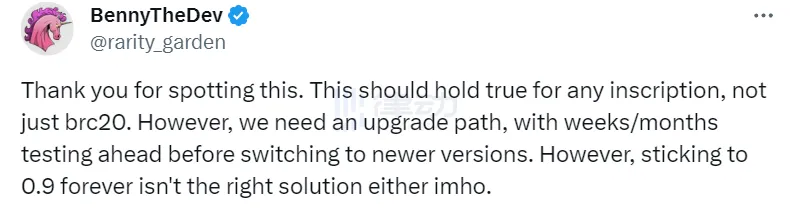
TRAC founder Benny has maintained a neutral stance on the disagreement. He stated that it is certain that the Ordinals protocol version running on the BRC-20 index has been stuck at v 0.9.0, but several weeks or even months of testing are required before upgrading to ensure that the switch to the new version goes smoothly.
Potential Impact
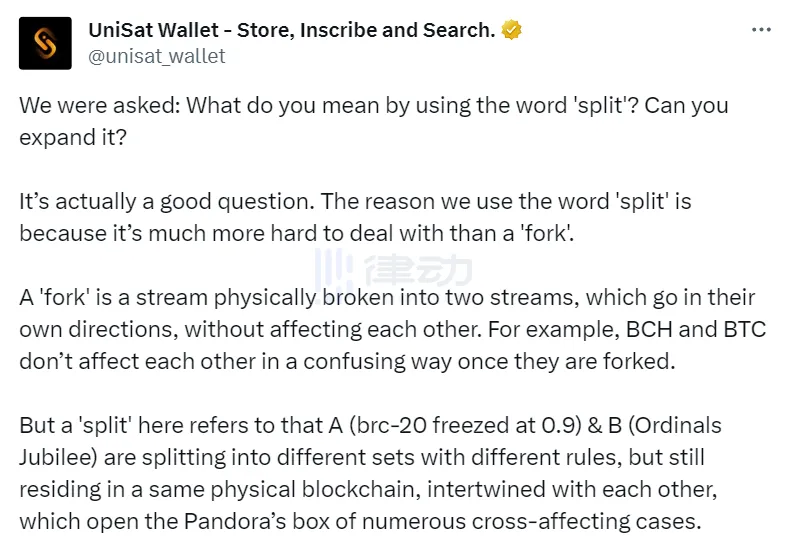
UniSat uses the term "split" to describe the current divergence, rather than "fork". UniSat points out that "fork" is a physical "divergence" formed by differences in consensus, such as BCH and BTC, which have actually formed two chains that develop independently according to their own consensus without affecting each other. The upgrade divergence of BRC-20 may result in two sets of rules with different indexes running on the same chain (Bitcoin mainnet), which will still affect each other.
The "split" dispute of BRC-20 has cast a shadow over the cooling Mingwen market. However, there is no need to worry too much because neither side really wants to harm BRC-20. It is just a matter of different understandings on how to better develop BRC-20, which is actually a good thing and a test that BRC-20 must undergo in its development process. It is believed that all parties will discuss this issue properly, come up with a result that everyone recognizes, and develop a good dialogue mechanism from this event. After the storm, the future of BRC-20 will definitely be brighter.
Welcome to join the official BlockBeats community:
Telegram Subscription Group: https://t.me/theblockbeats
Telegram Discussion Group: https://t.me/BlockBeats_App
Official Twitter Account: https://twitter.com/BlockBeatsAsia
 Related Articles