Selections from the 2023 Annual Report: The Rise and Competition of DEX
Original Title: "Selected Annual Report 2023: The Rise and Competition of DEX"
Original Author: Xiaoyu, DODO Research
The footsteps of spring always tread on muddy paths. 2023 is a year of challenges and opportunities for the cryptocurrency industry. We have witnessed the release of Uniswap V4 and UniswapX, the underlying code of Curve being attacked, and the emergence of new DEX players such as Maverick.
In this volatile market environment, DEXs have not only experienced technical challenges, but also faced increasing competitive pressure. Nevertheless, many DEXs continue to innovate and introduce more secure and efficient trading mechanisms, attracting a large number of new users to join.
Over the past year, the DEX Weekly Brief closely monitored and reported on the latest trends and key data in the decentralized exchange (DEX) market. The DEX Annual Report, compiled by the DODO Research team, consolidates their detailed observations and analysis of the market throughout the year, delving into significant trends and important findings in the DEX space for 2023 as a reference.
I. Trading Volume & Market Share
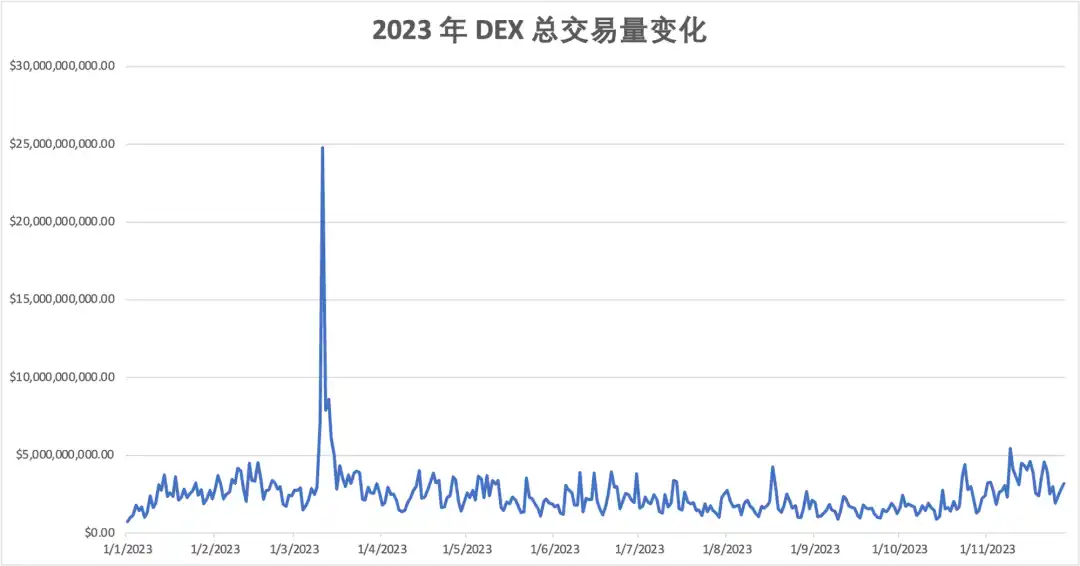
"In 2023, the total trading volume of DEX will be at a high level at the beginning and end of the year, while remaining in a low level of oscillation during the rest of the time, showing a certain positive correlation with the overall market trend."
Starting from October, influenced by the expected impact of ETF, the total trading volume of DEX has shown a significant increase. There are clear signs of market trading volume recovery, and it is expected to continue to grow until 2024.
From a single trend perspective, Uniswap has performed steadily throughout the year and occupies a major market share. Other DEXs have performed well in event-driven scenarios, such as Pancakeswap launching V3 on the BNB chain and Ethereum chain in April, improving capital utilization and restructuring fee results, resulting in a significant short-term increase in monthly trading volume and market share for the platform.
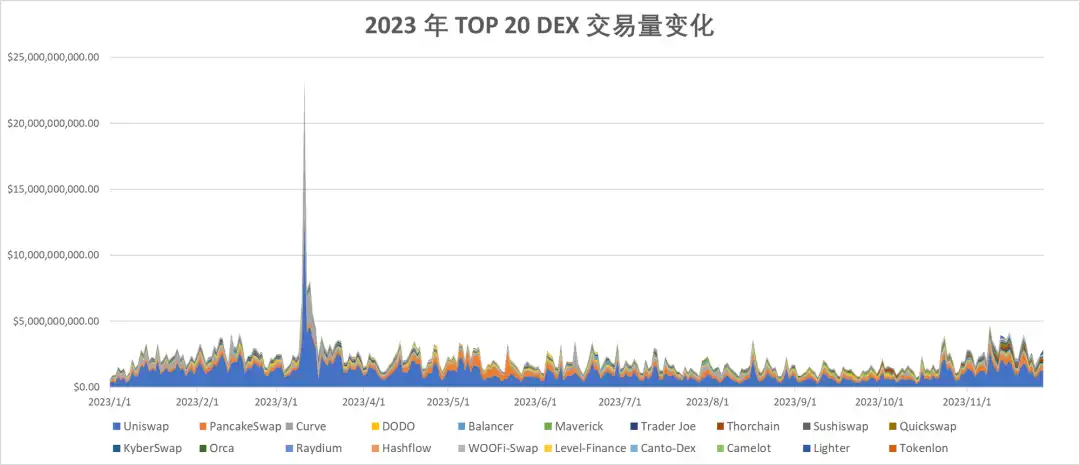
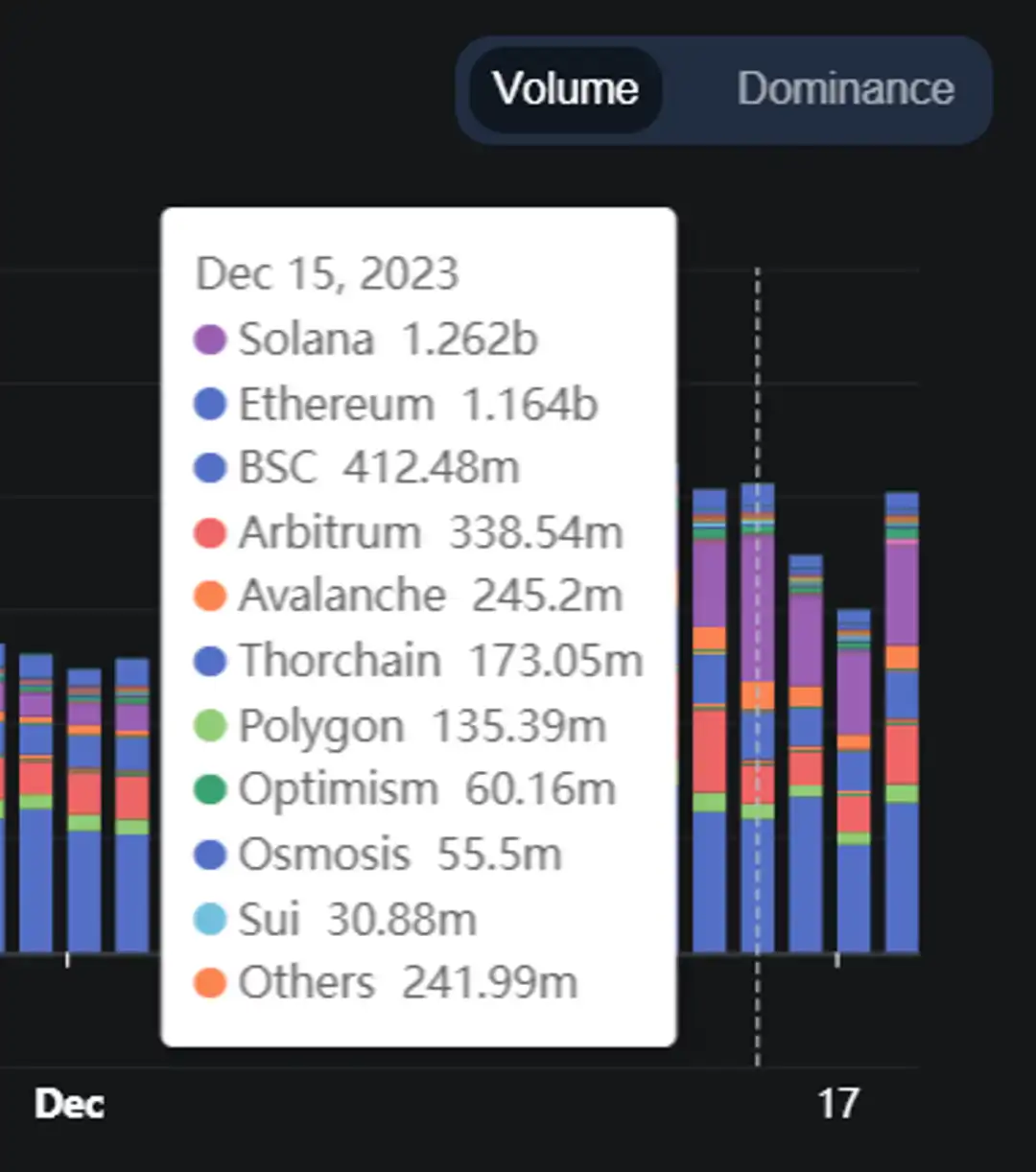
Starting from the end of October, the market style gradually changed: from Uniswap's dominance to a transition towards a "one super, many strong" pattern. Influenced by the active ecosystems of major public chains such as SOL and AVAX, the top DEXs on these chains have contributed a considerable amount of trading volume, even surpassing the mainstream DEXs on Ethereum's chain (see Weekly Brief for details). According to Defillama's data, on December 15th, the trading volume of DEXs on Solana's chain exceeded $1.2 billion, surpassing Ethereum's chain, which had previously held the top spot.
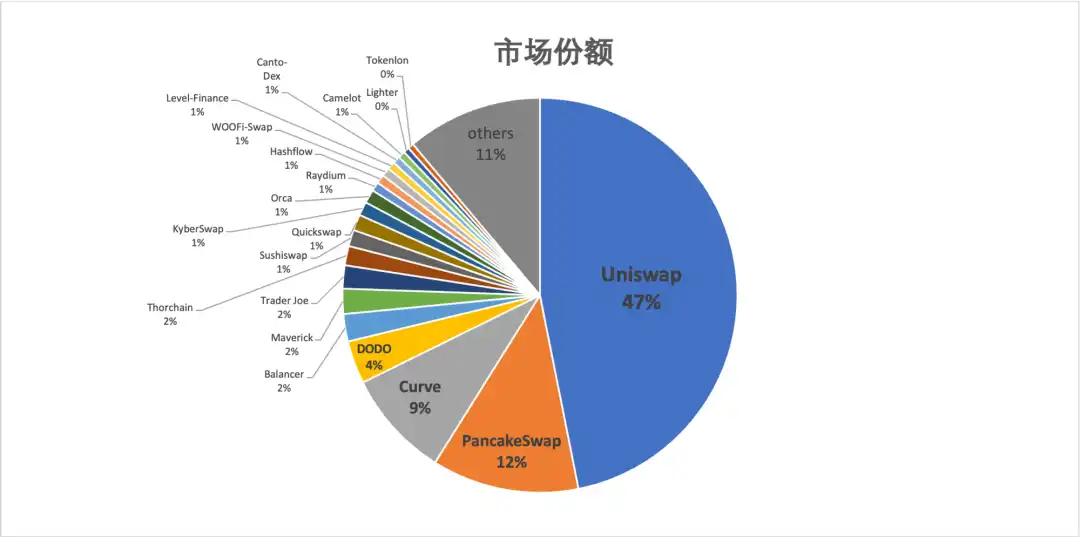
TOP 20 DEX market share rankings are shown in the pie chart, with these DEX accounting for approximately 89% of the total DEX market share. Uniswap maintained its leading position with 47% this year, and the overall DEX market maintains a "tiered" pattern.
Uniswap is in the first tier, with a rich product offering, wide reputation, and a market share of half the market. The second tier includes Pancake, Curve, and DODO, which account for 25% of the market share. The third tier includes Balancer, Maverick, TraderJoe, Thorchain, and others, while the remaining DEX are classified as the fourth tier.
The second-tier exchanges are all veteran exchanges with long operating time and mature and stable products. The third-tier exchanges include many newcomers. Maverick, with its automatic balance liquidity mechanism, has frequently entered the TOP5 market share since its launch earlier this year. Thorchain's unique forging mechanism has also been revitalized with the support of the market recovery.
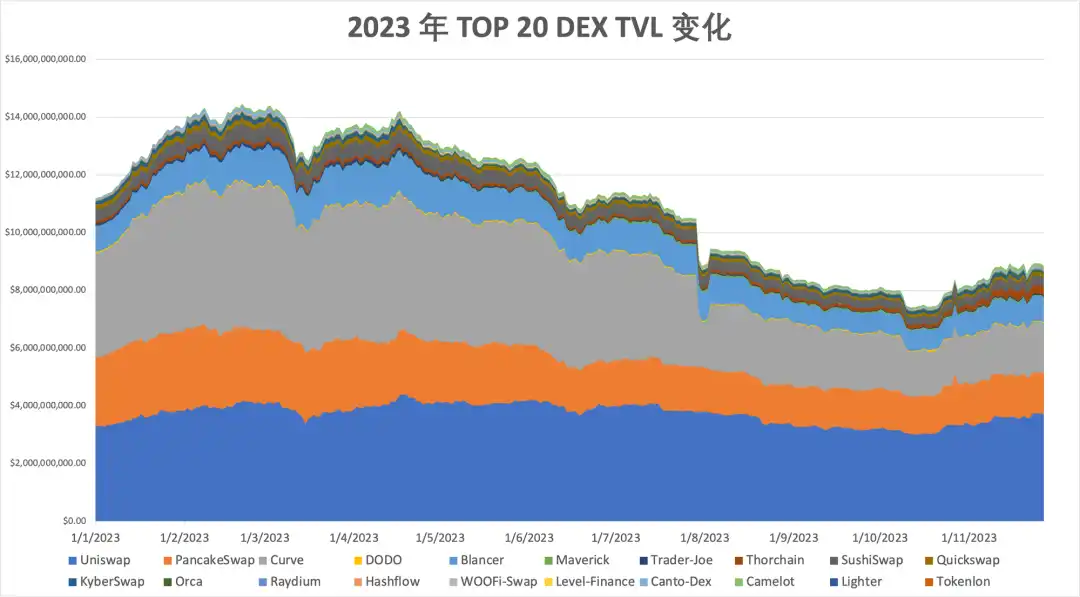
Represented by the TOP 20 TVL, the overall TVL of DEX has not experienced a cliff-like decline similar to that of 2022. After showing some signs of recovery at the beginning of the year, the rate of decline in TVL has gradually slowed down, and a turning point appeared in October, with the possibility of a reversal. The overall TVL scale is around $9 billion.
The vast majority of TVL is locked in the top exchanges: Curve, Pancakeswap, and Uniswap. Uniswap's TVL has remained stable, while Curve's TVL has significantly decreased after a hack incident, and Pancakeswap's TVL is not far behind. Thorchain's TVL has performed relatively well.
II. DEX Capital Efficiency
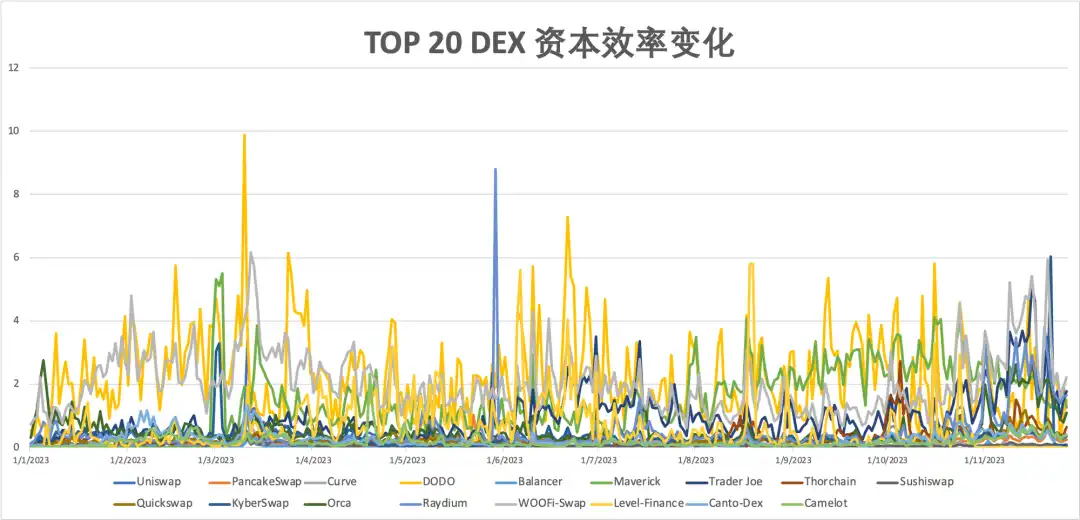
"Overall, in terms of capital efficiency, the DEX track has shown a recovery in capital efficiency, transitioning from local activity to global activity, improving capital efficiency, and the market is trending towards recovery."
From the perspective of capital efficiency of a single DEX, the yellow line DODO has been leading the market throughout the year, with only the gray line Curve keeping up with it in the early part of the year. Starting from August in the second half of the year, the green line Maverick emerged as a dark horse and performed well during the market fluctuations.
III. DEX's Multi-Chain Deployment
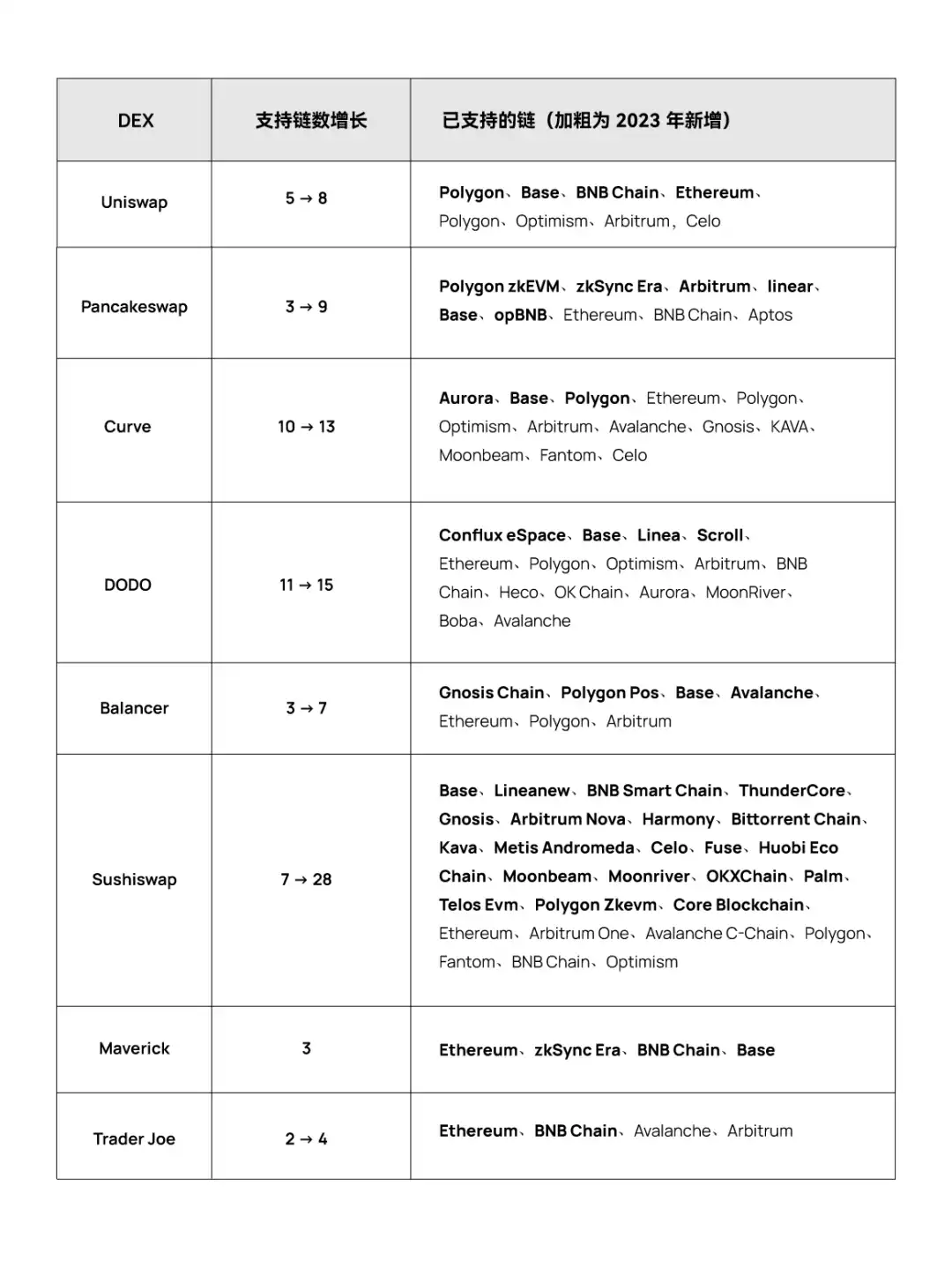
"Overall, major DEXs are actively expanding to EVM-compatible public chains and L2 solutions."
This not only helps diversify the product user base, but also reflects that DEX is using L2 solutions to reduce Ethereum chain-related costs and congestion (processing 4.5 times more transactions per second and saving 10 times the cost). Due to its different underlying architecture, the deployment cost of Solana chain is relatively high, and currently DEX support is limited. Raydium and Orca are the main DEX platforms for exchanging on the SOL chain.
However, the Solana network has the characteristics of high throughput and low transaction costs, so we have seen more cross-chain solutions emerge, allowing assets to move more seamlessly between different blockchains. The cross-chain platform ThorChain provides native asset exchange and has performed well in Q4. Cosmos' IBC architecture enables interoperability between different blockchains and is also a potential solution for DEX multi-chain deployment.
We have listed the multi-chain development status of common Ethereum exchanges in the Top 20 market share:
IV. DEX vs CEX Market Share Comparison
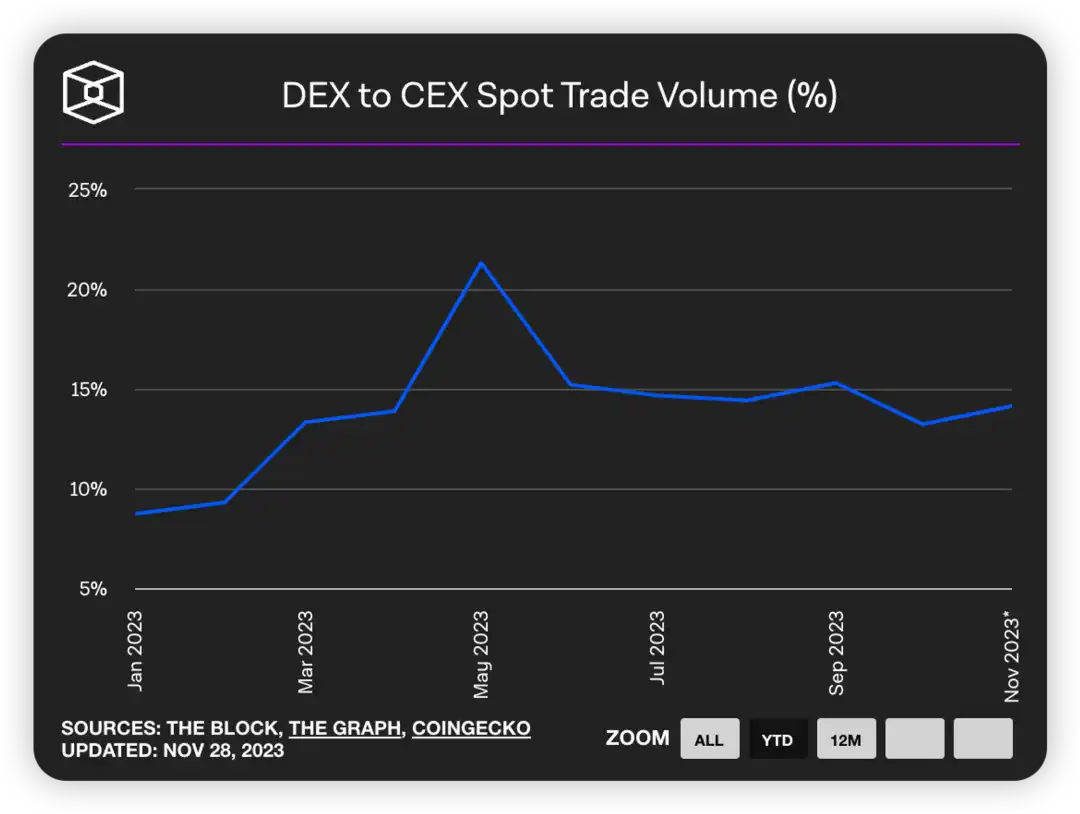
"The market share of DEX spot trading has increased in the first two quarters, reaching a record high of 21.31%."
The fallback stabilized at around 15%. This continues the trend from last year, where the trust crisis caused by the FTX explosion forced users to transfer their assets to DEX. At the same time, the user experience of DEX is also being further optimized, with Uniswap, Paraswap and other platforms launching their own wallet apps.
The most important thing is that DEX (especially AMM) allows users to add liquidity to long-tail tokens (such as meme tokens) without permission, which bypasses regulatory issues or other factors and frees them from the shackles of centralized exchange listings. Through DEX, projects can immediately guide liquidity and allow for greater market participation. According to CoinGecko's data, the tokens listed on Uniswap are almost 20 times that of Coinbase and 3.4 times that of Binance.
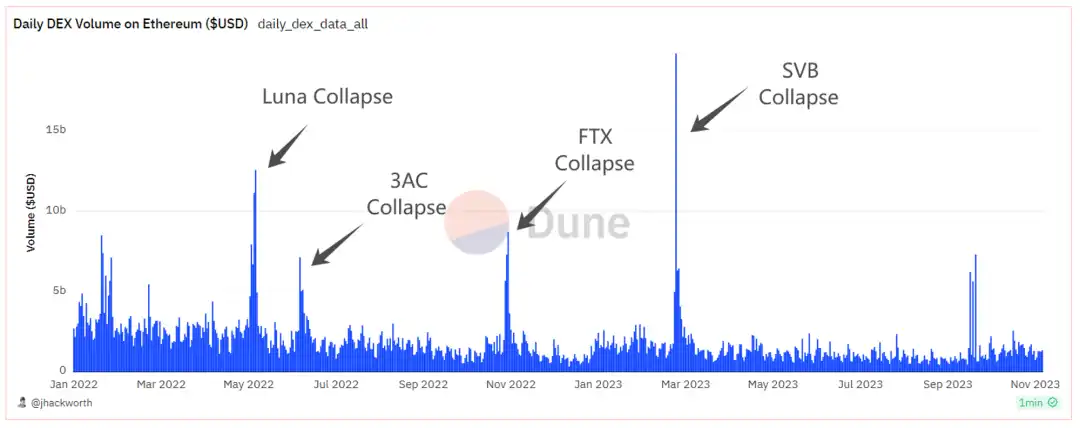
The most essential difference between DEX and CEX is that DEX repeats the programming rules by providing permissionless transactions. On the days when centralized entities (such as FTX, BlockFi, Celsius, and Voyager) collapse, the trading volume of DEX soars, setting a record for daily trading volume. The collapse of SVB (and the decoupling of USDC) led to a maximum daily trading volume of ~19.7 billion US dollars for DEX transactions.
V. DEX Mechanism Innovation
"MEV and large-scale adoption are still challenges facing DEX, and DEX has also introduced many mechanism innovations this year."
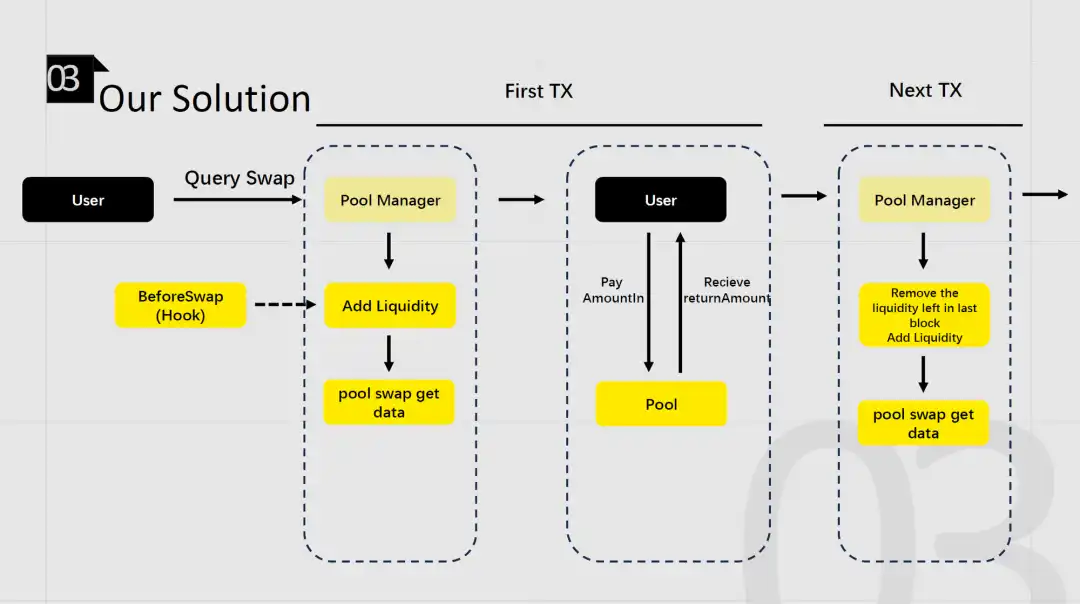
Representative examples include Uniswap X: allowing users to sign orders offline, solver Dutch auction execution; Maverick provides four modes, allowing automatic price tracking or one-way or two-way liquidity adjustment; DODO V3 allows LPs to entrust funds to professional market makers for active market making to increase returns.
Welcome to join the official BlockBeats community:
Telegram Subscription Group: https://t.me/theblockbeats
Telegram Discussion Group: https://t.me/BlockBeats_App
Official Twitter Account: https://twitter.com/BlockBeatsAsia

 Related Articles