Interpretation of BitRGB: the first "RGB20" asset trading market on the RGB protocol
Source: RGBS Community Enthusiast
The opportunity for a new asset in the Bitcoin RGB ecosystem has begun to emerge, and RGBS is the first RGB20 asset issued on the RGB Bitcoin smart contract layer. RGBS will be issued on the BitRGB platform. The core positioning of BitRGB is an asset management platform for RGB, aiming to provide trading users with a highly scalable, low-latency, and low-cost trading experience. According to official news from BitRGB, RGBS will open Mint at 7:00 am UTC on December 26, 2023, and distribute a total of 1,578,000,000 RGBS fairly to community users. RGB protocol is currently the most promising Bitcoin smart contract expansion solution in the Bitcoin ecosystem. It has received support from many star institutions including Fulgur Ventures, Bitfinex, Hojo Foundation, Pandora Prime, and DIBA. In addition, Tether has announced that it will issue USDT on RGB, which has also received support from the cryptocurrency exchange Bitfinex. Bitfinex has also been continuously promoting the development of the RGB protocol in recent years. BitRGB is a new Bitcoin asset issuance platform that combines innovation, scalability, and decentralization. Below, we will compare it with Nostrassets, a leading asset issuance platform focused on the Lightning Network Taproot Assets, in order to analyze their respective advantages in the field of Bitcoin asset issuance from multiple perspectives. With the wealth effect brought by the significant price increase of NostrAssets (hereinafter referred to as "NA") experimental airdrop tokens, NA has become the leading protocol in the Taproot Assets asset management platform track. BitRGB closely follows, focusing on the issuance and trading of RGB assets, and is expected to become the leading player in the RGB asset management platform track. The surge in NA's popularity will make it one of the most popular platforms for traders to invest and trade on the Lightning Network Taproot Assets. BitRGB's technical implementation has many similarities with NA, but there are also some differences, and the differentiation in positioning makes their cooperation relationship far greater than competition. BitRGB focuses on providing users with the issuance and trading of RGB assets, becoming a one-stop RGB asset management platform. There are differentiated characteristics between Taproot (formerly known as TARO) assets and RGB assets that NA focuses on. Taproot assets are a type of asset issuance scalable protocol developed by Lightning Labs, which was launched in 2022. RGB and Taproot have a high degree of similarity in design philosophy, both releasing data off-chain to free up Bitcoin block space and ensuring the validity of asset transactions through client verification. However, Taproot and RGB also show differentiation in privacy, Lightning Network compatibility, smart contracts, fees, core use cases, and other aspects. RGB: Third parties cannot detect transactions, and even senders and receivers are protected to some extent; on-chain traceability is 0; Taproot: In some cases, third parties may detect the payment, but detailed information is only known to the sender, receiver, and future receiver; the transfer leaves traceability on the chain. RGB: RGB state transition introduces an abstraction layer that is fundamentally different from Bitcoin transactions, posing certain challenges for Lightning Network developers. Taproot: Extra concepts are not abstract and may be more familiar to Lightning Network developers. RGB: The future plan is to support complex financial applications through Turing-complete smart contracts. Taproot: Unable to support smart contract scenarios. RGB: The size of on-chain transactions can be constant and actually cheaper than standard Bitcoin transactions. Taproot: Like NA, BitRGB also deeply integrates with the mainstream Bitcoin Lightning Network wallet Alby in the early stage, and adopts a semi-centralized approach to host users' RGB assets on the Lightning Network. However, BitRGB will iterate and upgrade to support self-hosting solutions in the relatively mature stage of the product, achieving higher decentralization. Welcome to join the official BlockBeats community: Telegram Subscription Group: https://t.me/theblockbeats Telegram Discussion Group: https://t.me/BlockBeats_App Official Twitter Account: https://twitter.com/BlockBeatsAsia
I am a practitioner in the encryption industry. Please translate the following Chinese text into English without considering the context or industry-specific terms and names. Do not omit any English words or phrases, including capitalized ones such as ZKS, STARK, and SCROLL. If there are English characters in an tag, do not translate them and return the tag as is. If the content consists only of punctuation marks, return them as is. Do not translate HTML tags such as , , , and
. If an HTML tag contains English characters, omit the translation and return the tag as is. Please preserve the content within tags. Translate all Chinese characters.
The text to be translated is:
Foreword
RGB Protocol Background
In short, RGB combines numerous technological innovations and capital favoritism, and BitRGB fully inherits its technological implementation concept, becoming the first high-performance RGB asset issuance and trading platform on RGB. The first Bitcoin RGB asset issued and traded on the BitRGB platform, RGBS, is naturally worth attention, as it carries the value of bitRGB and even the entire RGB protocol. Recently, the BitRGB official will launch the RGBS whitelist activity, and community users can join the discord/ and complete the Zealy task to obtain whitelist qualifications.BitRGB vs. NostrAssets
Background
Support for Asset Category Differences
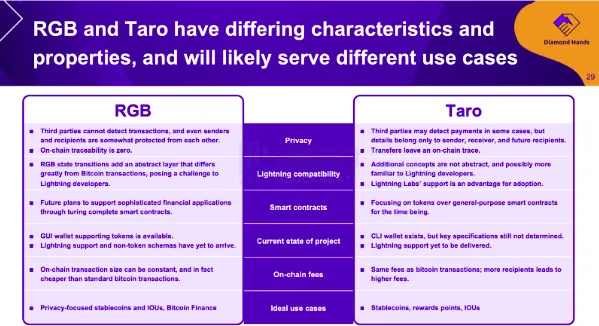
1) Privacy
2) Lightning Network Compatibility
3) Smart Contract
4) On-chain fees
The fees for transactions in the cryptocurrency industry are similar to those of Bitcoin; having more recipients will result in higher fees.5) Differences in Decentralized Implementation Paths
 Related Articles