The 'Ethereum Killer' is back, an article summarizing the Solana community's 'shilling language'.

The Solana ecosystem continues to heat up, with meme coins, inscriptions, and NFTs all making waves, making the crypto market aware that this once-considered most likely "Ethereum killer" is back?
Yesterday, the meme coin project SILLY in the Solana ecosystem saw its 24-hour increase expand to 211%. Multiple meme coins such as COQ and WIF also briefly made it to the trading hot list with astonishing gains. Meanwhile, Solana's native token SOL also briefly broke through $84 earlier today, with a 24-hour increase of 11%.
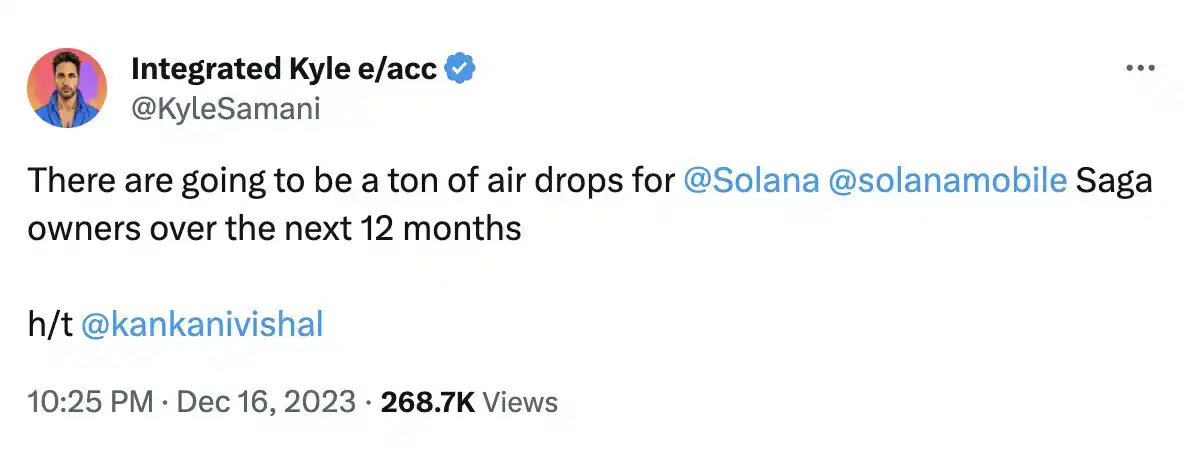
Before that, the hottest meme coin was Bonk, which once saved Solana from the fire. As the price of Bonk rose, Web3 phone Saga released by Solana Labs also gained a high premium in the secondary market, because each Saga phone has the right to receive up to 30 million BONK tokens airdrop. A few days ago, Kyle Samani, co-founder of Multicoin Capital, said on social media that he expects Solana phone Saga owners to receive a lot of airdrop activities in the next 12 months. This also adds fuel to the fire for Solana's meme season.
On December 16th, the trading volume of DEX on the Solana network was approximately $1.475 billion, surpassing that of the Ethereum network (approximately $1.164 billion). The trading volume in the past week reached $6.429 billion, an increase of 52.75%. Less than a week later today, the daily trading volume of DEX on Solana exceeded Ethereum for the second time in history, with a daily trading volume of over $1.2 billion.
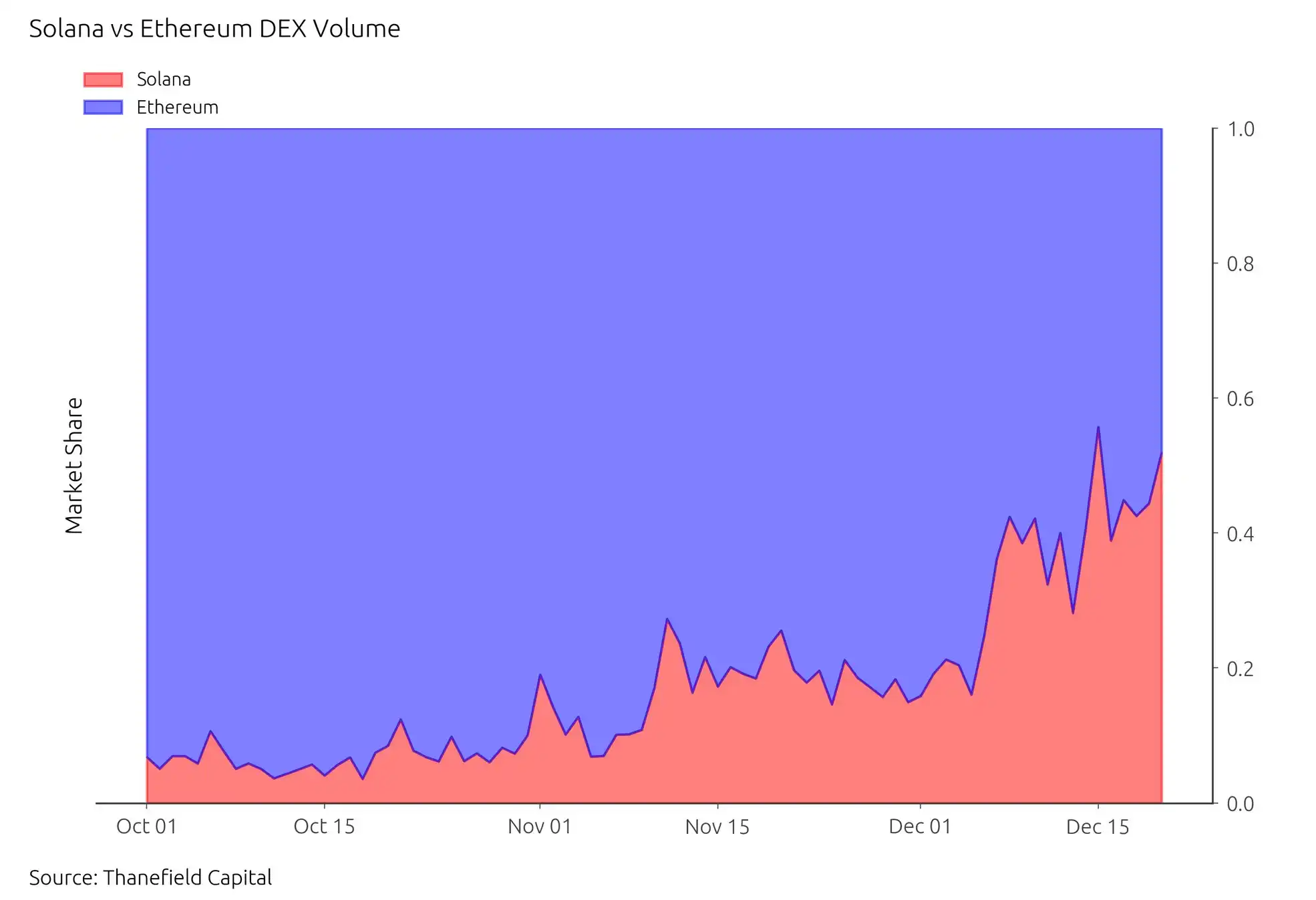
Analysts believe that Solana's trend of gaining market share as a new center for cryptocurrency trading may continue, thanks to its low-cost fees, faster transactions, and recent wealth effects in the ecosystem, providing a better user experience. This is precisely the huge vision of Anatoly, co-founder of Solana, to completely rebuild the New York Stock Exchange or NASDAQ on the chain.
"On-chain NASDAQ"
The origin of Solana can be traced back to the rise of cryptocurrencies in 2017, which created a wealth myth but also led to a very congested blockchain network. Anatoly, an engineer who had worked at Qualcomm for several years, realized that blockchain and communication networks faced similar problems and might have common solutions. One of Solana's goals is to compete for a share of the traditional finance market.
Solana seeks to solve the blockchain trilemma by using Proof of History to confirm transaction time, sacrificing some decentralization for speed, but "fast speed, low cost, and low user interaction friction" have also become Solana's signature. The theoretical maximum TPS of Solana is 710,000, exceeding Visa's 17,000.
In July 2020, Solana reached a major turning point when FTX announced the establishment of its DEX Serum on the basis of Solana. This marked the beginning of SBF's collaboration with Solana. SBF's demand for a high-frequency trading public chain and Solana's mission to build a Nasdaq-like exchange on the chain were a perfect match.
Afterwards, SBF not only publicly supported Solana multiple times, but also participated in multiple rounds of financing for Solana. Subsequently, SBF also invested in multiple applications based on Solana. With the support of FTX, Solana quickly established a foothold in the cryptocurrency world. Star VCs such as Multicoin Capital, a16z, and Polychain Capital also invested in Solana, and the return on investment was considerable. Solana is even referred to as the VC chain.
However, with the arrival of the cyclical bottom and the collapse of the FTX empire, Solana also experienced its biggest survival crisis since its inception. But as the market becomes more active and trading volume increases significantly, Solana's advantages are gradually being re-evaluated.
On October 31st, the Solana Foundation announced at the Breakpoint, the annual summit of the Solana community, that Firedancer, the second node validator of Solana developed by Jump Crypto, has officially launched the testnet. The mainnet is expected to be launched in the first half of 2024.
Firedancer is used to improve the diversity of node clients and the stability of the Solana blockchain, and to make Solana more resilient and resistant to attacks. Compared to the first client, Firedancer is developed using C/C++ language, which gives it higher compatibility and memory efficiency, while reducing the cost of running Solana nodes.
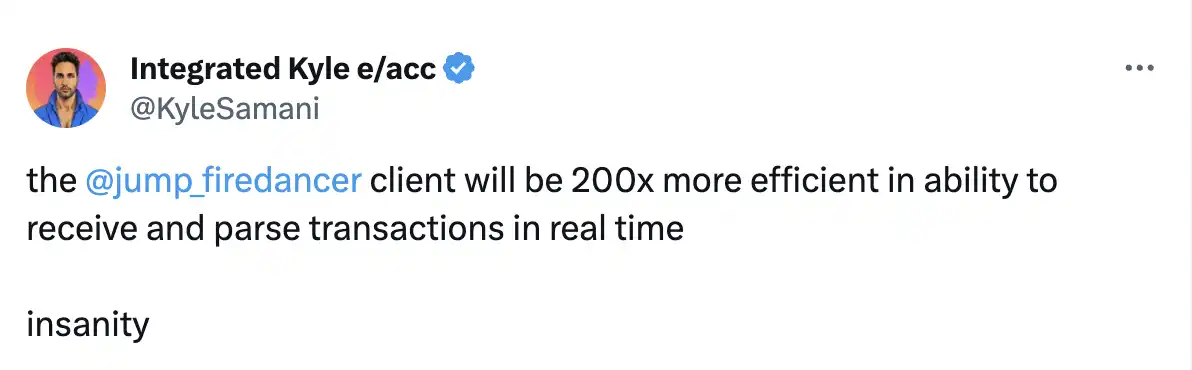
Today, Kyle Samani, co-founder of Multicoin Capital, mentioned on X that the efficiency of Firedancer's real-time transaction reception and parsing will be improved by 200 times, further reassuring the market.
Currently, Solana's TPS is 2373, with an average transaction fee of 0.00025 USD. In terms of cost-effectiveness, Solana is still ahead of Ethereum, which has a TPS of 14.8 and a gas fee of 1.66 USD. Despite the recent surge in NFT transactions, Solana's transaction fees have not increased significantly compared to before. However, the transaction fees of public chains such as Bitcoin, Ethereum, and Avalanche have skyrocketed during this period, which is daunting for many people.
"Ethereum Killer"
High transaction throughput has always been one of the core requirements for cryptocurrencies, which is also the reason why Ethereum has undergone major upgrades multiple times. Looking back at Solana's development this year, its "on-chain NASDAQ" vision is gradually moving forward, and the familiar title of "Ethereum killer" has once again been bestowed upon Solana.
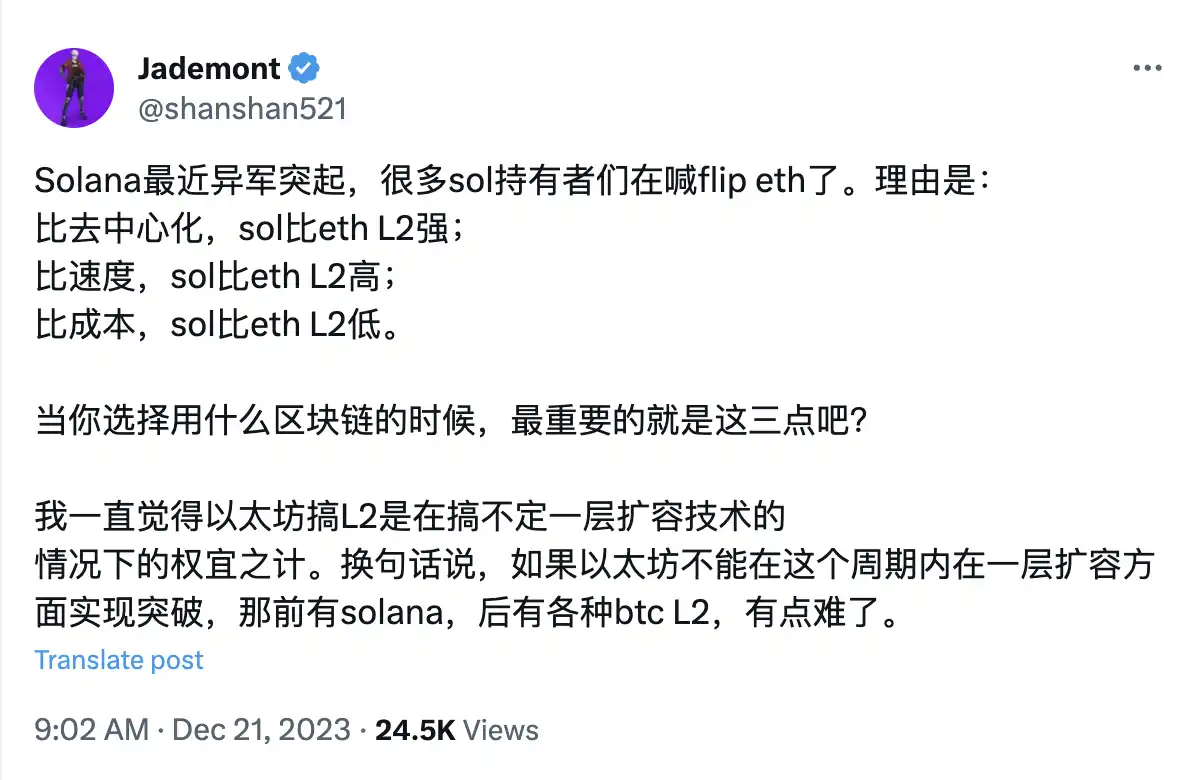
Waterdrip Capital founding partner Jademont posted on X today, stating that Solana's rise has caused holders to shout "Solana Flip ETH". He believes that "Ethereum's L2 is a stopgap measure when it cannot handle layer 1 scaling technology. In other words, if Ethereum cannot achieve a breakthrough in layer 1 scaling during this cycle, it will be difficult with Solana in front and various BTC L2s behind."
Messari wrote in yesterday's "CRYPTO THESES 2024" that "When I think of Ethereum and Solana, I think of Visa vs. Mastercard, not the crushing power of Google vs. Bing."
Related reading: "Messari's 2024 Investment Forecast: Bearish on ETH, Bullish on AI, DePIN, and DeSci."
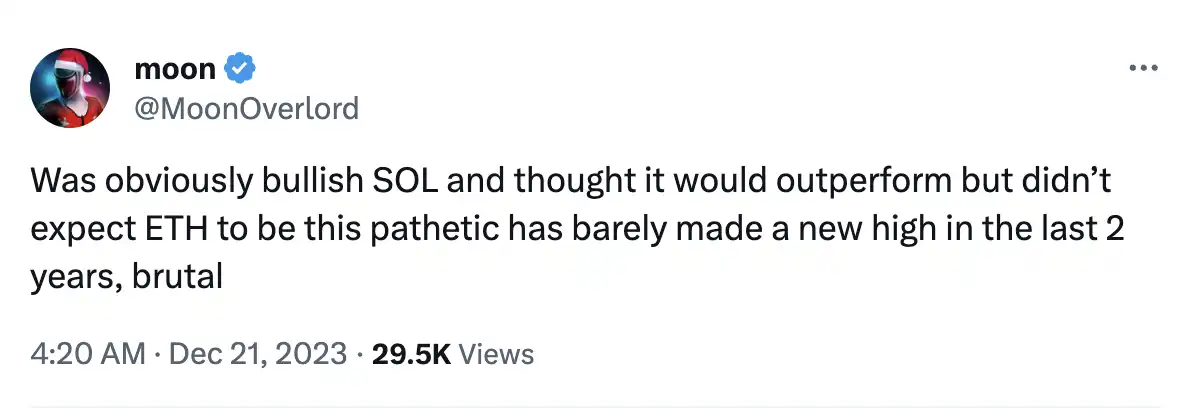
Cryptocurrency trader @MoonOverlord wrote on X, "Obviously bullish on SOL, thinking it will outperform the market, but didn't expect ETH to perform so poorly, cruelly not hitting a new high in the past two years." According to CoinGecko data, SOL has risen by 587.4% in the past year, while ETH has only risen by 81.7%.
On October 28th, asset management company VanEck released a report stating that it applied VanEck's standardized valuation framework to Solana and found that the value of a single SOL token could reach $335 by 2030. Despite its enormous potential, VanEck believes that the possibility of Solana hosting most of the world's cryptocurrency transactions by 2030 is still lower than that of Ethereum. If Solana can avoid Ethereum's narrative and achieve a dominant position similar to Ethereum, VanEck's bullish analysis framework shows that the revenue of the Solana network will reach $51.8 billion in 2030, with a target price of $3,211 for SOL.
The performance of Solana is evident, and its promise to upgrade Firedancer next year will once again increase the capacity of the Solana network by 10 times. The upgraded Solana network throughput can reach nearly 1000 times that of Ethereum 2.0. However, in 2024, Ethereum will usher in the Cancun upgrade, which also makes people look forward to how the cryptocurrency market will change next year.
Welcome to join the official BlockBeats community:
Telegram Subscription Group: https://t.me/theblockbeats
Telegram Discussion Group: https://t.me/BlockBeats_App
Official Twitter Account: https://twitter.com/BlockBeatsAsia

 Related Articles