Aptos, Solana, and the Cycle of New Public Chains

Original title: Aptos, Solana and the Cycle of New Public Chains
Written by: Wang Ye, Mint Ventures Researcher
Some time ago, I was invited by Babbitt to participate in the "Web3 Builder, No Questions" event, and was asked a question: "Top institutions such as A16Z, Binance and FTX are very optimistic about new public chains such as Aptos. Will these public chains challenge Ethereum's dominance?" In view of the large number of readers interested in this topic, the author has sorted out his thoughts so far and formed the following comprehensive review of Solana, Aptos and new public chains. The author positions Aptos' market position roughly as Solana's current market position.
In order to facilitate readers' understanding, this article simplifies the principles of blockchain consensus and communication technology.
The following content is only the author's periodic thinking on some specific issues of the new public chain, which is similar to a casual talk in form.
Preliminary division of the public chain track
In 2015, the launch of Ethereum ushered in the era of smart contract public chains, and also made public chains an indispensable infrastructure for the entire Web3.
In 2017, the explosion of ICO and Crypto Kitties almost paralyzed the Ethereum network. Since then, all practitioners have realized that the blockchain at this time is completely insufficient to bear the transaction needs of a larger area of real society, and capacity expansion must be the golden track of WEB3's long-term rigid demand.
To facilitate today’s discussion of new public chains, we will temporarily put aside Ethereum, which already has a large number of applications, a large number of developers, and a strong influence, but is constrained by many existing stakeholders and has to slowly transform. Instead, we will give priority to observing new public chains that do not have early influence and user accumulation, but have lighter historical baggage and can easily adopt new high-performance solutions. Solana was once the absolute king of the new public chain track, but now, Aptos is regarded as the "Solana Killer" by many investors.
High-performance new public chain track: Aptos takes over Solana
First of all, I think Aptos has a high probability of impacting Solana's position.
Before Ethereum officially implements sharding and achieves sufficient high performance, the high-performance new public chain track will show a certain cyclical law. Specifically, a new public chain grows rapidly due to radical high speed and low fees, and at the same time enters a negative flywheel due to loopholes caused by radical high speed and low fee choices. The high-performance narrative of Solana in this round began to lose its luster, and the nickname of "downtime chain" gradually replaced the title of "Ethereum killer", and capital began to look for new successors under the cyclical law.
The rise and fall of Solana - high speed and low fees
The story of ultra-high TPS
Solana's high TPS is based on 10 times the block size, low redundancy, 1/30 of the block time, and about 10 times the speed after parallel computing, achieving a theoretical TPS of about 3,000 times that of ETH.
(1) Block size
Among them, Solana increased the block size from about 1MB to 10MB, thereby bringing a 10-fold performance improvement. However, increasing the block size is not a very worthy solution, because too large a block size will cause two obvious disadvantages while increasing the system processing capacity: the number of full nodes that can store complete transactions on the blockchain is greatly reduced, and large blocks take too long to transmit in the system and are even vulnerable to attacks (Bitcoin's several famous forks, such as BCH and BSV, all originated from fierce debates over block size, and Bitcoin eventually insisted on small blocks).
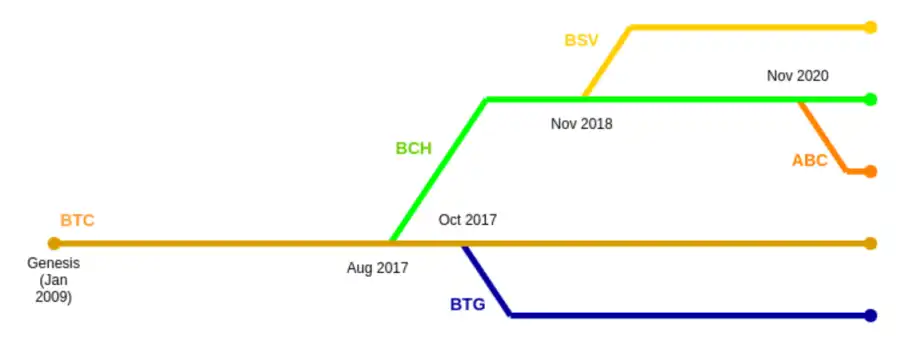
Source: https://vitalik.ca/general/2020/12/28/endnotes.html
Although Solana has made many improvements in the communication process and avoided some risks, Solana's large blocks still increase the threshold for full nodes and reduce the number of full nodes, which has a certain negative impact on the degree of decentralization and network security.
(2) Consensus-level improvements – block time and low redundancy
Centralized transaction processing flow
In the centralized system of web2.0, taking Alipay as an example, since there is only the official Alipay server in the background, the transaction processing is very simple:
Transaction information is sent to Alipay
Alipay directly confirms and executes the transaction
No one is responsible for verification, because most people believe that Alipay is unwilling to do evil.
In total, 1 send, 1 execution, 0 verification, the total time is almost negligible.
Decentralized transaction processing
However, in the public chain field, becoming a validator is almost a barrier-free thing. We cannot directly trust that a validator has made the correct transaction processing. Therefore, we need a large number of validators, and the verification process will be very complicated:
Ethereum
Let’s take a look at how Ethereum confirms transactions:
(1) After the transaction is completed, the relevant transaction information is transmitted to n nodes in the Ethereum network in 6 seconds
(2) A random node processes it, packages the processed transactions, and generates blocks
(3) The blocks are sent to n nodes in the entire network for verification.
Overall, a large number of transmission and verification times have been increased, and a block process is 12 seconds.
Due to the untrustworthiness of a single node, there must be multiple rounds of game mechanisms in the blockchain era to allow all nodes to verify each other, thereby maintaining the accuracy of the final result of the blockchain. This increases time consumption and redundant calculations, and is also an important reason for the existence of the blockchain impossible triangle.
Solana has greatly improved the speed at both the transmission level and the block verification level. Solana has reduced the block time from Ethereum's 12 seconds to 0.4 seconds (up to 0.8 seconds), thereby achieving about 30 times the expansion.
Solana
Let’s take a look at how Solana keeps accounts:
(1) Transaction transmission level: Solana will announce the leader of each slot in advance in each operation cycle (Epoch), which means that all transactions only need to be transmitted to the Leader, without being transmitted throughout the entire network, which reduces the redundancy of the transmission link.
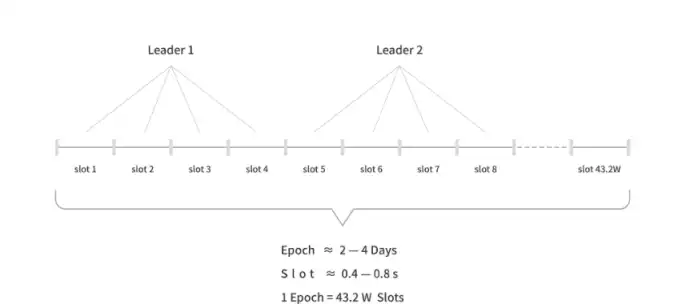
Image source: CatcherVC
(2) Transaction verification level: Solana block leaders split blocks, and other validators only need to verify their own parts, rather than the entire block.
Under Solana’s block generation mechanism, the redundancy of computation is reduced from n² to logn, thus achieving more efficient operation (the following is a simple popular science).
Let’s recall some classic math problems:
(1) If any two of n people need to exchange ledgers, how many times do the ledgers exchange? The answer is n(n-1), or n².
(2) Correspondingly, suppose any one of n people needs to exchange ledgers with a known “leader”, how many times do the ledgers exchange? The answer is 2(n-1), or n.
(3) Assume again that among n people, the known "leader" exchanges part of the ledger with each person, then how many times has the ledger been exchanged in total? Obviously, it is lower than the n level, and we can simply understand it as the logn level.
Among them, (1) corresponds to Ethereum, and (3) corresponds to Solana.
We can get the following diagram. Under Solana's consensus mechanism, the redundant calculations required for the system to generate blocks are greatly reduced, and the block generation speed is also significantly improved.
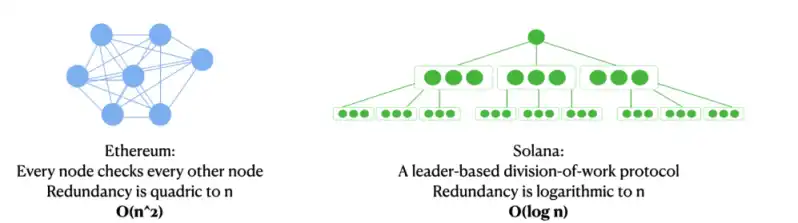
Image source: Twitter @TheAntiApe
At the beginning of Solana, this design did allow Solana to run at a very fast speed. But it is easy to find the disadvantages of this model: accepting various transactions, identifying valid transactions, packaging transactions, splitting blocks, requiring other validators to verify and recover the verification results, etc., are all completed by the leader node.
The leader node faces great pressure and is prone to crash when there are large transaction volumes/many invalid transactions. As we can easily see from the figure below, once the leader node crashes, it is very difficult for the entire system to operate normally, which causes frequent downtime of the entire block network.
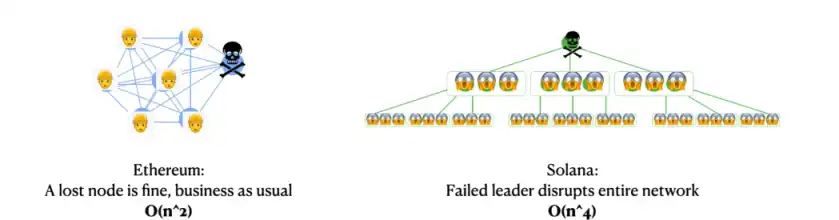
Image source: Twitter @TheAntiApe
In addition, the centralized problems such as bribery and targeted attacks of the pre-announced leadership nodes cannot be avoided, which also has a certain negative impact on the entire blockchain.
Since the outbreak of the Solana ecosystem in September 2021, there have been many downtime accidents. Frequent downtime accidents have limited Solana's development space. In the next bull market, users need a new public chain that will not frequently crash (at least not show a very high risk of downtime for the time being).
(3) Parallel Computing
In addition to the basic consensus mechanism, Solana has also made improvements to the parallel processing of smart contracts.
Early Ethereum used EVM as the operating environment for smart contracts. The important feature of this choice is serial computing (processing transactions in sequence), which is a relatively inefficient processing mode. Although the Ethereum community also has plans to upgrade EVM (to EWASM), it is still a long way from implementation.
Solana uses Sealevel to support parallel processing of smart contracts and supports the use of NVIDIA 4096-core GPUs for super-strong parallel computing. This allows Solana to demonstrate super-strong operating capabilities in most cases.
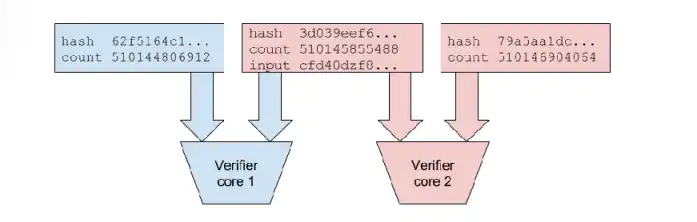
Image source: Solana White Paper
However, Solana will also face the following special situations:
(1) Solana needs to correctly determine whether transactions can be processed in parallel, and incorrect determination may cause failures.
(2) If Solana determines that transactions must be processed in series, its serial operation speed will be slower than Ethereum.
In summary, the parallel computing feature of 4096 cores allows it to have super high efficiency in programs that can be processed in parallel, but once it encounters transactions that cannot be processed in parallel, its efficiency will be lower than Ethereum, and it may even fail and crash. In addition, Solana's low redundancy feature, that is, through the "leader node assignment task" model, allows Solana to easily achieve higher normal operation efficiency. However, once a failure occurs, Ethereum's high redundancy allows it to recover quickly, while Solana's low redundancy can easily cause the network to crash. Overall, the Solana project has made a lot of high-value innovations. In the early days, Solana was able to rise quickly through high TPS, but in the later days, it had to pay the price for the feature of easy downtime.
This is the blockchain version of "using redundancy to fight uncertainty."
The story of ultra-low fees
(1) Public chain revenue and expenditure and "printing money"
Another major reliance of Solana's rise is low fees. In general, low fees come from ultra-high processing power on the one hand and from the system's coin issuance subsidy on the other. We can explain in detail the income and expenditure under this coin issuance subsidy model.
If we think about the business logic of the public chain, it provides a business environment for various commercial projects and collects taxes from all users. Then the public chain will be very much like a country, and the public chain token is more like legal currency used to pay taxes.
Further analysis, we simplify this income and expenditure according to the common characteristics of most public chains. The taxes of these "countries" are the handling fees of all users, and the fiscal expenditures of these "countries" are incentives issued to validators. If you look through the government's financial reports, you will most likely see this word: "balance of income and expenditure."
Just as a country needs to balance its income and expenditure, a public chain also needs to balance its income and expenditure. But if we check the income and expenditure of each public chain, we will find that the expenditure of most public chains exceeds their income:
Rewards for validators - handling fee income = loss of public chain
Bankless once made the following statistics on the loss rate of public chains:
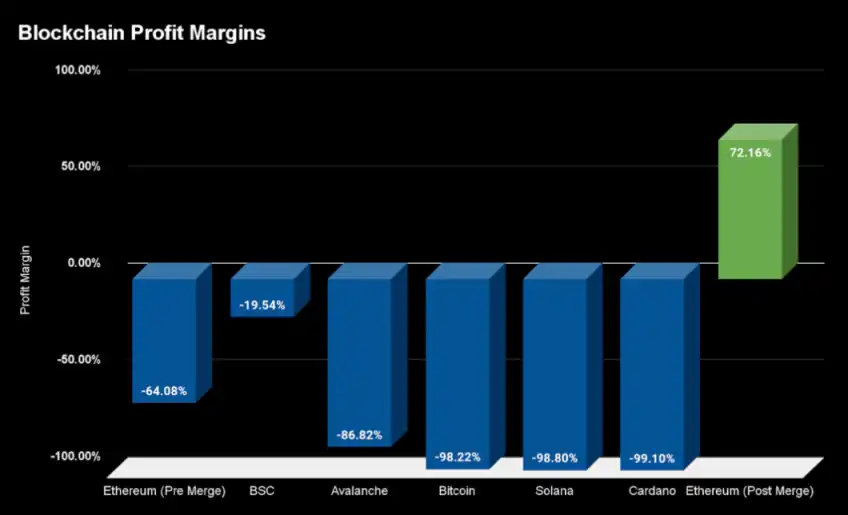
Image source: Bankless
When the income of a public chain is less than the expenditure required to pay the validator, the amount of these losses can often only be subsidized by "turning on the printing press" and issuing coins, that is:
Losses of public chain = additional issuance rewards
Then, the rewards for verification often come from two parts: normal income and "printing subsidies":
Fee income + additional issuance rewards = rewards for validators
For Solana, when a blockchain validator should receive 100 yuan in "salary", the amount of Solana's "printing subsidies" to the validator is often as high as 98.8 yuan, and the actual fees collected from users are only about 1.2 yuan. Of course, this data will change over time, but Solana still has a long way to go to break even and operate sustainably.
(2) “Printing money” brings inflation to the public chain
We chose to compare the public chain to the country and the public chain Token token to legal currency. For a public chain, the total value of the currency and the total value of the goods should be completely corresponding.
We can simply think about it as follows: a country’s only goods are apples. In the first year, the country produced a total of 100 kilograms of apples and issued a total of 100 yuan of currency. The market price of apples will be 1 yuan/kilogram. If in the second year, the country develops rapidly and has 200 kilograms of apples, and also issues 100 yuan of currency, the price of apples can also be stabilized at 1 yuan/kilogram. If the country's development stagnates in the third year and only 200 kilograms of apples are produced, but 100 yuan of currency is issued again, the price of apples will become 1.5 yuan per kilogram, which means that there will be serious inflation.
Correspondingly, for the Solana "country" that issues "currency" at a higher speed, the negative impact of issuing currency will be almost offset by the rapid growth of the total value of goods on the chain in the early stage.
However, when Solana has encountered an obvious development bottleneck, when the total amount of currency and the total value of goods begin to be out of balance, Solana continues to print money to make up for the deficit, or reduces the printing of money and increases "taxation", which is essentially not conducive to the development of blockchain. This is also called the "cyclical law of the new public chain" by some people.
At least in the next round, the market expects a public chain that can find a balance between income and expenditure again, or at least through the rapid development of the early ecology, it will not let users feel the imbalance of income and expenditure. At present, it seems that Solana may be taken over, and Aptos is also expected to become that person.
We might as well discuss Ethereum's business model here: For Ethereum, after the implementation of the EIP1559 destruction mechanism in 2021 and the official merger in 2022 to reduce operating costs, the corresponding formula has become:
Transaction fee income + additional issuance - destruction = expenditure on validators
If income - expenditure = profit, then for Ethereum:
Profit = destruction - additional issuance
Among them, the issuance amount after the merger dropped from 4.5 million per year to 180,000-2.09 million, and the destruction amount was determined by the usage of the blockchain. It is not difficult to calculate that when the Ethereum gas price exceeds 15, Ethereum is likely to be a blockchain that has exceeded the break-even line. If it can be maintained for a long time, it can achieve long-term development and survival.
(3) Some analysis cases from the perspective of income and expenditure
Income and expenditure may be a topic that everyone often ignores, but even in the new web3 world, the most basic logic of business still cannot be separated from income and expenditure.
In June 2022, the Immutable X (IMX) project on Starkware increased fees, and dydx left to build its own chain, which actually hinted at some impact of income and expenditure on the public chain structure. Here we can analyze the two projects from the perspective of income and expenditure.
IMX
For Immutable X, let's do a basic breakdown of its revenue and expenditure:
As a zkrollup, before June 2022, Immutable X claimed to be completely 0 gas, so its main business income was basically 0.
As a zkrollup developed based on starkware, it needs to package transaction records to the Ethereum main chain for verification and storage to ensure security, and pay corresponding fees to Ethereum, with the main expenditure being Ethereum's gas fee. In addition, IMX also needs to pay starkware usage fees, etc.
Such revenue and expenditure are obviously unbalanced, so in June 2022, IMX began to charge a 2% transaction fee to maintain the balance of system revenue and expenditure.
DYDX and the trend of short-term application chains
Next, we can observe its revenue and expenditure and choices from the perspective of DYDX:
For DYDX on Starkware, if it chooses Ethereum layer2, its revenue = transaction fees, and its expenditure = payment to Starkex + gas fee to the Ethereum system + cost of on-chain applications.
For DYDX that builds its own chain on Cosmos, its revenue = transaction fees + self-built chain gas fee, and its expenditure = chain cost.
That is to say, if DYDX chooses to build its own chain on Cosmos, it will save the payment to Ethereum, increase the chain cost and gas fee capture, and of course lose a certain amount of traffic in the Ethereum ecosystem. Under the premise of the current high block rent of Ethereum and the low chain building cost of Cosmos, it is a natural choice for DYDX to switch to Cosmos to build its own chain.
Of course, when Ethereum sharding is implemented and becomes more cost-effective and efficient, from the perspective of application (chain), building a chain by oneself will no longer be a sufficiently economically rational choice, and the original application chain narrative of projects such as DYDX will also reach a certain turning point.
Then according to the logic and cycle of high TPS and low fees, the development of Solana in the new public chain track has obviously encountered a bottleneck, and the successor of the new public chain leader will appear. From the capital pursuit, the re-selection of technology and the narrative of the Move language, it can be preliminarily seen that this successor may be Aptos.
Aptos is expected to take over the new public chain
At present, Aptos and Solana's investors are highly overlapped, and some of Solana's executives and on-chain project parties also have a trend of switching to Aptos, which is a great opportunity for Aptos to take over Solana. In addition, the re-selection of high performance and the new story of the Move language have also made Aptos more competitive. Of course, whether Aptos can take over and the actual development after taking over may test the ability of the project team.
On the first day of launch, the Aptos team caused some controversy in terms of token allocation and community management, which made the author not too optimistic about the ability of the project team.
The story of high performance
(1) Diem-BFT V4 consensus mechanism
The core innovations of this consensus mechanism are as follows:
First, the system compresses a large number of transaction records into a "summary" ("PoAv" in the figure) each time.
Second, the block only contains the "summary" instead of all transaction records.
In this way, blocks of the same size contain more transaction records, thus achieving a higher level of expansion. Of course, this compression will also have some potential risks. For example, transaction records in different batches need to be divided without duplication or omission, otherwise transaction processing failures will occur.
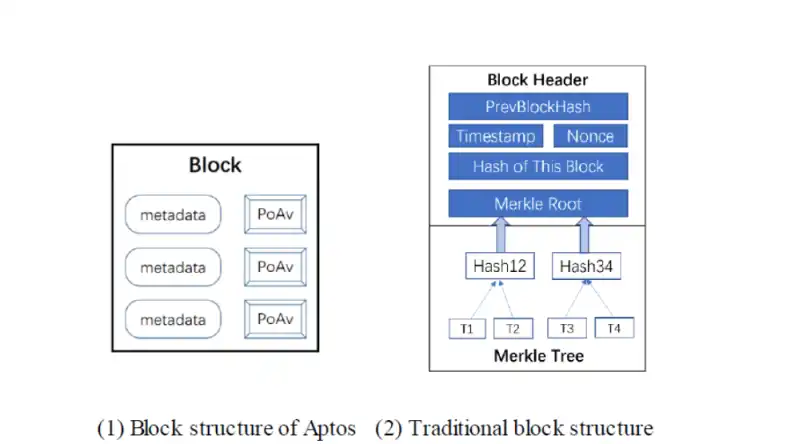
Image source: Huobi Research
Since the Tokenomics currently announced by Aptos is relatively vague, we will not delve into the sustainability of its economic model for the time being.
(2) Parallel computing
Aptos adopts an optimistic assumption, that is, it assumes that transactions have no correlation and processes them in parallel. If the correlation between transactions is very low and can be processed in parallel, Aptos will be greatly accelerated by parallel computing. However, if the transaction correlation is very high, Aptos will obtain a processing speed slightly lower than ETH, but the consequences are relatively not particularly serious.
Of course, Aptos finally chose 16 threads for parallel processing, which also has high requirements for node hardware, and the number of nodes that meet the requirements will also be reduced (some signals can also be seen from Aptos' current node screening), which will also sacrifice decentralization and security.
It should be said that from a purely technical perspective, Aptos is more of a trade-off than a complete innovation in parallel computing. The author is reserved about optimistic assumptions and other solutions.
The Story of the Move Language
The Move language is one of the main narratives of Aptos and does have a strong influence.
Move is a static programming language that emphasizes security. For example, Move does not support dynamic dispatch, which means that all codes must have the ability to fully understand various operating relationships at a glance before they are officially run. This is a solution that focuses more on security and has unique value in the financial field. Solidity supports dynamic dispatch and emphasizes flexibility.
Overall, Move language is worth adopting in many blockchain scenarios. However, Solidity's own advantages such as flexibility and past accumulation are enough to maintain a considerable number of users.

Image source: Buidler DAO
The Confrontation between New Public Chain and Ethereum
The author is pessimistic about Aptos' impact on Ethereum. Although Aptos and Ethereum have their own trade-offs in terms of blockchain performance, from the perspective of the future of multi-chain, it is difficult for Ethereum and Aptos to be called competitors of the same dimension:
Ethereum has built a secure and large-scale multi-chain system (including Optimism, Arbritrum, Starkware, Zksync and other Rollups), and some Rollups have reached a level of development close to that of the new public chain leaders, while Aptos is still a single chain with split liquidity. A secure multi-chain system will be Ethereum's invisible moat.
Multi-chain future
First of all, due to the inherent impossible triangle of blockchain, and the increasing number of tracks on the blockchain (Defi, Gamefi, NFT...), it is difficult for one blockchain to meet the needs of multiple users, so the future will definitely be multi-chain.
Cross-chain risk
In 2021, high-performance new public chains and dedicated chains for various tracks developed rapidly, but at the same time, users also noticed an extremely obvious problem, that is, the separation of cross-chain risks and liquidity. If a user buys and uses a domain name on Aptos, plays Stepn on the Solana chain, and buys the latest NFT on the Flow chain... users may need to transfer assets between different blockchains frequently, but so far, there is no secure cross-chain interaction method. The application of "cross-chain bridge" has been called "hacker's ATM" by the industry because of the repeated theft news.
As we all know, a single blockchain is constrained by a consensus mechanism and is safe. But when two blockchains interact, there is no consensus mechanism to constrain them, so cross-chain bridge projects have security risks that cannot be eliminated.
Therefore, the author's prediction for the multi-chain era is a secure multi-chain system, rather than several single chains with split liquidity.
Security of the multi-chain system
In the multi-chain era, Ethereum serves as a shared security layer, and each Rollup with its own characteristics meets the needs of different users. It is actually a very secure multi-chain system.
Imagine that users can deposit assets to play Illuvium games on IMX, or transfer assets to Arbitrum through the Ethereum main chain to participate in Odyssey to complete tasks. These asset transfer processes (Cross-Rollup) are all guaranteed by the Ethereum main chain to ensure security, avoiding most of the problems existing in cross-chain.
Powerful multi-chain system of Ethereum
Ethereum's multi-chain ecosystem has already become highly competitive, and the TVL of the two major OP Rollups on Ethereum: Optimism and Arbiturm have both entered the top 8. In the Ethereum Shanghai upgrade next year, it is expected that the cost of various Rollup projects on Ethereum to interact with Ethereum will be greatly reduced, which will prompt another leap in the development of various Rollups, and thus make Ethereum's multi-chain system with a shared security layer have an extremely solid industry position.
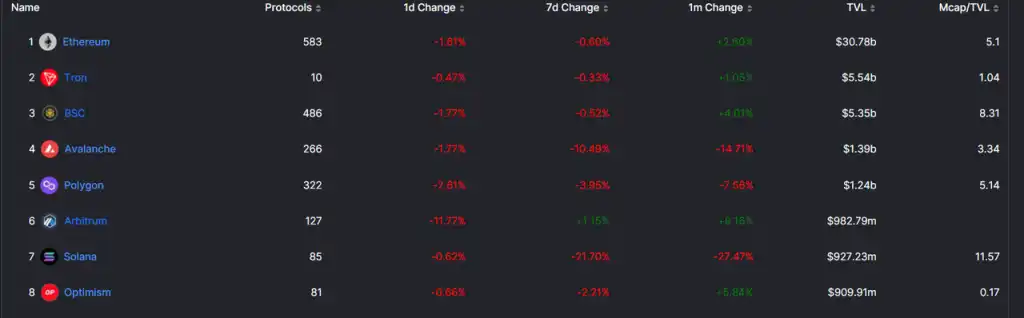
Image source: Deflama
In addition, ZK Rollup in Ethereum Rollup is also developing rapidly, and in the long run, ZK Rollup has a higher ceiling than OP Rollup in terms of security, transaction speed, transaction fees and other dimensions. With the launch of Zksync on the mainnet this month, the development of Polygon zkevm and Scroll, in the near future, the ecology of ZK Rollup will also be expected to reach the level of the new public chain leader. Even if Aptos and other single chains with split liquidity have multi-chain development plans, it is extremely difficult to impact the powerful Ethereum multi-chain system.
Original link
Welcome to join the official BlockBeats community:
Telegram Subscription Group: https://t.me/theblockbeats
Telegram Discussion Group: https://t.me/BlockBeats_App
Official Twitter Account: https://twitter.com/BlockBeatsAsia