EigenLayer increases TVL limit again, how to interact before closing?
Original Title: "EigenLayer once again raises TVL limit, how to interact before the door closes?"
Original Author: Azuma, Odaily Star Daily
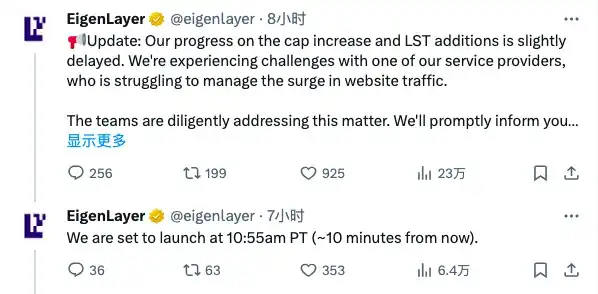
On December 19th, the Ethereum re-staking protocol EigenLayer once again opened the deposit window for liquid restaking and increased the total re-staking limit (which can be understood as TVL limit) of major ETH liquidity derivative tokens (LST) from 100,000 to 500,000.
This year, EigenLayer completed a $50 million Series A financing round in the first half of the year, with Blockchain Capital leading the investment and participation from Coinbase Ventures, Polychain Capital, Zonff Partners, Bixin Ventures, Hack VC, Electric Capital, IOSG Ventures, and others.
Earlier, EigenLayer completed a $14.5 million seed round of financing, led by Polychain Capital and Ethereal Ventures.
Due to the innovative re-collateralization mechanism that opens up the imagination space of the extended Ethereum trust layer, and the breakthrough progress of the data availability solution EigenDA that is currently being tested, the market has high expectations for the valuation and airdrop of EigenLayer.
This year in June, July, and August, after the launch of the mainnet phase one, EigenLayer raised the re-staking limit of LST three times. However, each time the limit was raised, it quickly reached the hard cap within a few hours, indicating the market's frenzy for the project.
This time, although EigenLayer has increased the re-staking limit by 400,000 tokens, in just a few hours from early morning to the time of writing, the market has quickly deposited over 200,000 LST tokens (real-time re-staking total amount of 380,390 ETH, minus the original 100,000 ETH deposited and the 74,144 ETH of native re-staking), bringing us closer to the hard cap.

So how can users participate in EigenLayer's re-staking? Currently, users can experience and interact with EigenLayer through two methods: liquidity re-staking and native re-staking. The difference between the two is that the latter is more suitable for staking users who run their own validation nodes.
In the following text, we will discuss the operational details of these two types of re-collateralization methods, especially the liquidity re-collateralization method that is more suitable for ordinary users.
流动性再质押
Liquidity Re-collateralization
Early this morning, in addition to the update that raised the total staking limit for LST, another major development was the addition of support for six types of LST on EigenLayer: osETH (StakeWise), swETH (Swell Network), OETH (Origin Protocol), EthX (Stader Labs), WBETH (Binance), and AnkrETH (Ankr).
Supported since the early stages of mainnet launch are stETH (Lido), rETH (Rocket Pool), and cbETH (Coinbase). EigenLayer currently supports a total of 9 LST varieties.
Take stETH, which is the most commonly used by users, as an example (it can be purchased directly on OKX, and the price is basically the same as ETH). After clicking on the stETH section on the official website of the Dapp here, users can jump to the corresponding re-staking page. Next, users need to enter the amount of stETH they want to re-stake, click "Next", complete the authorization (here you will be prompted to "customize the spending limit", just choose the maximum) and confirm the two transactions. When you see "Deposit Successful", it means that the re-staking is successful.
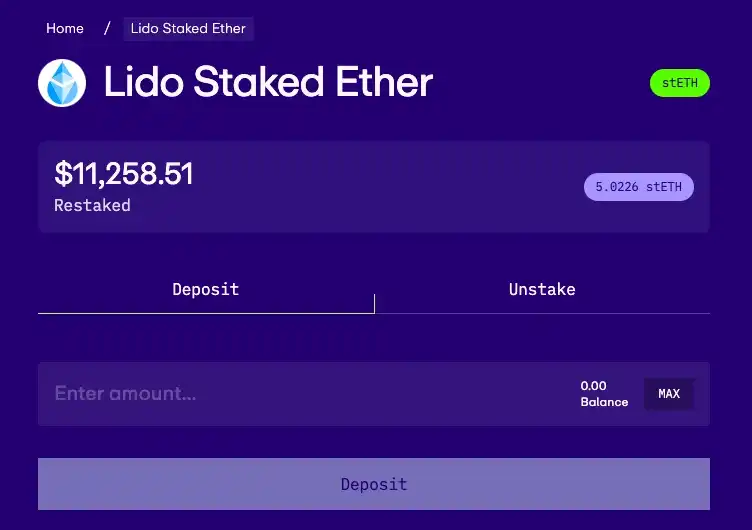
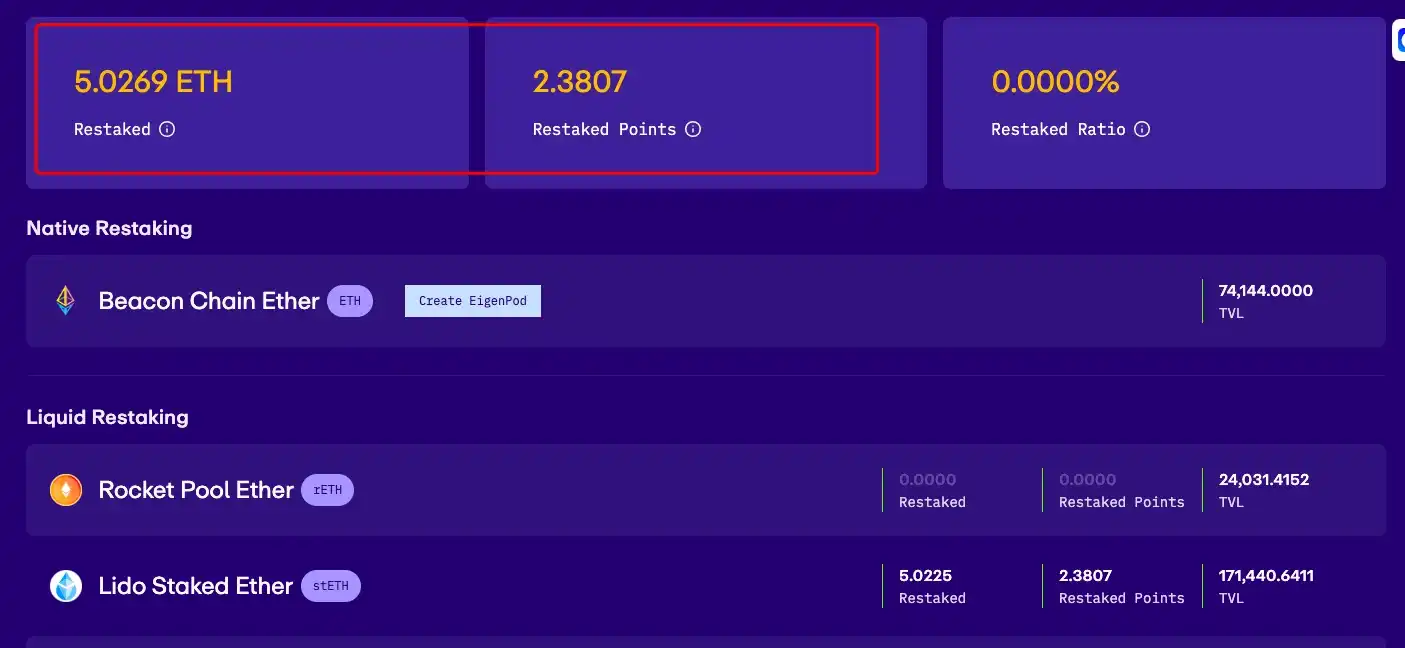
It should be noted that in addition to the overall limit of 500,000 tokens, EigenLayer has also set an individual limit of 200,000 tokens for 9 major LSTs, which means that each type of LST can store up to 200,000 tokens. Currently, the amount of stETH re-staked has exceeded 170,000 tokens. Once it reaches 200,000 tokens, users will need to choose other LSTs for re-staking operations.
After returning to the homepage, we can directly track the changes in our stETH reward for re-staking, and check our Restaked Points in real time - this score is fascinating.
After completing the re-staking process, we can also withdraw our assets by unstaking them on the re-staking page of the specific token. It is important to note that extracting funds from EigenLayer requires a 7-day safety period, so we must wait at least 7 days before withdrawing our assets.
Native Re-Staking
Unlike liquidity re-collateralization, native re-collateralization requires running a validation node independently, making the technical and financial barriers relatively high for users (also 32 ETH, but the restrictions on liquidity re-collateralization will be lifted in the future, while this is a hard requirement for Ethereum mainnet staking and is unlikely to change in the future).
For this method, EigenLayer did not set a hard cap, but it is clear that most users are unable to perform complex node operations on their own. Therefore, as of the time of writing, only 74,144 million ETH has been deposited, which is equivalent to 2,317 addresses making deposits.

For users who are running their own validation nodes and want to re-stake through this method, they can refer to the tutorial provided in the official documentation to allocate the withdrawal credentials of the validator to the EigenPods address. There are four specific steps for the deposit operation.
·First, go to the Dapp official website and link your wallet.
·Then click "Create EigenPod" to create an EigenPods. After successful creation, click "Pod Details" to obtain the specific address of the EigenPods.
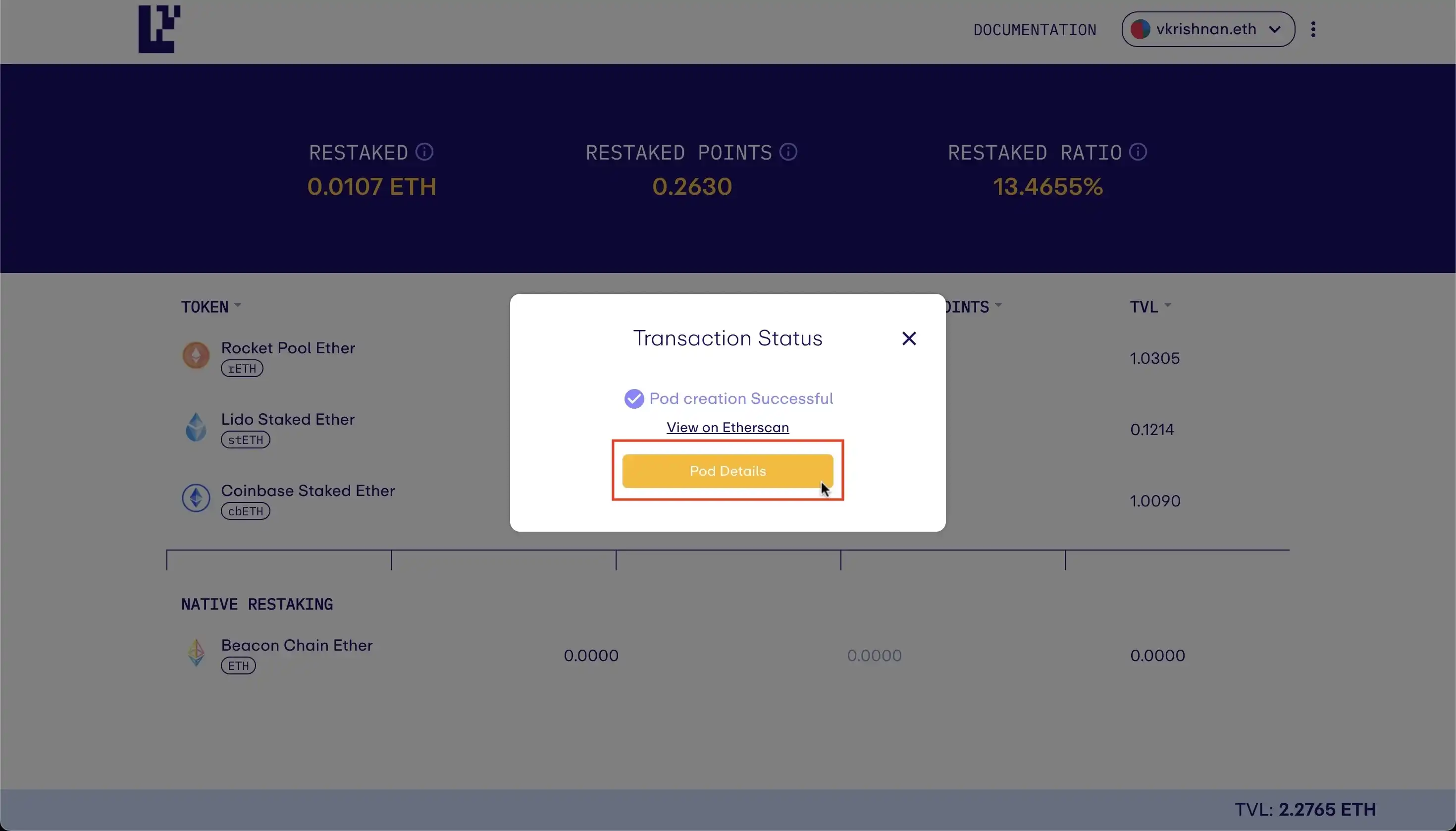
·Next, the user needs to configure the withdrawal voucher on the Beacon chain to the EigenPods address. (To complete this step, you need to run an Ethereum verification node.)
· Finally, you can also return to the homepage to check the real-time changes of your re-staking rewards.
First stage, just the beginning
According to the official disclosure from EigenLayer, the launch of this project will be divided into three phases to attract various participants to join the ecosystem.
In the first stage, "Stakers" (i.e. the operation we conducted earlier), stakers can attempt to re-stake through EigenLayer; in the second stage, "Operators", node operators can accept stakers' commissions on EigenLayer; and in the third stage, "Services", active verification services will be launched.
Last month, EigenLayer announced the launch of its second phase testnet and revealed the mysterious veil of its data availability solution, EigenDA, allowing Rollup to directly use EigenDA as a data availability layer.
Welcome to join the official BlockBeats community:
Telegram Subscription Group: https://t.me/theblockbeats
Telegram Discussion Group: https://t.me/BlockBeats_App
Official Twitter Account: https://twitter.com/BlockBeatsAsia

 Related Articles