Is Celestia the biggest competitor to Ethereum's DA? Can EigenLayer turn the game around?

Original Title: "Celestia: Ethereum's Biggest Competitor? Can EigenLayer Turn the Tide?"
Original Author: YBB Capital Researcher Ac-Core
Foreword:
According to the definition of the Ethereum Foundation, Ethereum's Layer2 = Rollup. According to Vitalik's recent new perspective, if other EVM chains use non-Ethereum as DA (Data Availability), then it is Ethereum Validium (moving the data availability layer of the blockchain off-chain and using effective proof to ensure the integrity of off-chain transactions). Although there is still some controversy over the precise definition of Layer2 due to the issue of DA, Ethereum's upgrade path is still centered on Rollup, and DA plays an important role in saving or uploading Rollup transaction data in Ethereum upgrades. Whether Optimistic Rollup and ZK Rollup can access relevant data through DA will to some extent affect their own security, even if their dependence levels are different. Faced with the innovation of Cosmos' shared security and Celestia's DA penetration, as well as the market-driven by market makers, can EigenLayer, located in the native Ethereum, regain market sovereignty by narrating the security of middleware to the Ethereum level?
EigenLayer
Source: EigenLayer Whitepaper
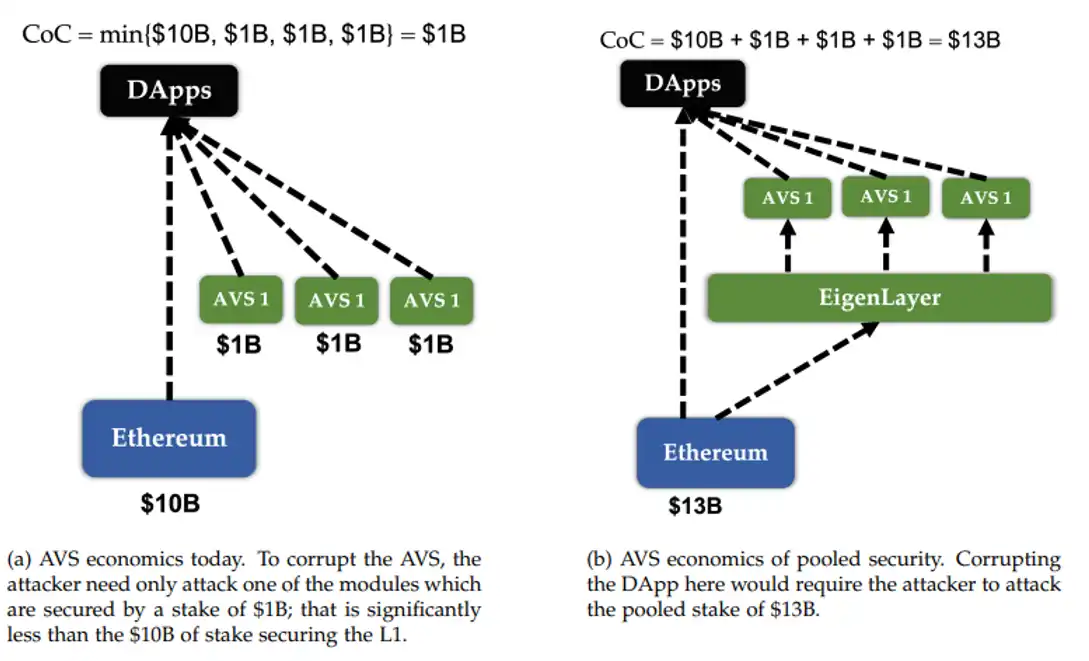
Simply put, EigenLayer is an Ethereum-based re-staking protocol that provides Ethereum-level security for the entire Ethereum crypto-economic system in the future. It allows users to re-stake native ETH, LSDETH, and LP Tokens through the EigenLayer smart contract and receive validation rewards, enabling third-party projects to enjoy the security of the ETH mainnet while also earning more rewards, thus achieving a win-win situation.
Ethereum is able to attract a large volume of transactions and liquidity because it is currently recognized as the most secure layer one blockchain, aside from Bitcoin. EigenLayer directly connects to the security and liquidity of Ethereum through its Actively Validated Services (AVS), which essentially delegates the security verification of its token model directly to Ethereum nodes (which can be simply understood as node operators), a process known as Re-staking. This article only cites EigenLayer's first AVS project: EigenDA.
EigenDA: Rollup Data Availability
 The content you provided is:
Source: EigenDA Official
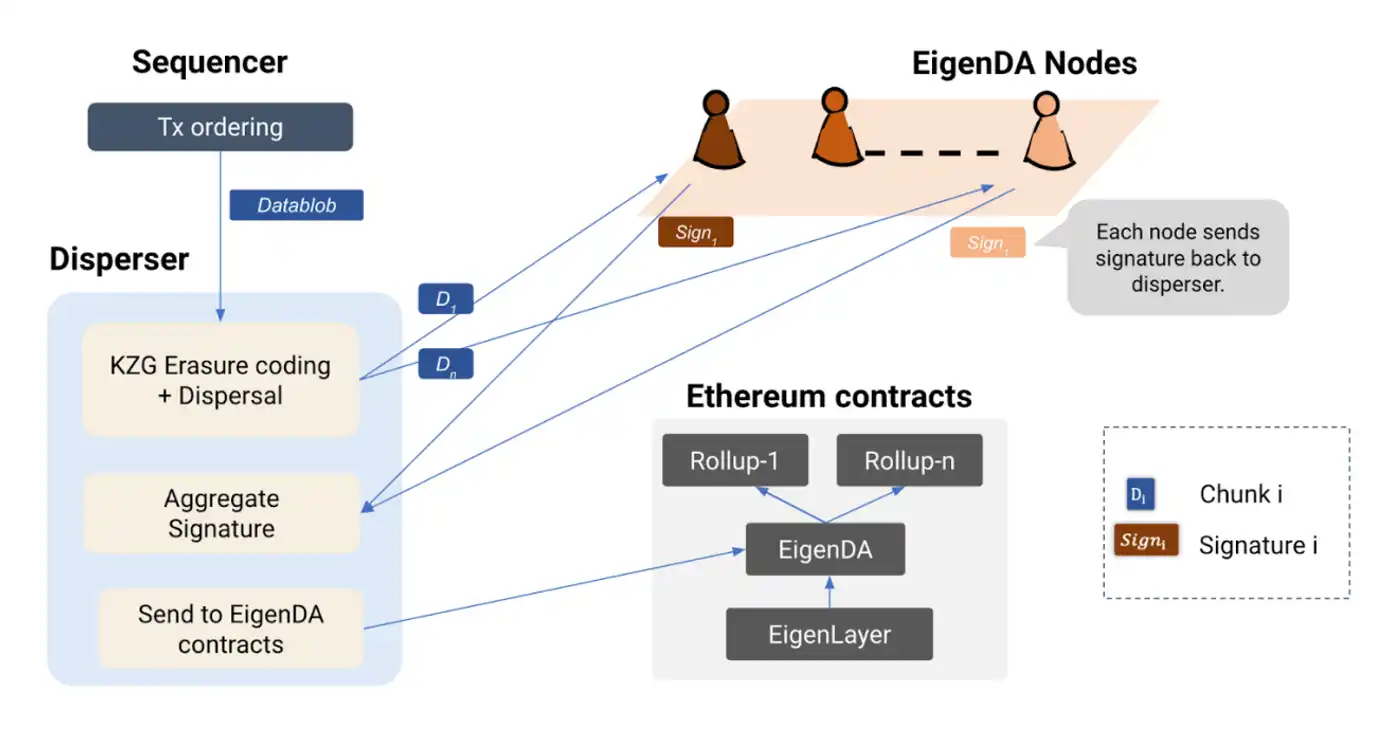
According to official explanations and introductions (currently without actual relevant data as support), EigenDA is a decentralized data availability (DA) service built on Ethereum using EigenLayer Restaking, and will be the first active verification service (AVS) on EigenLayer. Restakers can delegate staking to the executing EigenDA and node operators performing verification tasks, in return for service fees, and Rollups can publish data to EigenDA, thereby reducing transaction cost and increasing transaction throughput and improving the security of the entire EigenLayer ecosystem. The security and transaction throughput in this development process will expand with the overall development of staking, related ecological protocols, and operators.
EigenDA aims to provide innovative DA solutions for Rollups, allowing Ethereum stakers and validators to enhance security by connecting with each other, while reducing costs while increasing throughput. The EigenLayer shared security system will use a multi-node approach to ensure decentralization. According to EigenDA's tweet, its integrated Layer2 solutions include Celo, which transitions from L1 to Ethereum L2; Mantle and its associated products outside the BitDAO ecosystem; Fluent, which provides zkWASM execution layer; Offshore, which provides Move execution layer; and OP Stack in Optimism (currently used in EigenDA testnet).
EigenDA is a secure, high-throughput, and decentralized data availability (DA) service built on Ethereum, developed based on EigenLayer Restaking. The following are some key features and advantages that EigenDA is designed to achieve:
Features:
Shared Security: EigenDA utilizes EigenLayer's shared security model, allowing validators (Restakers) to participate in the verification process by contributing ETH, thereby improving the overall security of the network;
Data Availability: The main goal of EigenDA is to ensure data availability on Layer 2 networks. It verifies and guarantees the validity of data on the Rollup network through validators, preventing malicious behavior and ensuring the normal operation of the network.
Decentralized Ordering: EigenDA utilizes the decentralized ordering mechanism of EigenLayer to ensure that transactions in the Rollup network are executed in the correct order, thereby maintaining the correctness and consistency of the entire system;
Flexibility: EigenDA's design allows L2 developers to adjust various parameters as needed, including the trade-off between security and liveliness, the pattern of staking tokens, the ratio of erasure coding, etc., to adapt to different scenarios and needs.
Advantages:
Economic Benefits: EigenDA reduces potential staking costs by achieving shared security for ETH through EigenLayer. It lowers the operating costs of each operator by distributing data verification work, providing more cost-effective verification services.
High Throughput: EigenDA is designed to be horizontally scalable, and its throughput increases as more operators join the network. In private testing, EigenDA demonstrated a throughput of up to 10 MBps, with a roadmap to scale up to 1 GBps, providing possibilities to support high-bandwidth applications such as multiplayer games and video streaming.
Security Mechanisms: EigenDA employs multiple layers of security mechanisms, including shared security of EigenLayer, Proof of Custody mechanism, and Dual Quorum, to ensure the security, decentralization, and censorship resistance of the network;
Customizability: EigenDA provides flexible design, allowing L2 developers to adjust various parameters according to their specific needs and use cases, in order to find a balance between security and performance.
Collateralization Mode
Source: Delphi Digital
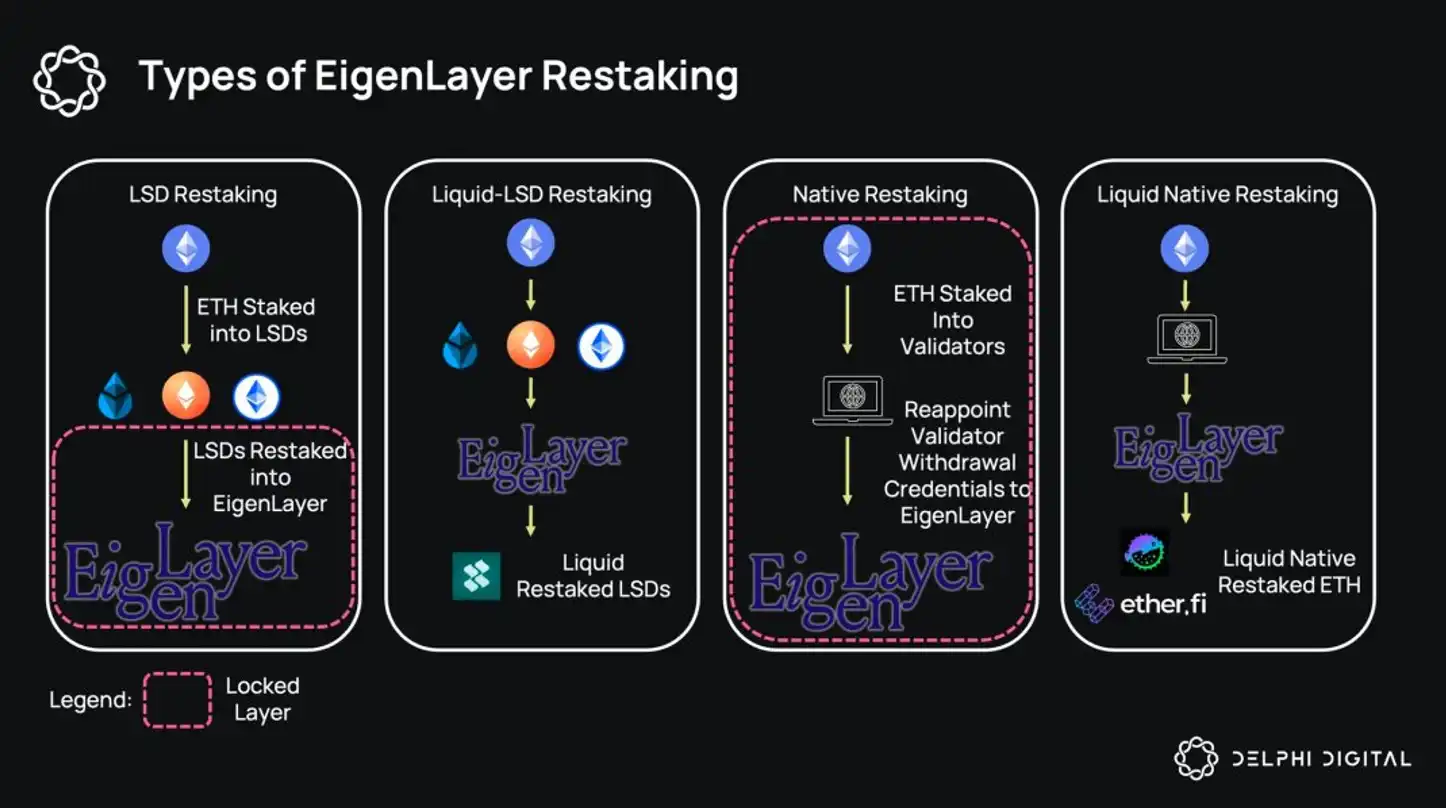
● Native ETH re-staking:
For independent ETH stakers, they can use withdrawal vouchers to point their staked ETH to the EigenLayer smart contract for re-staking and additional earnings. If independent stakers engage in improper behavior, EigenLayer can directly confiscate their withdrawal vouchers.
● LST re-staking:
LST (Liquid Staking Token) is the abbreviation for a liquidity staking token. Even if an ordinary investor does not have 32 ETH, they can still "carpool" through liquidity staking protocols such as Lido and Rocket Pool, deposit their ETH into the staking pool, and receive LST representing their ETH and staking rewards. Users who have already staked ETH in Lido and Rocket Pool can transfer their LST to the EigenLayer smart contract to achieve re-staking and obtain additional rewards.
● LP Token Re-staking:

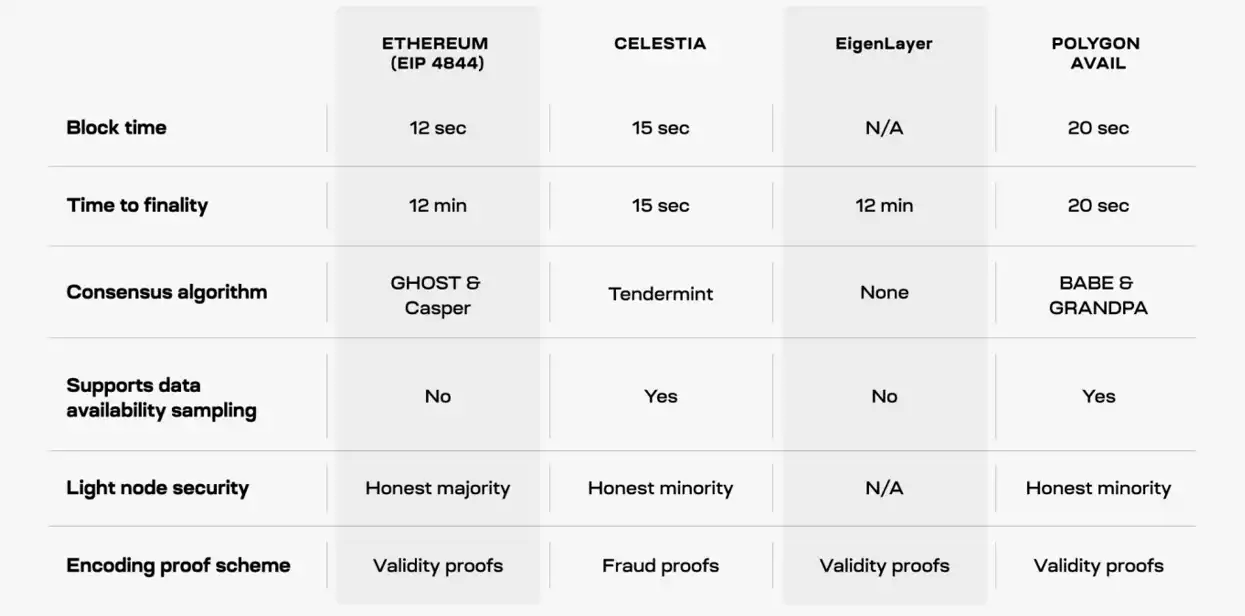
Celestia:
Decentralized Sorting: EigenLayer emphasizes its decentralized sorting mechanism, which essentially adds ETH tokens and forfeiture conditions to the PoS process of the Rollup sorter to provide higher security for Layer 2 networks. Through this mechanism, EigenLayer achieves efficient sorting processes;
Data Availability Service: EigenDA focuses on providing data availability services for Layer 2 networks, providing high-performance data transmission for on-chain applications through shared security and decentralized ordering via EigenLayer.
Avail:
Data availability design: Avail focuses on the design of data availability and introduces data availability sampling technology. This technology allows light nodes to verify data availability by downloading only a small part of the block, instead of relying entirely on full nodes to obtain data, thereby improving the scalability of the network;
Interoperability of blockchain: Avail is designed to improve interoperability between blockchains. Lightweight nodes that support data availability sampling make it more flexible to increase block size and improve overall throughput;
EIP 4844 Adaptation: Avail actively participated in the implementation of Ethereum's EIP 4844, which is an important component of Polygon's modular blockchain vision. The proposal aims to increase block size and lay the foundation for implementing Danksharding, enabling Avail to adapt to upgrades in the Ethereum ecosystem.
Conclusion
For Rollup, in the past 24 years, in addition to the certainty narrative brought by the Cancun upgrade, the debate over DA issues has also raised questions about the precise positioning of Layer2. Putting aside the issues of legitimacy, security, and cost that Ethereum DA actually faces, this debate between Celestia and EigenDA can easily lead to a consideration: under the confrontation between Ethereum killers and Ethereum's castle walls, will there be more market competition in the direction of composable modules in the future, leading to a new round of blossoming in Ethereum's scaling approach.
Although blockchain itself has many limitations, from the perspective of the financial market, the vast majority of the upward momentum in all markets comes from the "imaginary space", and there must be fresh stories to feed. As for innovation itself, in addition to maintaining its correctness, "unconventional methods" are also a narrative direction that jumps out of the original framework.
This article is from a submission and does not represent the views of BlockBeats.
Welcome to join the official BlockBeats community:
Telegram Subscription Group: https://t.me/theblockbeats
Telegram Discussion Group: https://t.me/BlockBeats_App
Official Twitter Account: https://twitter.com/BlockBeatsAsia

 Related Articles