Cross-chain message transmission protocol for Bitcoin network based on zkBridge.
Original Title: "Bitcoin Network Cross-Chain Message Transmission Protocol Based on zkBridge"
Original Source: Polyhedra Network
Polyhedra Network has launched a Bitcoin cross-chain messaging protocol based on zkBridge to significantly improve the interoperability of the Bitcoin network. This innovation aims to enable the Bitcoin network to efficiently and securely interact with other layer-1 and layer-2 blockchain networks.
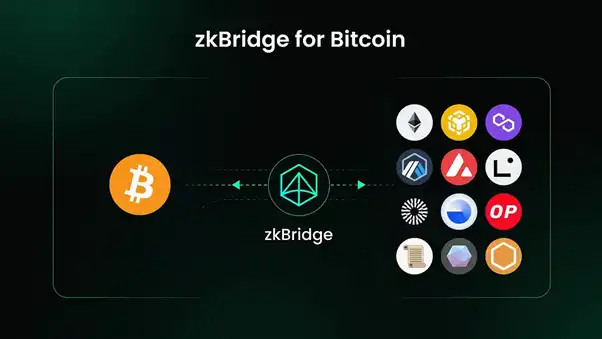
Bitcoin Network as a Sending Chain: Access Any Data and Protocol on the Bitcoin Network Trustlessly with zkBridge
In order to promote interoperability between Bitcoin and other blockchain networks, it is crucial to achieve cross-chain protocols where the Bitcoin network serves as both the sending and receiving chain. In the direction where the Bitcoin network serves as the sending chain, the Bitcoin network is fully compatible with the zkBridge framework of Polyhedra Network. zkBridge enables the updater contract (i.e. light client contract) on the receiving chain to directly verify the consensus mechanism of Bitcoin and verify every transaction on Bitcoin through Merkle proofs. This compatibility ensures that zkBridge can fully cover the PoW consensus proof and every transaction Merkle proof of the Bitcoin network.
The zkBridge of the Bitcoin network significantly enhances the interoperability of the Bitcoin ecosystem. Our zkBridge system allows for the transfer of all current and historical data on Bitcoin to any layer-1 and layer-2 blockchain network (such as Ethereum, BNB Chain, and Arbitrum) as well as any application. Our solution is also compatible with the latest innovative protocols on the Bitcoin network, such as Ordinals, BRC-20, and Atomicals. This enables smart contracts on other blockchain networks to access any data and protocols on the Bitcoin network without trust and implement various computational logic, with system security ensured by zero-knowledge proof systems.
Bitcoin Network as a Receiving Chain: Writing Data from Other Chains into the Bitcoin Network through Decentralized and Encrypted Economic Trust Model
The Bitcoin network interoperability protocol based on zkBridge can significantly improve the interoperability of the Bitcoin network and enhance the overall security of the blockchain world. However, when transferring messages and assets from other blockchains to the Bitcoin network, we will face a major challenge: the lack of native smart contract support in the Bitcoin network. Therefore, the Bitcoin network cannot serve as the standard zkBridge receiving chain because we cannot build lightweight client contracts on the Bitcoin network to verify the state of the sending chain. Therefore, we need a new model that can safely write data from other blockchains into the Bitcoin network. To simplify the discussion that follows, in this article, we will use Ethereum as a representative sending chain and Bitcoin as a receiving chain to explore how we can transfer data from other chains to the Bitcoin network.
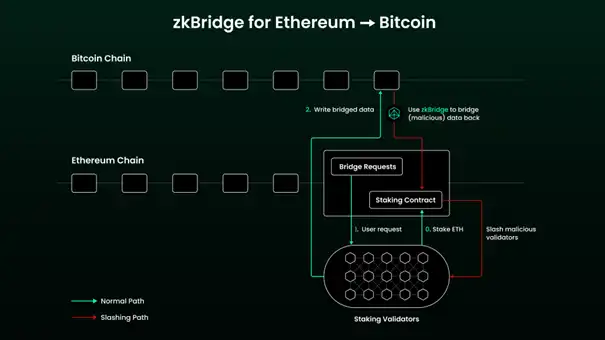
Illustration: Safely writing data from Ethereum onto the Bitcoin network
In order to ensure the security of these cross-chain transactions, we have adopted a mechanism similar to Proof of Stake (PoS). This includes inviting validators to stake Ethereum's native ETH tokens. If the sending chain is the BNB chain, then validators need to stake BNB tokens. These staked owners are then authorized to write data on the Bitcoin network. In order to achieve consensus on correct message sending, these validators will use Multi-Party Computation (MPC) protocol. It is worth noting that the use of MPC protocol is intended to enhance the robustness and reliability of our protocol.
Our proposal's core feature is that the security of our protocol does not rely on the accuracy of multi-party secure computation (MPC) protocols. Even if malicious entities control most of the MPC protocol members and tamper with correct information, our protocol can still provide sufficient security for users. If malicious entities control the MPC protocol, users can automatically initiate zkBridge requests to send the malicious message written into the Bitcoin network to Ethereum and verify it through zkBridge. After receiving the message, the confiscation (slash) contract on Ethereum will evaluate its validity (i.e. verify whether the message is really a malicious message) and, if necessary, impose confiscation (slash) on the MPC committee. The confiscated part of the pledged funds will then be compensated to the affected users. By introducing a decentralized and encrypted economic trust mechanism based on pledging/re-pledging, our solution ensures that user assets are still sufficiently secure under potential illegal behavior in the MPC protocol, thus ensuring that data from any blockchain network can be securely written into the Bitcoin network through the zkBridge protocol.
Our detailed plan is as follows:
1. The pledger initially deposits ETH tokens as collateral on the Ethereum network.
2. In this case, if a pledger engages in malicious behavior, any honest pledger or user can report this fraudulent behavior on Ethereum. Then we use zkBridge to transmit the relevant data written on the Bitcoin network to Ethereum. Specifically, as mentioned above, the one-way zkBridge structure with Bitcoin as the sending chain is very simple. Our zkBridge includes a decentralized zero-knowledge proof generation network. Any node in the network can transmit the current block header of the Bitcoin network and its zero-knowledge proof to Ethereum. Then Ethereum can use these block headers to verify any cross-chain transactions that appear on the Bitcoin network.
3. Meanwhile, there is a dedicated smart contract on Ethereum that is always ready to automatically verify the validity of messages transmitted from the Bitcoin network. Once a malicious message is detected and confirmed, the contract will automatically execute the operation of slashing the ETH deposit of the dishonest staker.
4. This ensures that as long as at least one committee member or user on the Bitcoin network remains honest, our staking mechanism can maintain its security, trustlessness, and decentralization.
Essentially, the introduction of our pledge/re-pledge mechanism not only enhances the usability of Bitcoin, but also strengthens the trust and security between Proof of Stake (PoS) blockchains, marking a significant advancement in the field of digital assets and decentralized finance.
Summary
In summary, the Bitcoin interoperability protocol introduced by Polyhedra Network marks a significant leap forward in blockchain technology. By enabling the Bitcoin network to act as both a sender and receiver, combined with zkBridge, our interoperability protocol paves the way for unprecedented interaction between Bitcoin and various blockchain networks. In the case of the Bitcoin network as the sending chain, zkBridge allows all current and historical data on the Bitcoin network to be transmitted to any layer-1 and layer-2 blockchain network without trust. In the case of the Bitcoin network as the receiving chain, our system not only ensures strong security through pledging and forfeiture mechanisms, but also enhances the practicality and coverage of Bitcoin. This innovation not only taps into the potential of idle Bitcoin, but also strengthens trust and security between proof-of-stake blockchains, heralding a new era of digital assets and decentralized finance integrated into the Bitcoin ecosystem.
Original Link
Welcome to join the official BlockBeats community:
Telegram Subscription Group: https://t.me/theblockbeats
Telegram Discussion Group: https://t.me/BlockBeats_App
Official Twitter Account: https://twitter.com/BlockBeatsAsia