What other projects in the full-chain gaming industry are worth paying attention to besides FOCG?
Original Title: "A Review of FOCG's Worthwhile Projects in the Full-Chain Gaming Industry"
Original Author: dt, DODOResearch
Full-chain games have always been the next major application of the blockchain that the encryption native community has been looking forward to. Unlike the GameFi trend that focuses on financial aspects and only puts assets on the chain, FOCG (Fully on-chain game) values gameplay more and deploys all core logic and states of the game on the blockchain, completely driven by the blockchain without any centralized servers involved. Compared to traditional games, full-chain games can achieve higher openness, decentralization, and persistence.
The ultimate goal of the entire chain game industry is to create a completely autonomous and open game world, also known as "Autonomous Worlds". In this world, games can exist permanently without relying on any centralized operator, and all rules, logic, and participation are carried out and verified through decentralized blockchain. At the same time, these autonomous game worlds can also seamlessly interoperate, and roles/assets from different games can be used in another game, thus building a truly open and interconnected "game metaverse".
This week, Dr. DODO will introduce to you some good projects worth paying attention to in the FOCG full-chain gaming field that have been deeply cultivated for a long time!
StarkNet Ecosystem
Recently, there has been a lot of discussion about the L2 public chain Starknet, which has caused a stir in the cryptocurrency industry. Its technology and development are highly suitable for deploying full-chain games, and its advantages can be divided into the following three categories:
·High Performance: Through techniques such as recursive proof and state transition, StarkNet can compress a large amount of computation and storage into a proof of constant size, greatly optimizing efficiency. This enables it to achieve transaction processing speeds of millions per second or even higher, fully meeting the high-performance needs of blockchain games.
·Fairness: Full-chain games require fair randomness, and StarkNet natively supports the use of zero-knowledge proof technology, which is needed for many games that require randomness such as card drawing and dice rolling. After the Cairo V1 upgrade, StarkNet enables the use of Verifiable Random Function (VRF) technology, which can prove the verifiability of random numbers, thereby ensuring the fairness of the game.
·Encoding efficiency: Compared to Solidity, the most commonly used language for traditional EVM public chains, Cairo, the official language of StarkNet, is more suitable for writing complex projects, with less code and higher execution efficiency, reducing the complexity of full-chain game development and saving expensive gas fees.
After introducing why StarkNet is suitable for full-chain games, let me introduce several projects developed in the StarkNet ecosystem:
·Dojo: Dojo is an open-source game engine and toolkit designed for StarkNet. It uses the Cairo language to implement an efficient entity-component-system architecture, simplifying the game development process. It also natively supports zero-knowledge proofs, ensuring randomness and data privacy. Several successful games, such as Influence, Loot Survivor, and Briq, have already been launched using Dojo. The Dojo community is continuously expanding its functionality and plans to focus on L3 solutions, optimistic rollups, and client-side proofs in the future.
·Loot Realm: Driven by the Loot NFT community DAO, it is committed to creating an open, scalable, and eternal on-chain gaming world. It includes multiple sub-games, currently including the text adventure game Loot Survivor and the MMO blockchain game Realms: Eternum. Loot Realm represents the potential for open sharing and autonomous operation of blockchain games.
·Influence: Influence is a space-themed resource management and strategy game. Players can engage in infrastructure and economic activities in the asteroid belt. The game fully utilizes the high performance of StarkNet to achieve full-chainization of the economic system and modeling of complex business logic. Currently, Influence is actively under development, with plans to release multiple sub-games in stages.
·Briq: Briq is an open on-chain creative space, known as the "Lego of the blockchain industry". Users can freely build unique blockchain artworks by collecting and assembling different blocks. Briq demonstrates the possibility of full-chain games supporting user-generated content and meta-space.
MUD Redstone - LATTICE Team
Next up is the introduction of the full-chain game engine MUD and the second-layer public chain Redstone designed specifically for full-chain games. Before we begin, we must first introduce the development team behind it - Lattice. Lattice is the core team of the open-source developer community 0x PARC. As early as 2020, they participated in the development of the first full-chain game Dark Forest. After Dark Forest, Lattice continued to delve into the full-chain game track and realized that there were many pain points in full-chain game development at that time. Therefore, they developed the full-chain game engine MUD.
The Lattice team claims that MUD is a game engine exclusively for FOCG. The so-called game engine can actually be divided into two parts: a smart contract application development framework and an on-chain relational database. It has a built-in efficient EVM database, supports automatic on-chain and off-chain state synchronization, and simplifies the development process by writing many commonly used game logics into frameworks. Developers can define data structures through configuration, and the MUD engine will automatically generate Solidity libraries. Currently, more than 90% of EVM-based games are built on MUD.

Source: https://github.com/latticexyz/mud
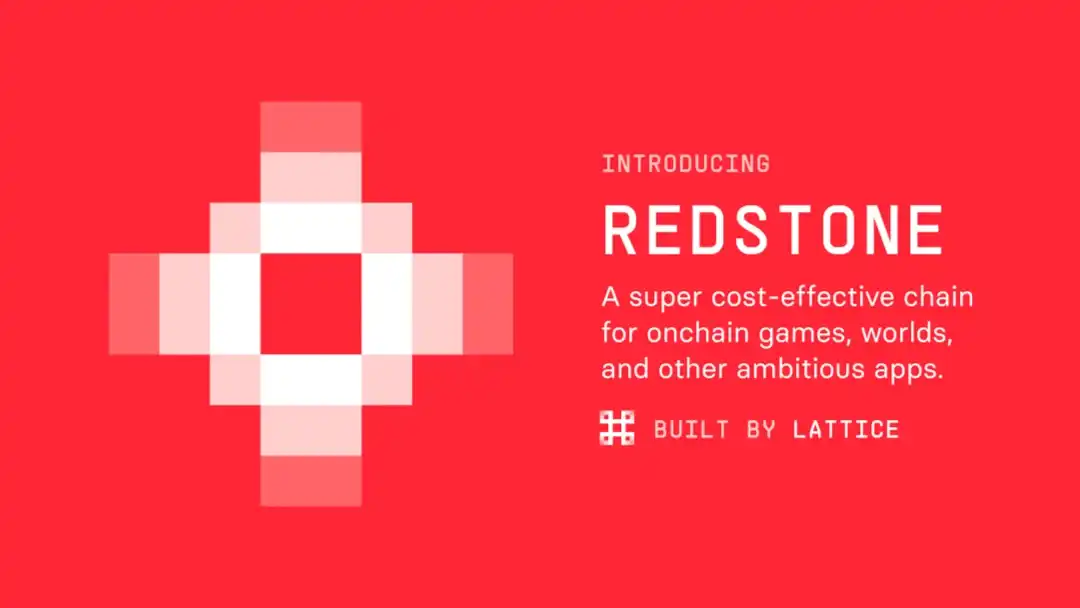
With the increasing number of MUD-based games, the Lattice team has found that existing EVM public chains are difficult to support large-scale on-chain applications. Therefore, they independently developed the Redstone rollup solution. Redstone significantly reduces costs by only submitting data digests at Layer 1, and is specifically optimized for compatibility with MUD in its design, making high-throughput full-chain games feasible.
Redstone represents the exploration of a new generation of Layer 2 technology for the entire chain game. It is deeply compatible with MUD and greatly promotes the development of the entire ecosystem. Currently, the Redstone test network has been launched, supporting multiple games including Sky Strife, and the main network is expected to be officially launched in Q1 2024.
Source: https://redstone.xyz/
Argus Paima
除了 Dojo and Lattice teams, there are many teams that are laying out development on the full-chain game engine and full-chain game public chain. Argus and Paima, which will be introduced next, are among the best.
Argus team members, like Lattice, also began to emerge from the Dark Forest developer community and gained an understanding of the difficulties faced by FOCG developers in today's blockchain infrastructure through their experience in Dark Forest. As a result, they founded Argus with the goal of creating a high-performance infrastructure for blockchain games. They have received tens of millions of dollars in funding from top-tier investors such as 1kx, Polychain Capital, and Dragonfly Capital. Currently, they have two main products:
·World Engine: This is Argus's self-developed Layer 2 solution for blockchain games. World Engine implements an innovative sharding mechanism that can horizontally scale to match the real-time workload needs of games, while greatly improving execution performance through customized Game Shards for game state transitions.
·Cardinal: This is a game shard solution built on top of World Engine. Cardinal is developed using Go language and implements an efficient entity-component-system architecture. It is highly compatible with mainstream game engines, allowing users to seamlessly integrate with commercial game engines such as Unity and Unreal.
While another outstanding player Paima is different from other teams mainly focusing on Ethereum or Ethereum L2, Paima focuses on Cardano and Milkomeda, and has received a million-dollar donation from the Cardano Foundation. Its flagship product, Paima Engine, is a universal development framework for blockchain games, which allows developers to deploy games directly within Paima's rollup, reducing the difficulty of game expansion. It also has built-in cross-chain mechanisms, allowing the same game to be deployed on different public chains and achieving state synchronization between environments. In addition, Paima also provides automated intelligent game units through the Shinkai AI layer, which can be seen as an open game "operating system".
My Opinion
The author believes that the concept of full-chain games is indeed very attractive, and the ultimate ideal Autonomous Worlds has a feeling of geek utopia, but there is doubt as to whether FOCG can be the next multi-billion dollar track in the blockchain world.
Due to the design of the entire chain, FOCG naturally sacrifices some performance and smoothness of the screen, which are important indicators pursued by Web2 game giants today. Instead, it focuses on gameplay and financial issues related to balancing the in-game economy. The author believes that FOCG's full-chain game will definitely attract a group of real users, but it cannot become a breakthrough for blockchain mass adoption.
Small and beautiful routes are more suitable for this type of project direction. Therefore, community loyalty and stickiness will be a key indicator for exploring high-quality projects in the FOCG track. However, in the overall blockchain world, the author is not optimistic that FOCG's full-chain game will become the next wave of diverse and flourishing narratives.
Original Link
Welcome to join the official BlockBeats community:
Telegram Subscription Group: https://t.me/theblockbeats
Telegram Discussion Group: https://t.me/BlockBeats_App
Official Twitter Account: https://twitter.com/BlockBeatsAsia

 Related Articles