Latest developments in Bitcoin technology as of Q4 2023.
Original Title: "Technical Developments in Bitcoin - Q4 2023"
Original Authors: Gabe Parker, Guillaume Girard
Original Source: galaxy
Original Translation: Lynn, Huoxing Finance
Executive Summary
This document focuses on introducing important technological developments that will occur in the Bitcoin ecosystem in October and November 2023. We will cover the following seven topics:
BitVM Whitepaper Released.
·Taproot Assets mainnet goes live
·OP_CAT Proposal
·OP_TXHASH Proposal
·Lightning Timeout Trees Proposal
·MuSig2-PSBT Proposal
·BIP-324 Proposal
Introduction
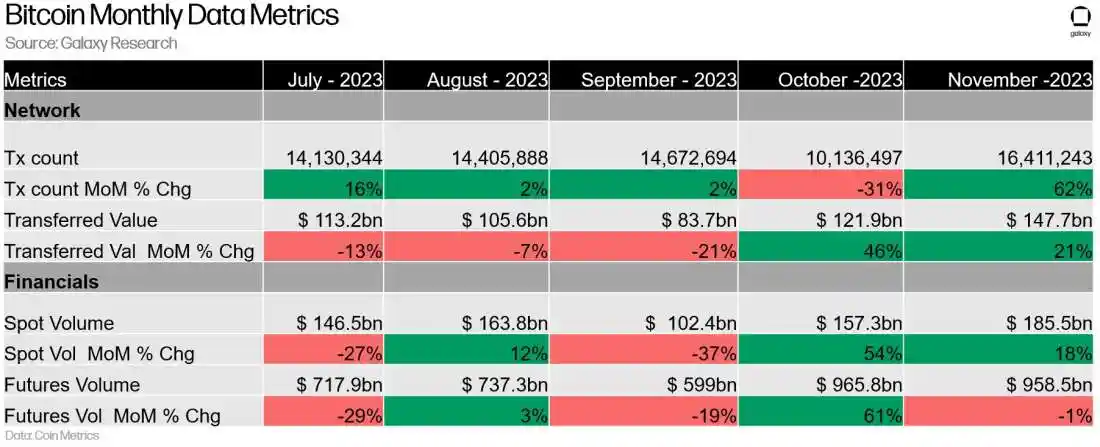
In November 2023, the number of on-chain Bitcoin transactions increased by 62% MoM, mainly due to Ordinals and BRC-20. The total value of Bitcoin transfers in November exceeded $147 billion, a significant increase of 21% compared to the previous month. This growth is mainly attributed to the appreciation of BTC price in USD, but the trading volume of BTC in the spot market also increased by 18% MoM, while the trading volume of futures decreased by 1% respectively.
Since the rise of Ordinals in January 2023, the Bitcoin development community has seen a significant resurgence in exploring new alternative token protocols, scaling solutions, and smart contract implementations. Overall, the post-Ordinal Bitcoin development landscape has expanded and is working harder than ever to enhance on-chain and off-chain application use cases. This document will focus on seven major developments and recommendations for Bitcoin in the fourth quarter of 2023. These developments highlight the new commitment of the Bitcoin ecosystem developers to expand the scope of Bitcoin applications and support use cases.
Technology Development
BitVM
What is it: BitVM supports smart contracts on Bitcoin. Considering the nature of Bitcoin's design, executing smart contracts directly on Bitcoin is both slow and expensive. With BitVM, smart contracts are executed off-chain, and participants only use Bitcoin's native scripts to execute contract rules when disputes occur. BitVM operates similarly to optimistic rollups used in the Ethereum ecosystem, including fraud proofs and challenge response protocols.
The structure of BitVM contracts works by getting two parties to agree on a pre-signed transaction sequence that leads to the event. Similar to optimistic rollups, these types of contracts assume that you will not cheat, but if you do, the honest party has the opportunity to challenge the cheater. It is crucial that BitVM does not require an upgrade to the first layer of the Bitcoin blockchain. BitVM only uses primitives that are already understood in Bitcoin, such as hash locks, time locks, and tapscript.
Why it matters: Bitcoin is often criticized for its lack of innovation and ability to directly compete with more versatile Layer 1s like Ethereum and Solana. Bitcoin has always prioritized layer scaling rather than attempting to expand the functionality of its base layer. The Lightning Network is an example of a high-performance network built on top of Bitcoin that is centered around payments. With BitVM, more complex computations can be executed on layers built on top of Bitcoin, allowing for continued layer scaling of Bitcoin rather than upgrading the core protocol.
Taproot Assets Mainnet Launch
What is it: Lightning Labs, a blockchain development company that builds software for the Bitcoin Lightning Network, has released a new protocol for issuing stablecoins and other assets on the Lightning Network. Taproot Assets (officially known as TARO) enables developers to issue, send, and receive Bitcoin-based assets. For years, Lightning Labs has been proposing and working on ways to issue assets on the Lightning Network, and this mainnet release is a significant milestone.
Taproot Assets are created by inputting arbitrary data into Taproot scripts (Tapscript). Tapscript is a scripting language used to enable various new transaction types in the Taproot upgrade. Taproot Assets store token data in Taproot outputs using Taptree, a Merkle tree data structure. All Taproot Assets are issued on-chain through standard Taproot transactions at the base layer. Although Taproot Assets are issued and settled on the Bitcoin base layer, Lightning Labs has specifically designed Taproot Assets to be compatible with the Lightning Network. The functionality of Taproot Assets is achieved through an improved version of partially signed Bitcoin transactions (PSBT), which is also used for trading Ordinals and BRC-20, called virtual partially signed Bitcoin transactions (vPSBT). This mechanism is a way to trade Taproot Assets in a trustless peer-to-peer manner on the Lightning Network.
Why it matters: Taproot Assets will provide an effective way to create fungible tokens on Bitcoin. In April 2023, Ordinals developers created a new fungible token standard called BRC-20. The token standard uses inscription technology, allowing users to attach arbitrary data to a single sat (the smallest unit of Bitcoin). The emergence of BRC-20 proves that there is a demand for fungible tokens on Bitcoin, despite the inefficiency of the BRC-20 standard. With the official release of Taproot Assets on October 18, 2023, fungible tokens on Bitcoin have the opportunity to flourish on the Lightning Network. The benefits of having fungible tokens on the Lightning Network include reducing network congestion on the Bitcoin native chain. Overall, Taproot Assets is a promising solution that can introduce fungible tokens on Bitcoin and bring more users to the Lightning Network.
OP_CAT Proposal
What is it: Bitcoin researcher Ethan Heilman submitted a Bitcoin Improvement Proposal (BIP) to the Bitcoin-Dev mailing list, suggesting the addition of the OP_CAT opcode to Bitcoin's scripting language. This opcode will allow developers to construct and evaluate Merkle trees and other hash data structures in Tapscript, a native scripting language used to enable new transaction types in the Taproot upgrade.
OP_CAT is not a new idea. Bitcoin developers previously removed the opcode from Bitcoin scripts because it allowed for the construction of data-intensive scripts, which could potentially increase the computational resource burden on Bitcoin nodes. However, due to the size limit of Taproot scripts (520 bytes) introduced by the Taproot upgrade, OP_CAT will become a useful tool for developers and will not bring too much computational overhead to node operators.
Importance: Before the Taproot upgrade in November 2021, Bitcoin relied entirely on Bitcoin Script to achieve programmability. However, the Taproot upgrade significantly expands Bitcoin's transaction programmability capabilities. Enabling OP_CAT will eliminate previous restrictions, further enhancing Bitcoin's programmability and creating new opportunities for different use cases.
OP_TXHASH Proposal Draft
What is it: Bitcoin core developer Steven Roose proposed a BIP that focuses on the benefits of implementing two new opcodes, OP_TXHASH and OP_CHECKTXHASHVERIFY, for the Bitcoin script language. The OP_TXHASH opcode will directly compete with the two main contract proposals for today's Bitcoin, BIP-118 and BIP-119. Contracts are predetermined spending conditions imposed on Bitcoin transactions. For example, a user can create a contract to ensure that the recipient of a transaction can only spend BTC sent to their address after 200 blocks.
Why it matters: Enabling contracts could be a driving force for the next major upgrade of Bitcoin. TXHASH is one of the leading BIPs, and developers hope to activate it within 1-2 years. TXHASH allows for custom transaction fields in Bitcoin transactions, providing a more adaptable way to express contracts. This flexibility allows users to adjust transaction fees, a key feature when dealing with uncertain and fluctuating rates, which other contract proposals such as BIP-119 do not support. Additionally, when used in conjunction with other BIPs such as OP_CAT, OP_TXHASH could replicate the functionality of BIP-118, another leading contract proposal currently being evaluated by the Bitcoin community.
Lightning Timeout Trees
What is it: The Lightning Network is the main second layer of Bitcoin, which has been widely adopted in recent years. One key obstacle to further adoption is that users need to initiate at least one on-chain Bitcoin transaction when using the Lightning Network to transfer funds off-chain. This limitation restricts the number of users who can migrate assets to off-chain, especially when on-chain transaction fees are high.
The long-term solution being explored is a concept called "channel factories". It allows multiple users to join the Lightning Network in a single Bitcoin transaction. The implementation of channel factories has the potential to significantly lower the entry barrier to the Lightning Network by reducing the cost of opening Lightning channels between multiple users.
Why it matters: Despite the theoretical existence of Bitcoin for many years, the script limitations of Bitcoin make it difficult for anyone to come up with a convincing and secure solution to enable channel factories. However, John Law's "Timeout Tree" proposal may have found a solution using contracts (i.e. spending conditions of BTC transaction outputs). The proposal introduces the concept of a coordinator (or Lightning Service Provider - LSP) who will oversee the opening and closing of user channels. By using contracts, the coordinator will be limited in spending a user's BTC without proper authorization. While the proposal is not without limitations, it is the first channel factory architecture that utilizes contracts, a powerful mechanism for adding spending conditions on BTC that is becoming increasingly popular among Bitcoin developers and applicable to various use cases including BTC custody.
(10/19) Strike enables bitcoin payments on everyday items.
(10/16) Larry Fink of BlackRock expressed that the resurgence of Bitcoin rumors indicates "suppressed interest in cryptocurrency".
(10/10) Paul Tudor Jones supports Bitcoin and gold as geopolitical risks rise.
原文链接Translation:
Original article link
Welcome to join the official BlockBeats community:
Telegram Subscription Group: https://t.me/theblockbeats
Telegram Discussion Group: https://t.me/BlockBeats_App
Official Twitter Account: https://twitter.com/BlockBeatsAsia
 Related Articles