Multicoin Capital: Why did we invest in Project Galaxy?

原文标题:《 Investing in Web3 Credentialing 》
原文作者: Mable Jiang,Multicoin Capital
Tao Hu, ChainCatcher
1 月 25 日, Project Galaxy Announced a $10 million funding round led by Multicoin Capital and Dragonfly Capital, Spartan Group, Sky9 Capital, Coinbase Ventures, Binance Smart Chain Growth Fund, Solana Ventures, Alameda Research and others participated. Here's Multicoin Capital's research note on the project, published the same day:
Web3 credentials
There are a variety of certificates available to indicate certain accomplishments or contributions. Historically, credentials have been shared through resumes, usually in the form of credentials from institutions such as universities, governments or training programs.
Web3 credentials, on the other hand, exist on the chain. While they are similar to traditional credentials obtained through proof of employment, the "work" of these credentials could be someone's on-chain contribution, such as the length of time they contributed liquidity to the pool or the number of Snapshot votes they participated in within a community. They can also be useful off-chain data to bring into the blockchain, such as contributions to community proposals or the number of forks they create on Github.
One of the most famous Web3 credential projects isPOAP(Proof of attendance agreement), which issues NFT, markers that demonstrate participation in important community activities. (Note: All "voucher data" referred to in this article are public data. There are other forms of credential data that may involve private or semi-private data, which Project Galaxy plans to provide in the future.)
Credential data can now be used in a number of ways. Here are some examples:
1. People who actively use certain DeFi protocols may be eligible for greater voting rights per unit of Token than passive Token holders;
2. People who help promote ideas or proposals (e.g., retweets or comments) on Twitter during a certain period of time can also get priority in the new Token issuance;
3. People who interact with certain contracts may be eligible for rewards in targeted growth hacks;
4. People who have achieved certain achievements in the game may be eligible for quick recruitment in certain guilds.
Web3 certification creates new ways for the flywheel effect and other organic growth of Web3 applications that were not possible before. In addition to the number of tokens a person has (which naturally represents more power for whales), Web3 credentials also represent qualitative data that helps describe the address profile (whose value has historically been ignored).
The democratization of credential data has effectively introduced a new (and better) way to allocate power to community members, rather than voting solely based on tokens. For non-quantified behavioral data -- especially off-chain data -- a power balancing mechanism can tilt the status and rewards of "true fans" in the community in favor of "true fans", even though they are usually not the largest Token holders.
Galaxy Network consists of two core components: a credential Network and a Network module that helps users interact with credential. Modules are pre-configured to provide different features, such as targeted airdrops, mission-based giveaways, access to closed communities, or Token distribution against witch attacks.
The workflow for interacting with Galaxy Network is simple: Curators expand the available audience by providing credentials to Galaxy Network without permission, and then Galaxy Network users (i.e., Web3 protocol and community) can run credential based activities using the credential set selected by the Galaxy Network module. They can also include Project Galaxy's voucher predictor as part of their smart contract so that it always targets the latest and most qualified voucher group.
By separating the credential predictor from the NFT badge issue, Galaxy Network users can map credentials to the appropriate person without limiting the transfer and speculation of NFT badges. Whenever the protocol requests this data, the predictor pushes the latest status of the credentials, and the NFT is issued for demonstration purposes as a snapshot of the credentials. Once credentials are contributed to the network, the more data sets used, the more income the corresponding curator can earn.
Proof of the flywheel
As I mentioned above, this is our second round of investment in the project. They have come a long way since our first inspection.
Before working on Project Galaxy,Harry With & have spent Charles As co-founder of Lino Network and DLive. I met this team in 2018, and they impressed me as one of the most capable, hardworking, and ambitious teams in Web3. Lino/DLive was eventually acquired by Bittorrent because the infrastructure was not ready for a decentralized social platform in 2019. Two years later, they went on to build their vision, this time through certification.
Certificate networks don't magically fit together by simply plugging query middleware into the blockchain. Because of the decentralized nature of the data required to create valid credentials, it is difficult to build a credential network, especially on a large scale. Fortunately, this community has been working on these issues for a long time, amassing one of the largest collections of Web3 credentials in the world in the process. It now has subgraph queries, on-chain snapshots, governance history, proof of attendance, and a database to interact with Web2 applications. Project Galaxy is also able to identify commonly used participating modules and constantly add missing modules to the Galaxy suite throughout the running of different activities.
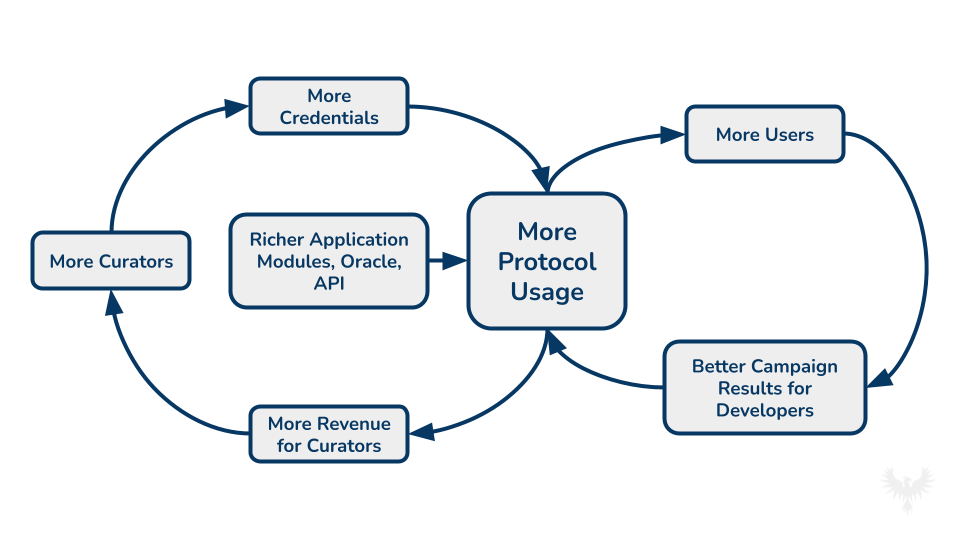
This creates an organic flywheel: 1) With the most abundant data and the easiest participation modules to use, Galaxy is now the preferred resource for projects that attract users; 2) As more and more users are rewarded based on credential data, other users will follow suit (resulting in desirable activities) and create more credential data; 3) This increasing use of Galaxy Network will enable credential curators to contribute more credential to the Network because their credential is more likely to be used (and therefore the curators are paid), which in turn attracts more projects to use Project Galaxy.
Support Web3 identity using the Galaxy Credential Network
There are two approaches to building a Web3 identity: top-down and bottom-up. Top-down identities are often granted by institutions, such as government-issued identity cards. Bottom-up identities are created by summing up previous actions, such as personal brands that represent the sum of their tweets.
Project Galaxy is looking for its next opportunity. They will allow people to associate their credentials on different chains with a Galaxy ID.
The Project Galaxy bottom-up approach is powerful in some meaningful ways:
1. There is no single, authoritative standard definition.For example, any decentralized application can freely define its own scoring system using the underlying credential data in the Galaxy network. An ID can have multiple scores (such as one AAVE, one Compound), and different applications can choose the scores that best meet their requirements or that they trust most.
2. Power Web3 LinkedIn.Web3 tasks (for example, tasks in Web3 applications and games) can be best matched based on the user's past activities and achievements on different chains. Galaxy Network provides anyone with data to curate the customized resume they need to recruit for a specific task: people can display in-game earnings history for joining a guild, and can display all participating badges from a community to be selected as community ambassadors.
3. Change the paradigm of targeted marketing.Web3 applications can provide incentives for certain behaviors by targeting the right audience with existing Web3 credentials to guide adoption. In the absence of public behavior data, it is much more difficult to replicate this kind of targeted activity in a Web2 environment.
Credential networks and on-chain digital identities are the core components of the Web3 stack. Until recently, they simply weren't possible because of the complexity and upgrades required to guide these networks. With this round of funding, Project Galaxy can now serve the entire crypto ecosystem on all chains. As Web3 continues to evolve and more complex applications are built, we expect it to play a central role in application development as well as cutting-edge marketing campaigns that interact with and engage users in new, truly crypto native ways.
The original link
Welcome to join the official BlockBeats community:
Telegram Subscription Group: https://t.me/theblockbeats
Telegram Discussion Group: https://t.me/BlockBeats_App
Official Twitter Account: https://twitter.com/BlockBeatsAsia

 Related Articles