An in-depth dismantling of Render Network’s Solana upgrade and its far-reaching impact

Original Title: "In-depth Analysis of Render Network's Solana Upgrade and Its Far-reaching Impact"
Original Source: Feng & Carol, DFG
Introduction
On November 2nd, Render Network officially announced that it has successfully completed the upgrade to Solana. This means that the leading enterprise in the decentralized rendering field has officially migrated from the Polygon ecosystem to the Solana ecosystem. This migration will involve the implementation of multiple RNP proposals (Render Network Proposals) that have been approved by the Render community for over a year, including the migration of Layer1 ecosystem, the issuance of new tokens (RENDER), and the implementation of a new Burn and Mint Equilibrium (BME) token economic model. This will have a profound impact on the entire Render ecosystem and all RNDR (soon to be upgraded and renamed as SPL token RENDER) stakeholders.
From recent secondary market data, it can also be seen that the entire community has given positive feedback on Render's recent actions. Coingecko data shows that Render's token RNDR has recently risen to over $4, reaching a new high in nearly 21 months.
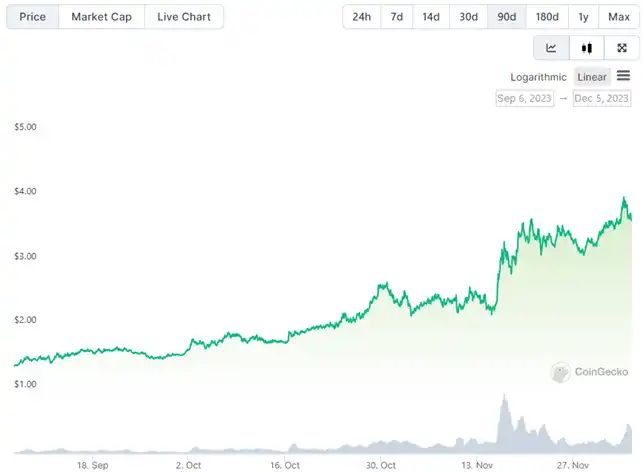
RNDR (ERC-20) price trend in the past three months / Source: Coingecko
What are the core contents involved in the upgrade?
Render is undergoing a series of significant technical upgrades, with each proposal supporting and enhancing one another. The core upgrade includes migrating from Polygon to the Solana ecosystem, upgrading from old token to new token RENDER, introducing the Burn and Mint Equilibrium token economic model, and designing token incentives and ecological resource redistribution mechanisms around the BME model.
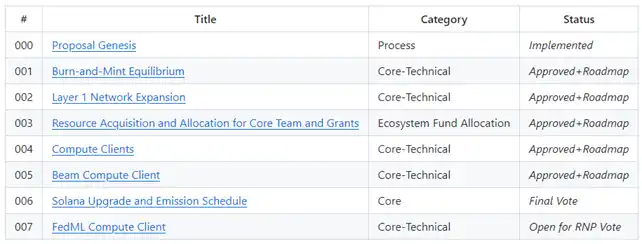
Render upgrade related RNP proposals / Source: Render Github
Introducing the BME Model
The innovation of token economic model is the core of this series of upgrades. As early as June 2022, the Render community created Proposal 001 for RNP, proposing to introduce the Burn and Mint Equilibrium (BME) token economic model, which has been successfully used by Helium Network (HNT).
Render Network is preparing to switch to the BME model with a net emission cap. By adopting a new token model, long-term supply-demand balance and even deflation of RENDER can be achieved. According to the plan of RNP-001, the new model is expected to be deployed in the coming weeks and will launch the emission plan on Solana.
Just now, the RNP-006 that passed the final vote provided a detailed introduction to the emission and distribution of BME, explaining in detail how emissions are distributed among different network participants, including node operators, computing client partners, artists, and liquidity providers.
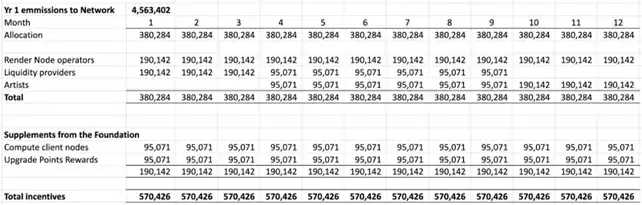
BME model emission and incentive allocation details for the first year / Source: Render
Joining the Solana Ecosystem
In order to better implement the BME proposal and meet the needs of network development, the Render community has made a major decision (RNP-002) to migrate from Polygon to the Solana ecosystem. In the community sentiment survey for selecting a new L1, nearly 55% of community members support Solana because it is faster, cheaper, and better able to handle the broad vision of the Render network.
One significant change in the Solana blockchain upgrade is the introduction of "RENDER" to replace RNDR. RNDR is an ERC-20 token, while RENDER is a new token built on the Solana blockchain. All work (3D and AI) on the Render network will be paid in $RENDER, and users can transfer their current RNDR (ERC-20) tokens and upgrade them to RENDER (SPL).
Another change involved in the Solana blockchain upgrade is the introduction of a new Solana-compatible voting system. Community members upgrading to the RENDER SPL token will participate in Render's network governance through Nation.io, a voting system similar to Snapshot. During the upgrade, both Nation and Snapshot voting on RNP will be open, and the vote counts on both platforms will be accumulated.
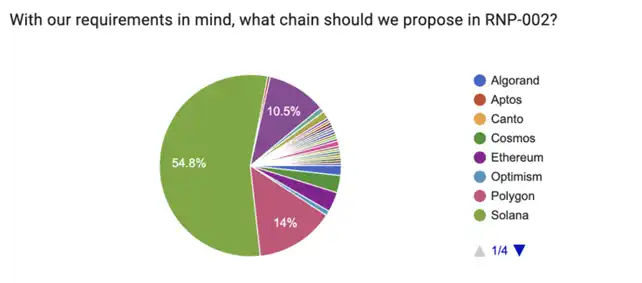
Render community survey results for L1s / Source: RNP-002
Ecological Resource Redistribution
The new BME economic model has established a balanced emission plan to ensure that the emissions are flexible enough to reward the four main stakeholders of the network (node operators, artists, liquidity providers, and computing clients) in proportion to their contributions.
The creator will receive a certain percentage of RENDER spent in this era as a reward in the form of RENDER tokens. The return percentage may be as high as 100% of the initial RENDER spent and may gradually decrease over time. Node operators will be rewarded for performing work or providing value, and the Render Foundation has announced the issuance of 1.14 million RENDER tokens as an incentive to attract new node operators to participate in AI computing tasks. Liquidity providers will be rewarded for contributing staked tokens to the liquidity pool of the cooperative exchange for each period. Early token holders can also receive incentives for migrating from RNDR (ETH) to RENDRE (ETH). In addition, given the growth goals of the network, the reward distribution between specific stakeholders or new stakeholders that emerge in network operations will remain adjustable to ensure that the work of value-adding participants is compensated. Overall, the implementation of the new model will bring incentives to all parties participating in the ecosystem.
Render 的 Solana 升级对生态有何影响?
Translation:
What is the impact of Render's Solana upgrade on the ecosystem?
Elastic and Sustainable Token Economic Model
After introducing the BME model, the RENDER token will receive more value support and will effectively transition into a deflationary mechanism. Compared to the old payment token model, the BME model has two main advantages:
● RENDER will be regarded as a commodity asset, which is more in line with the long-term goal of establishing tokenization standards for computing in the network.
● When the network utilization rate reaches a certain load condition, RENDER will enter a de facto deflation mechanism, and the value of the token will increase significantly.
Welcome to join the official BlockBeats community:
Telegram Subscription Group: https://t.me/theblockbeats
Telegram Discussion Group: https://t.me/BlockBeats_App
Official Twitter Account: https://twitter.com/BlockBeatsAsia