Evolution and potential future development trajectory of the Bitcoin asset protocol.
Original Title: "Off-Chain Transactions: The Evolution of Bitcoin Asset Protocols"
Original Author: @Ben77
Original Source: Mirror
Translation: Kate, Mars Finance
Foreword
Issuing assets based on Bitcoin has always been a hot topic. From the earliest Colored Coins in 2011 to the recent popular Ordinal protocol, the BTC community has been able to propose new participants and consensus, but few have persisted. However, the Lightning Labs has announced an ambitious plan to develop stablecoins based on Taproot Assets. Tether also announced that it will use the RGB protocol to mint USDT on the first layer of Bitcoin.
This means that the once-famous OmniLayer (formerly Mastercoin) is no longer the biggest player in the BTC ecosystem. Client-side validation (CSV) asset protocols are beginning to come into view for everyone. These protocols maintain the integrity of traditional Bitcoin asset protocols while enhancing scalability. However, a series of asset protocols in the Bitcoin ecosystem have raised related questions: what are the differences between them and how should people navigate and seize opportunities in this field?
This article aims to guide readers to comprehensively review various asset protocols that have appeared in the history of Bitcoin. In addition, it also attempts to delve into the potential trajectory of the development of Bitcoin-based asset protocols in the foreseeable future.
Colored Coins
The concept of colored coins was first introduced by Yoni Assia, the current CEO of eToro, in a groundbreaking article titled "bitcoin 2.X (aka Colored bitcoin)" on March 27, 2012. The article argues that the underlying technology of Bitcoin is as fundamental and perfect as HTTP is to the internet. Therefore, the colored coin token protocol was designed on top of BTC.
Yoni Assia envisions creating a BTC 2.0 economy through this innovation, allowing any community to generate multiple currencies in this way. At the time, using the underlying technology of Bitcoin for transaction settlement and preventing double spending was a groundbreaking idea.
Colored coins are a protocol used to issue assets on the Bitcoin blockchain. It represents other assets by "coloring" specific parts of Bitcoin. The tagged Bitcoins still retain their original function, but they also represent another asset or value. However, the pressing question is how this idea can be implemented on the Bitcoin network.
On July 3, 2014, ChromaWay took an important step and developed the Enhanced Protocol for Order-Based Colors (EPOBC), greatly simplifying the process for developers to create colored coins. This was the first protocol to use the Bitcoin script OP_RETURN function.
The result is as follows:
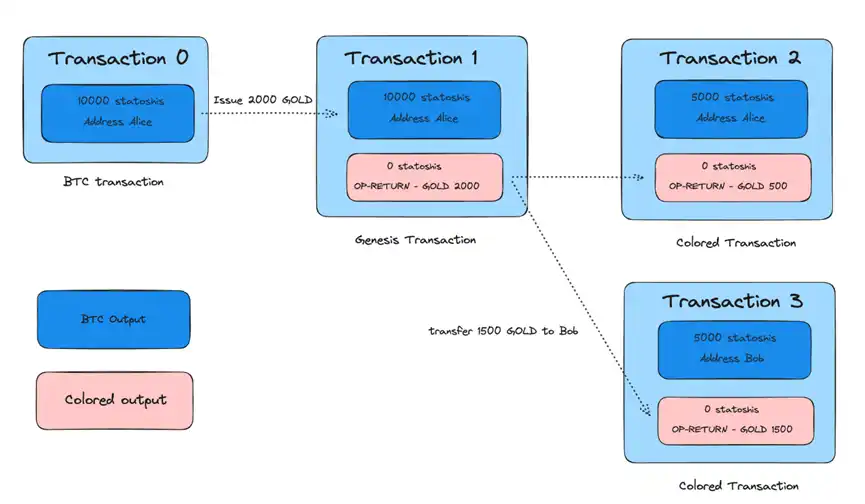
This implementation is very concise, but it also brings many problems:
1. The substitutability and minimum binding value issues are addressed by binding 1000 sats to a colored coin in the genesis transaction, making the minimum unit of the colored coin 1 sat. This means that the asset or token can theoretically be divided into up to 1000 units (but in practice, it will be lower to prevent dust attacks). For example, the minimum satoshi value was once set at 546 sat, and for Ordinals, it is even higher).
2. In order to verify the authenticity and ownership of colored coins, it is necessary to trace their transaction history and verify from the genesis transaction to the current UTXO. Therefore, dedicated wallets, full nodes, and even scanners need to be developed.
3. Potential miner review risks ColoredTransaction has distinct features, such as writing metadata in outputs, which brings the possibility of miner review.
Colored coins are essentially an asset tracking system that uses Bitcoin's validation rules to track asset transfers. However, in order to prove that any particular output (txout) represents a specific asset, you need to provide the entire transfer chain starting from the asset source. This means that verifying the validity of a transaction may require a long proof chain. To address this issue, proposals such as OP_CHECKCOLORVERIFY have been put forward to help verify colored coin transactions directly on BTC, but the proposal has not been adopted.
The first ICO in the encryption field: Mastercoin
The concept of Mastercoin was initially proposed by J.R. Willett. In 2012, he published a whitepaper called "The Second Bitcoin Whitepaper" which outlined the idea of creating new assets or tokens on top of the existing Bitcoin blockchain. This concept eventually became known as "Mastercoin" and was later renamed to Omni Layer.
In 2013, the Mastercoin project conducted an early version of what we now call an ICO (Initial Coin Offering), successfully raising millions of dollars. This is considered to be the first ICO in history. One of Mastercoin's most notable applications is Tether (USDT), a well-known fiat-backed stablecoin that was initially issued on the Omni layer.
In fact, the idea of Mastercoin predates that of Colored Coins. The reason we are discussing it second is that, compared to Colored Coins, MasterCoin is a relatively more comprehensive solution. MasterCoin has established a complete node layer, providing more complex functions such as smart contracts. In contrast, Colored Coins are simpler and more direct, mainly focusing on "coloring" or marking Bitcoin UTXOs to represent other assets.
The key difference between the two lies in the fact that on the blockchain, Mastercoin only records various transaction behaviors and does not store related asset information. In Mastercoin nodes, the state model database is maintained by scanning Bitcoin blocks, which resides in nodes outside the blockchain.
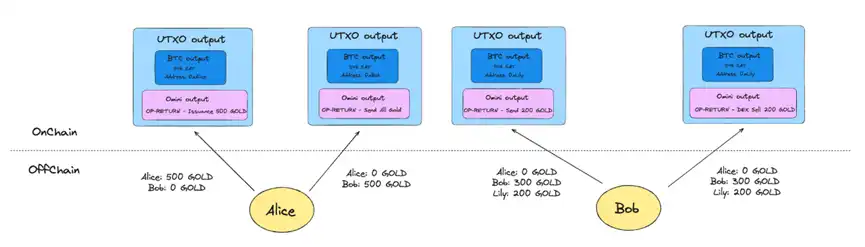
Compared to colored coins, Mastercoin can execute more complex logic. Additionally, since it does not record or verify the state on the blockchain, its transactions do not require continuity (continuous coloring).
However, in order to achieve the complex logic of Mastercoin, users need to trust the state maintained in the database of the internal chain of nodes, or run their own Omni Layer node to perform verification.
In short:
The main difference between Mastercoin and Colored Coins is that Mastercoin does not maintain all the data required for the protocol on the blockchain. Instead, it relies on the Bitcoin consensus system to manage its own transaction publication and ordering, and then maintains the state in an off-chain database.
According to the information provided by OmniBolt, the Omni Layer is proposing a new UBA (UTXO-based asset) asset protocol to Tether, which will utilize the Taproot upgrade. This protocol will embed asset information into Tapleaf and integrate conditional payments with Stark into the Lightning Network infrastructure of the Omni Layer.
Concept of Client-side Verification
If we want to understand the concept of Client-Side Validation (CSV), we need to go back to the year 2013, when colored coins and Mastercoin emerged. That year, early Bitcoin and cryptography researcher Peter Todd published an article titled "Disentangling Crypto-Coin Mining: Timestamping, Proof-of-Publication, and Validation." Although the title does not explicitly mention client-side validation, careful reading will reveal that this is one of the earliest articles to introduce this concept.
Peter Todd has been looking for ways to improve the efficiency of Bitcoin operations. He developed a more complex client verification concept based on timestamps. In addition, he introduced the concept of "one-time sealed envelopes," which will be mentioned later.
CTxIn -> CTxOut -> <merkle path> -> CTransaction -> <merkle path> -> CTxIn
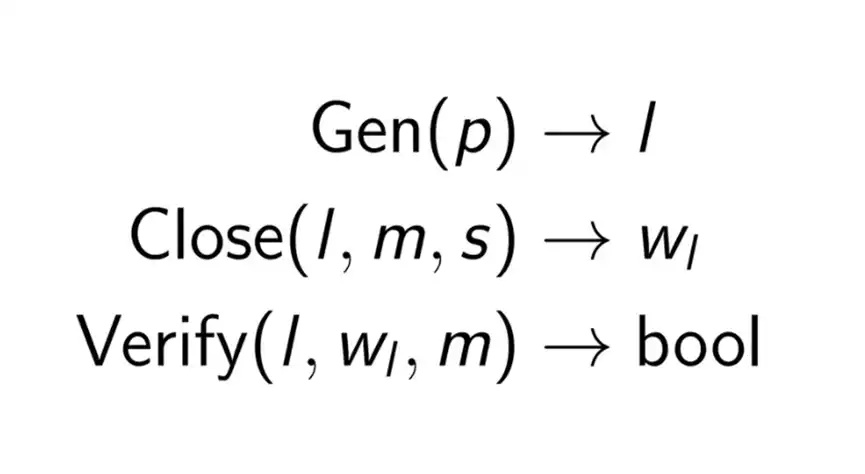
In summary, assets verified by the client have the following characteristics:
2. Commitment Mechanism: Although asset data is stored off-chain, the modification or transmission of this data is recorded on-chain through commitments. These commitments allow on-chain transactions to reference off-chain states, ensuring the integrity and immutability of off-chain data.
3. On-chain witness (not necessarily Bitcoin): Although most data and validation occur off-chain, assets verified by clients can still leverage the security of the underlying blockchain through embedded on-chain commitments (publishing proofs, transaction ordering).
4. Complete the verification process on the client side: Most verification work is done on the user's device. This means that not every node in the network needs to participate in verifying each transaction, only the relevant parties need to verify the validity of the transaction.
For those who use client-side validation of assets, there is one thing to note:
RGB, CSV Pioneer
The concept of RGB was proposed by the well-known community figure Giacomo Zucco after 2015. This was a period of Ethereum's rise, with a surge in ICOs (Initial Coin Offerings), and many people attempting to create projects beyond Bitcoin, such as Mastercoin and Colored Coins.
Giacomo Zucco is disappointed with these developments. He believes that these projects are not able to match the potential of Bitcoin, and previous attempts to implement tokens on Bitcoin were insufficient. During this time, he met Peter Todd and became fascinated with Todd's ideas about client-side validation (CSV), which led him to develop the concept of RGB.
These contract schemas are responsible for limiting unexpected behavior during VM execution. For example, RGB20 and RGB21 are responsible for imposing certain restrictions on fungible and non-fungible tokens during the transaction process.
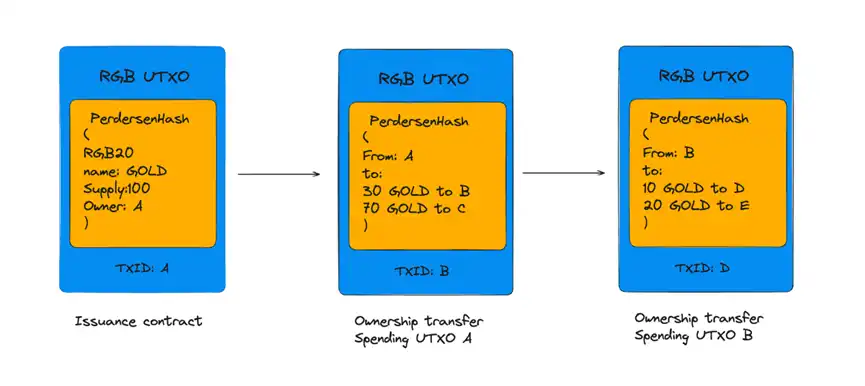
The commitment mechanism and Pedersen Hash used in RGB.
RGB Simplified Virtual Machine Design → AluVM
RGB Layer2 Expansion Direction: Lightning Network or Sidechain?
The client-side validation of assets cannot sustainably conduct off-chain transactions securely because they still rely on L1 for transaction publishing and ordering. This means that without layer 2 scaling solutions, their transaction speed is still limited by the block production speed witnessed by L1. This means that if RGB transactions are conducted directly on Bitcoin, under strict security requirements, the time interval between two related transactions needs to be at least ten minutes (BTC block time), which is usually unacceptable slow.
RGB and Lightning Network
In short, the operation of the Lightning Network involves having the parties involved in a transaction sign a series of contracts (promising transactions) off-chain. These contracts ensure that if any party violates the agreement, the victim can submit the contract (promising transaction) to BTC for settlement, recover their funds, and punish the violator. In other words, the Lightning Network ensures the security of off-chain transactions through protocol and game theory design.
RGB can build its own lightning network infrastructure by designing payment channel contract details that are suitable for RGB itself. However, due to the high complexity of the lightning network, building such infrastructure is not easy, especially considering the years of work by the Lightning Labs and LND's market share of over 90% in this field.
RGB's Sidechain Prime
The maintainer of the RGB protocol, LNP-BP, has proposed a client-side validation asset extension solution called Prime, which was put forward by Maxim in June 2023. In the article, Maxim criticized the existing sidechain and Lightning Network extension solutions for being too complex in the development process. He believes that, except for Prime, other extension methods, including the NUCLEUS multi-node Lightning channel and the Ark/Enigma channel factory, require more than two years of development time. However, Prime can be completed within a year.
Prime is not designed as a traditional blockchain. Instead, it is a modular proof publishing layer created specifically for client validation. It consists of four main components:
1. Timestamp service: This service can complete a series of transactions in just 10 seconds.
4. Smart Contract Protocol: RGB Sharding Contract (Replaceable)
Based on Taproot, CSV Asset Protocol: Taproot Assets
Taproot transactions only carry the root hash of the asset script, making it difficult for external observers to identify whether they involve Taproot Assets, as the hash itself is generic and can represent any data. With the upgrade of Taproot, Bitcoin gained the ability to execute smart contracts (TapScript). Based on this, the asset encoding of Taproot Assets actually creates a token definition similar to ERC20 or ERC721. Therefore, Bitcoin not only gains the ability to define assets, but also the ability to write smart contracts, laying the foundation for Bitcoin's token smart contract infrastructure.
The encoding structure of Taproot Assets is as follows:
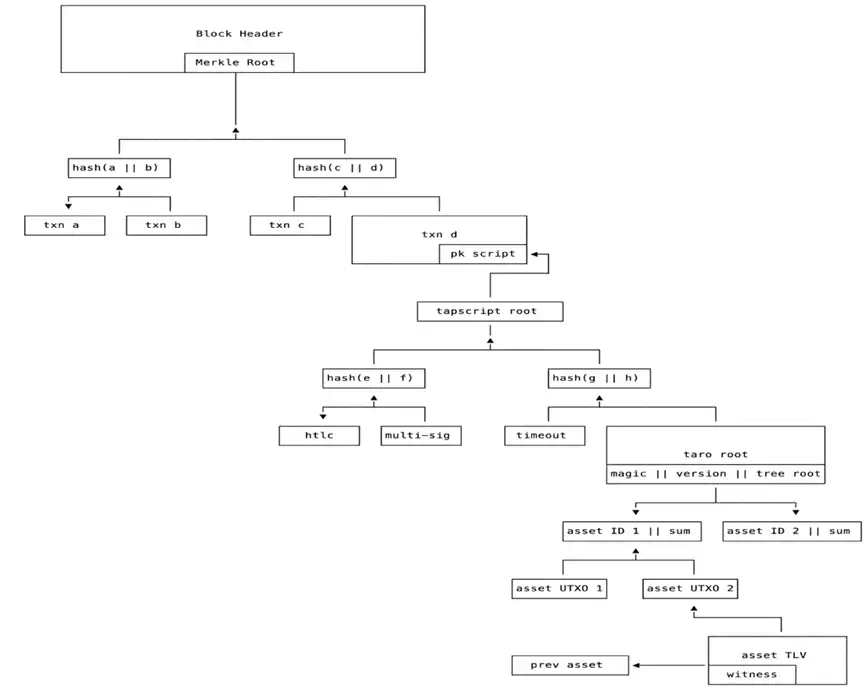
Author: Roasbeef, Chief Technology Officer of Lighting Labs

As a CSV asset protocol, Taproot Assets has a simpler design compared to RGB. The biggest difference between Taproot Assets and RGB in terms of application scalability is the execution VM. Taproot Assets uses the same TaprootScript VM as BTC's native default. In recent years, many infrastructure researches for BTC have been based on TapScript, but due to BTC's slow upgrade, it cannot be applied in the short term. Therefore, it can be foreseen that Taproot Assets will be the experimental field for these fresh ideas in the future.
Taproot Assets and RGB's Differences
1. Transaction Verification and Lightweight Node Friendliness
Taproot Assets has high verification efficiency and security due to its implementation of a sum tree structure. It allows for state verification and transactions through proof ownership without the need to traverse the entire transaction history. In contrast, RGB uses Pedersen commitments, making it difficult to effectively verify the validity of inputs. Therefore, RGB needs to trace the transaction history of inputs, which can become a significant burden over time and with the accumulation of transactions. The design of Merkel sum tree also enables Taproot Assets to easily facilitate lightweight node verification, a feature previously unavailable in asset protocols built on top of Bitcoin.
2. Execution Virtual Machine
Original Link
Welcome to join the official BlockBeats community:
Telegram Subscription Group: https://t.me/theblockbeats
Telegram Discussion Group: https://t.me/BlockBeats_App
Official Twitter Account: https://twitter.com/BlockBeatsAsia
 Related Articles