Bitcoin DeFi ecosystem is gaining momentum, what protocols should we pay attention to recently? [翻译]:


Currently, the Bitcoin ecosystem is one of the most talked-about topics in the cryptocurrency community. In addition to the hype surrounding the FOMO mentality and various token protocols that are continuously being built, investors who are still on the sidelines are more interested in the DeFi scene on the Bitcoin ecosystem.
With the recent surge in various BRC tokens over the past month, the related assets within the Bitcoin ecosystem have accumulated to a considerable scale. According to Coingecko data, the market value of BRC-20 has exceeded 600 million US dollars. This has led to a demand for liquidity from BRC-20 asset investors.
Recently, several DeFi protocols in the Bitcoin ecosystem have had new developments. BlockBeats has compiled them as follows:
Cross-chain Bridge
One relatively efficient way to explore DeFi applications in the Bitcoin network without smart contracts is to bring BTC assets into public chains with smart contract functionality such as Ethereum and directly utilize their sophisticated DeFi infrastructure. Bridges are a key infrastructure of Web3, and Bitcoin is no exception. Without decentralized/composable bridges, dApps built on Bitcoin cannot integrate cross-chain liquidity, thereby limiting their growth potential. This use case has given rise to projects that focus on cross-chain Bitcoin asset transfer.
MultiBit
Multibit is a bridging protocol that appeared in May of this year to connect BRC20 assets to the EVM network, allowing users to seamlessly transfer tokens between the ETH chain, BNB chain, and BTC network. Multibit completed its IDO auction on the Bounce Finance auction platform on November 12, raising 88 ETH. On November 4, it completed another IDO on the Bitcoin network donation platform TurtSat at the same unit price, raising 4.64 BTC. The total amount raised in both auctions was approximately $350,000.
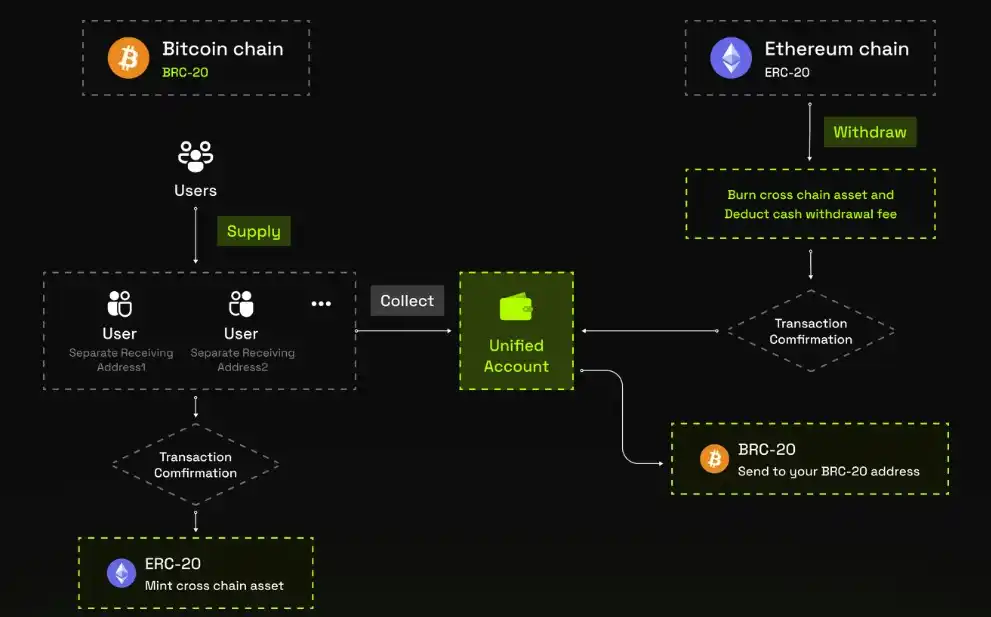
MultiBit simplifies the token transfer process between the BRC20 and EVM networks of Bitcoin. First, users transfer BRC20 tokens to a dedicated BRC20 address. Once confirmed, the Multibit protocol begins to operate, minting an equivalent amount of tokens on the Ethereum or Binance Smart Chain. The Multibit Protocol collects tokens from all distributed unique addresses, which are securely transferred to a unified cold wallet. When users need to withdraw tokens, the Multibit Protocol will destroy the corresponding number of tokens from the EVM chain. Then, it will transfer the equivalent tokens from the secure cold wallet to the user.
Two weeks ago, MultiBit drew high attention from the community due to the huge increase in its token MUBI. MUBI completed an Ethereum-based auction on the Bounce Finance platform on the 12th, with an IDO unit price of $0.00047 and a fundraising of 88 ETH. On the 14th, it completed an IDO on the Bitcoin network donation platform TurtSat at the same unit price, raising 4.64 BTC. The total fundraising for the two times was approximately $350,000. On November 14th, MUBI opened with a 1140% increase, and on the 16th, MUBI had a 24-hour increase of 122%, pushing it to touch $0.01385.
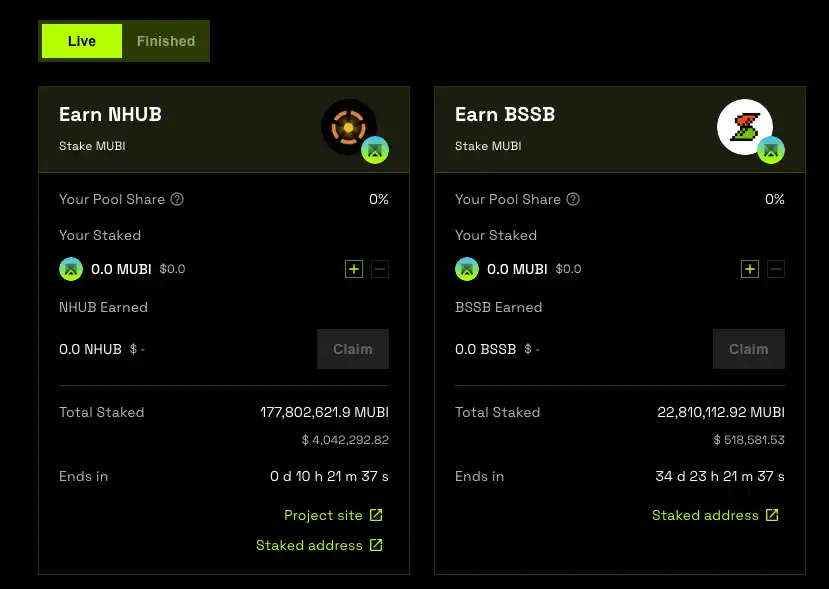
On November 26th, MultiBit launched its staking system. Users can stake $MUBI tokens and receive rewards in the form of ERC20 or BRC20 tokens on the Mutibit platform. Currently, users can stake and receive NHUB and BSSB tokens. At the time of writing, over 200 million MUBI tokens have been staked on Mutibit.
XLink
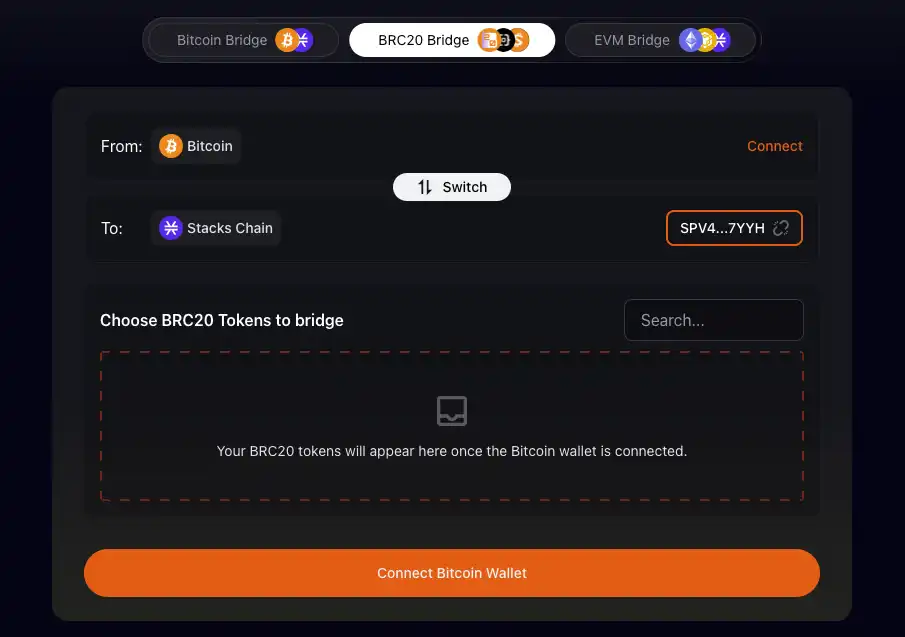
On November 24th, the Bitcoin DeFi platform ALEX announced that its cross-chain component ALEX Bridge will be transformed into the unique entity "XLink".
In its announcement, XLink's positioning is "to become the infrastructure connecting Bitcoin and its derivatives (such as BRC20), integrating the Bitcoin Oracle supported by ALEX, and thus achieving seamless and secure bridging between Bitcoin and Bitcoin L1 assets." XLINK can provide "native-like" BRC20 AMM or other DeFi applications for Bitcoin.
Before the separation of XLink, ALEX was an open-source DeFi protocol based on the Stacks public chain. The current mainnet version includes functions such as Swap, Lending, Staking, Yield Farming, and Launchpad.
Related reading: "Doubling in a day, Stacks founder explains the Bitcoin Layer2 concept of STX."
LSD
Fairlight CDP
FairLight CDP is a collateralized debt position protocol that allows users to deposit BRC-20 tokens, borrow BRC-20 synthetic asset sats, and then deposit sats to earn a portion of the lending interest as a reward. Users can also use FCDP tokens to participate in protocol governance and share protocol fees. On November 28th, Fairlight appeared as a partner on the official website of UniSat.
Developers have deployed a BRC-20 token named "FCDP" with a total supply of 16,180 (commemorating the birth of the natural logarithmic constant e in 1618), with each inscription limited to one. The developers have minted 207 tokens at the deployment address, accounting for 1.27% of the total supply, and all inscriptions have now been minted.
Fairlight's economic model aims to create a sustainable and growth-oriented DeFi ecosystem. The model revolves around the strategic use of SATS tokens and integration with the UniSat Swap module, creating a stable and prosperous environment for all participants.
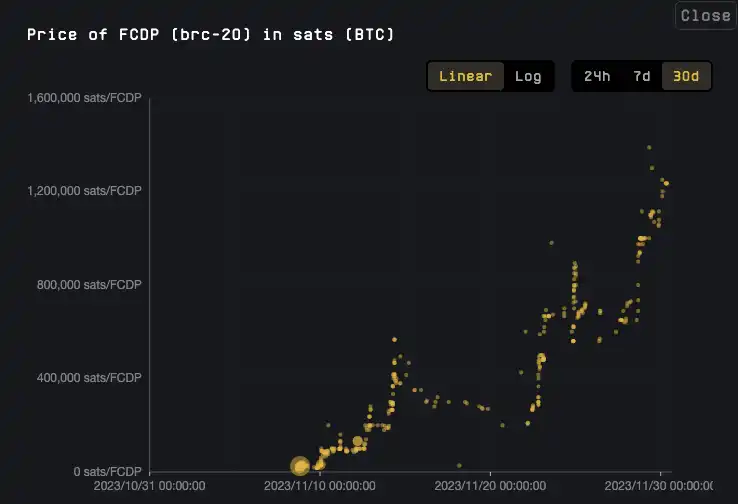
In DeFi, various financial operations such as borrowing, leveraged shorting, and arbitrage can be achieved through CDP. Therefore, FairLight CDP is expected to bring more trading volume and liquidity to BTC-20. Its token, FCDP, has also been highly sought after by the community. According to UniSat data, since the launch of FCDP less than a month ago, its price has more than tripled. At the time of writing, its floor price is 0.01 BTC, and the total trading volume has exceeded 22 BTC.
CEX
Orders Exchange
Orders Exchange is the first decentralized exchange (DEX) with a fully functional order book running on the Bitcoin network. It combines the Ordinals protocol, PSBT technology, Bitcoin script, and the revolutionary Nostr protocol to create an interconnected on-chain trading market. Last week, Orders Exchange launched a liquidity mining campaign.
PSBT (Partially Signed Bitcoin Transaction) is a standard format designed to simplify the handling of Bitcoin transactions that are not yet finalized. PSBT was initially introduced in Bitcoin Improvement Proposal (BIP) 174, and its core value lies in providing an efficient and secure collaborative process for constructing transactions, especially in cases where multiple signatures are required. By using PSBT, entities involved in the transaction can independently sign in an incremental manner without disclosing sensitive data to each other.
By utilizing PSBT and multi-signature technology, Orders Exchange can implement a completely trustless BRC20 liquidity pool. The liquidity provided by users is actually a PSBT single-signature asset pair, with its output pointing to a multi-signature address shared by the user and the exchange. This design ensures that the exchange cannot directly cash out the PSBT and take away the user's assets, thus protecting the liquidity provider's assets.
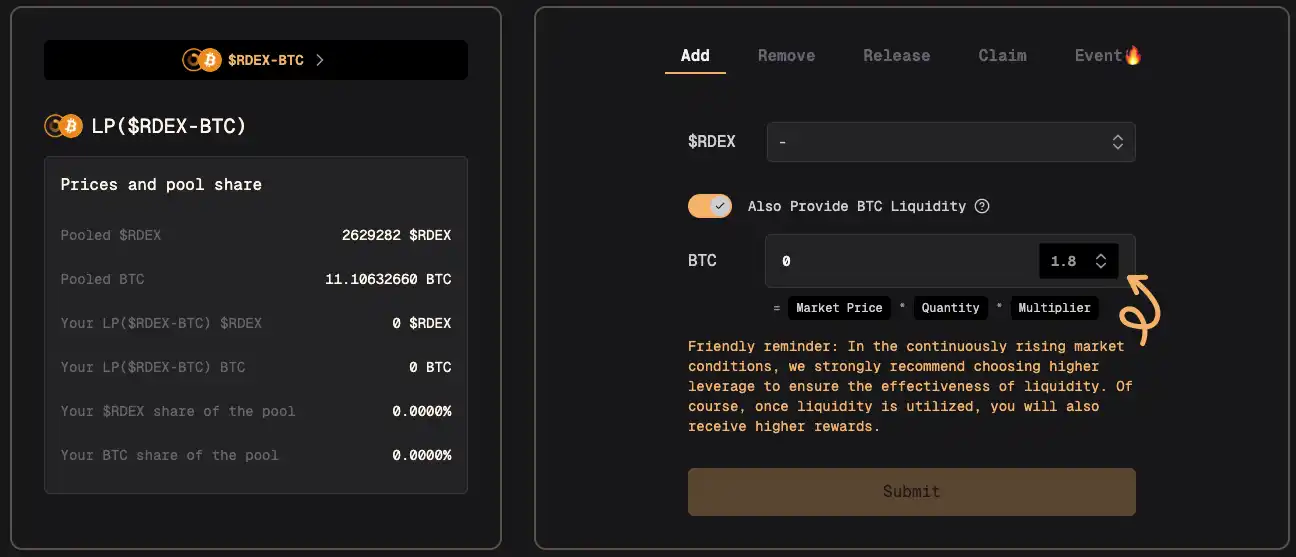
On November 24th, Orders Exchange launched a 10-day "first-ever liquidity mining on the Bitcoin network" event, aimed at rewarding users who provide liquidity and execute trades, and handling the service fees of BID orders through buyback and burn. Users participating in the event can receive rewards in the form of $RDEX tokens. Currently, Orders Exchange's liquidity pool holds over 2.6 million RDEX tokens, worth approximately 11 BTC.
Stablecoin
BitStable
BitStable is a decentralized asset protocol based on the Bitcoin network, allowing anyone to generate $DAII stablecoins collateralized against the Bitcoin ecosystem on the platform from anywhere. On November 29th, BitStable completed its IDO on the Bounce Finance platform, but due to a DDOS attack, there were issues with uneven token distribution.
Related reading: "$BSSB launched and was immediately attacked, BitStable was questioned by the community for being a "Rug"".
BitStable has a dual-token system and cross-chain compatible structure, with its tokens being $DAII and $BSSB. According to the official website, DAII is a stablecoin whose value and stability come from the robustness of assets in the Bitcoin ecosystem, including BRC20, RSK, and Lightning Network. Additionally, in BitStable's vision, with its cross-chain capabilities, DAII can also bring the Ethereum community into the Bitcoin ecosystem. The total supply of $DAII is 1 billion tokens.
BSSB is the governance token of the platform, which the community uses to maintain the system and manage DAII. BitStable also incentivizes BSSB holders through dividends and other measures.
Conclusion
除了以上列出的 DeFi 协议外,比特币生态中还有一些发展较为早期的 DeFi 协议,如基于 Stacks 生态的开源比特币 DeFi 平台 ALEX,其代币在近两周内涨幅一度超 40%。此外,比特币侧链 RSK 上的借贷协议 MoneyOnChain 和 DeFi 平台 Sovryn 也已经积攒了一定的流动性。
Translation:Aside from the aforementioned DeFi protocols, there are also some early-stage DeFi protocols in the Bitcoin ecosystem, such as the open-source Bitcoin DeFi platform ALEX based on the Stacks ecosystem, whose token has surged by over 40% in the past two weeks. In addition, the lending protocol MoneyOnChain and DeFi platform Sovryn on the Bitcoin sidechain RSK have also accumulated a certain level of liquidity.
BlockBeats reminds investors that the development of DeFi applications in the Bitcoin ecosystem is still in its early stages and carries significant uncertainty risks. Before making any investment decisions, investors should fully understand the protocols involved, evaluate their own risk tolerance, and make decisions cautiously.
Welcome to join the official BlockBeats community:
Telegram Subscription Group: https://t.me/theblockbeats
Telegram Discussion Group: https://t.me/BlockBeats_App
Official Twitter Account: https://twitter.com/BlockBeatsAsia
 Related Articles