Grim Forker: Attacks and Mechanism Design in AMM Protocol Fee Governance
Original Title: "Grim Forker: checks and balances to AMM protocol fees"
Original Author: lajarre
Translated by: Luccy, BlockBeats
Editor's Note:
This article is translated from Lajarre, co-founder of the decentralized governance protocol Butter, proposing the AMM protocol fee governance mechanism Grim Forker in the Ethereum research forum.
The name Grim Forker comes from Grim trigger, a repeated game trigger strategy in game theory. Initially, both parties cooperate together. Once the other party betrays or makes a mistake for their own benefit, the cooperation will end forever, and the betrayer will not have a chance to correct their mistake. Grim Forker plays a similar role to Grim trigger in the governance process, promoting both parties to actively maintain cooperation and benefiting both sides in an infinite number of repeated games.
In explaining the design of Grim Forker, Lajarre proposed a simple CFMM model based on Uniswap v2 and attached a related competitive equilibrium analysis, demonstrating how an AMM can be surpassed by a funded fork. The Grim Forker mechanism aims to force AMM governance to adjust protocol fees through forks and funding contracts. Lajarre pointed out that although Grim Forker can increase the surplus of liquidity providers (LPs), it may harm the interests of UNI token holders.
This article summarizes our research at Butter, focusing on the governance mechanism of protocol fees in AMM. Our exploration was inspired by some innovative ideas, such as "Votes as Buy Orders: A New Type of Hybrid Coin Voting/Futarchy" and "Governance Mixing Auctions and Futarchy". The goal of this research is to propose new ways to enhance the governance of protocol fees. We look forward to feedback from the community on the feasibility of the proposed attack methods and suggestions for the overall mechanism design. A draft of our paper can be found at here.
The protocol fees in AMM have been controversial, as they are a way of providing a return on investment for initial development by assigning value to governance tokens. These fees form a rent, extracting value from AMM (reducing LP rewards) and thus reducing the surplus value of AMM users.
In the following text, we propose a simple CFMM model based on Uniswap v2 (which can be extended to multiple pools and v3), and provide a related competitive equilibrium analysis, demonstrating how an AMM can be surpassed by a funded fork.
Next, we will demonstrate how LPs can take advantage of this opportunity to launch a coordinated attack on the original protocol, in order to increase their LP returns. Specifically, this will be achieved by deploying a free AMM fork and a funding contract.
Finally, we will explore the objectives in the context of mechanism design. We will demonstrate that the possibility of attacks can severely trigger governance, effectively limiting the extractable value of token governance (GEV), thereby increasing the efficiency of the protocol in a short-sighted manner. However, we will also prove that this mechanism to some extent hinders the return on investment in research and development, which may reduce the well-being of AMM users and Ethereum users in the long run.
竞争均衡分析
translates to
Competition Equilibrium Analysis
Assuming there are two AMMs, namely AMM1 and AMM2, each containing a single pool consisting of the same two tokens. The only difference between these two AMMs will be the different reserve amounts, namely R1 and R2, and the different trading volumes per unit time, namely V1 and V2.
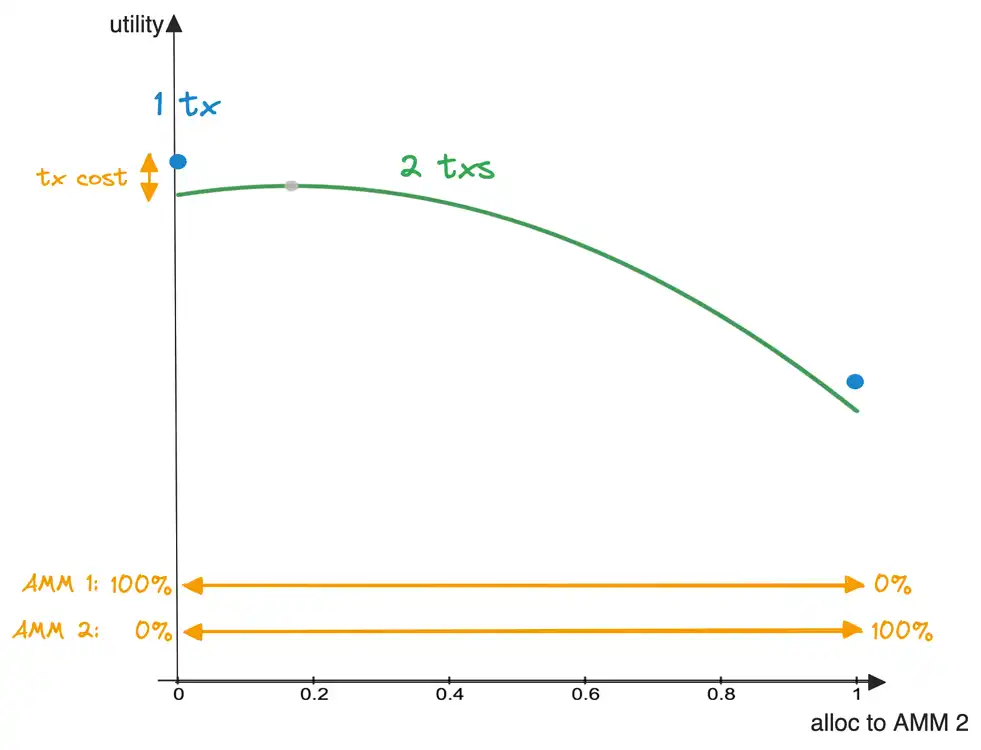
From the perspective of traders willing to allocate trades, the only difference will be the slippage cost, which will be lower in AMMs with larger reserves. The utility of trade allocation will have a cost item that looks like -(1-x)²/R1-x²/R2 (see figure below), where x is the ratio allocated to AMM 1 and AMM 2 (between 0 and 1). Therefore, traders executing small trades will prefer to only use AMMs with larger reserves.
For small LPs, the allocation utility will be as follows: (1-x)V1/R1+xV2/R2. Therefore, rational small LPs will allocate all reserves to the AMM with larger existing reserves.
The combination of these two conclusions proves an intuitive fact: over a long enough period of time, AMMs with larger reserves and trading volumes will accumulate a monopoly position in liquidity. This is a classic network effect, as visualized in the simplified simulation below.
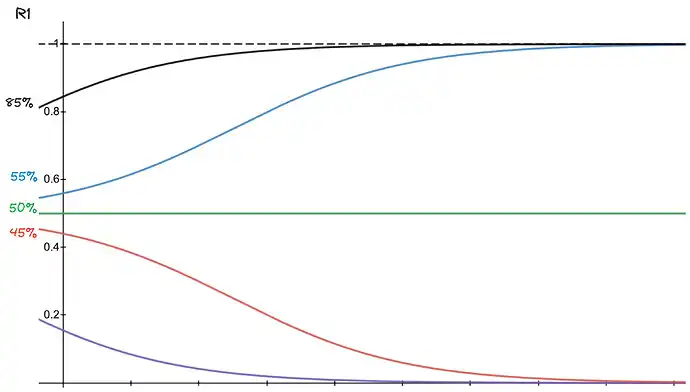
The y-axis represents the proportion of R1, and the x-axis represents time. If R1 is greater than 50%, then within a sufficiently long time frame, liquidity will be completely concentrated on AMM 1.
Now, assuming that AMM 1 has permanently activated protocol fees. In AMM 1, the function for distributing returns to LPs from the reserve will change from the factor (1-γ)V1/R1 to the factor (1-γ-ρ)V1/R1, where 1-γ is the LP fee and ρ is the protocol fee (as annotated by Angeris et al. in 2019).
- The ρ term will shift the percentage threshold upwards, meaning R1 needs to start at a certain percentage to ensure that the network effect ultimately benefits AMM 1 (which will be greater than 50%).
Assuming that AMM 2 has added a subsidy to its LP rewards, the return will now have two components: (1-γ)V2/R2+σ, where σ is the subsidy factor.
σ will also move the percentage threshold mentioned above upwards. With sufficient subsidies, the threshold can be made arbitrarily close to 100%.
Analyzing the balance of this allocation game will yield a minimum subsidy value. Beyond this minimum value, network effects will systematically reverse in favor of AMM 2. With a large enough subsidy, AMM 2 can absorb all liquidity from AMM 1.
In a simple way to model the risk preference and switching costs of LP, our paper has done some preliminary calculations to evaluate the total amount of subsidies, and the result is reasonable: for every $100 of reserves, the total amount of subsidies (within the lifespan of AMM 2) is approximately $10.
Please note that these calculations need to be easily carried out under strong assumptions to be more realistic. In particular, this simplified model does not take into account strategic assets such as brands, intellectual property, or other important factors.
Attack
Here, we will design a programmatic attack on AMM 1, assuming that the protocol fee is permanently activated. This will help us think about the potential impact on governance in AMM 1.
Let's consider the following attack scenario:
· Attacker: LPs.
· Attacked protocol: AMM 1, including its governance.
· Attack vector: Forked AMM contract with subsidy, funding mechanism contract.
· Attacker's profit: ρ minus potential participation in funding mechanism.
The minimum subsidy that the funding mechanism contract can generate triggers the liquidity loss from AMM 1 to AMM 2, which is discussed above.
Assuming that AMM 2 still needs to be governed, we suggest creating a mechanism to control these parameters through auctions, which will generate seller surplus.
Then, the subsidy will be generated by debt instruments funded by auction mechanisms, with specific settings as follows:
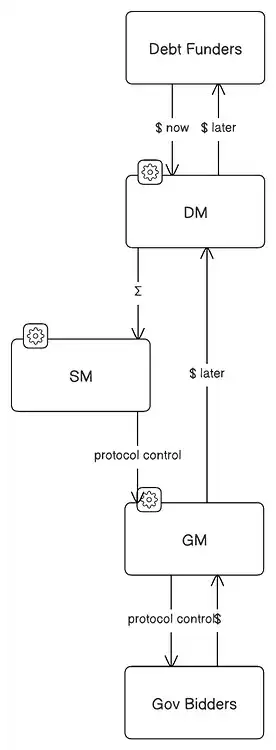
DM: Debt mechanism determined based on the total amount of subsidies.

Welcome to join the official BlockBeats community:
Telegram Subscription Group: https://t.me/theblockbeats
Telegram Discussion Group: https://t.me/BlockBeats_App
Official Twitter Account: https://twitter.com/BlockBeatsAsia

 Related Articles