Wang Feng's Ten Questions Live: Me and My FriendTech Friends.
Source: MarsBit
Have you booked a room with your friend today? I think this sentence should become the advertising slogan of Friend.Tech (hereinafter referred to as FT). Whether you love it or hate it, there is no dispute that FT has become a phenomenal product.
This head is well opened, suddenly lifting the tempting encrypted social dining table. With the advent of many imitations and new experiences that promote competition in SocialFi, there is the Stars Arena, which collapsed due to rushing to ensure safety, and Tomo, which has just entered in the form of an app.
Today, it is necessary for us to do a small review of this seemingly long-awaited yet sudden new species, and talk about the behind-the-scenes story of FT's overnight popularity, to understand the experiences and feelings of the deeply involved participants.
In this issue, I hope to use the "Wang Feng's Ten Questions Live/Web Three-Person Show" column to further discuss and look at the possibility of the large-scale application stage of the Social Fi, Game Fi, and Layer2 network ecology from different perspectives.
The Web3 world in Chinese needs free and open dialogue, sparking thoughts and participation. In the future, every other week, I will host a Web3 talk show with developers, investors, and opinion leaders who are deeply involved in Web3 and active in the community. Each episode will feature two special guests.
Guest Introduction:
1) Wang Feng (Xiaoyin)
Element initiator, CEO of Bluehole Interactive (HK) Group, former Senior Vice President of Kingsoft Corporation, has been involved in antivirus software, online gaming, encrypted media, and NFT trading markets.
2)Cryptowillaim.eth
Former commercial director of Tencent Games platform, responsible for joint distribution of over 100 games and P11 product operations. Currently a family fund manager, long-term holder of BAYC, and FT grassroots growth participant. Within one month, the Key price reached the highest in the world's Top14.
3)Christian Li
A NFT collector born after 2000, the top player on the FT leaderboard one week ago, has already earned over 300,000 FT points. Currently an undergraduate student majoring in philosophy at Peking University, with a passion for modern art.
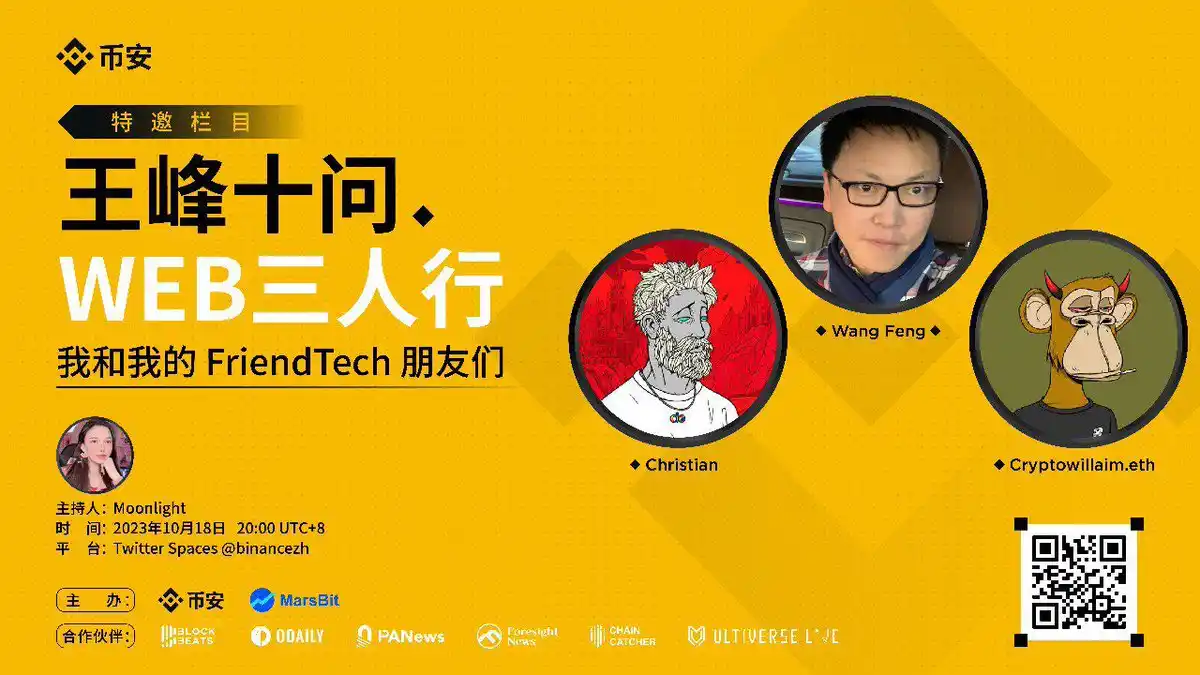
The following is a transcript of the conversation:
One, the emergence of new generation KOLs born after 2000
F: Thank you to the Binance Chinese Live channel for inviting me to organize a regular "Wang Feng Ten Questions Live/Web Three-Person Dialogue" program. This is the first episode. We will discuss the hottest topic in the current FT world. Both of our guests are popular figures in the FT world, especially Christian, who has become a rising star in the cryptocurrency community and a KOL with significant influence among the post-2000 generation on Twitter.
Actually, the three of us have intersecting points. William, who came from Tencent, and I are colleagues in the online gaming industry. Christian is a fellow alumnus from Peking University. I obtained my Master's degree from Peking University Guanghua School of Management in 2003. It's unexpected that we are reunited because of FT.
I have met William twice at the Web3 event at the University of Hong Kong. We got along well and talked about games and the NFT market. Actually, he had invited me to participate in FT a long time ago, but I didn't listen to him. It wasn't until I joined FT more than ten days ago that I realized the Key he had minted was already a blue-chip. William also introduced me to Christian. By the way, how did you two meet? What is your previous experience in the cryptocurrency field? I feel like William wants to start a business in the gaming industry, while Christian plans to focus on being an investment partner.
C: I met William during the bull market at the end of 2021. We were both in an investment and cryptocurrency trading group at the time, and we continued to discuss industry topics such as our respective thoughts on NFTs and GameFi, as well as helping each other introduce friends and resources. In the past two months, based on our common interests and the desire to promote and share in the Chinese community, we have had more discussions with each other, especially after the explosion of FT.
When William first started playing FT, we bought keys from each other and went through the process from 0 to 1 together. Currently, there are not many top KOLs in China who are careful and have a great vision. I am glad to be able to play together. This time, he invited me to participate in the conversation with Wang Feng, and I am very grateful for that.
Regarding my previous experience in the cryptocurrency industry, I mainly focused on the NFT field and invested some money in this area. Through participating in many communities, I have made many friends. I am one of the few people who have continued to hold and buy during the bear market. In addition to holding blue-chip projects such as Heavy Monkey and Azuki, I have also invested in some NFTFi projects. Later, I became a partner of Little Ghost because of our shared vision, and together we are building a Web3 trend brand that can truly lead Mass Adoption.
W: I met Christian a few years ago in a cryptocurrency group introduced by a friend. We had a lot of exchanges in his previous entrepreneurial projects. I think he is not only a wealthy second-generation, but also a very thoughtful young man.
I myself probably won't become a founder in the Web3 field. This field has relatively high risks, whether it's related to legal affairs or the level of responsibility to users. However, I will continue to pay attention to the cutting-edge entrepreneurial market through incubation and investment.
Speaking of my experience in the encryption industry, I bought my first BTC in 2013, but I didn't continue to pay attention to it due to my studies. Two years ago, I missed the DeFi Summer because I was addicted to working at Tencent. Since then, I have been deeply involved in NFT trading and ecological research. At the same time, I have also started incubating some gaming projects, investing in some first-level Web3 funds and studios, and doing some second-level transaction-related learning on my own (also looking for opportunities to comply with Web3 regulations in Hong Kong).
F: What was the most important project you participated in before FT this year?
C: Apart from the NFT field, I am currently mainly responsible for investment in NextGen Digital Venture with two other partners. We are a newly established hedge fund that mainly trades in GBTC and the secondary market of US stocks. We have achieved decent performance in the difficult market conditions of the past six months. Of course, the most rewarding experience is growing together as a leek and participating in the trading, arbitrage, and early investment of various projects on the chain with friends in the industry.
W: Get ARB and SEI airdrops, participate in the Ordinal craze, build positions in BTC, and invest in establishing a fur-stripping studio.
二、第一次亲密接触 FT/你因何而来
translates to
2. First Intimate Contact FT/Why Did You Come?
in English.
F: William has been working on product operations at Tencent. What was your initial impression of this product?
W: There is nothing remarkable about the product itself, similar to the early days of Feixin. However, influenced by early platform operation experience, I immediately noticed the FT distribution model, which bypasses the Apple and Google stores, and even bypasses enterprise signing. This is a very smart approach and very advantageous for distribution, but it also limits the development potential.
Additionally, I am also intrigued by the concept of "going up and down the stairs" in terms of pricing, which is a very new way of issuing asset pricing. At the same time, I am also impressed by Christian's points system, which may be the key factor that ultimately drives me to join in the fun.
F: I joined the industry relatively late and would like to know when you got involved. Do you remember if it was before or after Paradigm's investment when you entered the game?
Secondly, clear expectations for points, airdrops, and timing make it more conscientious than many public chains and projects favored by PUA users. (Please don't PUA us with Element by Mr. Wang Feng in the future, we beg you.)
Finally, FT has a very concise contract architecture. After security incidents occurred in Stars Arena and Tomo, we found that the most valuable aspect of FT is that there has not yet been a particularly large security incident or a security event that would cause panic.
After discussing the advantages, let's talk about the shortcomings, which are also three points. Firstly, the development of functions is slow, and the performance optimization is poor. It often cannot be opened on mobile phones, and the waiting time is too long, which greatly affects the user experience. This is the most urgent area for improvement. In addition, there are relatively few new ideas and new things. It feels like the project party has less communication and interaction with everyone, and we don't know what they are thinking.
Secondly, regarding the issue of preventing BOTs, FT has not implemented any effective measures to prevent them and has instead chosen to ignore the problem. I believe that there are ways to address this issue. The BOT ecosystem has hindered many people from taking the next step, or some people have entered and been snatched by BOTs, causing the account trading system to become chaotic and affecting the motivation of many people to continue participating.
Thirdly, the transaction fees are too high. If the fees were lower or if creators were rewarded more, there would be more diverse gameplay options available.
Four, My Friends/KOL in FT and the Secret to Booking a Room (KEY)
F: I have been involved in FT for half a month. Some people compare FT to the Happy Network in the cryptocurrency industry. I can relate to that, but my circle of friends is not that big. In 2008, many of my online friends were added through Happy Network. I remember adding the main backbone of an internet company in just a few days, and becoming friends with many of them. After Weibo came out, this relationship quickly shifted away. In FT, where do your friends come from? What is the ratio of new and old acquaintances? By the way, can you talk about the general demographic of FT's current user base?
C: In the FT industry, my friend ratio is exactly fifty-fifty. Half of them are friends from the circle who had a good relationship with me before, especially those who supported me in the early stages. The other half are people I didn't know at all before, but I got to know them and became familiar with them because of FT and holding each other.
Regarding the general profile of the FT audience, I believe they are the most valuable users in the current crypto field. Firstly, being able to accept this product means having the ability to try new products and take risks, especially the top users who are mostly important KOLs, entrepreneurs, and investors in the crypto field. This group of people not only have the funds and strength, but also have their own influence.
W: Most of my friends come from the cryptocurrency industry. Some of them are long-time friends, some are people I have looked up to for a long time, and some are people I knew before but never worked on a project together (because of FT, we can also be considered as working on a project together in a sense, when people's behavior is linked to economic interests, they will see the essence more quickly). Of course, there are also friends like Professor Wang Feng, with whom we have had some intersections, but no opportunity for in-depth communication. In summary, the ratio of new friends to old friends is 8:2.
Previously, I published a tweet about the classification of FT users, in which FT users were divided into the following categories:
1) Investors. Jason from Folius participated in FT very early on and provided a very professional valuation of the value of Airdrops from an investor's perspective. They are more involved from the perspective of industry research and investment.
2) Whales. Especially NFT whales like Christian will prefer to enter FT, because everyone will pay for the product logic of community and socialization for NFT, and their understanding of FT will also be faster.
3) KOL. They already have a fan base themselves.
4) Lumaodang. This type of person participates in mining.
5) Trading party. This includes traders, including robot scientists.
6) FT Native (just emerging). For example, Levi and I both started to gain recognition from the FT platform and eventually caught everyone's attention. I believe this is also an important innovation point for FT and an important underlying logic that Web3 products should have, which is the redistribution of social resources and attention - seizing the first-mover advantage in the new Web3 world and seizing traditional social resources (including money, social relationships, etc.). Therefore, the DeFi explosion is because many people have become rich; the rise of NFT is because many people have established the advantage of community. The popularity of FT has given grassroots like me the opportunity to be seen. In the future, how to evaluate whether a copycat is awesome or not depends on whether there are changes in the top players. If it is still the traditional big Vs and those of us who have established the first-mover advantage with FT, it means that the mechanism and gameplay of this copycat are not innovative.
The next new breakthrough will definitely come from people in traditional industries. Old Money is all about FUD, but some people enter regardless to establish a first-mover advantage, and then ignite market sentiment through breakthrough narratives and functional points. Old Money may just be entering or completely missing out, but those with a first-mover advantage will have a say and establish more say. I hope to see more projects like this emerge, as this is the real opportunity.
Currently, the explosion of FT lacks some big shots from traditional fields. Similar to when Curry bought monkeys, if Trump, Musk, or some celebrities participate in FT, although it is not certain that they will operate well, they will definitely bring strong attention from outside the circle and higher TVL.
Another one is the new killer-level capability, just like when WeChat launched voice input, drift bottle, nearby people, red envelopes, every awesome capability update brought huge numbers of users. The corresponding product features of web3 may also need to include some financial capabilities and attributes, etc.
F: I saw that Levi, who ranked first on the list this week, bought 3000 Keys. I guess this is related to his belief that the weight of the radius of friendship will be increased due to the bearish airdrop policy.
When the big V enters the market, the pre-operation momentum is unprecedented. Twitter is eagerly awaiting. After a series of operations, it becomes the target of robots and Flipper's waiting. So, can we practice like playing Warcraft, reach level 40 and then create a new character if it fails? Difficult!
Because this Key is bound to your real ID on Twitter. At this time, if you have tens of thousands of followers, you wouldn't want to ruin your existing image, right? This is one of the reasons why many big V's don't have such a high Key Price. Among them, there are limitations such as market participation and energy. Do you have any tips? For example, how do you plan your transaction fee income and investment?
W: I consider transaction fees as everyone's trust in me. Basically, I use them to increase the value of Key 33 and for lottery. The only simulated trading experience I have now is Tomo, and I use all the transaction fees to repurchase my own Tome Key. I don't see this part of the profit as income, but rather as a way to give back to everyone's trust.
In addition, to sum up, I think the biggest secret is the timing of entry. Why do I say that? Because if I start a new account now, as an ordinary player, I don't know how to play this version except for using some studio logic to batch create accounts for mutual support and brushing. When we entered, we bought in friends we knew and IDs we were familiar with. As long as people who were willing to play followed the growth of the platform's TVL, they would enjoy price increases. Among them, those who participated seriously and were willing to spend more money might turn their keys into blue chips. When the platform's TVL grows, any strategy is basically correct, including Flipper, which also has a lot of room. So I once thought that TVL growth would be the North Star indicator of FT's current stage, but after experiencing it, it seems that the handling fee may be? Actually, it's quite confusing.
Before the airdrop, FT will have 1-2 waves. I am very excited about the application of Tokenomics after the airdrop. Seize these opportunities to come and play, go with the flow, and find the right way to profit for yourself.
C: My secret is simple - "choose" more stable users when building. I hold a lot of my personal keys, and overall it is very stable. Other holders are also mainly based on good character, vision, and strength, such as William and I supporting each other by buying keys. This is very important because many people will casually change keys later on, and once there is a rug, it will collapse and cause a lot of losses. Therefore, the secret is to choose friends with vision and to do well for oneself, not to give up one's reputation and accumulated things for a small immediate gain. From the beginning, I said that I would not sell my keys in advance, and I will definitely leave time for everyone to sell before leaving.
Many people raise their prices to cut leeks, but I disdain to do so, especially when everyone is using real names, which will lose the trust of many friends. I hope that in the end, we can all get a large amount of FT airdrops together because of Hold. Although the wool comes from the sheep in the end, at least I think this investment logic is more reasonable and acceptable to everyone. I won't be friends with people who use various methods to cut people around them, and I won't approve of this behavior.
Five, Value Differences/Social Fi Another Cognitive Bias
F: I noticed that many people are expressing non-participatory opinions on Twitter. Even criticism and ridicule.
Chen Yizhou has twice touched on social media. He is the boss who acquired Wang Xing's Renren.com. When he returned to China, he was the first to create a university alumni network (which was later acquired by Zhang Chaoyang's SOHU). After selling it, he was very depressed. Five years ago, when I invited him to be a guest on "Ten Questions for Wang Feng", he candidly admitted that he had been doing social media his whole life. Not only did he regret copying Kaixin.com and causing both companies to suffer, but he also unfortunately encountered Tencent every time, which was a testament to his lack of social skills. He decided to focus on investing instead." However, it is clear that Zhang Yiming did not believe in this superstition. TikTok came in a different way, and the era of short videos has arrived.
And there is also the issue of company genes. A few days ago, a mining partner who was with me on the way to Africa asked me why Xiaomi, which was so successful at the time, was surpassed by WeChat when it came to launching Mi Chat so early? Ignoring the fact that Tencent QQ had a huge social user base at the time and was ready to enter the mobile end at any time, if we look at the essence, there is still an obvious difference. Putting aside the comparison of technical capabilities, Xiaomi's mobile phone learned from Apple's hardware and software integration business, and its approach emphasized branding, while Tencent has a pure internet gene and management emphasizes operations. What I want to remind everyone is that the operation of social products is very important. On this stage of social interaction, the cake is too fat and tempting. If the heat continues like this, more open rooms, voice and video, more choices of transaction curves, and more agile airdrops may be rolled up.
Seven, FT's simulated trading and eager killers
F: When playing on the FT platform, I always feel that there is a certain taste in it. There is an old saying: "Yesterday you ignored me, today you can't flatter me." The price mechanism of the FT's joint curve makes it difficult for later entrants to afford the Key price. From this perspective, it is difficult to say that FT is a very satisfying social platform, let alone a social media platform. On the contrary, the Stars Arena's square has a bit of a social information flow media (FEED) meaning.
Back to talking about FT. When FT slows down and there is a slight pause, new opportunities arise. What improvements and expansions do you think should be made to FT products? Without comparison, there is no harm. In fact, we can discuss how to view FT's imitations and competitors. Christian can speak more about this here.
C: Regarding the issue of the FT simulation platform, I actually have a very open-minded attitude towards it. Excellent projects will continue to emerge, but at least in the short term, there is no possibility of surpassing FT. From the perspective of everyone's consensus on the original creator and the endorsement of institutions such as Paradigm, FT is definitely the most worthy of investment and expectation.
Perhaps there will be good products that truly achieve long-term success by providing value propositions, but this is a long-term build and cannot be achieved simply by having a better economic model than FT.
There should be at least dozens of competitors in the market now, and many teams have directly approached me for cooperation and asked me to open an account. My own participation is very limited, and I believe that most users have the same considerations. One is whether the team has certain endorsements, and the other is whether the product is excellent. Regarding the latter, the only FT product I have invested some money in is Stars Arena.
Participating in Stars Arena is not only because of the difference in product form and FT, but also because the setting of information flow and the atmosphere of group chat are the best. Additionally, the team's vision is even greater.
Many competing teams are not aware of a problem, that is, the entire model is centered around the creator, and FT can collect a 5% transaction fee, which they are qualified to do, but newcomers are unlikely to foolishly pay.
Especially some products even deploy a large number of robots themselves, first buy all the head KOLs, and then try to attract users to take over. I personally despise this kind of behavior, which is even less likely to last. Whether the whole model can ultimately succeed depends on whether influential KOLs are willing to continue operating, and simply registering an account cannot bring any effect.
When it comes to continuous operation, it involves the distribution of benefits. How to set the transaction fee sharing, what functions can bring new demand and revenue, these are all considerations for a new product. We believe that everyone is smart, whether as a money-making KOL or an ordinary person spending money, they will measure whether your team holds a long-termism, and even a little short-sighted and greedy behavior will be reflected in your results. So I am willing to experience new products myself, but whether I will spend a lot of money and time will be carefully considered.
F: Some people say that being a latecomer to the market also gives new players who are slower to participate in FT a chance. For example, if I fall behind in FT, I might as well look for the next platform and go to a new game like Stars Arena and Tomo to find my own advantages. What do you think?
W: It is important to play with simulated trading, but the investment must be controlled and the source of profit must be understood. If you do not know where the profit comes from, you may be the profit. After participating, you also need to think and analyze. My analysis result is: I am very optimistic about the simulated trading of FT derivative ecology rather than direct simulated trading; there must be comprehensive innovation in the mode, similar to the asset innovation brought by FT (Tomo and a certain simulated trading of Vote before are counted, but not critical, without strong value support); bring breakthroughs in user value and usage significance.
Types of FT simulation games that are promising in the future: first, Social GameFi derived from social relationships; second, places that issue assets through AMM, such as NFT platforms that trade NFTs through AMM (swapping the relationship between people and objects, based on Key for project derivatives and providing liquidity based on AMM); third, a new logical disk for innovation in asset categories, asset issuance, and asset trading.
Maybe Amazon seller stores can be used for assetization? Maybe there is a game that can appear in the form of LP pool battles? Maybe ContentFi is a new way of thinking? We have been exposed to Fi things: social accounts, running sports, entertainment games, payment transactions, and there are still some high-frequency scenarios (such as e-commerce and content experiences) that have not been Fi-ized, which can be considered from these perspectives.
Additionally, are there any new groups of content creators and new core traffic owners emerging? This is a standard I use to judge whether a new project is impressive or not.
C: Let me talk about the innovations that I think are worth looking forward to. Is it possible to have functions that are more segmented based on Crypto users, such as breaking down the existing users' needs in essence? Otherwise, it's either airdrops or trading, and some individuals may have some research, technical discussion needs. I haven't seen any of the existing products launch functions specifically for these, such as better promoting everyone's creation and sharing of information, whether there are functions that combine with DeFi or display boards in terms of trading, and how to break the independence of the ecosystem is an important issue. This can refer to some projects on TG, starting from the source and doing some integration. Only in this way can true retention be generated after the bystander effect, especially under the competition pattern of various public chains now. Whether SocialFi can bring drainage and mutual support effects to other projects in the ecosystem is worth looking forward to.
Eight, Compliance and Regulation/SocialFi: Tokenizing a New Era?
F: In the past, the asset release model of the encryption industry for retail investors was ICO/IEO/INO. It is not easy for ordinary people to participate in the issuance of any type of encrypted asset.
As we all know, no matter who releases ERC20/ERC721 assets in any way, even if it is a free airdrop, there is always a "compliance blade" hanging over their heads. In FT, a person becomes a medium of exchange similar to currency by providing a room key, which is a type of encrypted asset. So, does this greatly reduce the risk for ordinary people to directly participate in cryptocurrency? Can everyone tokenize now?
W: This pattern is still relatively early and relatively simple. Although simplicity is the ultimate sophistication, I feel uncertain about how long this pattern can survive.
C: I may have a different opinion from many people, believing that caution and self-awareness are crucial. Since the birth of FT, there have been concerns raised about these issues, including why there were not many KOLs participating in the past two weeks, due to concerns about regulatory risks.
From a personal perspective, I don't want to see my Key as a financial product. I have never promised any financial behavior such as excessive sharing with holders, and I am not targeting domestic users. I have never aggressively forced or tempted anyone to buy it, and I am more relaxed about it. I believe that if your product is valuable and people trust it, they will be willing to buy it and make friends. However, if you deliberately create FOMO in a pyramid scheme-like manner, and focus solely on profits, the entire platform will lose its integrity. We should maintain an exploratory attitude and not just focus on making money from others.
As a user's mentality, it is your own choice to exchange time and liquidity for future token airdrops. This investment decision is reasonable and does not infringe on others' interests. Therefore, I also hope that more people can realize this and not deliberately hype and cut leeks, which can actually help maintain the price of their own tokens in the long term.
Tokenizing is a neutral action that depends on the end result. Are you looking to profit or hoping to find like-minded friends through this method?
Nine, further imagination of new gameplay derived from Social FI
F: It is very likely for SocialFi to incorporate reward systems and gamification. The best scenario on social platforms often involves games. When Facebook first started, the social gaming giant Zynga, located in San Francisco, quickly became a parasite on it, launching games such as chess and mini-games that could better cure the boring embedded environment of the social system. William, how do you see the potential for FT to drive games?
W: Simply put, I believe that FT has a perfect combination of timing, location, and people for social gaming. The timing is right (there is no competition in the market, but the market is eagerly anticipating good GameFi products), the location is favorable (there are already mature social relationship chains and successful products), and the people are in place (a large amount of funds have been deployed, and airdrop expectations are high). FT provides the most valuable thing for social gaming, which is its relationship chain. Many people may not know the charm of relationship chains, but Tencent's takeoff in the era of web games and mobile games was largely due to relationship chains. You can see which friends are playing, which ones are not, and invite them to play directly, which is of great help to the distribution and social gameplay of games.
And now all the data related to Key is public and transparent, which is like exposing our WeChat friends' relationships to the public for game companies to use at will in Web2. In addition, the core players of the blockchain, FT, are in a long period of stagnation, and the simulation trading has become exhausted. If there is a social game at this time, with some capital endorsement and the expectation of some airdrops, and highly utilizing the existing data and information of FT, I believe the probability of success will be very high.
In 2023 and 2024, Layer2 will likely continue to dominate the market, and several star projects have also gradually launched their mainnets. From the perspective of an investor and user, Layer2 has indeed improved the interaction experience and reduced costs, but it is still not enough, lacking in the completeness of the ecosystem.
SocialFi will definitely become an important part of Layer2 in the future, there is no doubt about it. We can already see this from the support of various public chains for their own ecological projects, which is currently very effective. For example, I am now participating in Stars Arena, and previously, apart from GMX and Trader Joe, I was not inclined to use Avalanche. However, new projects bring new users and hotspots, and they are all high-quality users, not just spam bots, which is quite good.
Additionally, regarding some recent narratives that have been popular, I believe they are also worth paying attention to. For example, utilizing Intent-Centric to better leverage liquidity, even with so many chains, can still complete automatic switching and seamless transaction processes. Or aggregating orders and assets may be the direction for the future.
The era of public chains relying on performance and endorsement will pass, and in the future, public chains may even create more gameplay and attract more users and holders through economic models and benefit distribution, just like various DeFi applications. I also look forward to seeing more interesting attempts, and the next cycle should be more about opportunities for applications.
Joke time, now the teams of major public chains should start to feel anxious. Everyone should be even more anxious than first-tier investors to research and look for projects, and choose the right partners. Otherwise, when the next cycle comes, it is very likely that after the coin is issued, they will end up with nothing, holding a lot of money scraped from the secondary market, not knowing how to spend it, having only some numbers, and missing the opportunity to make a name for themselves in the blockchain industry by making real contributions.
W: It has been proven that SocialFi can indeed drive up the price of cryptocurrency, but the core logic still lies in the issue of attention. However, for the growth of the ecosystem, it is not just one product or concept that can support such a highly valued chain.
Actually, I have a point of view to share about this. Some people say that the one who beats instant noodles is not the next instant noodles, but takeout food. The one who seizes WeChat traffic and user time is not the next WeChat, but TikTok. Therefore, I believe that if other ecosystems can only copy and do not have their own new things, do not have the determination to start a new narrative, and do not have the ability to capture new attention, then I would think that these people really have no dreams.
Disclaimer: This article does not constitute investment advice. Users should consider whether any opinions, views, or conclusions in this article are suitable for their specific circumstances and comply with relevant laws and regulations in their country or region.
Original article link
Welcome to join the official BlockBeats community:
Telegram Subscription Group: https://t.me/theblockbeats
Telegram Discussion Group: https://t.me/BlockBeats_App
Official Twitter Account: https://twitter.com/BlockBeatsAsia

 Related Articles