ETH Research: Simulation and Statistical Data on Post-MEV-Burn.

Original Title: "In a post MEV-Burn world - Some simulations and stats"
Original Author: @Nerolation, Ethereum Research
Translated by: Kaori, BlockBeats
TL;DR:
· In the past, the mining revenue has exceeded the reward from the intrinsic consensus layer of Ethereum, making mining revenue the main economic incentive for participating in Ethereum consensus.
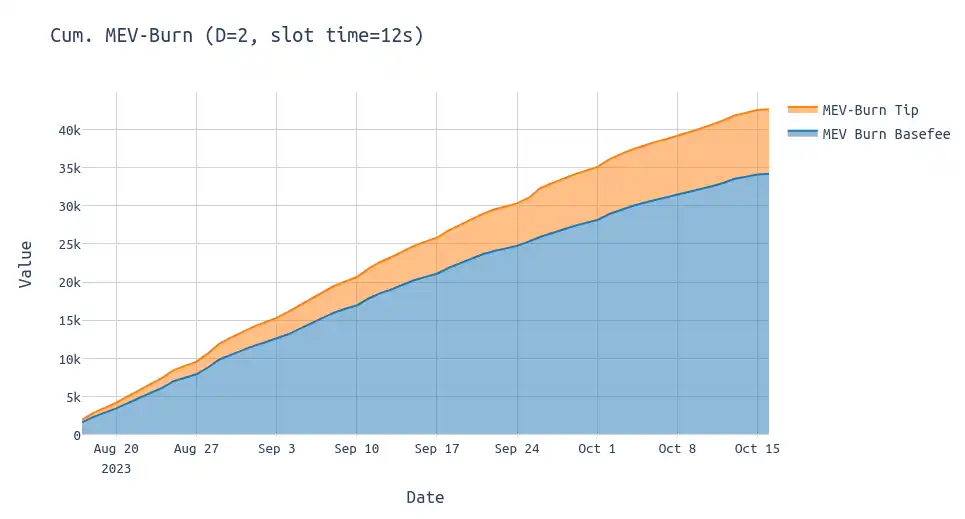
· Considering that the bidding dynamics remain unchanged, MEV-Burn will result in the destruction of approximately 90% of the profits flowing to validators; in the past two months, the amount of Ethereum destroyed has reached 35,000 ETH.
· The median MEV profit of each proposed block may decrease from approximately 0.05 ETH to approximately 0.002 ETH, a decrease of 96%.
· MEV-Burn may reduce the absolute inequality of MEV payments/profits, but it will increase relative inequality.
· Despite the rarity of MEV lotteries greater than 10 ETH (assuming no changes to time slot duration and Δ time d < 2), we still regularly see jackpots greater than 1 ETH.
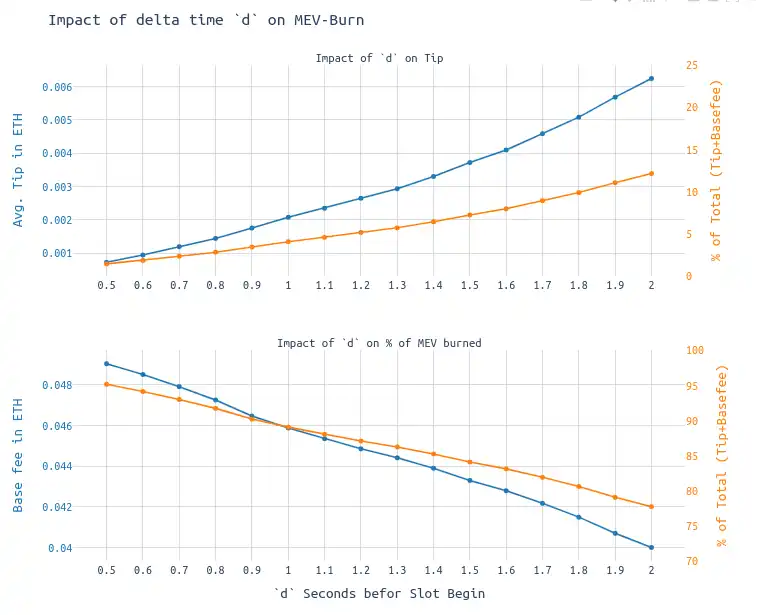
· The Δ time d between setting the basic payload fee and the end of the time slot may have a linear relationship. Higher d will result in relatively higher MEV Burn fees for validators.
MEV-Burn How Does It Work?
MEV-Burn has been proposed as an additional component of ePBSs, attempting to address negative externalities associated with MEV and PBS.
MEV-Burn aims to solve several problems. Firstly, validators are rewarded too much for completing secure tasks. Secondly, the unpredictability and sporadic nature of rewards generated by MEV and the associated economic dynamics.
MEV-Burn determines the basic load fee by setting a fixed deadline within a time slot. During a specific number of seconds in this time slot, the highest bid becomes the basic load fee and is then destroyed. The highest bid value observed before the deadline is destroyed, and the difference between the highest bid value at the end of the time slot and the destroyed portion is paid as a MEV-Burn tip to the validator.
Other validators observe and only confirm blocks that align with their local view of the minimum base fee. There is also a time interval d to ensure everyone has enough time to determine the highest bid before the deadline. With MEV-Burn, the evolution of time slots looks as follows:
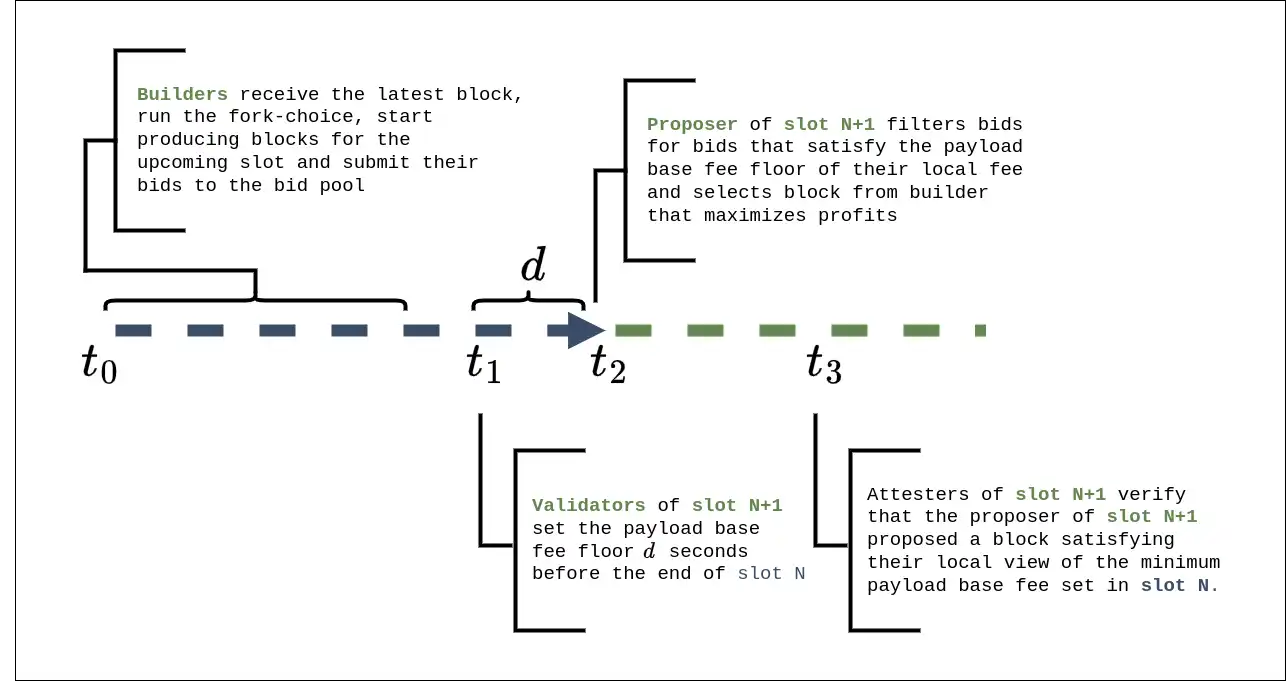
As usual, starting from the t0 second (i.e. the moment when the block builder observes the latest block), the block builder begins to construct at the recent head of the chain. In the t2 second of the time slot, the proposer selects the most valuable bid that brings them the maximum benefit.
The change introduced by MEV-Burn is that the highest bidding value observed in the t1 second of the time slot will be destroyed. This destruction is enforced by the protocol, so that a valid block must always destroy the amount of ETH recognized by the majority of validators in the current epoch.

Therefore, in the time slot, block builders will bid for the second t2. Then, at the second t2 moment perceived by the witness, the witness will check the highest bid up to the first t1 and remember that value. Next, the witness will only witness blocks that burn at least the minimum perceived payload base fee.
In a world that implements ePBS, block builders will submit their bids to a public bidding pool. The upcoming proposers and the witness committee of the upcoming time slot are particularly concerned with the basic payload fee determined d seconds before the end of the time slot. The witness of the upcoming time slot executes Burn by only witnessing blocks that burn at least the basic payload fee in its local view, and burns at least the lowest part it considers.
Either the block burns at least the amount recognized by most witnesses, or nothing burns because it did not enter the standard chain.
Visual Data Analysis
The following chart shows the amount of ETH that will be burned after implementing MEV-Burn (in blue), as well as the MEV-Burn fees (in orange) that will still be allocated to the proposer.
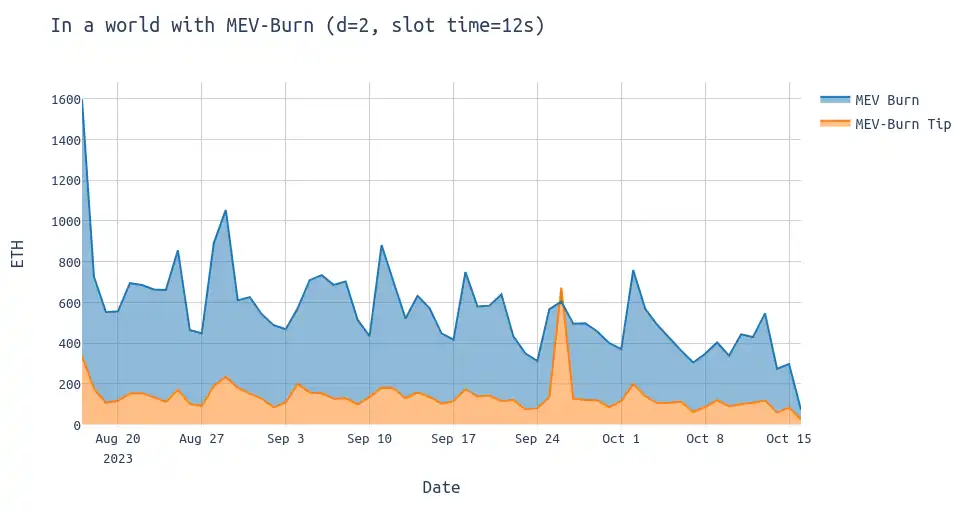
This chart shows that currently, about 10% of the MEV flowing to validators will continue to flow to validators. The remaining 90% will be destroyed, which will benefit all ETH holders.
Based on the cumulative data of the past two months, the situation is as follows:
MEV-Burn Impact
The following figure uses the Lorenz curve to visualize the difference between MEV-Boost payments and MEV-Burn tips. These curves are commonly used in economics to illustrate income inequality. Here, we can use them effectively to demonstrate the uneven distribution of MEV profits among validators.
In this initial step, I sorted MEV payments in ascending order and plotted the cumulative sum against the proportion of validators. The x-axis displays the cumulative percentage of validators, while the y-axis displays the cumulative share of MEV payments.
"Equality" line represents an ideal scenario where MEV payments are evenly distributed among validators - for example, 50% of validators receive 50% of MEV payments. The greater the deviation from the equality line, the higher the degree of payment inequality.
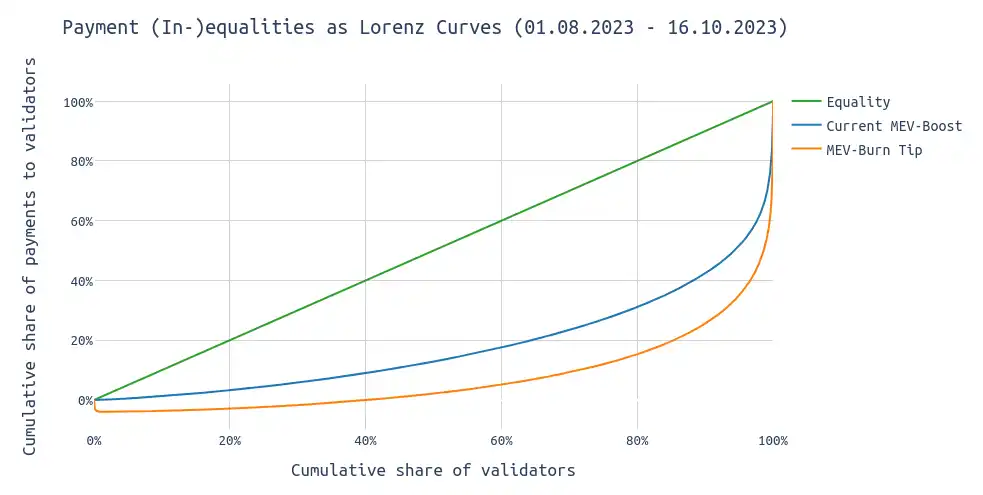
The above figure shows that there is a significant payment gap between block producers in both the existing MEV-Boost system and the MEV-Burn world. In fact, the introduction of MEV-Burn will increase the relative inequality of additional income for block producers. However, in absolute terms, through MEV-Burn, most of the total MEV payments will be destroyed in one time slot, thereby reducing inequality.
It is worth noting that as absolute payments decrease, their impact on the total validator rewards (CL reward + EL reward, where EL reward = MEV payment) is also decreasing. This is very desirable.
Lower absolute amounts are beneficial in reducing the incentive for DoS attacks against a block producer, in order to steal MEV profits from that block producer. Additionally, this may allow staking pool providers like Rocketpool to lower their minimum staking amount while also preventing "rug-pools".
The chart below shows the reward share obtained by validators for each task performed over time. The top chart shows the reward distribution under the current MEV-Boost setting, while the bottom chart shows what the reward distribution will look like in a world after MEV-Burn. Assuming an incremental time of 2 seconds (d).

Despite the reduced impact of MEV on regular rewards for validators, large-scale lotteries affected by events may still occur in the final d seconds after determining the basic fee for the load, as they do now.
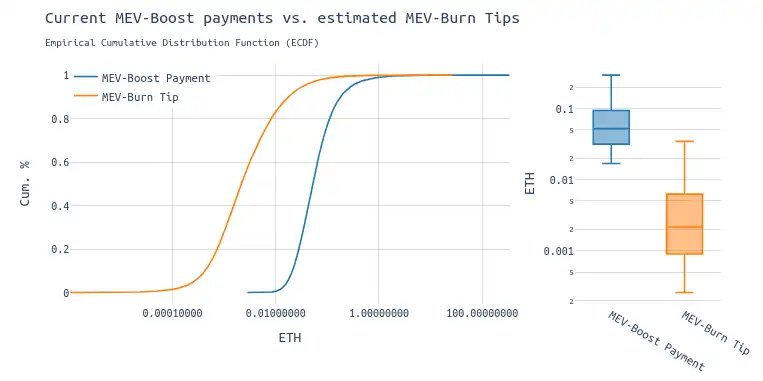
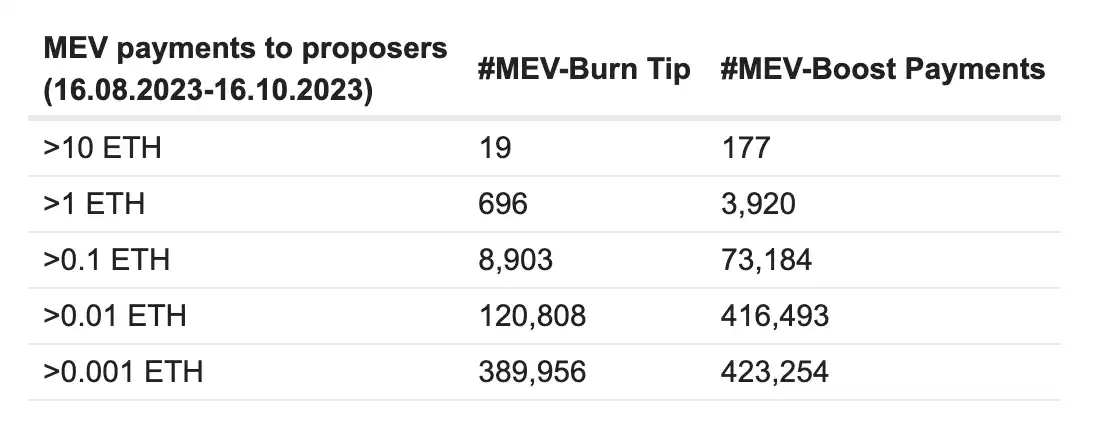
In my opinion, the reaction of the block builder is not 100% clear.
Large block builders do not submit to the public bidding pool, risking the chance of validators missing their bids. We see the same situation in MEV-Boost, where large block builders start bidding relatively late in the time slot, risking the chance of validators requesting blocks earlier and missing their opportunity compared to smaller block builders.
"Original article link"
Welcome to join the official BlockBeats community:
Telegram Subscription Group: https://t.me/theblockbeats
Telegram Discussion Group: https://t.me/BlockBeats_App
Official Twitter Account: https://twitter.com/BlockBeatsAsia