Volt Capital: ZK state channels are a better scaling option for on-chain MMO games.
Original author: @MohamedFFouda
Translated by: BlockBeats
Volt Capital partner @MohamedFFouda shared his views on the extension of on-chain games on social media platforms, pointing out that ZK state channels are a better option for scaling multiplayer games on the chain. BlockBeats has translated the original text as follows:
In previous discussions, I delved into the concept of application-level scaling, with a particular focus on full-chain games. Horizontal scaling is a very suitable solution for single-player games. However, for multiplayer games, zero-knowledge proof (zk) state channels have become a better scaling option. So, what exactly is a zero-knowledge state channel?
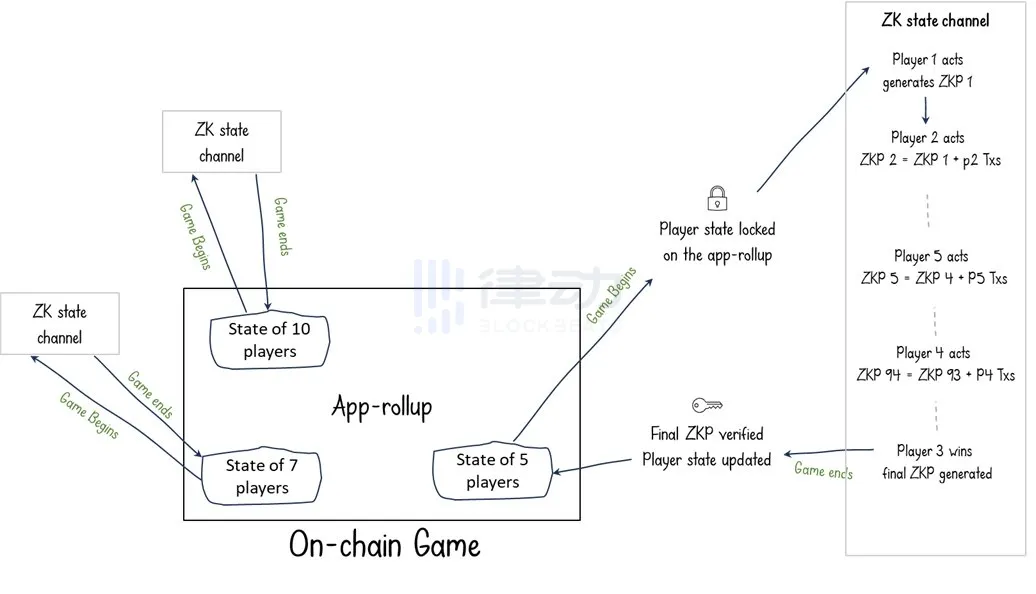
State channels are not a novel concept. In fact, they are one of the earliest scaling solutions for Ethereum. The essence of state channels can be divided into three parts: first, extract a portion of the on-chain state; second, continuously update this state off-chain; and finally, submit the final state back to the chain when necessary.
Obviously, this concept originated from the design extension of the Bitcoin Lightning Network, which is essentially a payment channel. However, without zero-knowledge proofs (ZKP), the advantages of state channels are not significant. Without ZKP, all signatures authorizing off-chain state changes must be verified on-chain, which does not significantly reduce costs compared to on-chain transactions.
Zero-knowledge proof provides convenience to solve this problem. Participants in state channels only need to generate an off-chain proof to prove that all their interactions and signatures are valid. This proof can be verified on-chain at low cost, thus achieving significant cost savings. So, what is the connection between this and scaling multiplayer on-chain games?
Many games, such as poker, are based on competition, which means that a group of players create and participate in game competitions, and based on the game results, each person's assets will change accordingly. In this case, zero-knowledge state channels can effectively extend multiplayer games, reduce the cost of on-chain verification, and ensure the security and fairness of the game.
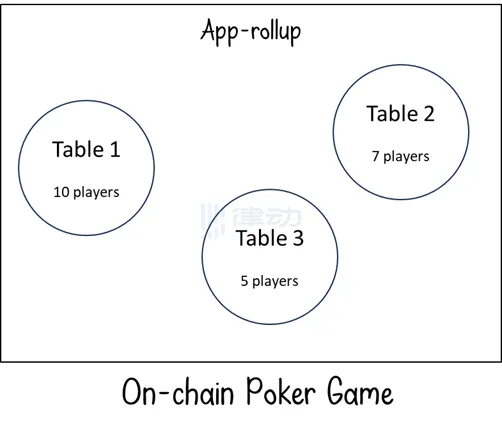
For this type of game, you need a shared layer to store all players' assets. In each game, the specific details that occur are not as important as the final result, which is the change in asset balance. Additionally, players cannot participate in multiple games simultaneously.
This makes these games ideal candidates for zero-knowledge state channels. Once the game starts, the state of participating players is locked on the rollup. During the game, players generate zero-knowledge proofs (ZKPs) to prove that their actions are valid. These ZKPs are recursively built on top of previous ZKPs, and so on.
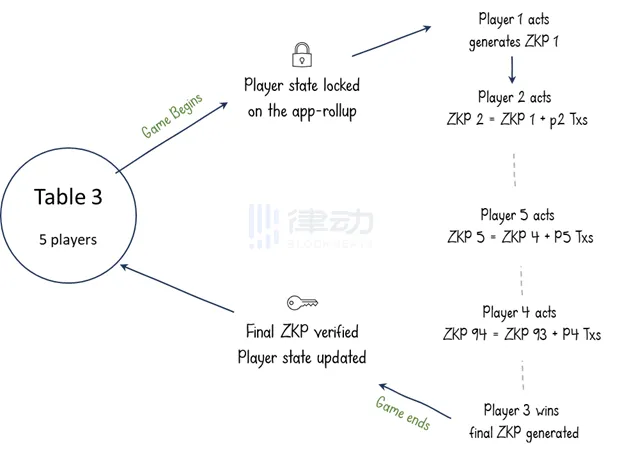
When the game ends, only the final zero-knowledge proof (ZKP) and related state changes will be submitted to the application rollup for settlement. This is because intermediate transactions (TX) are not processed on the rollup, achieving up to 100 times scalability. This approach is also applicable to non-turn-based games, such as "Among Us".
However, in this case, an entity is needed to act as a "temporary" sequencer to sort channel transactions and generate intermediate recursive zero-knowledge proofs (ZKPs). I refer to this situation as "temporary L3". The main challenge faced by the zero-knowledge state channel approach is the online requirement of channel participants. A player who exits may force the remaining players to continue the game on the application rollup, resulting in other players paying higher fees.
Despite this, this approach has tremendous potential, and many teams, including Ontropy, Paima Studios, and Cartridge, are working hard to achieve this goal.
Welcome to join the official BlockBeats community:
Telegram Subscription Group: https://t.me/theblockbeats
Telegram Discussion Group: https://t.me/BlockBeats_App
Official Twitter Account: https://twitter.com/BlockBeatsAsia