Underwhelming performance of Ethereum futures ETF, with on-chain data at a low level.
Original Title: "Ethereum Futures ETF Falls Short of Expectations, ETH On-Chain Data at Low Levels"
Source: Ebunker Chinese
Under the bear market background, institutional interest in Ethereum is limited
Against the backdrop of the bear market in the cryptocurrency industry, six different Ethereum futures financial instruments officially began trading on October 2, but they have not reignited institutional investors' enthusiasm for ETH. The total trading volume on the first day of ETH futures ETF was less than $1.5 million, compared to the first day trading volume of over $1 billion for the first BTC futures ETF (BITO) in 2021, according to Bloomberg data. In other words, the net inflow of funds on the first day of ETH futures ETF was less than 2% of BITO.
Coinbase Research's Duong, the head of the team, believes that there are several main reasons for the above differences:
Firstly, the market timing for the launch of ETFs is different. Proshares' BTC futures ETF was launched during the 2021 crypto bull market cycle, with ample market liquidity and funds available. On the other hand, the ETH futures ETF was launched during the current bear market cycle, with severe fund shortages.
Secondly, the familiarity of investment advisors varies. Investment advisors are usually more familiar with BTC, which is easier to integrate into their clients' investment portfolios. ETH is generally considered a more complex investment product and has not yet been well understood and accepted in the traditional investment community.
Third, the change in legal expectations. In a recent court ruling in Risely vs Uniswap, Judge Katherine Polk Failla classified ETH as a cryptocurrency commodity. This may have raised market expectations for ETH spot ETFs, while causing a less enthusiastic market reaction for ETH futures ETFs.
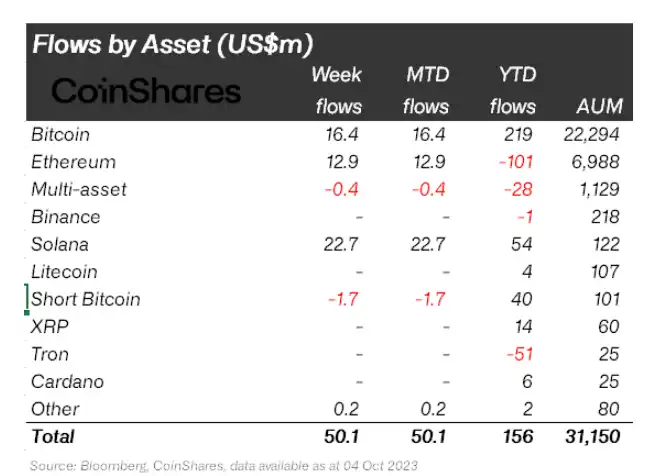
From the perspective of capital flow, the crypto bear market continues to have a huge impact on institutional capital. According to Coinshares' statistics, there were net outflows of funds in 24 out of 39 weeks since 2022, accounting for 61.5% of the entire period. Changes in institutional interest in crypto assets can also be seen from the data on capital flows: as of October 4th, the net outflow of funds for ETH this year reached $101 million, while BTC had a net inflow of $219 million during the same period. However, the recent weekly net inflows of BTC and ETH are similar, at $16.4 million and $12.9 million, respectively.
Overall, although the ETH futures ETF has cooled down, its trading volume is still at a normal level for new ETFs, which has a positive effect on institutional investment interest. However, due to the bear market background and other reasons, it needs the overall warming of the cryptocurrency market to attract more institutional funds.
Ethereum Staking Potential Risks
On October 5th, JP Morgan released a research report pointing out the centralization problem of Ethereum's network. The report also mentioned that the ETH staking yield has decreased from 7.3% before the Shanghai upgrade to 5.5%. Compared with the still rising yield of traditional financial markets, the attractiveness of ETH as an investment target has declined.
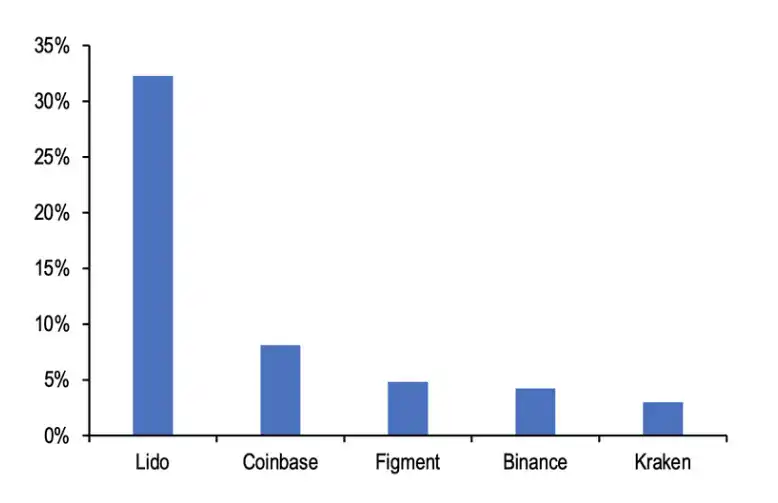
The report points out that the top five liquidity providers for collateralized assets, Lido, Lido, Coinbase, Figment, Binance, and Kraken, control 50% of the ETH collateralized assets, with Lido accounting for almost one-third of the total ETH collateralized assets.
Lido, a liquidity collateral platform, is considered by the cryptocurrency community as a better alternative to centralized exchange collateral platforms. Currently, in order to mitigate centralization risks, Lido has been expanding its list of node operators to prevent any single entity from controlling the majority of ETH collateral.
In addition, in order to combat the centralization risk of the Ethereum blockchain, the Ethereum community has begun to promote distributed validator technology (DVT), such as SSV and Obol. DVT allows multiple node operators to run a validator. This is done to reduce the risks associated with validators without affecting the blockchain.
JP Morgan raised another concern about the practice of re-pledging liquidity collateral assets. This involves the issue of reusing liquidity tokens as collateral in various DeFi protocols. If the value of the collateral assets suddenly plummets or is damaged due to malicious attacks or protocol vulnerabilities, this practice may trigger a chain reaction of liquidation.
Ethereum gas fees hit bottom
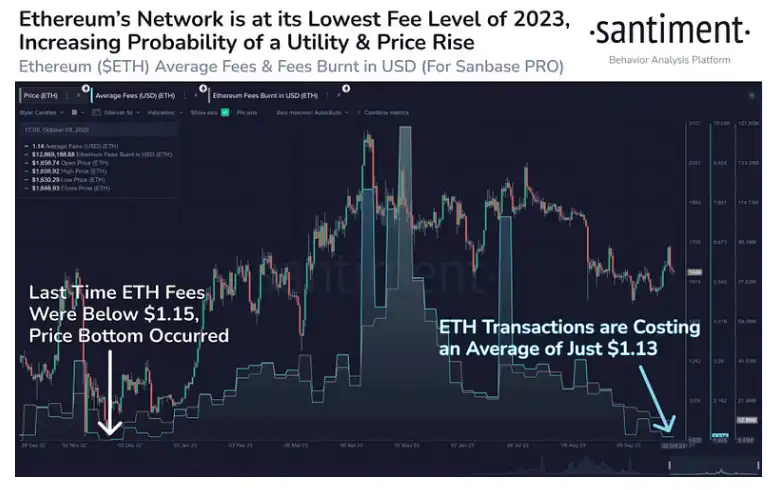
According to the on-chain analysis platform Santiment, Ethereum gas fees have dropped to the lowest level in nearly a year. The average cost of Ethereum transactions on the chain in the past week was only $1.13, a significant decrease compared to early May. It is worth noting that the last time gas fees were below $1.15, the price of ETH was at the bottom position.
L2 is paving the way for Ethereum expansion
The significant decrease in Ethereum gas fees is related to the adoption of L2 scaling solutions. Due to the cost and efficiency advantages, a large number of users have flocked to L2, causing a significant increase in L2's block space requirements.
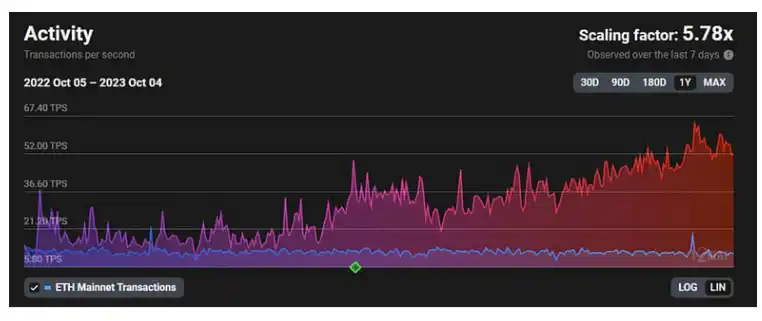
According to data from L2Beat, transaction activity for L2 scaling solutions has seen a significant increase in 2023. Based on data from the past week, L2's TPS has reached 5.78 times that of the Ethereum blockchain.
Essentially, L2 is fulfilling its original purpose, even as it helps to alleviate the transaction burden on the Ethereum main chain and assist in its scalability. Santiment believes that lower gas fees can promote the use of the Ethereum network, attracting more decentralized applications and smart contracts. In the long run, as the Ethereum network becomes more widely adopted, the price of ETH will also increase.
Recently, Grayscale Research also pointed out that L2 is paving the way for Ethereum expansion. In terms of functionality, L2 can enhance Ethereum's scalability and reduce network costs for users by 100 times. In August of this year, Coinbase launched BASE (Ethereum's L2 blockchain), which also marks a strong recognition of the Ethereum ecosystem and opens up its decentralized applications to 100 million Coinbase users.
Coinbase is trying to pave the way for mass adoption of DAPPs on its own Ethereum L2 BASE. If some alternative L1s are not attractive due to low security budgets and lack of liquidity, integrating into Ethereum L2 may become a more attractive option.
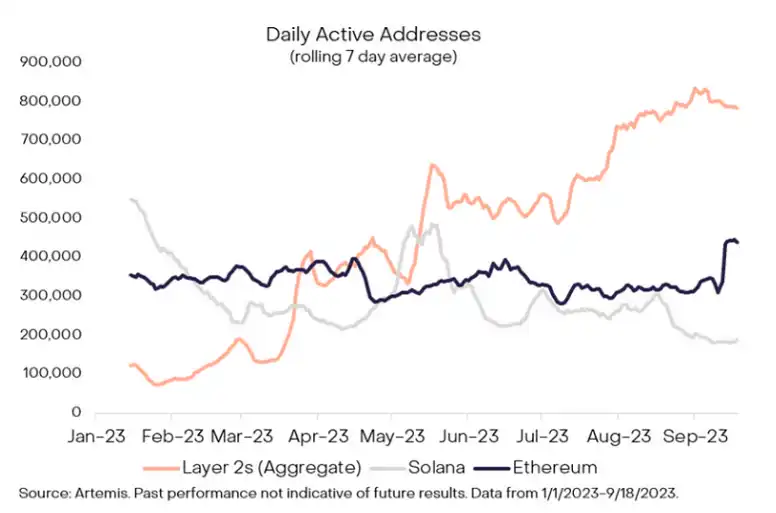
The usage of Ethereum L2 scaling solutions has been increasing over the past year, with the total daily active addresses on L2 surpassing those on the leading L1.
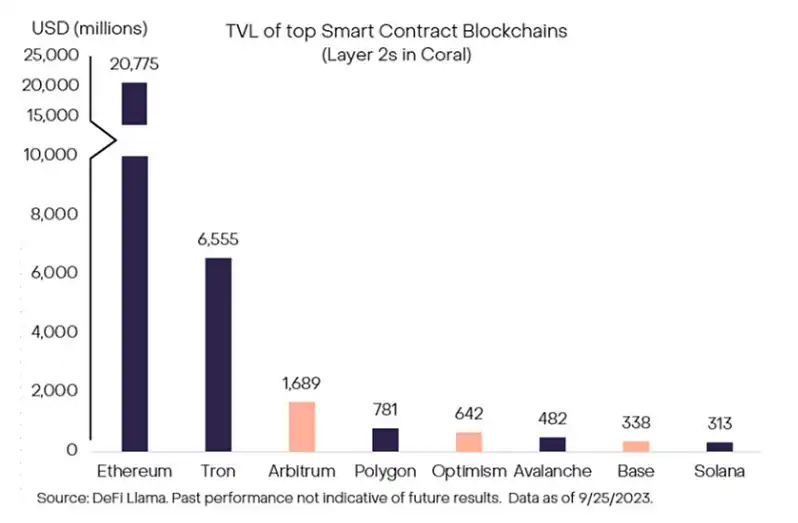
In addition to active addresses, Total Value Locked (TVL) is also important as it reflects the level of trust users place in a specific blockchain. The TVL of the best-performing L2s (including Arbitrum and Optimism) exceeds that of Ethereum's competitors on L1 (Solana and Avalanche), indicating the market's overall trust in the Ethereum ecosystem and the attractiveness of scaling solutions.
With the expansion of the network scale, more activities will be transferred to cheaper L2. In return, L2 directly accumulates the value back to Ethereum. Specifically, for each transaction on L2, users need to pay transaction fees. L2 retains a portion of the fees (currently with an average profit margin of about 1/4), while Ethereum network validators capture the remaining approximately 3/4.
For each transaction sent on L2, the Ethereum network also burns a small portion of the total supply of ETH. Therefore, the incremental activity on Ethereum L2 directly accumulates value for ETH. If Ethereum's L2 continues to maintain a positive development trajectory, they will consolidate Ethereum's position as a leading L1 blockchain.
Centralized platform's ETH balance hits new low in 5 years
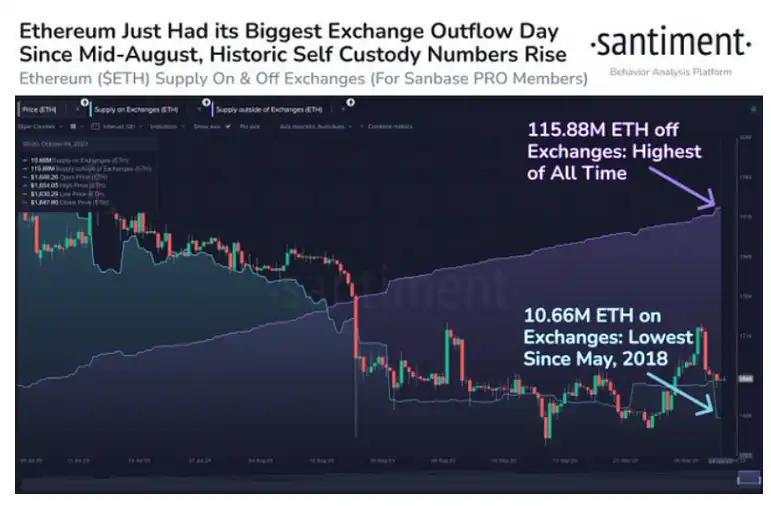
According to Santiment's data on October 5th, the amount of ETH in cryptocurrency trading platforms has dropped to 10.66 million, the lowest since May 2018. In contrast, there are 115.88 million ETH stored outside centralized trading platforms, which is the highest in history.
On October 4th, about 110,000 ETH (worth over $180 million) were withdrawn from centralized trading platforms, marking the largest single-day ETH outflow since August 21st. These phenomena are usually seen as a long-term bullish outlook on the valuation of ETH assets in the market, demonstrating investors' long-term confidence.
Original Link
Welcome to join the official BlockBeats community:
Telegram Subscription Group: https://t.me/theblockbeats
Telegram Discussion Group: https://t.me/BlockBeats_App
Official Twitter Account: https://twitter.com/BlockBeatsAsia
 Related Articles