MetaMask's growth flywheel is failing, and pan-user applications have become the new "entry"
The original title: "MetaMask's growth flywheel is failing, and pan-user applications are the new "entry" center."
The original author: Pengyu, Co-founder of Particle Network
The original source: DeepTechFlow
MetaMask is the most well-known wallet product in the industry, and its influence has surpassed the wallet field, giving people an almost unshakable impression. The core reason is that it takes advantage of the first-mover advantage in the developer community and jointly builds a growth flywheel with the dApp ecosystem. This article will analyze the launch and operation of MetaMask's growth flywheel, and why it may be failing.
A Brief Review of MetaMask's Development History
Let's briefly review the development history of MetaMask:
MetaMask was co-created by Kumavis (also known as Aaron Davis) and several other core members. Its purpose is to simplify user interaction with dApps through a browser extension plugin. Prior to 2016, interacting with Ethereum-based dApps typically required running a full Ethereum node, which was quite complex for many users.
Contrary to what many may think, MetaMask was initially positioned as a developer tool, with the aim of providing developers with a user-friendly and easy-to-use interface for user access.
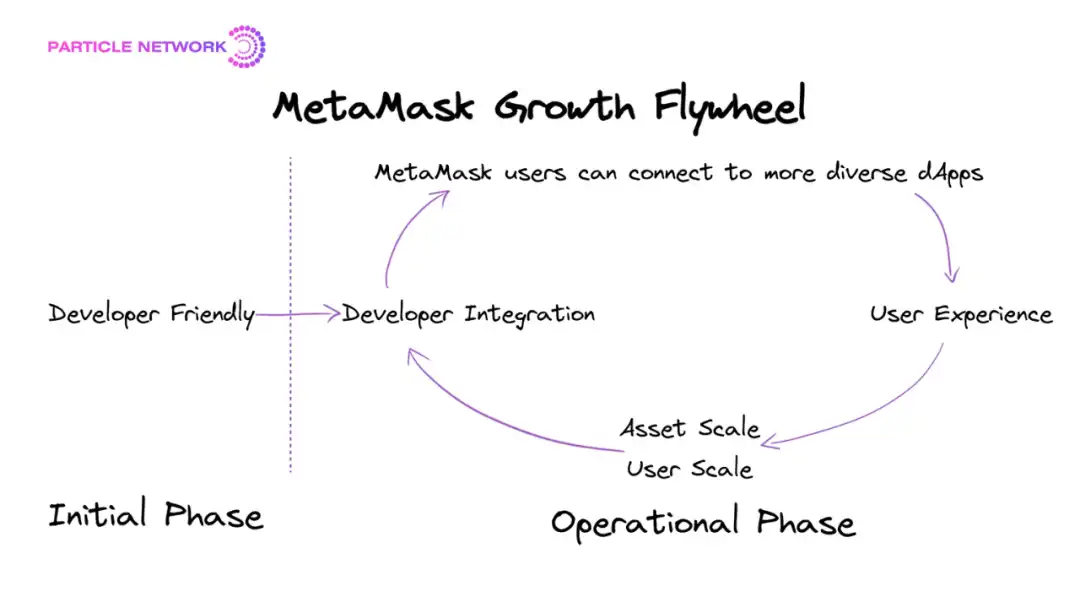
Figure 1 - MetaMask's growth flywheel
From the development history, we can summarize the starting and running states of MetaMask's growth flywheel
With the rapid rise of DeFi and NFT in the industry, more and more dApps are choosing MetaMask as their preferred solution for connecting to on-chain businesses, thanks to MetaMask's asset and user scale advantages. This further enhances MetaMask's asset and user scale.
Summarizing the development history of MetaMask, we can clearly see the starting, launching, and operating stages of its growth cycle.
The starting stage of FeiLun: focusing on developer-friendly features and becoming the default user access tool for early dApps.
The start-up phase of the flywheel: leading in user and asset scale.
The operation stages of the flywheel: the "wealth effect" in the industry - incremental users enter the on-chain products (mainly DeFi products, mainly through web interaction) - default connection using MetaMask - increase the user and asset scale of MetaMask - transform from a single user access tool to a complete user ecosystem - thereby attracting more developers to use MetaMask.
Why does it fail?
I believe that the growth engine of MetaMask is failing for several reasons:
1. Not becoming an "entry point" has made the growth flywheel operate more steadily.
Throughout the entire traffic path, MetaMask is not the core driving force for incremental user entry, but rather one of the receiving areas for new users entering Web3 under the drive of wealth effect. In terms of traffic interaction, MetaMask is manifested as unidirectional absorption without distribution and feedback. Another characteristic is that the proportion of users who use MetaMask as a starting point for active demand other than transfer is very small.
I believe that the entrance should be the starting point for active demand aggregation and distribution, not just a traffic hub. For example, Google is an entrance, but Lu.ma, the activity management platform frequently used by Web3 professionals, is not an entrance. In fact, MetaMask hopes that Snaps can undertake the task of traffic aggregation and distribution.
2. On-chain core business scenarios are migrating: Non-DeFi category of user-oriented application layer projects are rapidly emerging.
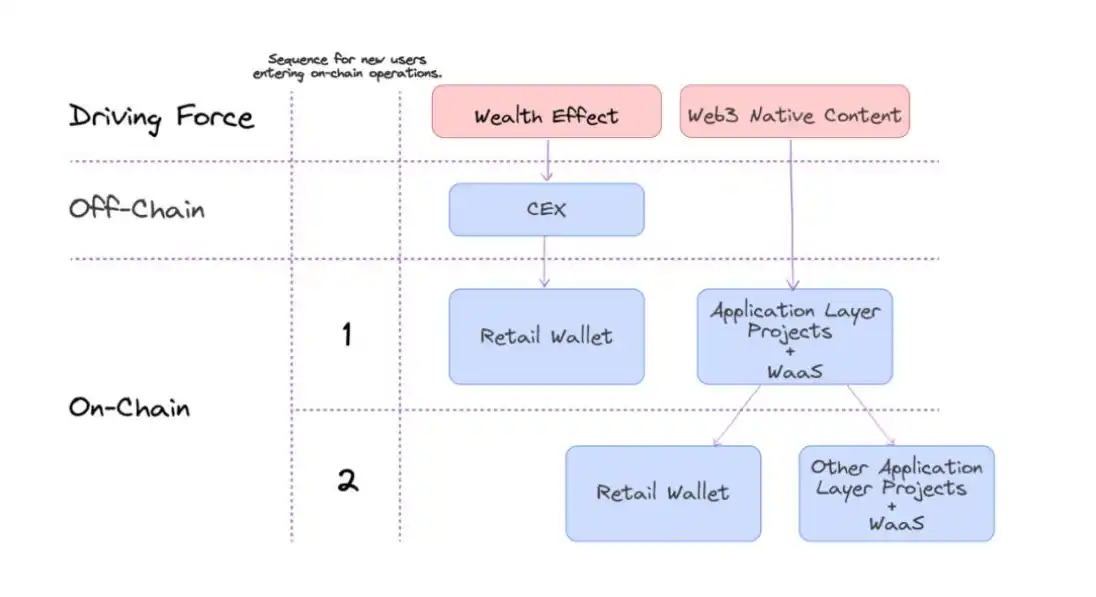
The migration of core business scenarios will change the underlying driving force of incremental users in the industry. In the past, almost all the underlying driving force of new on-chain users came from the wealth effect of head assets such as Bitcoin and Ethereum. However, with the rise of application projects, this driving force will shift to the dual drive of head asset wealth effect and Web3 native content. Therefore, the entry path for incremental users has undergone significant changes.
In the business scenarios of generalized user application layer projects, the characteristics of user interaction with the blockchain are: cross-platform, low value, high frequency, different from the web-based interaction of Defi products, which are high value and medium to low frequency. The standard configuration for generalized user application layer projects will prioritize mobile devices and adopt a cross-platform product matrix.
When using MetaMask as a tool for users to access business scenarios on mobile devices, it will bring a significant experience segmentation. Specifically, in terms of product data, the registration conversion rate of new users is very low, and the completion rate of calling MetaMask for signature in mobile business scenarios is also very low. In this case, the damage caused to the end user experience of developers will be significantly amplified, and the asset scale and user scale advantages of MetaMask are no longer able to make up for it.
3. In the wandering of the account abstraction domain.
Some business scenarios of certain application layer projects have entered a more complex stage of intelligent interaction by utilizing the ability of account abstraction. However, MetaMask has not strengthened its interaction with the business scenarios of these application layer projects, but only plays the role of a Signer.
The essence of account abstraction is to generalize account types, with the ultimate goal of eliminating EOA accounts. However, as a leader in the EOA account system, MetaMask faces certain conflicts with the ultimate goal of account abstraction, resulting in a less aggressive business layout in the field of account abstraction.
4. Iterative thinking and the mismatch of product essence: As a Web3 chain product with the largest number of C-end users, the product's thinking is oriented towards developer priority.
MetaMask's overall approach is developer-first, which was a good strategy in the early days of the industry because basically all users were developers, and developers were all users.
There is no problem during the DeFi boom, but as user-friendly applications rapidly emerge in the industry, the cryptocurrency industry is transitioning from a crypto-punk friendly industry to a mass consumer industry. Prioritizing developers may lead to a disconnect with end-users.

Figure 2 - Migration of on-chain core business scenarios
Two core reasons for the failure of the growth flywheel and what changes may occur in the "entrance" pattern?
1. MetaMask has not yet become an entry point and has lost the flywheel effect of enhancing asset and user scale between dApps on mobile.
1. A mobile-first retail wallet that has unique insights into and can meet the native needs of end users in mobile scenarios.
The most lasting impact of the migration of on-chain core business scenarios on the "entry" pattern is not only the failure of MetaMask's growth flywheel, but more importantly, the main driving force for attracting new users on the chain has undergone a transformation.
Before the rise of application layer projects, the main driving force for new users on the chain was the wealth effect of top assets. However, with the rise of application-based projects, this driving force has shifted to a dual drive of the wealth effect of top assets and Web3 native content.
Therefore, in order to have a clearer understanding of the possible changes in the "entry" pattern, we should pay more attention to how general user application layer projects will handle the interaction between new users and the chain. This includes: public key generation, private key management, initiating signatures, completing signatures, and providing feedback after signatures.
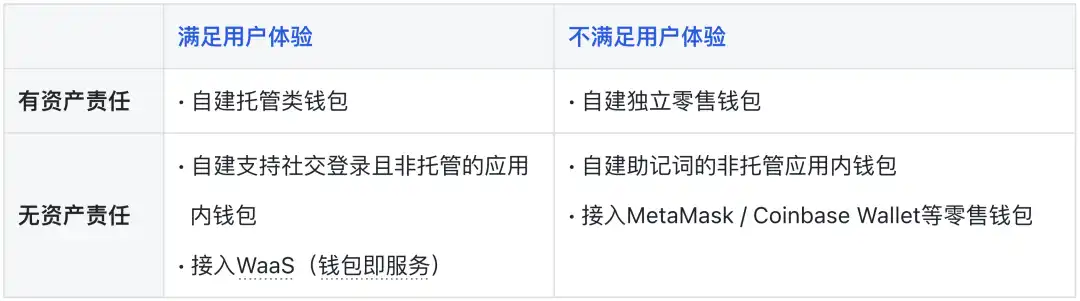
There are three options for handling new user and link interaction in general user application layer projects:
1. Connect to high market share retail wallets such as MetaMask / Coinbase Wallet.
2. Self-built wallet.
3. Integrate with WaaS (Wallet as a Service).
1. Self-hosted applications with built-in wallets.
3. Self-built social login, non-managed application built-in wallet.
4. Build an independent retail wallet.
First solution: Integrate with high market share retail wallets such as MetaMask / Coinbase Wallet.
Building an independent retail wallet is a relatively poor choice because compared to high market share retail wallets such as MetaMask/Coinbase Wallet, it not only fails to solve the experience fragmentation problem, but also increases the responsibility of user assets.
The advantage of building a self-created mnemonic wallet is that it eliminates the need to download an additional mobile application. However, the issue of low conversion rates for new user registrations due to the difficulty of understanding and memorizing the mnemonic phrase remains unsolved. Generally speaking, for general users (those without much experience using Web3 products and services), the process of understanding and memorizing the mnemonic phrase can cause over 60% of users to drop off.
Building and hosting an embedded wallet within the application is a relatively feasible short-term solution that can solve user experience issues. However, the drawback is that independent user on-chain behavior cannot be tracked, and as the business grows, the asset responsibility of the application layer project continues to increase.
Building a non-custodial application with built-in wallet that supports social login is relatively the best solution. However, for the majority of project parties, considering the cost of building and maintaining it themselves, this solution is not cost-effective.
Third solution: Connect to WaaS (Wallet as a Service).
The essential services provided by wallet-as-a-service products have two aspects: first, providing social login solutions for dApps it serves to significantly increase the registration conversion rate of new users; second, generating a built-in full-featured wallet within the corresponding dApp, allowing on-chain signatures related to business to be completed within the dApp without the need to jump out.
There are essential differences between the SDK for retail wallets: firstly, the entry process must be non-mnemonic, otherwise it conflicts with the demand for new user registration conversion through social login; secondly, there is no independent wallet product as a necessary condition for signature generation. In addition, wallet-as-a-service products also differ from retail wallets in terms of business models and product iteration paths.
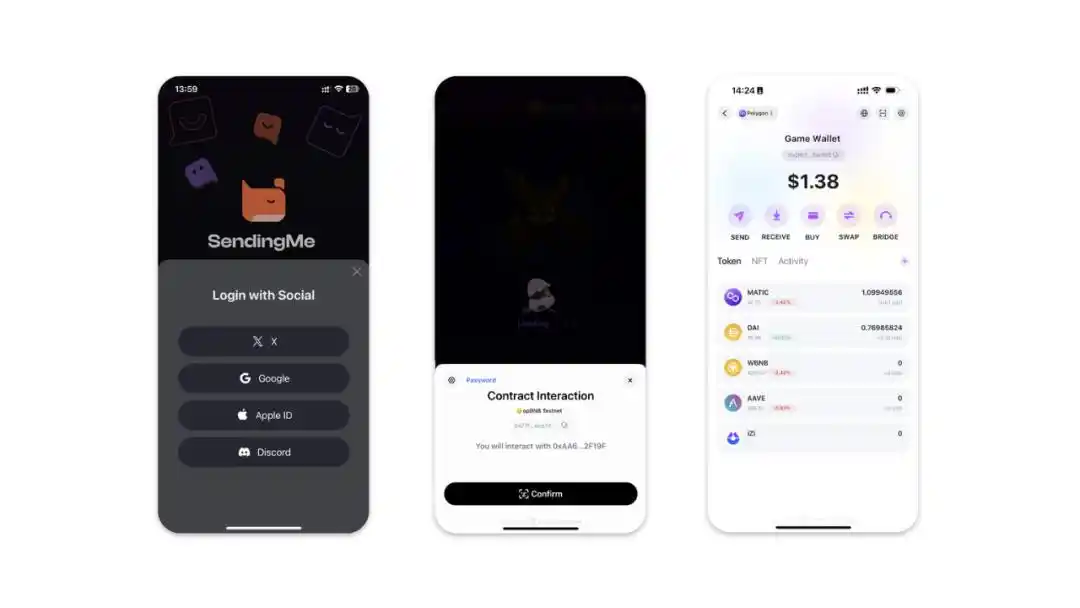
Figure 3 - Wallet as a Service product (enter - in-app signature - full on-chain operation)
This approach can solve the issues of asset liability and user experience, but the risk lies in the dependence on the operational capabilities of wallet-as-a-service companies to some extent. However, I believe that the core risk is not in the business itself, but in making the right choices among partners.
Who is the new "entry point"?
Under this development trend, have general user application layer projects become a new entry point?
Under this trend, the pan-user application layer project has actually replaced the role of MetaMask in receiving traffic, and the advantage over MetaMask is that it is also one of the underlying driving forces for incremental users to enter the industry.
However, even a single application layer project that has the ability to drive incremental users into the industry will not directly become an entry point, because there are two problems that need to be solved:
In this flow path diagram under the dual driving force, it can be seen that the head effect determines the scale of the general user application layer project, while the redistribution capability determines whether it can form a positive two-way interaction with traffic based on the receiving end.
The judgment of the top effect is a seemingly path-dependent but highly uncertain matter, and only one type of product is widely recognized: Web2 super applications that continue to invest in Web3 business and have clear goals. For example, Telegram. Is the Web3 native top-level application product with incremental user driving ability happening in the centralized exchange's further evolution or in Web3 social communication protocols or game platforms?
Redistribution ability is one of the essential characteristics of the "entrance". However, in the Web3 industry, I believe that the meaning of redistribution ability is broader, not only the distribution of traffic, but also the distribution of capabilities and consensus. The distribution of traffic is very intuitive, which means actively guiding the attention of a large number of end users to upstream and downstream products. The distribution of capabilities includes on-chain asset operation capabilities and user community operation capabilities. The distribution of narrative and consensus is essentially the distribution to head users.
The head effect and redistribution ability determine whether a sustainable "entrance" can be formed.
Additionally, we cannot ignore two roles:
Welcome to join the official BlockBeats community:
Telegram Subscription Group: https://t.me/theblockbeats
Telegram Discussion Group: https://t.me/BlockBeats_App
Official Twitter Account: https://twitter.com/BlockBeatsAsia

 Related Articles