Centralization concerns in staking: being prepared or groundless worries.
Original author: Luke Nolan, researcher at CoinShares
Translation: BitpushNews
There has been a lot of discussion about the potential impact of Ethereum staking and different staking levels (as a percentage of total ETH supply) on the future of the entire network.
Currently, validators are staking approximately 22% (27 million ETH) of the current ETH supply, and the queue time for joining is around 10 days (based on the peak of approximately 45 days in June 2023). Although the queue length data in the timestamp below does not go back far enough to show this clearly, it should be noted that in the days leading up to the Shanghai upgrade (which enabled staking withdrawals), the number of withdrawals briefly exceeded the number of entries into the queue (17 days vs 8 days) (April 2023).
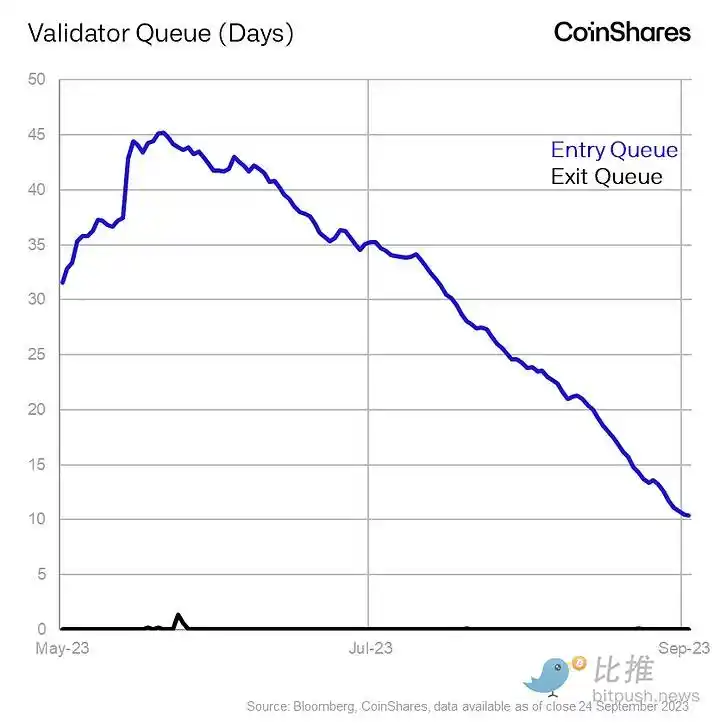
Users who want to stake ETH have multiple options, which can be categorized into two main types: they can stake ETH on their own (at the cost of reserving 32 ETH), or rely on liquidity staking providers, which allow staking with less capital and usually have no minimum ETH requirement.
Among all the staking providers, Lido currently has the largest market share (about 32%), followed by Coinbase, which accounts for about 8%.

Centralized Risks and Their Significance for Security
Although the queue is already full (although it is rapidly decreasing), the amount of ETH pledged has been continuously increasing, and Lido has not shown any signs of slowing down its dominant position over other providers. Some industry insiders have pointed out that Lido is about to control 1/3 of the pledged ETH, which sounds the alarm for centralization risks.
First of all, for a decentralized blockchain, having such a large number of validators under a platform leader is not a good sign, because ideally, block production should be done in a decentralized way. In addition, if Lido is subject to governance attacks and malicious actors control Lido validator nodes, the necessary amount of ETH staked will exceed 33% of the total staked supply to prevent chain finalizing delays. Through malice or lack of proof, attackers may cause serious problems for the entire network, such as double finalizing. After being selected as a block producer, attackers may generate two or more conflicting proposals, vote twice with more than 33% control, and cause the chain to fork into two independent blockchains, which would have serious consequences.
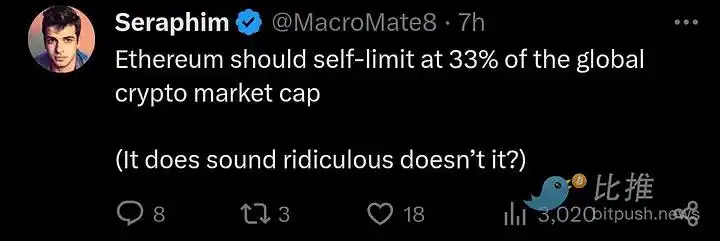
The risk of Lido being attacked is relatively low (as the operator nodes are distributed among about 30 companies), but it should not be taken lightly. The Ethereum community has had many discussions and believes that some measures should be taken to avoid the possibility of any governance/other attacks, but Lido has not yet formulated any official plans. Some members of the community have even expressed opposition, and they do not seem to believe that this is a real threat. Lido DeFi expansion manager Seraphim has made the following statement:
Another risk of decentralization in Ethereum is the "cartelization" of Lido, a term widely used in discussion forums to describe activities that could further consolidate its monopoly position. By reaching the critical consensus threshold (such as the 33% mentioned above), Lido node operators can theoretically participate in block timing manipulation and coordinated MEV extraction, resulting in huge rewards (relative to other providers) and forming a monopolistic dominant position in reward distribution. This means that Lido has a clear competitive advantage and users have little incentive to stake elsewhere.
Lido's dominant market position partly comes from its first-mover advantage (deep liquidity and long-term proven stability) and attractive annual interest rates compared to other liquidity providers. It is reasonable to expect competition for market share to emerge as the segment matures and more competitors scale up. So far, there is little data to support this assumption as new validators continue to flock to Lido.
Future Scenarios for Coping with Liquidity Pledges
The next area to be discussed is the overall growth of validator numbers and the potential impact this may have on the performance and underlying characteristics of the network. Approximately two weeks ago, Ethereum core developer Dankrad Feist published a blog post outlining his concerns about the future of staking liquidity.
As previously mentioned, although the validator queue is rapidly decreasing and is expected to reach 0 in the coming weeks/months, the demand for staking is once again rising and there is a non-zero possibility that the queue may remain full in the foreseeable future. Dankrard stated that if the queue remains full, this would mean that "by May 2024, 50% of all ETH will be staked, and by December 2024, 100% will be staked."
From a technical perspective, the increase in the number of validators leads to increasing pressure on the peer-to-peer network, as the processing speed between nodes increases proportionally with the number of active validators. If we reach a level of 2 million active validators, node operators may find themselves needing to upgrade their hardware. Generally speaking, upgrading hardware is not the correct direction for Ethereum to become a highly scalable network.
If the pledge queue is still full and we reach a higher level of pledged ETH, there may be a further problem, namely the "untested economic regime" mentioned by Dankrad - the market value of pledged ETH becomes greater than the market value of unpledged ETH.
Similarly, the probability of this situation occurring is very small but non-zero, so solutions to avoid this situation should be explored. It is important to remember that there is an inverse decay relationship between the percentage of ETH staked and the percentage of annual interest received by validators.
It is expected that as the number of validators increases, validators will begin to withdraw because the opportunity cost of tying up capital for a yield of less than 2% is not worth it. One risk of doing so is that entering and exiting liquidity providers is easy - only individual stakers can truly tie up significant amounts of capital. This is especially advantageous for providers like Lido, where economies of scale may make hardware costs irrelevant as yields decrease.

The benchmark federal funds rate in the United States is at a multi-year high, increasing the opportunity cost of funds tied up in ETH staking. However, given that people can still choose to buy US Treasury bonds with yields of around 4.0-5.5%, it seems that we are reaching some form of balance related to staking demand (as evidenced by the rapid decrease in the queue). The risk profiles of typical ETH stakers and typical Treasury bond investors differ, but if US bond yields decline (as indicated in the chart, possibly at some point next year), staking demand is sure to rebound.
Solution (Short-term)
The long-term solution is still unclear - just like the liquidity pledge dynamics were not fully understood when introducing the pledge, any solution included in a hard fork must consider what dynamics it may change in the future.
However, short-term solutions are currently being developed.
Dapplion has proposed EIP-7514, which modifies the validator churn limit from an unlimited increase in quantity to a hard cap (16, 12, 8, 6, or 4). In short, this reduces the number of new validators that can be added per epoch (6.4 minutes), greatly increasing the time required to reach milestones such as staking 50%, 75%, or 100% of ETH. This assumes a scenario where the activation queue remains full and staking demand is not affected by the aforementioned "self-balancing" decay relationship.
As shown above, changing the leakage limit to a hard upper limit will significantly slow down the growth of active validators. If the situation remains unchanged, with the increase of the active validator set, the expected leakage limit will continue to rise, which will accelerate our pace of reaching a higher level of ETH mortgage (as a percentage of the total).
This solution does not address any fundamental issues we have discussed, but it provides enough time for the Ethereum developer community to propose a real solution to the staking dynamic problem. Dankrad and other members of the Ethereum community have proposed some potential long-term solutions, such as:
MEV DestructionIncrease the maximum effective balance of validators.
Reduce the attractiveness of staking rewards (by reducing issuance rewards).
Reduce the entry barrier for liquidity providers of collateral (to incentivize decentralization).
The above plan will fundamentally change one or more dynamics of the entire network and may trigger significant second-order effects, therefore careful planning and consideration are required.
Overall, it seems unlikely that the queue will be permanently full, and we will reach a higher level of stake, around 40-45% of the total supply, than other PoS blockchains. If this level is reached, there should be no potential negative effects, except for scalability (the ability of the network to handle increased messaging and adapt to this situation). In the future, we will need to explore proposed long-term solutions and upgrades to Ethereum that will fundamentally affect the network's operation.
Original article link
Welcome to join the official BlockBeats community:
Telegram Subscription Group: https://t.me/theblockbeats
Telegram Discussion Group: https://t.me/BlockBeats_App
Official Twitter Account: https://twitter.com/BlockBeatsAsia
 Related Articles