Analyze the impact of Ethereum repledge protocol on the current pledge system
原文标题:《 Endgame Perils of Restaking 》
Original writer: Tripoli
czgsws
TL; DR
Repledge protocols may bring substantial benefits to validators, but their success risks compromising Ethereum's ability to self-regulate pledge engagement and moderate centralizing forces. We believe that the logical ultimate goal is to limit the population of validators to a certain size.
The long-term challenge for Ethereum is to get fewer people to pledge
The consensus among the less knowledgeable is that in the final stages of Ethereum, the scale of pledge participation will be closer to that of chains such as Solana and Cardano, both of which have around 70% of their Token supply pledged and inactive. However, there is a deep consensus among the Ethereum developer community that this is not a good outcome.
In one sense, the bitcoin minimalists are right about Ethereum's monetary policy, which is not set in stone and could change in the future. However, they are going in the wrong direction, Ethereum is not going to overinflate, mortgage demand is likely to be much higher than expected, and the corresponding reward returns will be somewhat lower.
Readers who believe in compliance may see more pledged participants as a positive for Ethereum, but remember that proof of equity runs counter to monetary policy. Higher issuance (and therefore higher pledge yields) does not reduce the likelihood that the holder will Hold; Instead, it encourages holders to pledge their assets and achieve higher annualised returns.
For example, people claim that IP-1559 is a very sound monetary scheme, but 1559 actually reduces the pledge APR and encourages network activity rather than pledge/hold.
EigenLayer and other repledge protocols provide non-Ethereum gains, distort market incentives, and undermine Ethereum's monetary policy controls. The agreements paint a worrying picture of a potential hyper-financialization endgame for crypto assets.
Monopolistic dynamics
Ethereum's monetary policy includes a built-in negative feedback loop to prevent over-pledging: as more people lock their ETH into contracts, yields lower. This reduces additional pledge activity and reduces the opportunity cost of choosing to use the chain.
I find it a useful way to analyze this feedback loop to think of various pledgees as monopolists of a single or small group, and to calculate the optimal real benefits they can extract from non-pledgees and the share of supply they will lock in.
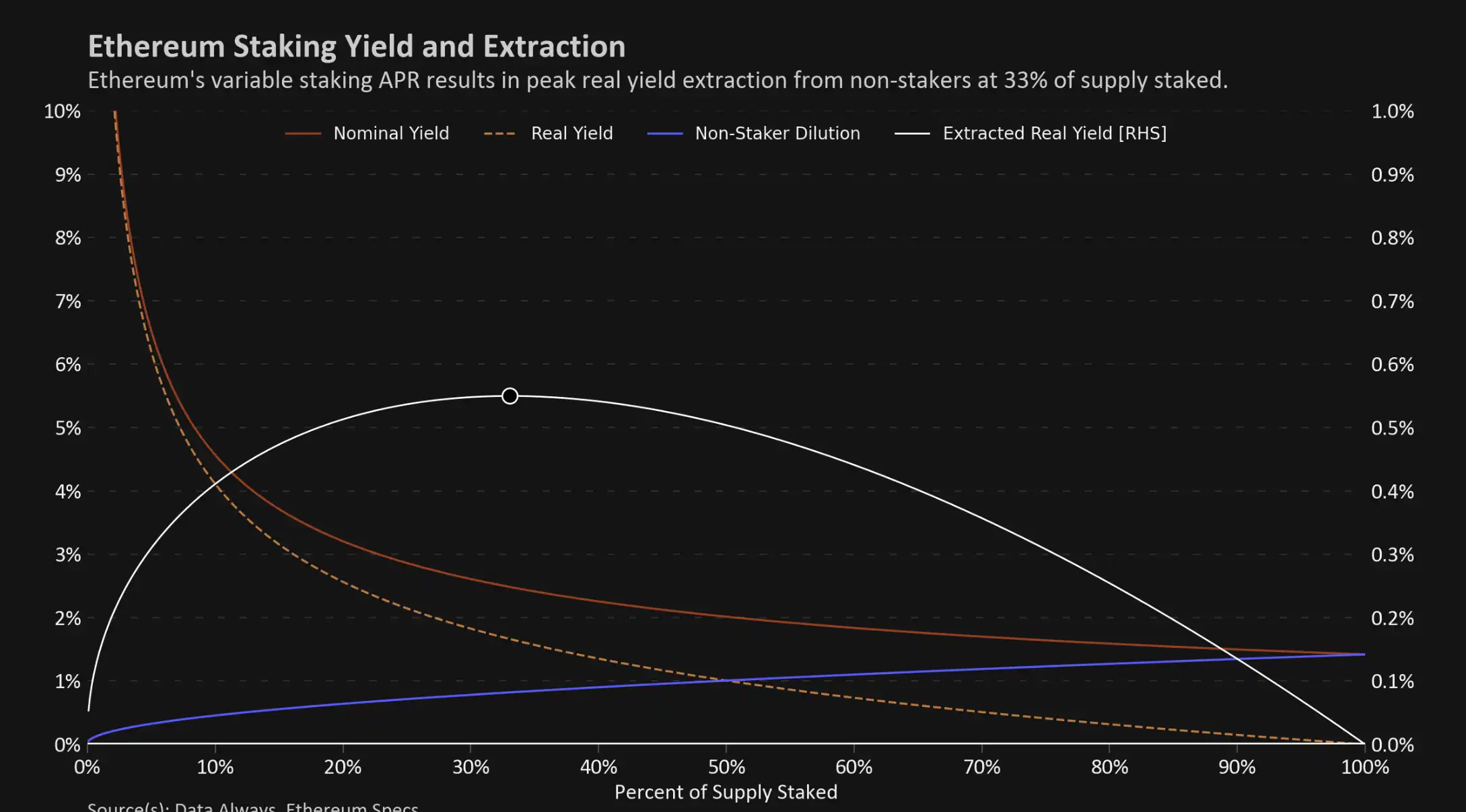
I have discussed this model in the past, but in order to remind readers of how extracting the actual yield curve works, we should realize that the pledge reward comes purely from dilution by other holders and validators. If individuals own and pledge all ETH in circulation, they are only diluting themselves and therefore earning zero real returns. Similarly, if there is no pledge to protect the network, no one gains. The two boundary conditions are in 0% and 100% Pledge supply means the maximum yield extraction point, which we plot in the figure above.
Any deviation from this peak represents a lower levy on the non-pledgee's benefit than the maximum. We view the peak in the chart above as the lowest point at which a long free market is likely to drive pledge participation, at about. 33%.
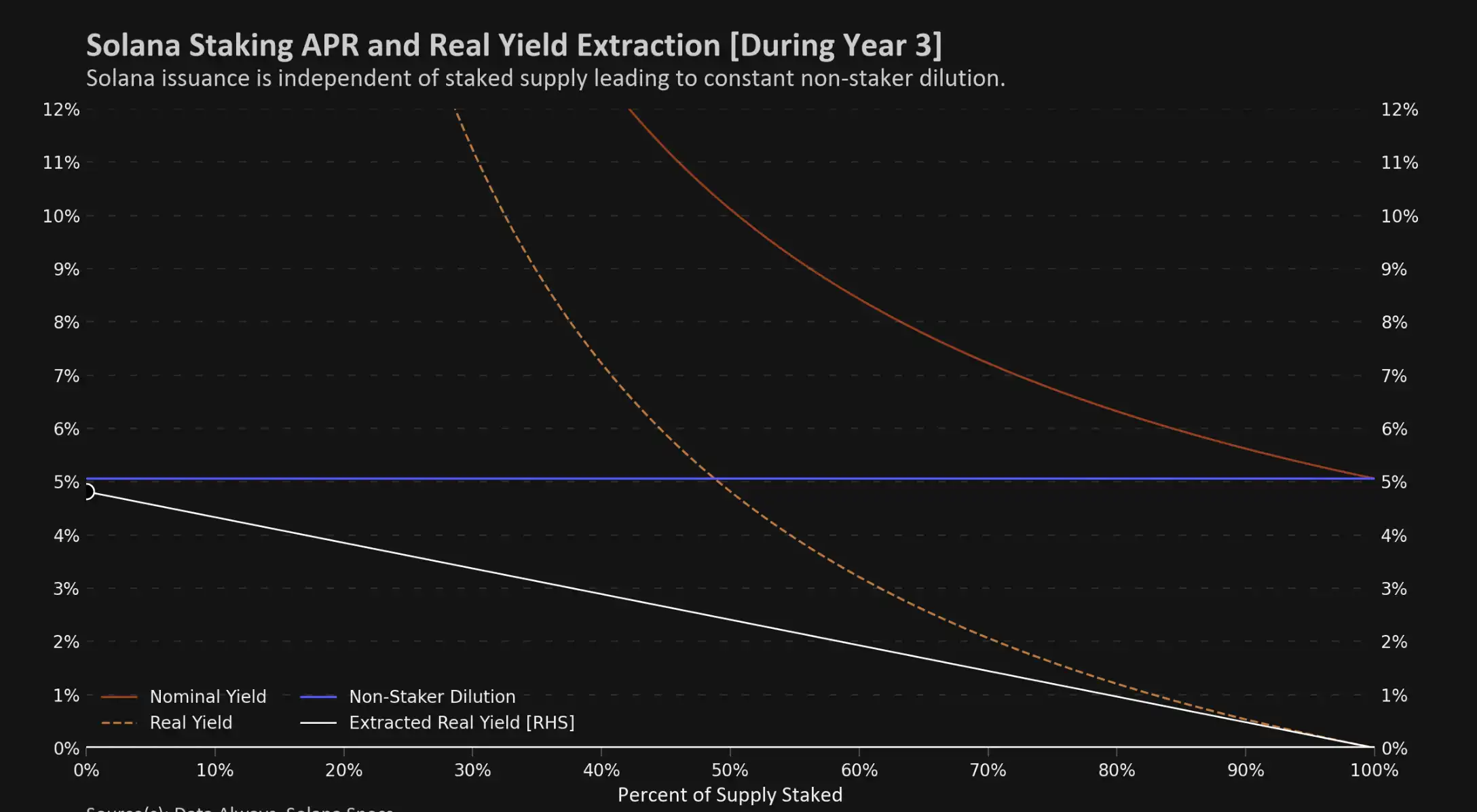
与以太坊的发行时间表形成鲜明对比的是 Solana 的发行是预先设定的,与验证者的数量无关。因此,为了最大限度地提取,垄断利益相关者理想情况下会持有尽可能少的供应 (以尽量减少自我稀释)。 然而,在实践中,每个人都可以轻松地委托他们的质押,发行量仍然存在,生态系统仍在发展中,因此我们观察到非常高的参与率。
The role of cost and risk
This article mainly discusses the factors that increase the return on pledge, but it should be noted that operating costs and risk adjustment are equally important. With the arrival of the "Shanghai" upgrade, the risk profile of participating in the pledge will change significantly and may require more detailed discussion at that time.
对于这个分析, 我们将通过允许读者选择折现率来结合运营成本和风险调整。 这提供了一定的灵活性;例如,25% 的费率可能代表中心化交易平台的质押费用、带有 15% 费率的流动性质押Token(LST)以及额外的 10% 合约风险折扣,或者家庭质押者可能遇到任何类型问题的折扣。
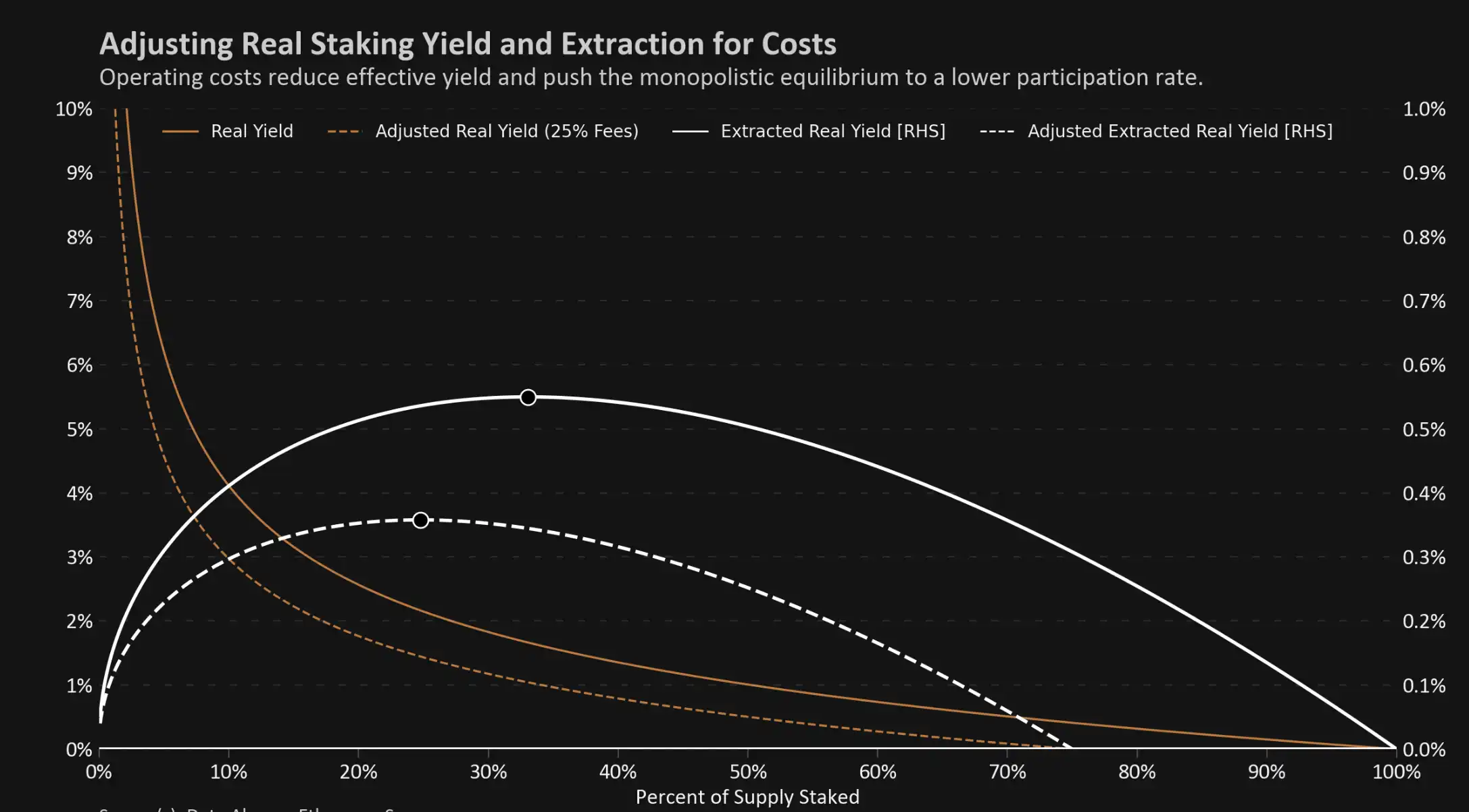
One thing to note is that fees are charged in nominal value, but the proceeds that the pledgee should be interested in are measured in real value. When we adjust fees, real returns no longer approach zero but turn negative at high rates or high pledge participation. The disconnect between nominal costs and real benefits shifts the monopoly equilibrium to lower participation rates.
In the chart below, we generate profiles for the different rates.
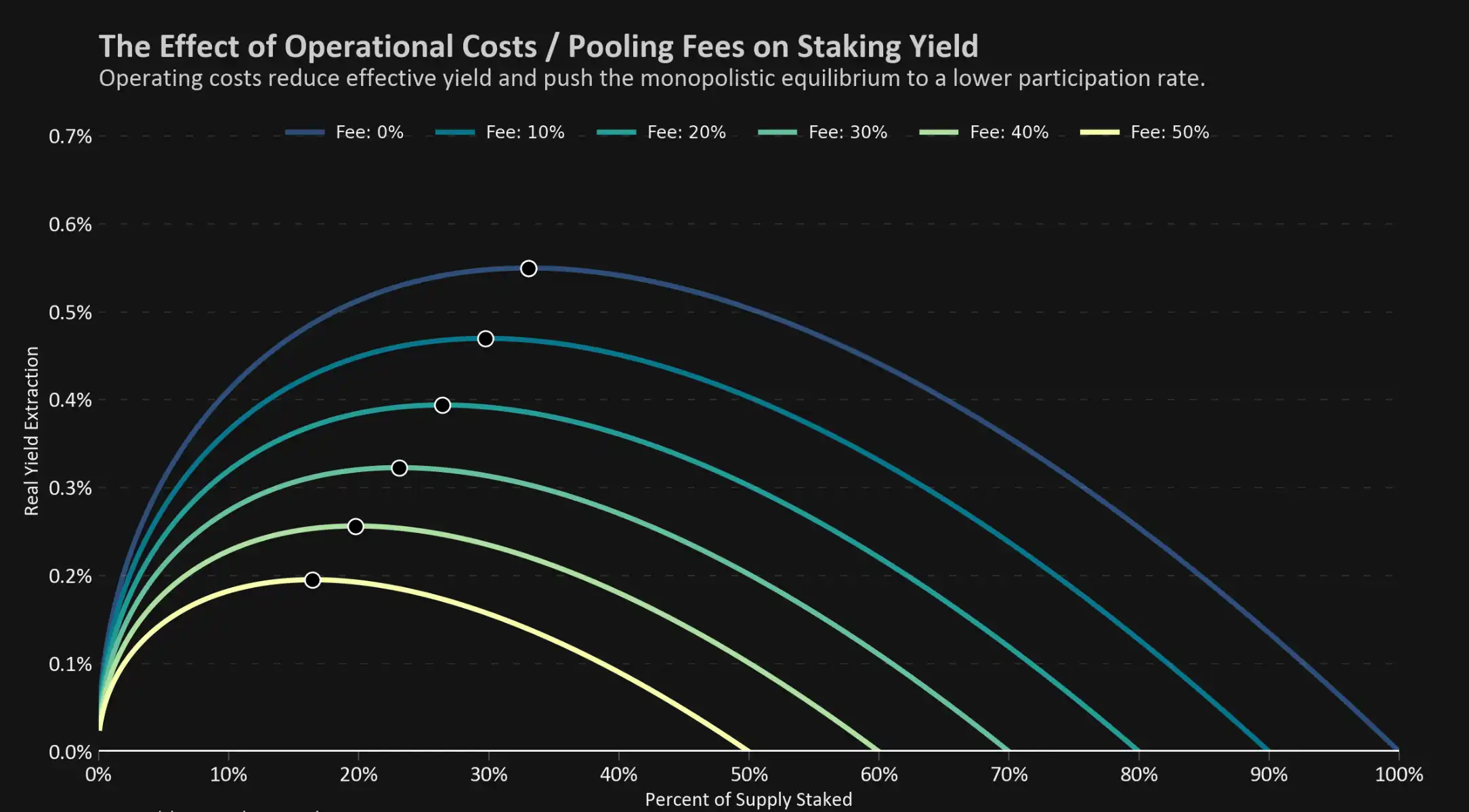
在启用验证者提款之前,有人可能会争辩说接近 50% 的折扣率是合适的, 但我们并不是要表明生态系统目前接近于有意义的均衡。
The role of repledge and external income
再质押,这个术语用于描述质押生态系统中的各种活动。 当人们在讨论 LST 时,例如 Lido 的 stETH 或 Rocket Pool 的 rETH,再质押通常是指将质押奖励反馈到生态系统中以创建更多的验证者并增加协议获得的收益。此外,在 2022 年初,再质押通常是用来描述循环 stETH 交易的术语,这些交易失控了。公司将ETH存入 Lido,以获取 stETH,然后抵押这些 stETH Token以获取杠杆,并重新质押以获得额外的收益。本文不讨论这两种再质押方法中的任何一种。
Today, the most common repledge is something like. Protocols like EigenLayer, a series of smart contracts that allow Ethereum pledge holders to repledge their pledges to protect secondary applications or protocols. By opting for custom strings defined by the smart contract, the pledge will soon be able to earn a yield that exceeds Ethereum's monetary policy. If you are not familiar with this concept, I suggest you read the following:
, & have spentEigenLayer White paper
, & have spentConsensys description of the protocol
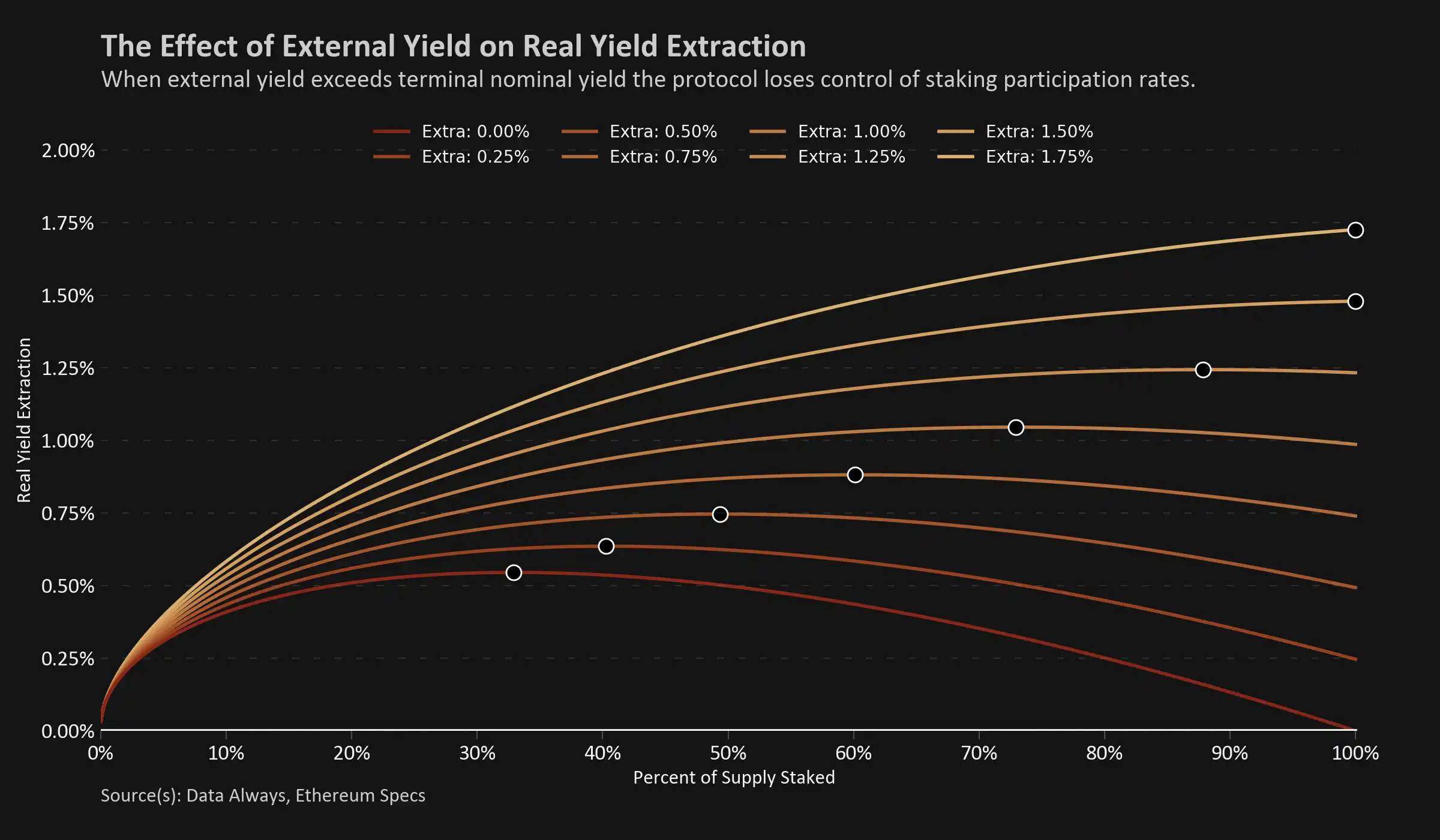
Use something like EigenLayer's agreement is subject to repledge or use cycle. The key difference between LST transactions is the concept of internal and external income. While both methods increase benefits and risks, circular pledge is limited by the negative feedback loops embedded in Ethereum's monetary policy. In contrast, the Ethereum protocol does not prevent users from using external revenue protocols.
As a result, circular pledge moves the equilibrium point to a lower percentage of pledge supply, while external repledge moves the equilibrium point to a higher percentage of pledge supply.
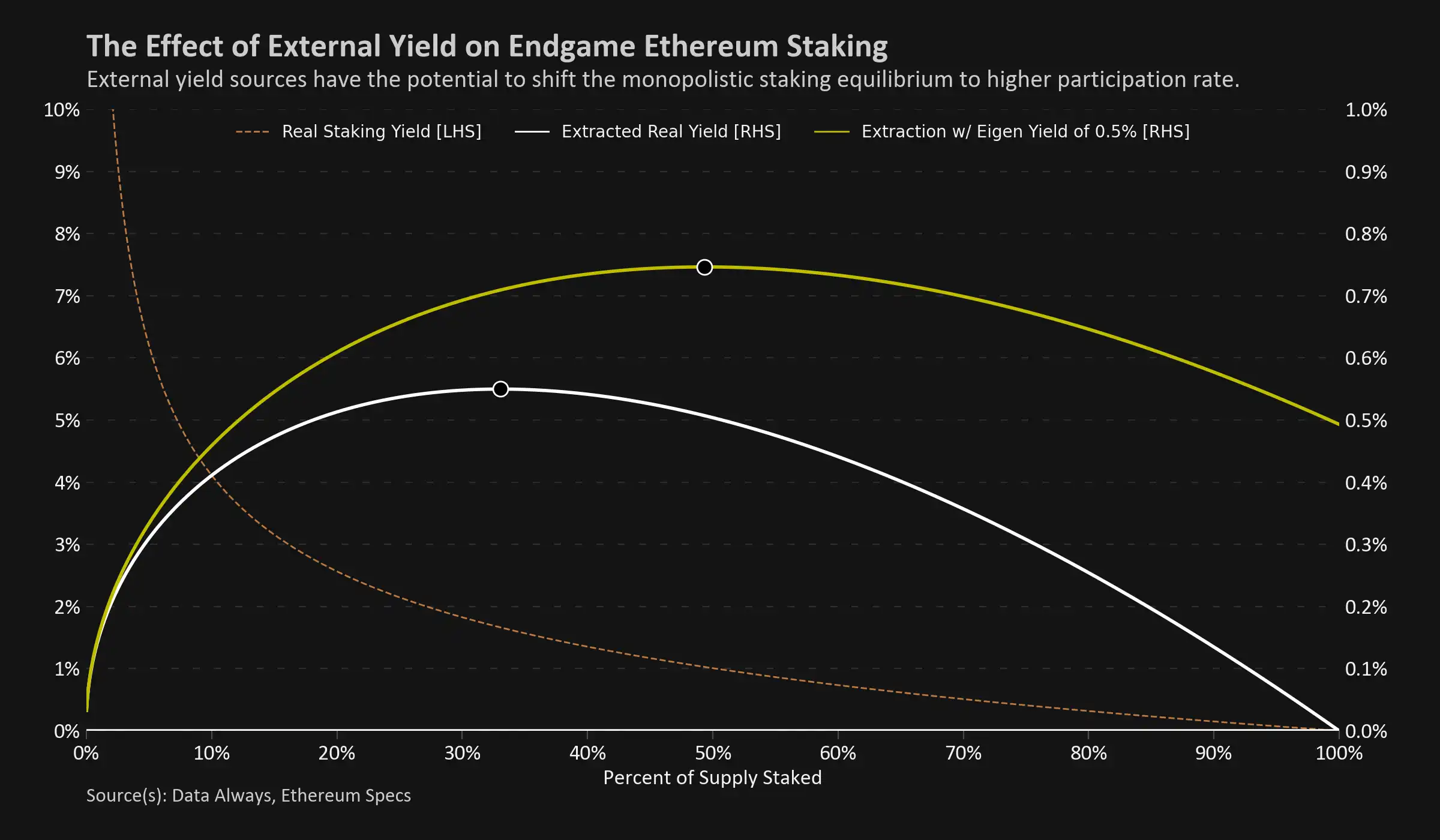
当我们为不同的外部再质押收益建模不断演变的均衡点时,结果是惊人的。 由于外部收益不会自我稀释,即使是增加少量收益也可能对质押生态系统产生巨大的影响。 像 EigenLayer 这样的协议收益率如果仅为 1%,都能让最佳的抵押动态被推到难以维持的水平。
The Ethereum research community generally considers the adoption of a minimum viable circulation policy to be key to curbing high pledge participation rates. The idea is that if too many people want to pledge, lowering the yield will make the pledge less attractive, while also improving the monetary attributes of the crypto asset.
Due to the competitive nature of the network, the minimum viable circulation policy may still produce the desired effect, but in the monopoly optimization problem, repledge will subvert the result. In this dynamic, lowering the number of agreements issued reduces the impact of self-dilution and encourages the monopolist to pledge more tokens and leverage outside gains.
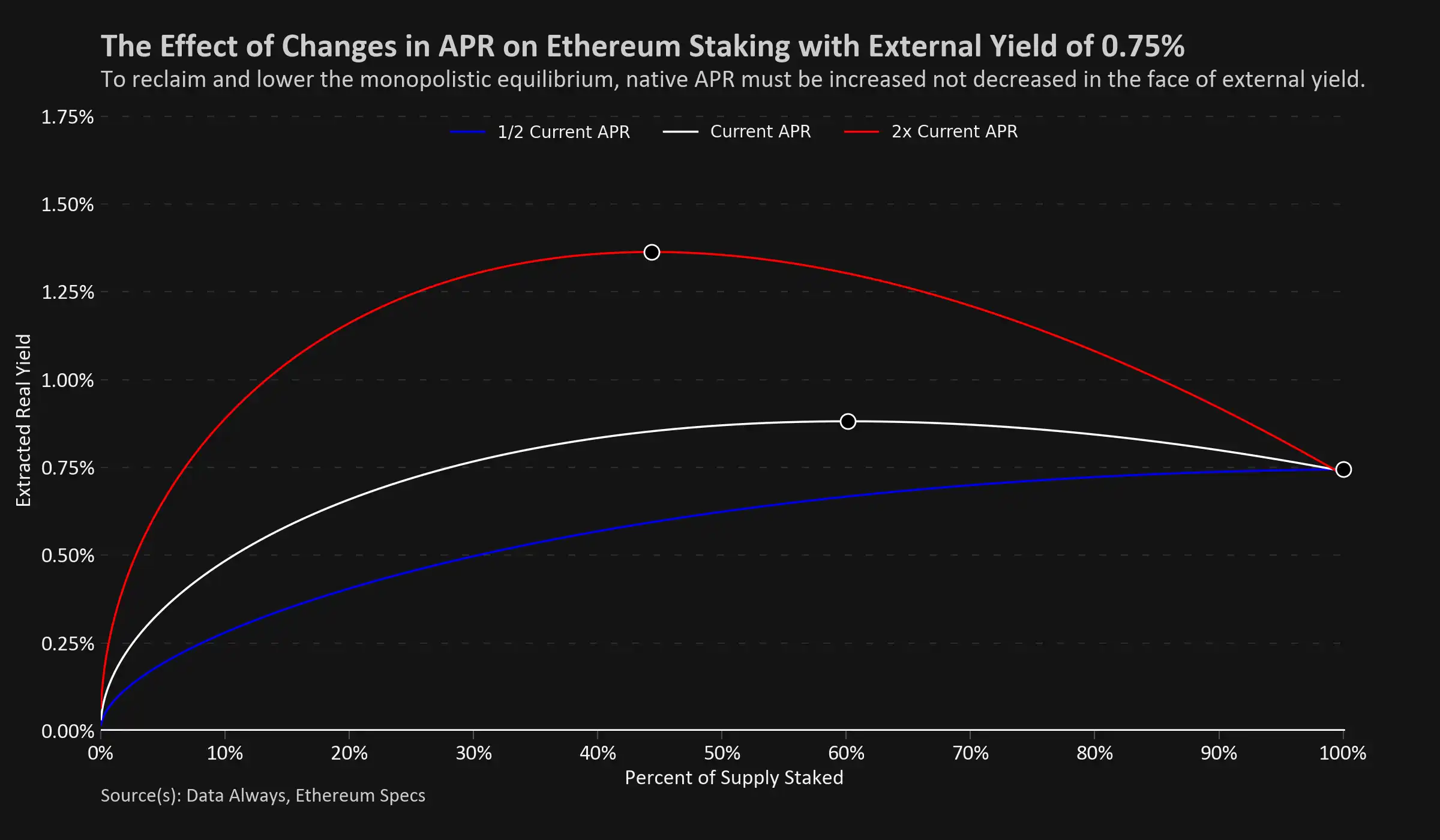
In order to regain the monopoly equilibrium and reduce the optimal pledge level of large players, the correct game theory strategy will turn to increasing pledge. APR, which imposes more value on other holders rather than getting repledged rewards.
低发行量和高参与度可能对网络来说是可以接受的结果, 但监测质押的中心化程度的变化非常重要。例如,如果 Lido 与 EigenLayer 的整合是市场上最受欢迎的结果,那么最低可行发行量或许也不会是一个有效的解决方案。
conclusion
The repledge agreement distorts the internal pledge feedback loop. In the long run, Ethereum may not be able to adjust APRs to resist high pledge participation rates and centralizing forces.
The core solution to this problem has been discussed for years, and Data Always believes that a cap on the number of active validators will eventually be needed. To stay on top of this discussion, one should look at Ethereum's Robust Incentives Group and the work of Anders and Barnab on auctioned validator slots.
Original link
Welcome to join the official BlockBeats community:
Telegram Subscription Group: https://t.me/theblockbeats
Telegram Discussion Group: https://t.me/BlockBeats_App
Official Twitter Account: https://twitter.com/BlockBeatsAsia

 Related Articles