List of 13 finalist projects from ETH Global New York Hackathon.
Original Title: "Quick Look at the 13 Finalist Projects of ETH Global New York Hackathon: Emerging Trends in Application Layer Innovation"
Original Source: DeepTech TechFlow
The recent ETH Global New York hackathon showcased the creativity of developers in building DApps. This article summarizes and introduces some of the excellent works and their core innovations from the hackathon.
1. FRAMED!

FRAMED! is a full-chain trust game that hides information (similar to the Mafia) built using fhEVM.
The public and transparent nature of blockchain makes it possible for a decentralized financial and trust-based economic world. However, this also makes it difficult to build interesting experiences on the chain. Recent developments in fully homomorphic encryption allow us to create new gaming experiences on the chain, allowing you to play games that hide information completely without trust!
In the FRAMED! game, players are randomly assigned roles such as civilians, thieves, police, or detectives, and this information is stored on the chain through encryption methods. The goal of the game is for the thieves to eliminate the civilians, while the civilians need to cooperate to find the hidden thieves and vote them out. Players need to discuss and socialize to reason with each other.
This game is unique in that it can directly store encrypted states on the chain. Homomorphic encryption smart contracts allow for computation on encrypted data without the need for decryption. This innovation solves privacy limitations and opens up a new era of smart contract development.
2. F.A.S.T.
F.A.S.T. is the fastest way for users to interact on the blockchain. Users can register by taking a photo, and then easily interact with each other's addresses by taking a group photo.
Its inspiration comes from a conversation at a hackathon, where someone commented that it would be interesting if money could be sent to a person's wallet address simply by taking a photo of their face.
So the F.A.S.T. team began construction. The core issue was simple:
Due to significant technical barriers, the adoption rate of Web3 is relatively low.
The user does not know their own address, and almost certainly does not know the address of others.
Their assumption is that AI will achieve highly distributed web3 through the following means:
People will have a simpler chat interface, rather than a confusing user experience;
Artificial intelligence will provide a better way to connect people with their addresses.
3. ZeroTrustBounty

ZeroTrustBounty solves the problem of traditional vulnerability bounty platforms, where enterprises have to disclose sensitive data to third parties and white hats have no guarantee of payment.
They use TLS notarization and Lit protocol to solve this problem. Assuming you discover an SQL injection vulnerability, ZeroTrustBounty allows you to hide key information of the attack (the HTTP request of the attack), but disclose the HTTP response, so that affected enterprises can encrypt and verify your report, and understand the impact of the vulnerability. For the payment part, ZeroTrustBounty uses Lit protocol to encrypt HTTP requests/responses, so that enterprises can decrypt them after paying to a certain address or holding a certain NFT. This ensures that if the enterprise is willing to fix the vulnerability, the white hat can also get a reward, while avoiding the problem of third-party services stealing vulnerability technology/reports. This also solves the problem of enterprises disclosing sensitive information to third-party services.
4. Doom Arena
This project uses the original "Doom" game as an example and introduces a novel method of hosting game competitions. These competitions are completely on-chain and decentralized, opening up new avenues for game developers' economy. Game developers and internet celebrities can launch competitions for their own games, offering attractive prize pools to incentivize participation.
Every year, millions of games are released, and game developers need unique ways to attract players. This project provides a solution that allows developers to hold competitions, provide incentives for players, and also generate revenue for developers.
The organizer initiates the competition by providing an initial APE token prize pool. Players will log in using their ENS avatars and pay APE tokens as entry fees to participate. 90% of the fees will go into the prize pool, and 10% will go to the organizer. On average, after 100 players join the competition and pay the entry fee, the organizer will break even.
In short, this project has created a decentralized platform for hosting gaming competitions, providing game developers with an innovative way to promote their games and attract players, while creating a sustainable economic model for game promotion. Anyone can initiate or participate in competitions, contributing to the thriving gaming ecosystem.
The organizer needs to determine the following parameters when initiating the competition:
Competition name;
The initial prize pool provided by the organizer;
Participation ticket price;
Game difficulty;
Doom game levels;
5. AirTracker

6. SafeCreate2
7. ConsciousNFT

8. Space Guardians
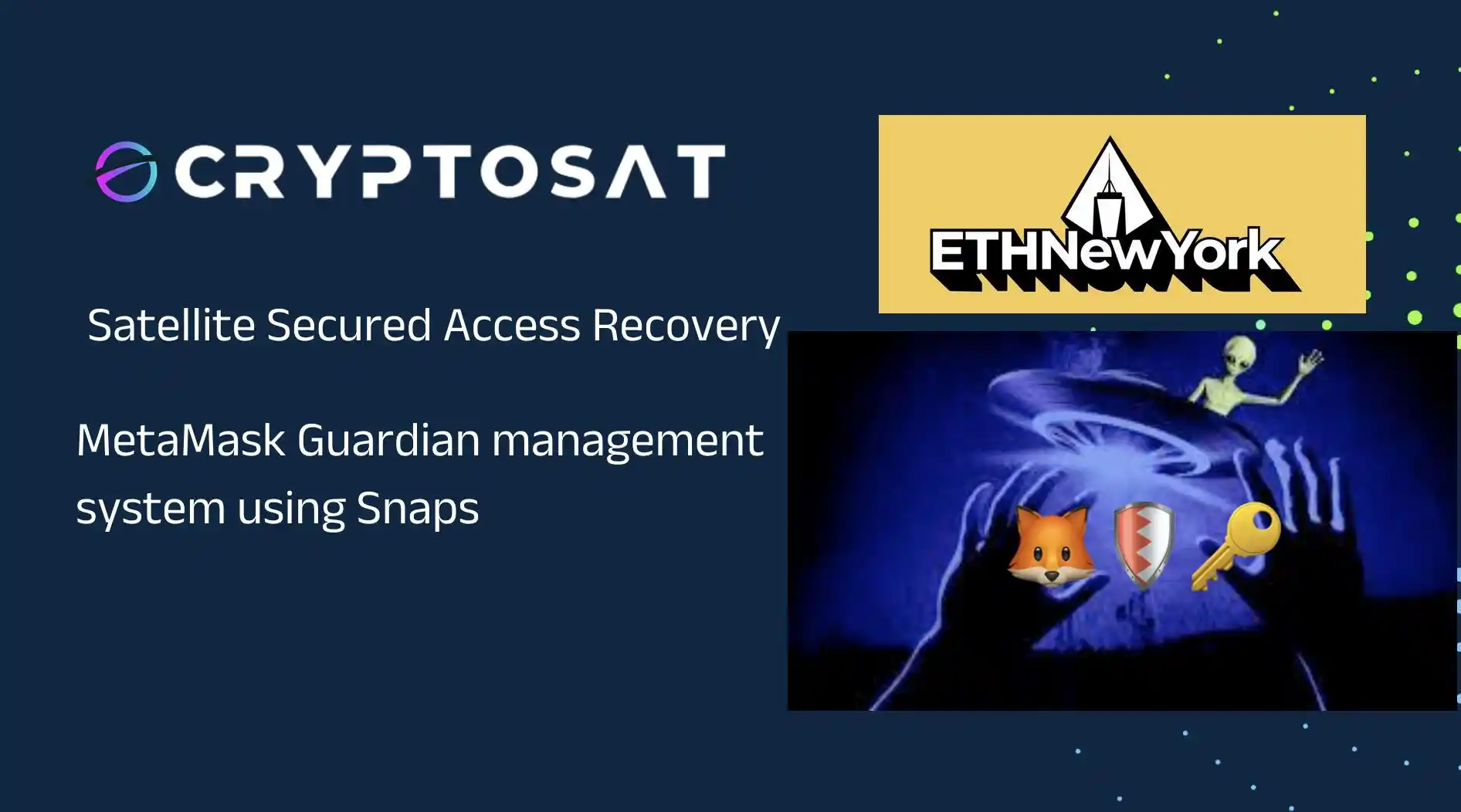
In Web3, there is no "forgot password" option. Existing solutions are vulnerable to threats.
1. The safety of the guardian may be threatened;
2. Notification - Reduce the possibility of collusion events.
Space Guardians has developed a secure solution for social key recovery: MM Snaps + Encryption Satellites. This solves the problem of managing notifications and audit trails, thereby reducing the possibility of collusion.
9. A.S.R.
If the contract is owned by a person instead of an address, what will happen? A.S.R. allows users to deploy smart contracts that are bound to their unique personal identification (such as World ID). After verification through World ID, users can deploy contracts as owners and then take over ownership from different EOA.
This design pattern can be extended to many different use cases. Although we start with a simple self-ownable contract, the same principles can be applied to any smart contract role. Additionally, World ID can be exchanged with different identity providers. A.S.R. also envisions how to apply it to ERC20, allowing users to declare their balance from a new address. Currently supported operations:
1. Use wallet to log in.
2. Verify identity through World ID
3. Deploy smart contracts as an owner.
4. Import existing contract
5. Transfer the ownership of the contract to a new EOA bound to the World ID holder.
10. MEVictim Rebate
This project will identify victims of MEV attacks on the Goerli chain and award ERC-721 tokens to these victims, with holders eligible for subsidies when providing liquidity in the Uniswap v4 pool on Scroll. Ultimately, the project incentivizes users to perform better on Scroll based on their historical on-chain data on the Goerli chain.
This is a powerful new primitive - proof of statements about historical behavior on the chain - and using this proof to authenticate certain users' privileges on complex new generation DeFi.
First, use Subgraph to identify potential MEV victims (individuals who have been attacked by front-running/ sandwich/ back-running attacks) on the Goerli chain. Then provide the transaction hash and log ID as input to the Axiom circuit.
Axiom circuits use transaction hashes to prove that a wallet address is indeed a victim of MEV attacks. If eligible, the wallet address will receive an ERC-721 token (a Nouns NFT contract named MEVictim created using Unlock Protocol).
Then you can use Hyperlane Warp Route deployment to bridge ERC-721 tokens to Scroll. Only holders of ERC-721 tokens can exchange them on the token gate of Scroll's Uniswap v4 pool.
11. RealReturn

RealReturn is a verified real investment return public ranking list, supported by TLSNotary and Jomo.
Now this industry is not only full of gambling, but also a lot of false information and fake FOMO.
Until today, people can only identify these false information by examining screenshots or making common sense inferences based on these numbers. Unless the account holder is willing to publicly share their credentials, neither party can truly prove themselves.
Now with RealReturn using Jomo and TLSNotary, anyone can prove their investment return without sharing certificates with anyone or anywhere. This cryptographic method is applied to the TLS session between the user and the application server, such as three-party TLS and MPC, so that even if the session content is visible to the user and the application server, the notary can still generate something on the side to prove that the record has not been tampered with.
Privacy and verifiability, we no longer need to sacrifice one for the other, but can embrace both at the same time.
12.Abstract Wallet
This project provides users with a completely frictionless single-click login. It combines the Solidity FCL library to implement a WebAuthn-based Userop. Abstract Wallet combines it with Infinitism ERC4337 Entrypoint and a custom PayMaster to pay user fees, making it accessible even to complete beginners.
13.XSafe
X-Safe is a solution designed to optimize the multi-signature (multi-sig) framework in Gnosis Safe for multi-chain transactions. Its core goal is to reduce the time and complexity required to perform the same management functions on multiple blockchain networks. With X-Safe, users can propagate a single signature and a single transaction across multiple chains, reducing costs and speeding up workflows. Technical features include: [no translation for technical terms]
Single Signature Propagation: Traditional multi-signature operations require users to individually sign each transaction on each blockchain network. X-Safe simplifies this process by enabling a single signature to automatically propagate to all integrated blockchains.
Not related to blockchain: X-Safe is designed to be blockchain agnostic, which means it can integrate with any blockchain supported by Gnosis Safe.
Workflow:
Initialization: Users integrate X-Safe as a custom module through Gnosis Safe UI (one-time setup).
Transaction Creation: A transaction created by a user or administrator that needs to be executed on multiple chains.
Signature Generation: Users use their private keys to sign transactions through the X-Safe interface.
Signature propagation: X-Safe will propagate the generated signature to the corresponding Gnosis Safe contract integrated on all blockchain networks.
Safety: Utilizing the powerful security of Gnosis Safe while also adding cross-chain functionality.
By implementing X-Safe, developers can significantly optimize their cross-chain operations, making the system more efficient, secure, and cost-effective.
Original Link
Welcome to join the official BlockBeats community:
Telegram Subscription Group: https://t.me/theblockbeats
Telegram Discussion Group: https://t.me/BlockBeats_App
Official Twitter Account: https://twitter.com/BlockBeatsAsia
 Related Articles