Nouns Forking Sensation: Forking is a new feature, not an error.
Original Title: "Nouns Forking Sensation: Why Forking is Wonderful"
Original Author: Jacob
Original Translation: Foresight News
In 2016, I wrote an article about the Ethereum The DAO fork, mainly to help myself understand forks.
Now, the first Nouns fork has just been executed, and I happened to have a quiet Saturday morning, so I think I should write something to summarize my understanding and changes about forks. I remember feeling very angry during the Ethereum fork, but I feel very excited about the Nouns fork.
Fork, also known as a hard fork, refers to creating a complete copy and another instance of an existing entity. Forks can introduce their own new changes and improvements, but in some cases, they are identical versions. An important difference is that the people and communities involved are different as part of it, and the reason for the fork is usually due to fundamental differences in the community. In the field of cryptocurrency, forks are more common because protocols and networks are completely open. Cryptocurrency forks are not only more popular, but also much riskier than non-cryptocurrency open source code repositories. This is because they often have token ownership and governance of the encryption protocol, so there is tradable value.
The Nouns with over 28,000 ETH just completed their first fork (Translator's note: NounsDAO completed the fork on September 15th, and more than half of the NFT holders chose to join the new DAO). This fork is completely different from any other forks we have seen in Ethereum, Ethereum Classic, or any other forks so far.
Why do you say that? I will elaborate on several aspects.

Nouns now have multiple forked versions competing for the same meme
Nouns Unique Features of Forking
Nouns 分叉是特意设计的功能
Nouns fork is a deliberately designed feature
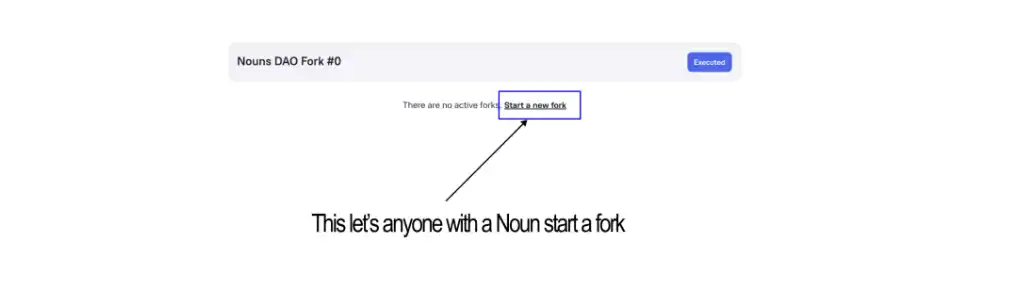
This is the most crucial detail and the most important thing to understand: the fork of Nouns is a specially built feature and also a well-designed one. It has a simple and intuitive user interface, allowing any Nouns holder to easily exit and enabling the entire community to track all updates in real time.
Ethereum fork is designed to cope with large-scale hacker attacks, but it is not a long-term network-level feature, and its built-in functionality is not intended to allow for easy forking in the future. However, in Nouns, this is by design, and forking is part of the protocol.
The user interface has a permanent action button that any Nouns holder can press at any time. This button triggers a series of elegant and complex protocol operations designed and built by the Verbs team, which is funded by Nouns to provide technical support.
Noun holders can only choose one fork version, you cannot have both

Noun holders must choose the fork version where their Noun is located. You must truly choose one fork to enter, instead of owning multiple forks like everyone does in Ethereum forks. In Nouns, everyone either holds the original Noun or maps the original Noun to a new fork version, which is a necessary choice.
The forker can take away the treasury funds allocated to them proportionally
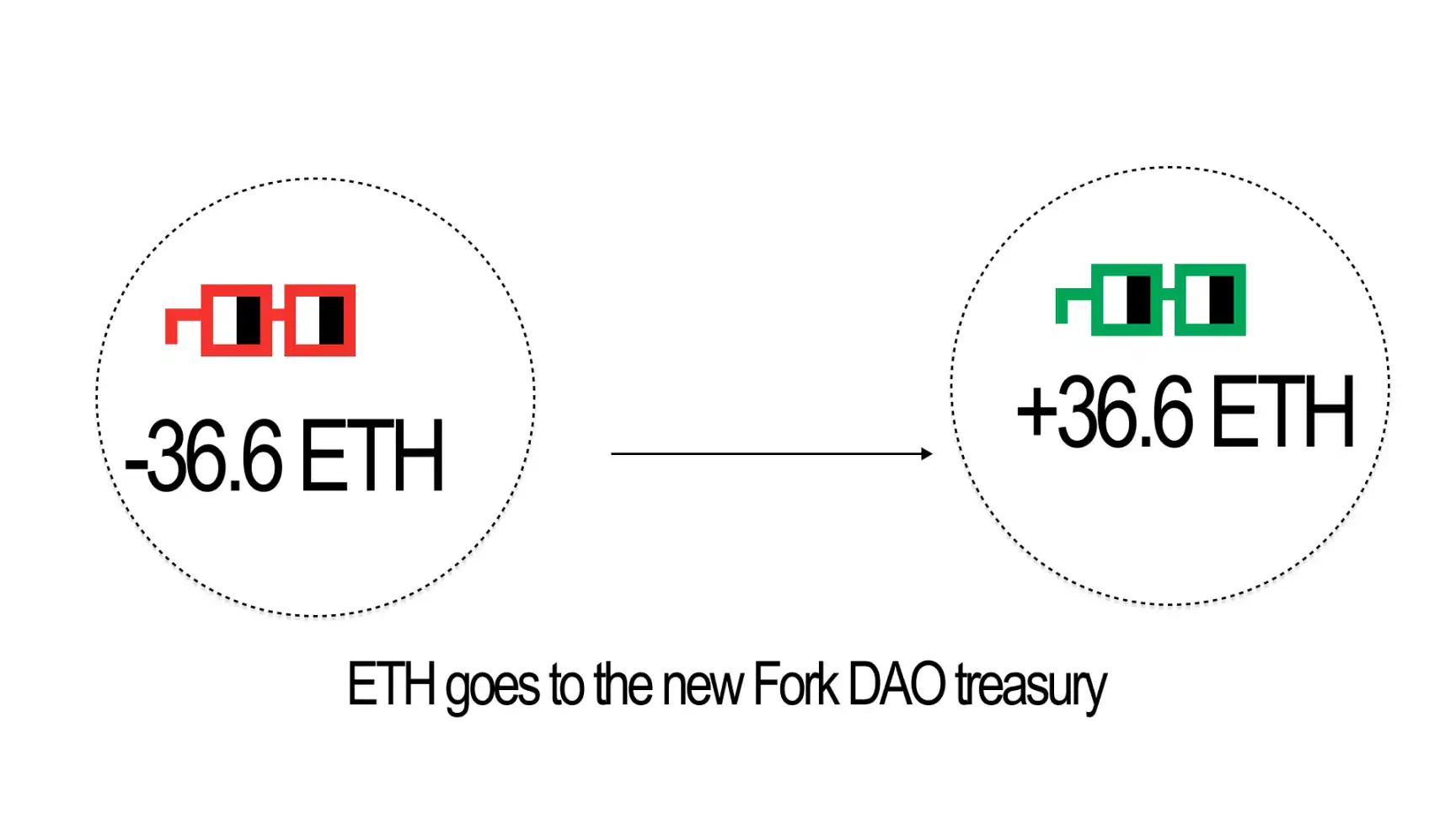
Nouns has a huge wealth of about 28,000 ETH in its treasury. Anyone can fork the Github codebase and deploy their own DAO, but doing so will not magically increase the ETH in the treasury. This means that if a fork wants to organize before this, they must obtain new funds, which is usually not easy. Through built-in forking, each forker brings their original Noun's share into the treasury of the new fork. This is a fair exit option, and at the time of forking, each Noun has approximately 36.6 ETH in assets supporting it. Therefore, the treasury of the forked DAO has more than 14,000 ETH.
Forking DAO allows for complete exit
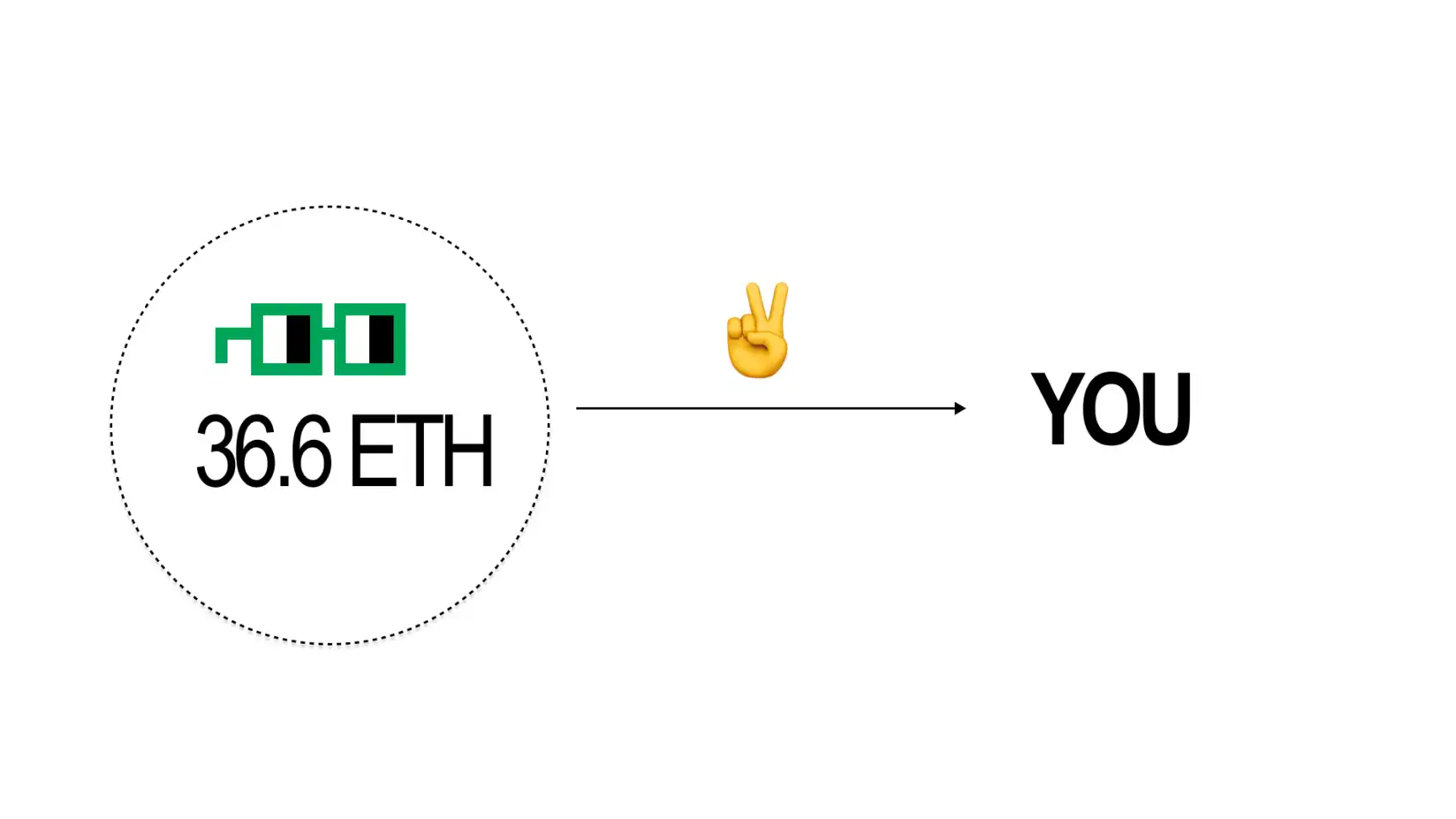
Nouns forks have the function of "peaceful exit", where you can hand over the forked Noun to a forked DAO and receive assets that support the Noun. In this example, it is assets worth approximately 36.6 ETH mentioned earlier.
This gives on-chain rights to holders who truly need or want to exit.
Two forked versions have equal ownership of meme (art)

The artwork behind the Noun is in the public domain, and there is no traditional intellectual property or ownership in the off-chain world. This means that two DAOs have the same amount of meme ownership as each other, but they appear to have no ownership on the surface.
The original DAO and its Noun have original sources, but holders of the fork receive the same Noun and token ID in the fork.
A forked DAO has its own complete and fully functional on-chain Noun art instance, with on-chain names and other content identical to the original Noun.
Further Thoughts
All of the above content is very innovative, and what I have summarized only scratches the surface. Some of the content is worth writing separate articles to introduce and analyze (in fact, there are already quite a few). But instead of doing that, I thought of something different and interesting:
Noun is now a multi-party system, unified under one meme.
Because meme (art) belongs to the public domain, and both DAOs currently have the same art - they are essentially further competing (or even collaborating) on the same meme.
They may compete fiercely, like political parties. But just as the highest level political parties work hard to push local states forward, ultimately these Nouns forks still cooperate on the same project.
meme competition
The original DAO and forked DAO both have fully functional on-chain art contracts. They can add new features at the end of the corresponding DAO iteration.
Currently, the only major difference is that they have different block tags and member bases. The images are the same, but the tags are different. What if the images start to deviate?
No Nounders reward
Nouns ecosystem already has many subDAOs, which are essentially DAOs that receive funding or organize and carry out work within the Nouns ecosystem. Nouns Builder is a tool specifically designed to make this precise behavior as simple as possible.
Nouns is a type of meme, but generally speaking, it has two very high-level schools of thought: meme value and book value. Without writing a complete article, it is difficult for me to explain the definitions and differences between the two. The meme value crowd wants to spend all capital to maximize diffusion and is willing to make trade-offs that may deplete the treasury reserves. The book value crowd wants to spend all capital to maximize financial value and is willing to make trade-offs on meme value.
Like most things in life, both are actually correct, and the opposition of the two seems to lead to some good decision outcomes. It may be inevitable for these two camps to form their own DAO through forking, but it is a group of private equity-style arbitrageurs who have accelerated and pushed this issue. Nouns become meme-negative (which can be understood as Nouns being sold below book value), and arbitrageurs find that if they buy enough funds, they can eventually push DAO to allocate these funds to Noun holders for profit.
Ultimately, this is a flaw in the system design. The market is the market, and there will always be arbitrageurs. It can be said that the same thing still exists in the earliest DAOs, either requiring the prompt acquisition of positive memes (Nouns priced higher than book value), or possibly leading to another fork caused by arbitrage.
Nouns as Governance Standards
Nouns governance contract is based on Compound Bravo. With the introduction of forks, Nouns itself has become a unique governance system and model.
What does adopting the Nouns governance feature set mean for other existing and new DAOs?
Forking is wonderful

In public and permissionless environments like Ethereum, forking is a mechanism that allows transparent and open competition between similar visions of competing versions. This is a good thing for everyone, as it means a potentially faster rate of evolution and we should see more innovation and progress as a result.
So far, forking has become an implicit part of most governance systems, as anyone can redeploy the same version of open source code. The content created by Nouns makes it a clear feature of its governance, making it easy to use, fair, and open for any Noun holder to call upon when needed.
For Nouns and how we view the entire DAO, this is clearly a breakthrough moment, and a year from now we will have a deeper understanding of DAO as a result. The activity of Nouns has reached a new level, and internal competition will push itself to the best state - which would not be possible without this mechanism. I have no doubt that we will also see forks implemented in a more innovative way, and this will be seen as a valuable lesson in governance at least. In successful cases, it may eventually become a verified standard that every DAO sees as a benchmark. As always, exciting times are coming.
Original article link
Welcome to join the official BlockBeats community:
Telegram Subscription Group: https://t.me/theblockbeats
Telegram Discussion Group: https://t.me/BlockBeats_App
Official Twitter Account: https://twitter.com/BlockBeatsAsia

 Related Articles